




Volume 203 - Issue 1
Differing trends in thickness and survival between nodular and non-nodular primary cutaneous melanoma in Victoria, Australia
Authors: Sarah L Smithson, Yan Pan and Victoria Mar
Med J Aust 2015; 203 (1): 20. || doi: 10.5694/mja15.00148
Published online: 6 July 2015
Published online: 6 July 2015
Our best opportunity to reduce melanoma mortality still lies with early detection
To the Editor: Australia has the highest incidence of melanoma in the world, with more than 12 500 new cases diagnosed each year.1 Despite advancing techniques in diagnosis and management, mortality remains high, with around 1500 deaths each year.1
We performed a retrospective review of four 1-year cohorts including all cases of cutaneous melanoma reported to the Victorian Cancer Registry during 1989, 1994, 1999 and 2004. We reviewed 5775 cases of primary invasive melanoma and 3649 cases of in situ melanoma. Mortality data were available for all patients, and were collected up to 31 December 2013, providing adequate follow-up time.
In an earlier study of these same cohorts we showed that nodular melanoma (NM) accounted for 43% of all melanoma deaths, despite comprising only 13.5% of all invasive melanomas.2
To further understand trends over time associated with NM as a distinct entity from other melanomas, all melanomas other than NM were grouped together (superficial spreading melanoma, 42%; lentigo maligna melanoma, 33%; desmoplastic melanoma, 1%; acral lentiginous melanoma, 1%; and other less common subtypes3) and classified as non-nodular melanoma (non-NM). Trends were compared between the two groups.
The incidence of all types of melanoma increased over time. The proportion of in situ melanomas increased from 33% in 1989 to 43% in 2004. As previously reported, NMs were thicker at diagnosis2 (median Breslow thickness of 2.6 mm, compared with 0.6 mm for invasive non-NM). The thickness at diagnosis of invasive non-NM decreased over time, whereas NM thickness did not change (Box).
For all melanomas there was a significant association between increasing thickness and decreasing survival (P < 0.001). Survival among patients with non-NM improved over time (crude hazard ratio for diagnosis year, 0.98 [95% CI, 0.97–1.00]; P = 0.04). This was explained by the decreasing trend in thickness (thickness-adjusted hazard ratio for diagnosis year, 1.00 [95% CI, 0.98–1.02]; P = 0.94). For NM, there was no evidence of a change in survival over time.
This analysis highlighted that although patients with non-NM were being diagnosed earlier, when lesions were thinner, and had improved survival outcomes, this was not true for patients with NM.
Since 2004, and particularly in the past 5 years, we have come a long way in the treatment of metastatic melanoma, with targeted therapies and checkpoint inhibitors offering an improved prognosis for patients with advanced disease (be it from NM or non-NM primary cancers). However, our best opportunity to reduce melanoma mortality still lies with early detection. While public health education and improved screening have led to earlier diagnosis of non-NM, greater awareness of the clinical features of NM (which are often distinct and differ from the ABCD [asymmetry, border, colour, diameter] diagnostic criteria4) is still required to reduce overall melanoma mortality.
Distribution of Breslow thickness for nodular melanoma (NM) and invasive non-nodular melanoma (non-NM) diagnosed during 1989, 1994, 1999 and 2004*
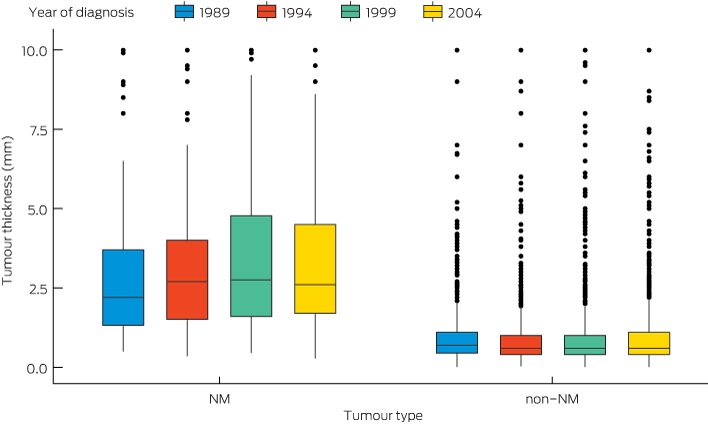
* Box plots show interquartile ranges (IQRs). Horizontal bars within represent median values and whiskers extend to the last value within 1.5 × IQR of the 1st and 3rd quartiles. The thickness of non-NM decreased with time (age-adjusted trend, − 0.5% per year [95% CI, − 0.89% to − 0.11% per year]; P = 0.01). The thickness of NM did not show evidence of a decrease over time (age-adjusted trend, 0.5% [95% CI, − 0.42% to 1.43%] per year; P = 0.28).
Competing interests
No relevant disclosures.
Acknowledgements
Details of additional authors of this letter are available in the Appendix. We acknowledge the contribution of data collected by the Victorian Cancer Registry, without which this project would not have been possible.
References
- Australian Institute of Health and Welfare, Australasian Association of Cancer Registries. Cancer in Australia: an overview, 2012. Canberra: AIHW, 2012. (Cancer Series No. 74; Cat. No. CAN 70.) _ENREF_1
- Mar V, Roberts H, Wolfe R, et al. Nodular melanoma: a distinct clinical entity and the largest contributor to melanoma deaths in Victoria, Australia. J Am Acad Dermatol 2013; 68: 568-575. _ENREF_2
- Clark WH Jr, From L, Bernardino EA, et al. The histogenesis and biologic behavior of primary human malignant melanomas of the skin. Cancer Research 1969; 29: 705-727. _ENREF_3
- Chamberlain AJ, Fritschi L, Kelly JW. Nodular melanoma: patients' perceptions of presenting features and implications for earlier detection. J Am Acad Dermatol 2003; 48: 694-701. _ENREF_4
Provenance: Not commissioned; externally peer reviewed.
Diagnosing Acute Kava Dermopathy: A Case Report of a Characteristic Cutaneous Eruption
Ali Abid, Nicholas Allen, Abeer Hagelamin, Christopher Henderson, Artiene Tatian
Localised Herpes Simplex Following Midline Laparotomy
Jessica S. Bulluss, Paul Chee, Matthew J. Verheyden
No silver lining with health misinformation: argyria caused by intentional silver consumption
Luke Collins, Logesh Palanikumar, Stephen Bacchi
Lingual Raynaud phenomenon
Michael Taggart, Mina John
Melasma in the male: a less well recognised entity
Tim Aung, Rowland Noakes
Age group‐specific changes in keratinocyte cancer treatment rates in Australia, 2012–2021: a retrospective cohort study based on MBS claims data
Catherine M Olsen, Nirmala Pandeya, Rachel E Neale, David C Whiteman