




Snapshot
Volume 201 - Issue 8
Splenic rupture: a rare complication of infectious mononucleosis
Authors: Eugene Ng and Michelle Lee
Med J Aust 2014; 201 (8): 480. || doi: 10.5694/mja13.00116
Published online: 20 October 2014
Published online: 20 October 2014
This complication is rare, but potentially disastrous
A 28-year-old man presented to the emergency department with acute left upper quadrant tenderness and postural hypotension. He reported having had fever and cervical tenderness for 1 week before his presentation.
Blood tests showed an elevated white cell count with reactive lymphocytosis. A test for infectious mononucleosis heterophile antibody was positive, consistent with recent infection.
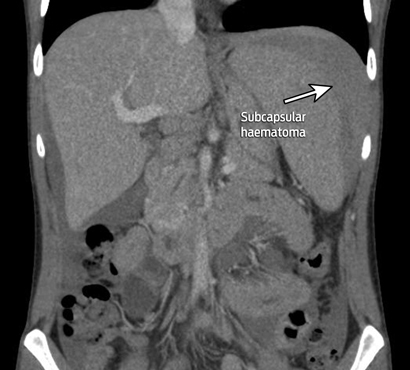
A contrast scan of the abdomen showed splenomegaly with subcapsular haematoma.
Splenic rupture after infectious mononucleosis is rare (incidence, 0.1%–0.5%), but can have disastrous consequences if overlooked.1,2
References
- Khoo SG, Ullah I, Manning KP, Fenton JE. Spontaneous splenic rupture in infectious mononucleosis. Ear Nose Throat J 2007; 86: 300-301. _Ref399327916
- Pfaffli M, Wyler D. Lethal atraumatic splenic rupture due to infectious mononucleosis. Arch Kriminol 2010; 225: 195-200. _Ref399327919
‘Once Bitten’: A Case of Tetanus Following Snakebite in Australia
Adrian A. S. Doherty, Naomi N. E. Clarke, Sarah Fletcher, Sarah Huffam, Camille V. Awburn, Eugene Athan
Epidemiology and Quality of Care for Aboriginal and Torres Strait Islander Peoples Treated by Emergency Medical Services for Stroke in Victoria, Australia: Retrospective Analysis of Linked Data
Candice Menezes, Ziad Nehme, Luke J. Burchill, Tegwyn McManamny, Angela Dos Santos, Michelle Crilly, Luke P. Dawson, Benjamin Clissold, David Anderson, Emily Nehme
Intranasal Adrenaline Use for the Management of Insect Venom-Induced Anaphylaxis
Thomas J. Young, Wilhelmina R. F. Johnson, Braydon L. Pennington, Troy Wanandy, Wun Y. Lau, Thanh-Thao A. Le
Gabapentinoid Poisoning Presentations to Victorian Emergency Departments: A 15-Year Trend Analysis
Bishaal Tej Gurung, Amy McNeilage, Angus Skeen, Tina Lam, Joanna F. Dipnall, Jane Hayman, Suzanne Nielsen, Ting Xia
They Brought the Hospital to Me
Hugh N. Burrill
Predictors of Ambulance Transport to Hospital for Older People Living in Tasmanian Aged Care Facilities: A Retrospective Cohort Study
Sharon Andrews, Pieter F. Fouche, Belinda Flanagan, Michael McDermott, Melanie Greenwood