




Volume 197 - Issue 3
Opportunistic serological surveillance for Murray Valley encephalitis virus in Victoria, February–May 2011
Authors: Joseph S Doyle, Suellen Nicholson, Jennifer A Leydon, Rodney J Moran and Michael G Catton
Med J Aust 2012; 197 (3): 150. || doi: 10.5694/mja12.10221
Published online: 6 August 2012
Published online: 6 August 2012
To the Editor: Murray Valley encephalitis virus (MVEV) is rarely seen in south-eastern Australia, as described in the recent review in the Journal by Knox and colleagues.1 During the MVEV transmission period in early 2011, there was extensive flooding, and high notification rates were reported for other mosquito-transmitted infections, including flavivirus infection among horses. MVEV seroconversion was detected in sentinel chicken flocks. However, despite concerns ...
To the Editor: Murray Valley encephalitis virus (MVEV) is rarely seen in south-eastern Australia, as described in the recent review in the Journal by Knox and colleagues.1 During the MVEV transmission period in early 2011, there was extensive flooding, and high notification rates were reported for other mosquito-transmitted infections, including flavivirus infection among horses. MVEV seroconversion was detected in sentinel chicken flocks. However, despite concerns about widespread human disease, there were only four notifications of confirmed cases during this time.2 We designed a study to detect and monitor asymptomatic human transmission of MVEV to aid public health decisions about mosquito control.
Real-time opportunistic serological surveillance was conducted on sera referred sequentially to the Victorian Infectious Diseases Reference Laboratory from the Murray River region for other tests from February 2011 to May 2011. The surveillance was based on postcode data, and was conducted with approval from the Victorian Department of Health. An epitope-blocking ELISA (enzyme-linked immunosorbent assay) was performed to detect antibodies to MVEV or Kunjin virus (KUNV) in the samples. The results were compared with a reference sample matched by age and sex, obtained from metropolitan Melbourne. The monoclonal antibody assay was targeted against epitopes on the non-structural proteins NS1-10C6 (for MVEV) and 3.1112G (for KUNV), and results were considered positive if the monoclonal antibody inhibited binding by at least 50%.3,4
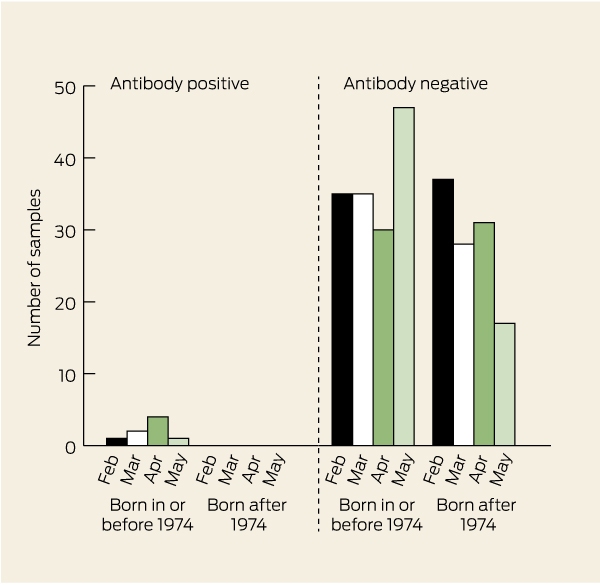
Overall, 346 samples (50% from males) were tested, with 65–73 individual samples from each month (total test sera, 268) compared with 78 baseline control sera. One hundred and thirteen individuals (42%) were born after the last regional outbreak of MVEV in 1974. MVEV antibodies were detected in 3.0% of samples overall (95% CI, 1.3%–5.8%). No individuals born after 1974 had detectable MVEV antibodies (95% CI, 0%–3.2%) (Box). The proportion of sera with detectable MVEV antibodies did not increase over time (Fisher exact test, P = 0.5). KUNV antibodies were detected in 2.2% of all samples (95% CI, 0.8%–4.8%), with no change over time, and no control sera had detectable antibodies to MVEV or KUNV (95% CI, 0%–4.6%).
Despite the environmental conditions in 2011 being favourable to MVEV spread, as predicted by the hypotheses of Forbes5 and Nicholls,6 MVEV seroprevalence was comparable to background rates.7 There was no serological evidence of recent human MVEV infection in this small, opportunistic sample, but low levels of infection may have been missed. Further study of the conditions in 2011 and close monitoring of MVEV activity in the future are needed to improve our understanding of human MVEV transmission.
Competing interests
No relevant disclosures.
References
- Knox J, Cowan RU, Doyle JS, et al. Murray Valley encephalitis: a review of clinical features, diagnosis and treatment. Med J Aust 2012; 196: 322-326. 0_BABDFDBD
- Department of Health and Ageing. National notifiable diseases surveillance system. Canberra: Commonwealth of Australia, 2012. http://www9.health.gov.au/cda/source/cda-index.cfm (accessed Jul 2012).
- Hall RA, Broom AK, Hartnett AC, et al. Immunodominant epitopes on the NS1 protein of MVE and KUN viruses serve as targets for a blocking ELISA to detect virus-specific antibodies in sentinel animal serum. J Virol Methods 1995; 51: 201-210. 0_CBBFDJCB
- Loroño-Pino MA, Farfan-Ale JA, Blitvich BJ, et al. Evaluation of an epitope-blocking enzyme-linked immunosorbent assay for the diagnosis of West Nile virus infections in humans. Clin Vaccine Immunol 2009; 16: 749-755. 0_i1142888
- Forbes JA. Murray Valley encephalitis 1974 — also, the epidemic variance since 1914 and predisposing rainfall patterns. Sydney: Australasian Medical Publishing Company, 1978. 0_i1142891
- Nicholls N. A method for predicting Murray Valley encephalitis in southeast Australia using the Southern Oscillation. Aust J Exp Biol Med Sci 1986; 64: 587-594. 0_i1142893
- Slota-Kan S, Leydon J. Murray Valley encephalitis sero-survey of northern Victoria, 2008. Vic Infect Dis Bull 2011; 14: 43-45. 0_i1142895
Costs of Delivering the Hep B PAST Model of Care in Remote Australia: A Retrospective Pre–Post Study
Hoa Nguyen, Anh Le Tuan Nguyen, Paula Binks, Melita McKinnon, Emily Vintour-Cesar, Karen Wills, Nicola Stephens, Benjamin Cowie, Joshua S. Davis, Yuejen Zhao, Peter Nihill, Julie A. Campbell, Andrew J. Palmer, Jane Davies, Barbara de Graaff
Buruli Ulcer Acquired From Ringtail Possum Rescue
Daniel P. O'Brien, Naomi Clarke, Sara Bonnici, Mohammad A. Hussain
Q Fever Visceral Abscesses After Contact With Native Australian Marsupials
Samantha J. Laws, Enzo Binotto, James Stewart, Jennifer Ho, Trent Yarwood, Josh Hanson, Simon Smith
Hospital-Admitted Injection-Related Infections Among Incarcerated People Who Inject Drugs in Australia: A Retrospective Cohort Study
Andrew Palmer, Matthew Carter, Jeremy Yeo, Cecilia Shim, Jason Connor, Jeremy Hayllar, Gerald Holtmann, Naomi Moy, Elliott G. Playford, Naomi Runnegar, Paul J. Clark
The Live Attenuated Influenza Vaccine in Australia: An Additional Tool for Influenza Prevention
Cyra Patel, Alexis Pillsbury, Tran Nguyen, Xia Wang, Helen E. Quinn, Clayton K. Chiu, Allen C. Cheng, Katie L. Flanagan, Zhicheng Wang
Reflex Testing for Hepatitis D Infection: A Unique Opportunity to Reduce Hepatitis D-Related Chronic Liver Disease Deaths in Australia
Jessica Howell, Lauren Andersson, Miriam T. Levy, James O'Beirne, Leon Adams, Katharine Irvine, Avik Majumdar, Golo Ahlenstiel, Kathy Jackson, Krispin Hajkowicz, Joseph Doyle, Jane Davies, Sarah Cherian, Wayne Dimech, Alexander J. Thompson