




Volume 195 - Issue 9
Borderline health: complexities of the Torres Strait treaty
Authors: Claire E Brolan, Susan J Upham, Peter S Hill, Graham Simpson and Stephen D Vincent
Med J Aust 2011; 195 (9): 503-505. || doi: 10.5694/mja11.10327
Published online: 7 November 2011
Published online: 7 November 2011
Self-interest and global responsibility create a public health balancing act
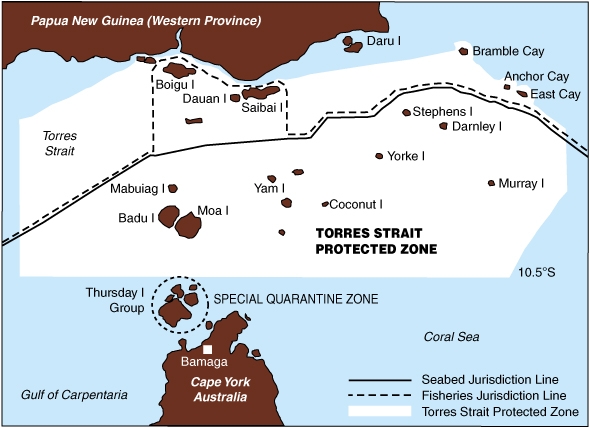
The treaty between Australia and Papua New Guinea (PNG) referred to as the “Torres Strait treaty” entered into force in February 1985.1 The treaty’s purpose is to provide certainty of the sovereignty and maritime boundaries between the two countries, including in the Torres Strait, where there are over 200 islands. The three major inhabited Australian islands of Boigu, Dauan and Saibai are situated several kilometres off the coast of the South Fly District of PNG’s Western Province (Box 1).2
In September 2009, the Australian Senate requested that the Foreign Affairs, Defence and Trade References Committee inquire into and report on matters related to the region and the treaty,3 including the administration and management of public health in and around the Torres Strait. Although the treaty excludes health access as a justification for travel, its free-movement provisions have contributed to a situation where access to Australian health services by people from PNG and public health issues — particularly those related to tuberculosis (TB), HIV/AIDS, cholera, dengue and malaria — have become major concerns.
We present our analysis of the committee’s November 2010 report and highlight the increasing immigration, health, socioeconomic, cultural and human complexities that exist in the region. Such complexities require collaborative commitment between state and national governments from both sides of the border in formulating policy and providing resources.
The Torres Strait treaty
The Torres Strait treaty established a Torres Strait Protected Zone. Within the protected zone, people who live in the coastal areas of PNG and Australians who are Torres Strait Islanders are permitted to travel across the border in accordance with their way of life as the traditional inhabitants of the region.
Australia and PNG are divergent in wealth and development, and this divide has grown in the past 20 years. PNG has one of the poorest health records in the Pacific region and is unlikely to meet any of its health-related Millennium Development Goals.4 Communicable diseases are the major cause of death and illness across all age groups; life expectancy is 57 years;5 and 30% of children in PNG are considered to be moderately to severely malnourished.6
The health system in the remote Western Province is particularly poor.7 This area’s main health facility is Daru Island Hospital, which operates with poor infrastructure as well as ongoing staff and clinical supply shortages.8 The hospital lacks capacity to support rural areas in clinical outreach services.9
Western Province has been described as the “most economically depressed region of PNG”.10,11 Poor sanitation and water quality and limited disease-control activities result in outbreaks of infectious diseases such as malaria, HIV/AIDS and other sexually transmissible infections, TB and multidrug-resistant TB (MDR-TB).8
Unsurprisingly, the international border provides a bridge for emerging infectious diseases.9,12,13 To counter this, the treaty allows for border integrity as a public health priority — under its provisions, Australian or PNG authorities can close the border to limit or prevent free movement.14 All cross-border travel was restricted in 2009 because of the H1N1 influenza epidemic,15 and again in 2010 because of a cholera outbreak in Daru that killed 30 people.16 There is increasing alarm over the potential for a major public health crisis on Australian shores, such as MDR-TB spreading into vulnerable Aboriginal communities in north Queensland.9,12
Main committee findings related to
health services
Traditional inhabitants were exempt from usual immigration health checks at the Australian border in the Torres Strait: This exemption, under the treaty’s freedom of movement provisions, aroused locals’ “fear of likely transmission of serious diseases”. The committee highlighted that
Unauthorised visitors who manage to land on the islands undetected . . . increase the risk of diseases being transmitted to people on the islands.17
PNG residents traversed the border for Australian health care services: Although access to health services is not classified as a traditional activity pursuant to the treaty, the reality was that people from PNG frequently travelled into Australia to receive treatment at Queensland Health clinics, particularly those located on the islands of Saibai and Boigu.17
Demand for Queensland Health services was increasing: Although data on the number of people from PNG who sought medical assistance in the Torres Strait were incomplete, there were “significant” and rising numbers receiving Queensland Health services. This caused a strain on Queensland Health services and subsequent access difficulties for Australian Torres Strait residents that contributed to local unease and tension.17
The committee found that the situation was complex, with “very strong push and pull factors” driving the trend for PNG residents to seek Queensland Health services.17
A lack of health care services and resources in Western Province, and particular paucity in the South Fly District adjacent to Torres Strait.
The proximity of Australian medical facilities for South Fly District residents. Queensland Health clinics on Saibai and Boigu islands are a 15–30-minute boat trip, costing about A$60 return for fuel, which was subsidised by the clinics.9 Daru hospital is a 2-hour boat ride, for which the cost of the fuel ranged from $180 to $240.
Provision of health care by Queensland Health, with the support of the Australian federal government, to PNG residents who required urgent medical attention. This occurred on humanitarian and public health grounds, especially to prevent the spread of infectious diseases into Australia and throughout Western Province. Australia’s “level of care” extended to medical evacuations of people from PNG to the Australian mainland and Thursday Island Hospital,17 outside the Torres Strait Protected Zone. Only patients with acute life-threatening conditions were admitted (Box 2).15
Additional challenges identified by the committee
The committee found that local Australian residents were concerned that Australia was sending a “mixed message” by allowing PNG residents limited access to Queensland Health services. That is, while the treaty did not allow movement for the purposes of accessing health care, Australia was nevertheless providing services on certain grounds. There was fear that this would set a precedent and foster demand for Queensland Health services, causing resentment among local Torres Strait communities and local health care managers because of the increasing use of resources. Further, Australian-based health professionals have experienced confusion over treatment protocols for visitors from PNG in the Torres Strait.
The committee also acknowledged that the complex situation was muddied by the multiple government agencies operating in the region with overlapping portfolios (Box 3), resulting in inefficiencies in service provision, gaps in communication and problem planning, and potential resource mismanagement.
The committee’s recommendations and the long road ahead
Support for PNG health care initiatives by the Australian Government: The aim of this recommendation is that PNG residents will eventually not need to seek Queensland Health services in the Torres Strait region. The committee acknowledged the long road ahead, particularly in the remote Western Province. While AusAID supports development of PNG’s health system substantially through cooperative capacity-building exercises, the differential between health services in Australia and PNG will persist into the foreseeable future.
Reframing the health issues as a collaborative cross-border approach: Development assistance is primarily framed around a host nation’s needs. However, the Torres Strait situation warrants reframing as a regional cross-border issue and a specific project targeting the needs of both countries. This would need to move beyond the current model wherein the Torres Strait Health Issues Committee (known as the HIC), meeting twice yearly, examines health issues associated with the free border movement of PNG residents and Torres Strait islanders.7 Rather than the HIC, an adequately resourced, targeted project that deals with cross-border issues on both sides is needed, and one that particularly includes consultation with both PNG and Australian communicable disease physicians who work in the region.
Increased monitoring of Australian development projects in Western Province: While the committee’s recommendation for greater accountability over how Australian development funding is spent appears to be reasonable, what is needed is a greater focus on results and mutual accountability over the outcomes that would result from a harmonised approach to this cross-border issue.
Collaboration between all government agencies: The committee recognises that investment in health infrastructure by both the PNG and Australian governments in Western Province is insufficient. Continuing financial support is needed for maintenance so that the benefits of initial aid outlays are not lost — a recognition that is consistent with the redefining of sustainability in development.18 The committee encourages all agencies to work together in the use of resources, so “projects on both sides of the border should complement and strengthen each other”. The recognition that this is an “atypical jurisdiction” invites innovative solutions: the Torres Strait situation could be framed as a regional trans-border issue, and health authorities of Australia, Australian states, the Torres Strait, Western Province and PNG, as well as other stakeholders, could be invited to collaborate on developing a network of cross-border services, with defined objectives that address specific shared concerns. Given a long and continuing history of migration to the Torres Strait region from Asia and Melanesia,10 a broader regional approach could be justified. Experience from Australia’s tristate Aboriginal health services in Central Australia19 and from Mekong cross-border development collaborations20 provides appropriate models.
Continued provision of services by Queensland Health to PNG residents in the foreseeable future: On humanitarian and public health grounds, the committee stated its full support for Queensland Health. Yet Queensland Health will need to be better resourced by the federal government as part of a collaborative strategy for health care services at this regional interface. Failure to recognise this as an international obligation will see Queensland Health’s commitment to communicable disease control compromised. The economic and public health implications for Australia of reducing current cross-border communicable disease strategies warrant urgent attention. This is already a demonstrable concern for Australian health professionals working in the region, with Queensland Health’s recent decision, on financial grounds, to close its TB clinics on Saibai Island.
Review of Australian Government funding to Queensland to ensure it is commensurate with actual costs incurred: In view of the previous recommendation, it is unsurprising that the committee made this additional comment. Developing a cross-border project would enable clear costing of and responsibility for the agreed strategies, while building communicable disease control capacity within PNG and safeguarding Australian public health interests.
Conclusion
Current Queensland Health policy regarding access for PNG residents to health services from Australian health clinics — to provide acute services only — is in tension with public health imperatives and the long-term management of some chronic infectious diseases. Problems are compounded by the number of agencies and levels of government responsible for interlinked funding and health care provision bridging the border. Solving the problems demands a collaborative but innovative approach, with improved health services for the people of PNG in their own country as the long-term goal. In the interim, the Foreign Affairs, Defence and Trade References Committee report identifies a range of strategies and makes clear recommendations that will guide progress.
These recommendations are enmeshed with concepts of health diplomacy, as international health issues have now achieved foreign policy priority.21 The risk of cross-border disease transmission in the Torres Strait is a clear demonstration that health is a global, rather than a local, agenda.
People from PNG will continue to challenge the treaty provisions and seek lifesaving health services that are unattainable in their own country. A mother from Western Province making the 20-minute dinghy trip to a Queensland Health clinic seeking treatment for her young child with TB is unaware of any potential concerns of the Australian public — her need is urgent, and Australia has comparatively unlimited resources. This is the human side of the Torres Strait quandary, reminding us how intensely personal public health is, and how health and human rights arguments intersect.22,23
1 Map of the Torres Strait region, showing the boundaries between Australian and Papua New Guinean territory
2 Admissions of Papua New Guinea residents to Thursday Island Hospital, Sep 2008 – Sep 20097,15
3 Overview of agencies operating in the Torres Strait
Competing interests
No relevant disclosures.
References
- Australian Government Department of Foreign Affairs and Trade. Torres Strait Treaty and you. http://www.dfat.gov.au/GEO/torres_strait/brief.html (accessed Mar 2011).
- Burmester H. The Torres Strait Treaty: ocean boundary delimitation by agreement. Am J Int Law 1982; 76: 321-346. http://www.aph.gov.au/Senate/committee/fadt_ctte/torresstrait/qon/index.htm (accessed Mar 2010).
- Commonwealth of Australia Parliamentary Debates. The Senate speech Monday, 14 September 2009. http://parlinfo.aph.gov.au/parlInfo/genpdf/chamber/hansards/2009-09-14/0050/hansard_frag.pdf;fileType=application%2Fpdf (accessed Mar 2010).
- Asian Development Bank. Millennium development goals in the Pacific: relevance and progress. Manila: ADB, 2003. http://www.adb.org/documents/books/MDG_Pacific/mdg.pdf#page=22 (accessed 11 Mar 2011).
- The World Bank. Data by country: Papua New Guinea. http://data.worldbank.org/country/papua-new-guinea (accessed Aug 2010).
- World Health Organization Western Pacific Region. Papua New Guinea (country profile). Health situation and trend. http://www.wpro.who.int/countries/png/2009/health_situation.htm (accessed Sep 2010).
- House of Representatives Standing Committee on Health and Ageing. Regional health issues jointly affecting Australia and the South Pacific. Report of the Australian Parliamentary Committee Delegation to Papua New Guinea and the Solomon Islands. Canberra: Commonwealth of Australia, 2010. 0_i1115513
- Australian Government Department of Health and Ageing. Submission to Senate Foreign Affairs, Defence and Trade References Committee. In: The Torres Strait: bridge and border. Senate Foreign Affairs, Defence and Trade References Committee. Canberra: Commonwealth of Australia, 2010. http://www.aph.gov.au/senate/committee/fadt_ctte/torresstrait/report/report.pdf (accessed Feb 2011)
- Gilpin CM, Simpson G, Vincent S, et al. Evidence of primary transmission of multidrug-resistant tuberculosis in the Western Province of Papua New Guinea. Med J Aust 2008; 188: 148-152. 0_i1115517
- Arthur WS. Culture and economy in border regions: the Torres Strait Case. Australian Aboriginal Studies 1992; 2: 15-33. 0_i1115519
- Lawrence D. Customary exchange in the Torres Strait. Australian Aboriginal Studies 1998; 2: 13-25. 0_i1115521
- Simpson G, Coulter C, Weston J, et al. Drug resistance patterns of MDRTB in the Western Province of Papua New Guinea. Int J Tuberc Lung Dis 2011; 15: 551-552. 0_i1115523
- McIver LJ, Kippin AN, Parish ST, Whitehead OG. HIV, Malaria and pneumonia in a Torres Strait Islander male — a case report. Commun Dis Intell 2010; 34: 448-449. 0_i1115525
- Australian Government Department of Foreign Affairs. Australian Treaty Series 1985, no. 4. Treaty between Australia and the independent state of Papua New Guinea concerning sovereignty and maritime boundaries in the area between the two countries, including the area known as Torres Strait, and related matters. Article 16 (3) (c). Canberra: Commonwealth of Australia, 1995. http://www.austlii.edu.au/au/other/dfat/treaties/1985/4.html (accessed Mar 2011).
- Australian Government Department of Immigration and Citizenship. Submission to Senate Foreign Affairs, Defence and Trade References Committee. In: The Torres Strait: bridge and border. Senate Foreign Affairs, Defence and Trade References Committee. Canberra: Commonwealth of Australia, 2010. http://www.aph.gov.au/senate/committee/fadt_ctte/torresstrait/report/report.pdf (accessed Feb 2011).
- Parnell S. PNG plagued by lethal neglect: cholera. The Australian 2010; 27 Nov. http://www.theaustralian.com.au/news/health-science/png-plagued-by-lethal-neglect-cholera/story-e6frg8y6-1225961144953#Scene_1 (accessed Nov 2010).
- Senate Foreign Affairs, Defence and Trade References Committee. The Torres Strait: bridge and border; 2010. Canberra: Commonwealth of Australia, 2010. http://www.aph.gov.au/senate/committee/fadt_ctte/torresstrait/report/report.pdf (accessed Feb 2011).
- Ooms G, Hill PS, Hammonds R, et al. Applying the principles of AIDS “exceptionality” to global health: challenges for global health governance. Global Health Governance 2010; 4 (1): 1-9. http://www.ghgj.org/Volume%20IV%20Issue%201.htm (accessed Jun 2011).
- Northern Territory Government Department of Health and Families. Tristate Agreement. March 2010. http://www.healthinfonet.ecu.edu.au/key-resources/promotion-resources?lid=18908 (accessed Jun 2011).
- Greater Mekong Subregion: Regional Communicable Diseases Control Project. Hanoi: GMS-CDC, 2009. http://gms-cdc.org (accessed Jun 2011).
- Feldbaum H, Michaud J. Health diplomacy and the enduring relevance of foreign policy interests. PLoS Med 2010; 7: e1000226. 0_i1115541
- Mann J. Voices from the past. Health and human rights: if not now, when? Am J Public Health 2006; 96: 1940-1943. 0_i1115543
- Taylor AL. Global governance, international health law and WHO: looking towards the future. Bull World Health Organ 2002; 80: 975-980. 0_i1115546
Pharmaceutical Industry Payments to Patient Groups in Australia: A Longitudinal Analysis of a Decade of Disclosures
Ashleigh Hooimeyer, Annim Mohammad, Alice Fabbri, Lisa Parker, Kellia Chiu, Barbara Mintzes
Not Gone but Often Forgotten: Action Needed to Address Tuberculosis in Aboriginal and Torres Strait Islander Communities
Nikkita Joshua, Emma L. Smith, Eunice (Cheeky) Love, Christopher P. Lowbridge, Nicole Tukana, Amy Bowden, Megan A. Campbell, Dawn Casey, James Ward
Unshrouding Social Determinants: A Case for Standardised Data in Australia's Health Information Ecosystem
Christopher Ryan, Christine T. Shiner, Rebecca J. Harris, Carrie Lethborg, Vijaya Sundararajan
Inequity Is Our Biggest Killer: Looking Upstream to Tackle the Burden of Disease in Australia
Meggan J. Devery, Katie Brooker, Kitty-Rose Foley
Inequity Is Our Biggest Killer: Looking Upstream to Tackle the Burden of Disease in Australia
Lucio Naccarella, Katrina Plamondon, Alison Brown, Alexandra Kent, Sana Shahram, Donya Eghrari, Nicole M. Rankin, Stephanie Best, Marlena Klaic, Zoe Fehlberg, Michelle Lambert, Sue Crengle
Inequity Is Our Biggest Killer: Looking Upstream to Tackle the Burden of Disease in Australia
Saman Khalatbari-Soltani, Edward Jegasothy, Seye Abimbola, Anita van Zwieten