




Volume 193 - Issue 8
Evidence of increasing frequency of herpes zoster management in Australian general practice since the introduction of a varicella vaccine
Authors: Kristina A Grant, Kylie S Carville and Heath A Kelly
Med J Aust 2010; 193 (8): 483. || doi: 10.5694/j.1326-5377.2010.tb04009.x
Published online: 18 October 2010
Published online: 18 October 2010
To the Editor: Nelson and colleagues1 referred to the limited community data from the Melbourne Medical Deputising Service (MMDS) that was analysed by Carville et al.2 MMDS consultations also represent general practice consultations, although the majority of MMDS consultations occur after hours. We can now provide an update on MMDS consultations from January 1998 to June 2010, stratified by age.
De-identified data were extracted from the MMDS database for diagnoses that included the terms “chicken pox” or “varicella” and “shingles” or “zoster”, and patient age. Using the total consultations as the denominator, we calculated the crude and age-specific rates of varicella (chickenpox) and herpes zoster (HZ [shingles]) per 1000 consultations by week, and present the results here by year.
These updated data support the conclusions reached by both groups of researchers that there has been a decrease in varicella cases and a rise in HZ cases in Australian general practice consultations since the introduction of a varicella vaccine in 2000. We had previously shown a decrease in hospitalisations and MMDS consultations for varicella and an uncertain effect on HZ up to 2007 after the introduction of varicella vaccine.2
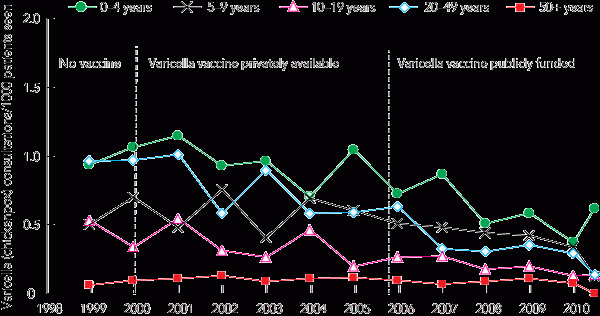
The overall rate of varicella-related MMDS consultations continued to decline from 2007 to 2010, with an annual average rate of 3.3/1000 consultations in 2000 decreasing to 1.5/1000 consultations in 2007 (P < 0.001, 2000–2007) and to 1.0/1000 consultations for the first half of 2010 (P = 0.043, 2007–2010). Decreasing rates of varicella-related consultation were seen in all age groups, although an apparent increase in the consultation rate for children aged less than 5 years in 2010 might be explained by a summer peak in varicella infection and incomplete annual data (Box 1).3
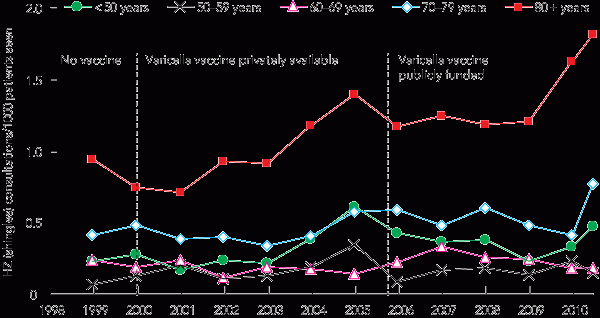
The trend in HZ-related MMDS consultations showed an increase in the annual average rate from 1.7/1000 consultations in 2000 to 2.7/1000 consultations in 2007 (P < 0.001, 2000–2007) and to 3.4/1000 consultations for the first half of 2010 (P = 0.020, 2007–2010). There was a substantial increase in the HZ-related consultation rates for people aged 70–79 years and 80+ years (Box 2). Our updated data support the recommendation for adding vaccination against HZ to the vaccine schedule for older Australians,1 although the optimal age at which this should occur remains to be determined.
References
- Nelson M, Britt H, Harrison C. Evidence of increasing frequency of herpes zoster management in Australian general practice since the introduction of a varicella vaccine. Med J Aust 2010; 193: 110-113. 0_CBBFBFIJ
- Carville KS, Riddell MA, Kelly HA. A decline in varicella but an uncertain impact on zoster following varicella vaccination in Victoria, Australia. Vaccine 2010; 28: 2532-2538. 0_CBBFBFBD
- Miller ER, Kelly HA. Varicella infection: evidence for peak activity in summer months. J Infect 2008; 56: 360-365. 0_i1095422
Costs of Delivering the Hep B PAST Model of Care in Remote Australia: A Retrospective Pre–Post Study
Hoa Nguyen, Anh Le Tuan Nguyen, Paula Binks, Melita McKinnon, Emily Vintour-Cesar, Karen Wills, Nicola Stephens, Benjamin Cowie, Joshua S. Davis, Yuejen Zhao, Peter Nihill, Julie A. Campbell, Andrew J. Palmer, Jane Davies, Barbara de Graaff
Buruli Ulcer Acquired From Ringtail Possum Rescue
Daniel P. O'Brien, Naomi Clarke, Sara Bonnici, Mohammad A. Hussain
Q Fever Visceral Abscesses After Contact With Native Australian Marsupials
Samantha J. Laws, Enzo Binotto, James Stewart, Jennifer Ho, Trent Yarwood, Josh Hanson, Simon Smith
Hospital-Admitted Injection-Related Infections Among Incarcerated People Who Inject Drugs in Australia: A Retrospective Cohort Study
Andrew Palmer, Matthew Carter, Jeremy Yeo, Cecilia Shim, Jason Connor, Jeremy Hayllar, Gerald Holtmann, Naomi Moy, Elliott G. Playford, Naomi Runnegar, Paul J. Clark
The Live Attenuated Influenza Vaccine in Australia: An Additional Tool for Influenza Prevention
Cyra Patel, Alexis Pillsbury, Tran Nguyen, Xia Wang, Helen E. Quinn, Clayton K. Chiu, Allen C. Cheng, Katie L. Flanagan, Zhicheng Wang
Reflex Testing for Hepatitis D Infection: A Unique Opportunity to Reduce Hepatitis D-Related Chronic Liver Disease Deaths in Australia
Jessica Howell, Lauren Andersson, Miriam T. Levy, James O'Beirne, Leon Adams, Katharine Irvine, Avik Majumdar, Golo Ahlenstiel, Kathy Jackson, Krispin Hajkowicz, Joseph Doyle, Jane Davies, Sarah Cherian, Wayne Dimech, Alexander J. Thompson