




Volume 193 - Issue 3
Expiry of patent protection on statins: effects on pharmaceutical expenditure in Australia
Author: Liliana Bulfone
Med J Aust 2010; 193 (3): 186-187. || doi: 10.5694/j.1326-5377.2010.tb03849.x
Published online: 2 August 2010
Published online: 2 August 2010
To the Editor: Although Clarke and Fitzgerald’s claim that prices for generic medicines in Australia are high compared with prices in other countries1 is valid, their claim that the Pharmaceutical Benefits Scheme expenditure on statins could be reduced by up to $9.31 billion, by increasing the proportion of generic prescriptions to 100% and paying equivalent prices to those in England, is problematic. For the proportion of generic prescriptions to be increased to 100%, the available generic statins would need to be directly substitutable for currently available statins, including those whose patents have not yet expired (eg, atorvastatin and rosuvastatin).
Nicholls and colleagues present the results of a meta-analysis of various doses of atorvastatin, rosuvastatin and simvastatin.2 The findings of the Pharmaceutical Benefits Advisory Committee (PBAC) on the comparative effectiveness of the various statins can be summarised as follows:3
Simvastatin is the benchmark statin; the maximum recommended dose is 80 mg/day.
Pravastatin is equivalent to simvastatin on a milligram-for-milligram basis: pravastatin 10 mg is equivalent to simvastatin 10 mg. The maximum recommended dose of pravastatin is 80 mg/day.
Atorvastatin 1 mg is equivalent to simvastatin 2 mg: atorvastatin 10 mg is equivalent to simvastatin 20 mg. The maximum recommended dose of atorvastatin is 80 mg/day. It is notable that a simvastatin dose equivalent to atorvastatin 80 mg (ie, simvastatin 160 mg) is beyond the maximum recommended dose of simvastatin.
Rosuvastatin 1 mg is equivalent to atorvastatin 3 mg, which would be equivalent to simvastatin 6 mg (ie, rosuvastatin 10 mg is equivalent to atorvastatin 30 mg, which would be equivalent to simvastatin 60 mg). The maximum recommended dose of rosuvastatin is 40 mg/day. It is notable that a simvastatin dose equivalent to rosuvastatin 40 mg (ie, simvastatin 240 mg) is beyond the maximum recommended dose of simvastatin.
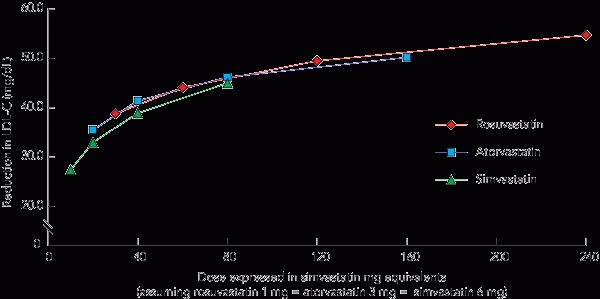
By applying the therapeutic relativities accepted by the PBAC to the results reported by Nicholls and colleagues, the dose–response curves for rosuvastatin, atorvastatin and simvastatin, all expressed in simvastatin mg equivalents, can be generated as shown in the Box. As seen in the graph, simvastatin (available as a generic) may not be substitutable for atorvastatin or rosuvastatin in patients who need a reduction in low-density lipoprotein cholesterol level of > 45 mg/dL (> 1.15 mmol/L).
Although having patients switch to generic prescriptions would reduce expenditure on statins, the possibility that such a switch might be associated with inferior outcomes needs to be considered.
Competing interests
I have provided advice to AstraZeneca for a submission to the Pharmaceutical Benefits Pricing Authority for rosuvastatin.
References
- Clarke PM, Fitzgerald EM. Expiry of patent protection on statins: effects on pharmaceutical expenditure in Australia. Med J Aust 2010; 192: 633-636.
- Nicholls SJ, Brandrup-Wognsen G, Palmer M, Barter PJ. Meta-analysis of comparative efficacy of increasing dose of atorvastatin versus rosuvastatin versus simvastatin on lowering levels of atherogenic lipids (from VOYAGER). Am J Cardiol 2010; 105: 69-76. 0_i1092972
- Pharmaceutical Benefits Pricing Authority. Therapeutic relativity sheets. Canberra: Department of Health and Ageing, 2010. <eMJA full text> (accessed Jun 2010).
Intranasal Adrenaline Use for the Management of Insect Venom-Induced Anaphylaxis
Thomas J. Young, Wilhelmina R. F. Johnson, Braydon L. Pennington, Troy Wanandy, Wun Y. Lau, Thanh-Thao A. Le
Gabapentinoid Poisoning Presentations to Victorian Emergency Departments: A 15-Year Trend Analysis
Bishaal Tej Gurung, Amy McNeilage, Angus Skeen, Tina Lam, Joanna F. Dipnall, Jane Hayman, Suzanne Nielsen, Ting Xia
Still Treating Yesterday's Risk? Reconsidering Antiviral Use for Mild-to-Moderate COVID-19 Cases in a Broadly Immune Population
Hadar Mudrik-Zohar, Tim Cutfield, Susan Morpeth, Thomas Hills, Eamon Duffy, Laura J. Edwards, Allen C. Cheng, Steven Y. C. Tong
Birth prevalence, clinical sequelae, and management of congenital cytomegalovirus infections in Australia, 1999–2023: a national prospective study
Ece Egilmezer, Suzy M Teutsch, Carlos Nunez, Stuart T Hamilton, Adam W Bartlett, Pamela Palasanthiran, Elizabeth J Elliott, William D Rawlinson
Medication delivery and dispensing interval preferences of people who use antihypertensive medications in Australia: a survey study
Carissa Bonner, Michael A Fajardo, Rachael M Keast, Emily Atkins, Niamh Chapman, Kristie R Weir, Anthony Rodgers, Aletta E Schutte
Concurrent use of hormonal long‐acting reversible contraception by women of reproductive age dispensed teratogenic medications, Australia, 2013–2021
Michelle KY Chen, Adrian Lim, Deshan F Sebaratnam