




Volume 193 - Issue 11
Osler and his Australian associations — part 2: continuing influence
Author: Milton G Roxanas
Med J Aust 2010; 193 (11): 690-693. || doi: 10.5694/j.1326-5377.2010.tb04106.x
Published online: 6 December 2010
Published online: 6 December 2010
“I would like an arrangement made with publishing houses in India and Australia to issue special editions of my text-book in those countries ... I have so many friends in both places, many of them men in official and teaching positions that the book would be adopted in the schools — as indeed it has been at Sydney ...”
The first part of this article examined the life and medical influences of William Osler (Box 1) in the context of his Australian connections. This second part looks at his encounters with Australians in the final years of his life, and the influence and legacy he left on Australian practitioners and medical practice after his death.
In 1918, the Oslers were still grieving the loss of their son Revere in the war the previous year. This catalysed Osler’s decision to bequeath his house to “Christ Church [College, Oxford] as a permanent home for my successors”, in the absence of any progeny.1
On 24 March 1918, Lady Osler wrote to Kate Cushing (Harvey Cushing’s wife):
These wonderful pictures have just come from Major Fiaschi from the Australian hospital in Boulogne. He — Fiaschi — was once in Baltimore from Australia as a PG [postgraduate]. Perhaps you remember him — we often see him. He says he has sent some pictures to Dr Cullen ...
This implies that when Piero F B Fiaschi (Box 2) worked with Harvey Cushing in Baltimore in the United States, he was introduced to William Osler and that he continued the friendship and visits after Osler went to Oxford.2,4
As the tide of war was turning in 1918, Osler was lecturing Canadian and American medical officers on postgraduate medical courses and preparing them for life after the war. In October of that year, Hugh Cairns (Box 3), an Australian from Adelaide, was introduced to Osler by A L Smith, the master of Balliol College, Oxford. Osler offered Cairns an appointment at the Radcliffe Infirmary for 6 months when he was discharged from the army, and then advised him to work for a Bachelor of Science in surgical pathology at Oxford, and subsequently to prepare for obtaining Fellowship of the Royal College of Surgeons.5 Cairns was a frequent visitor at the Oslers’ house, the “Open Arms”, and on 25 January 1919 was introduced to Harvey Cushing. Cairns attended Osler’s Saturday morning rounds at the Radcliffe Infirmary, which continued until Osler became ill with bronchopneumonia in December. Osler then developed empyema and died on 29 December 1919, at the age of 70 years.
Cairns continued to visit Lady Osler, and she recommended him to Cushing for neurosurgical training. During 1926–1927, Cairns spent 12 months with Cushing at the Peter Bent Brigham Hospital in Boston. On his return to London in September 1927, Cairns set up the neurosurgical unit at the London Hospital and was instrumental in persuading Lord Nuffield (who was previously Osler’s car mechanic) to donate money to establish Nuffield chairs at Oxford University. Cairns played a major role in setting up mobile neurosurgical units in World War II,6 and was involved in the early trials of streptomycin and penicillin in treating cerebral infections. He became the first Nuffield Professor of Surgery at Oxford.
Cushing’s biography of Osler was published in 1925, and Robert Scot Skirving (Box 4), a senior physician, was chosen to review it.8 After a delightfully thorough review, he ended by quoting a description of Osler from the biography: “He joyed with the joys and wept with the sorrows of the humblest of those who were proud to be his pupils”. Scot Skirving took it upon himself to write a short publication on the life of Osler for the Australian market.9 He praised Osler’s textbook, The principles and practice of medicine, as “absolutely sane, without faddism and with a perfect blending of scientific facts with their practical applications ...” His work was not without error however — for he writes that Osler died at 71 instead of 70 years.
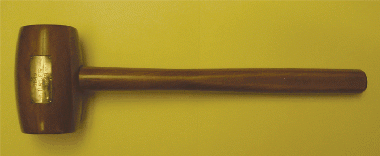
A physical connection between Osler and Australia exists in the form of a gavel (Box 5) that was donated to the Royal Australasian College of Physicians in March 1950 by Dr William C Gibson, a Canadian neuroscientist who worked with neurophysiologist John C Eccles in Australia and who had a notice on his office door that said, “If you think medical research is expensive, try disease”.10 This gavel is made from wood saved from Osler’s childhood home, the parsonage at Bond Head, Ontario, Canada. The history of similar gavels has been described and catalogued — it appears that Osler’s nephew, Dr Norman Gwyn, used wood from the Osler home to make paper knives for the family and gavels that he gave to various associations (although the one in the possession of the Royal Australasian College of Physicians is not mentioned).11
Osler’s approach to the practice of medicine was a balanced one, between the bedside clinical, the laboratory, and postmortem pathology. He bought microscopes for his students, performed postmortem examinations himself and was careful with therapeutics. He used to remind his readers of a sensible approach to pathological tests and their importance to the clinical situation. In an editorial accompanying a “Clinching the diagnosis” series in Pathology that posed the question, “what would Osler say today?”,13 James P Isbister (Box 6) concluded by writing, “In the Oslerian sense, it [the series of articles] will be a collection of problem-oriented reviews aimed at bridging the gap between clinical and laboratory medicine”. Written from the pathologist’s point of view, Isbister discussed the various approaches to interpreting pathology results, weighing possibilities and relating them to the clinical picture rather than viewing them in isolation — wise counsel at a time when doctors often spent more time looking at results than talking with the patient.
In 1996, Dr Oleg Preda (Box 7) privately printed 500 copies of his book The master-word of Dr William Osler.14 In the preface, he writes:
He [Osler] never claimed to have more than modest abilities which he organised and used properly. This knowledge he shared with others and along with the charm of his personality made friends of his colleagues of all ages and in all places.
Preda edited many of Osler’s speeches, giving them modern, relevant titles, removing gender-specific language, and adding notes to abide with Osler’s wishes (eg, Osler’s handwritten request on his copy of A way of life to add a Sanskrit poem by the Indian dramatist Kalidasa to any future reprints of the address). He divided the book into a brief history of Osler’s life followed by four sections based on the principles by which he practised medicine and lived his life: (1) “Credo” contained his beliefs and philosophy; (2) “Study” referred to students, libraries and bedside reading; (3) “Work” outlined the need “to do what lies clearly at hand”, and relations among colleagues and nurses; and (4) “History” aimed to connect the past with the present. In this technological era of medicine, Preda’s book added humanity and philosophy to the technical aspects of medicine, and he was modest in printing a small number of copies at his own expense and giving these to friends instead of making them available to a wider audience of doctors and students.
In 1999, Professor Michael O’Rourke (Box 8) wrote an editorial in the Medical Journal of Australia titled “William Osler: a model for the 21st century?”.15 The publication mentioned various aspects of Osler’s life and stressed his attitude to medicine, especially his enthusiasm, knowledge and ethics. Osler’s rejection of gossip endeared him to friends and foes, which helped unite the medical profession. O’Rourke referred to notes inside a copy of Cushing’s The life of Sir William Osler (held in the library of the Royal Australasian College of Physicians) in which Robert Scot Skirving wrote that James Linklater Isbister (Box 9) had met Osler twice and that “he [Isbister] was extremely impressed by his character and influence on the young”. O’Rourke reminded us that, “given the explosion of knowledge and the frequent intrusions from phone, facsimiles and email which frustrate our routine and challenge our equanimity”, we need to sit back, reflect and weigh knowledge, commonsense and ethics in our daily practice, as Osler taught and practised.
A recently found letter from Osler to D Appleton & Co, publisher of The principles and practice of medicine, dated 18 February 1898, stated:
I would like an arrangement made with publishing houses in India and Australia to issue special editions of my text-book in those countries ... I could even add if necessary a short supplement to the special edition dealing more fully with certain affections peculiar to those countries. I have so many friends in both places, many of them men in official and teaching positions that the book would be adopted in the schools — as indeed it has been at Sydney ...17
This led to the eventual release, in 1913, of a special eighth edition of his textbook for Australia, which was used in Australian universities.17 At that time there were three medical schools in Australia (Sydney, Melbourne and Adelaide), with a total enrolment of 957 medical students, while the number of doctors in the country was less than 3000. These numbers were sufficient for Butterworth & Co to publish a special Australian edition made up of American sheets.17 Unfortunately, Osler did not identify who his Australian friends were. Osler was keen for his book to have as wide a market as possible, as he used royalties from its sale to further his own book collecting.
Osler’s influence on Australia was similar to that on other countries. The Australian edition of his textbook taught the principles of medicine to a generation of doctors. Those fortunate enough to visit or meet him took pride in the experience and were inspired to practise medicine with high ideals and humanity. His writings and timeless sayings (eg, “take heed to [your] education, and [your] reputation will take care of itself”) are often quoted because they have well articulated wisdom, even in this age of molecular medicine. His cautious attitude to medication (“man has an inborn craving for medicine”) is a constant warning to those practising polypharmacy. He also highlighted the need for continuing medical education by stating “it is astonishing with how little reading a doctor can practice medicine, but it is not astonishing how badly he may do it”. The employment of modern tests, be they chemical, imaging or pathological, do not lessen the need to be wise, well read, experienced, and compassionate towards the patient, in spite of the help given by computers and other technology. Australian doctors, medical teachers and writers continue to look to Osler’s guidance in applying his principles to modern medical practice.
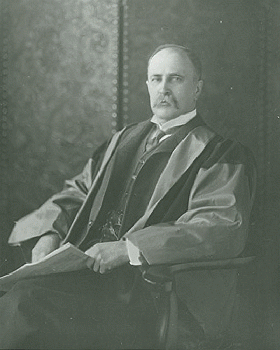
1 Sir William Osler at Oxford, 1908
 |
|
Reproduced with permission of the Osler Library, McGill University. |
2 Piero Francis Bruno Fiaschi (1879–1948)
Fiaschi was born in Windsor, New South Wales, second son of Thomas Fiaschi, a medical graduate from Florence, Italy. He graduated in dentistry from the New York College of Dentistry in 1903 and then in medicine from Columbia University in New York in 1905. He worked with Harvey Cushing in Baltimore and met him again in Abbeville, France, during World War I. He served in the Australian Army Medical Corps in Gallipoli, Egypt, France and the United Kingdom from 1914. Fiaschi was a pioneer in using saline for treating hypovolaemic shock in France. He became a urologist and venereologist and was associated with Sydney Hospital. In World War II, he was a medical inspector of prisoner-of-war camps in Australia.2,3
3 Hugh Cairns (1896–1952)
Cairns was born in Port Pirie, South Australia. He started studying medicine at the University of Adelaide in 1912 but left to join the Australian Army Medical Corps. He served in Lemnos, Greece, where the Gallipoli casualties were taken. After the withdrawal from Gallipoli, he was repatriated to Adelaide to finish his studies, which he did in 1917. He then re-enlisted with the rank of Captain and went to the 2nd Australian General Hospital at Wimereux, France. In October 1918, he obtained leave to visit his father’s relatives in Scotland, and then used a letter of introduction to visit A L Smith, who in turn introduced him to Sir William Osler. Cairns was so upset at the death of his friend T E Lawrence (of Arabia) in a motorcycle accident in 1935 that he researched and advocated the wearing of crash helmets for motorcyclists. In 1945, he was called to treat the American General Patton, who had fatal spinal injuries from a motor vehicle accident. Cairns wrote on brain abscesses, head injuries, brain tumours, akinetic mutism, and cingulectomy for treating psychosis. He was appointed the first Sims Commonwealth Travelling Professor in 1947–48. He died from lymphoma of the caecum in July 1952.5
4 Robert Scot Skirving (1859–1956)
Scot Skirving was born in Scotland, the son of a farmer. He travelled to Adelaide as a sailor on the Tantallon Castle and suffered from beri-beri on the return voyage, which influenced him to enrol in medicine at the University of Edinburgh. He graduated in 1881, in the same year as Thomas Anderson Stuart (the first Professor and Dean of the Faculty of Medicine at the University of Sydney) and Arthur Conan Doyle. He returned to Australia as a ship’s surgeon on the emigrant ship Ellora. After working in Queensland, in 1883 he was appointed medical superintendent of Sydney’s Prince Alfred Hospital (which received its Royal charter in 1902). He also served as honorary physician at that hospital and honorary surgeon at St Vincent’s Hospital. He was a lecturer at the University of Sydney and had a lecture theatre named after him at Royal Prince Alfred Hospital.7 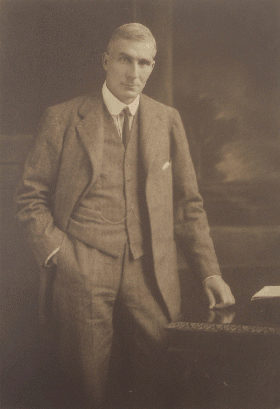 Reproduced with permission of Ann Macintosh, Scot Skirving’s granddaughter. |
5 Gavel at the Royal Australasian College of Physicians
6 James Paton Isbister (1943–)
Isbister is the son of two physicians (James and Clair). He graduated from the University of New South Wales in 1968 and, after residency at Prince Henry and Prince of Wales hospitals, specialised in clinical haematology, working at St Vincent’s Hospital in Sydney and the Royal Postgraduate Medical School of London. He was head of the Department of Haematology and Transfusion Medicine at Royal North Shore Hospital for many years and, while there, set up the first blood cell separator (apheresis) unit and first allogeneic bone marrow transplant service in Australia. He is currently Chair of the Advisory Committee of the Australian Red Cross Blood Service. He has written several books and many articles on haematology.12
7 Oleg (Alec) Preda (1941–)
Preda was born in Russia. He graduated from the University of Sydney in 1972 and was a resident doctor at Royal Prince Alfred Hospital, Sydney Hospital and Hornsby Hospital in Sydney. He became a Fellow of the Royal Australian College of General Practitioners and was in general practice in the Sydney suburb of Castle Hill. He first became acquainted with Osler when, on expressing a wish to study medicine to the doctor conducting his physical examination before national service, he was urged to read Osler’s The student life. In his second year of medicine, he found Cushing’s biography of Osler in his local library, and reading it left a lasting influence on his life and work. Preda made a pilgrimage to all the places where Osler worked, visiting Toronto, the Wistar Institute in Philadelphia, McGill University and the Osler Library, Johns Hopkins University, and Osler’s house (the “Open Arms”) in Oxford. He viewed Osler’s brain at the Wistar Institute where it is held, and said “sadness came over me as I saw the gaps in the specimen where the greedy had debased this noble relic by cutting out portions of his brain” (Oleg Preda, personal communication).
8 Michael O’Rourke (1937–)
O’Rourke graduated from the University of Sydney in 1960 and was a resident at St Vincent’s Hospital, Sydney, proceeding from anaesthetics to physiology and finally cardiology. He worked in the Department of Physiology at Johns Hopkins Hospital, before returning to Australia to become Professor (later Emeritus Professor) of Medicine at the University of New South Wales. His main interest is arterial haemodynamics, and he has written extensively, including several books, on the subject. He was instrumental in showing that arterial vasodilator drugs such as calcium channel blockers and angiotensin-converting enzyme inhibitors are superior to β blockers in treating hypertension. He is a Member of the Order of Australia (AM) and a member of the American Osler Society (Michael O’Rourke, personal communication).
9 James Linklater Thomson Isbister (1870–1936)
Isbister was born in Scotland and went to school both there and in Adelaide, before graduating in medicine from the University of Adelaide in 1896. He worked at the Sydney Hospital before starting in general practice in North Sydney in 1898. He became an honorary surgeon and gynaecologist at the Royal North Shore Hospital in Sydney. In 1908, he spent a year travelling to London, Scotland and his ancestral origins in the Hebrides. He must have met Osler during this visit (as noted by Robert Scot Skirving), but there is no mention of this association in any other source. Isbister was described as a reserved, meticulous and saintly man. He was a foundation member of the Royal Australasian College of Surgeons.16 He treated Sister Mary MacKillop at the convent in Mount Street, North Sydney, and was the grandfather of James P Isbister (see Box 6).
Competing interests
None identified.
Acknowledgements
I wish to sincerely thank Elizabeth Milford (Royal Australasian College of Surgeons), Pamela Miller (Osler Library), Liz Rouse (Royal Australasian College of Physicians), Kay Lee and Frances Miechels (Concord Hospital Medical Library) who contributed to this article with their willing help in searching references and pictures. I acknowledge with gratitude the inspiration and guidance of Dr Charles George, Dr Richard Golden, Dr Oleg Preda, Professor Michael O’Rourke and Dr Jill Forrest.
References
- Cushing H. The life of Sir William Osler. 1st ed. Oxford: Clarendon Press, 1925. 0_i1095502
- Roxanas MG. Harvey Cushing and some Australian connections: part 1 — early life and work. J Clin Neurosci 2010; 17: 168-172. 0_i1095504
- Walsh GP. Fiaschi, Piero Francis Bruno (1879–1948). Australian Dictionary of Biography 1981; 8: 491-492. Melbourne: Melbourne University Press, 1981. 0_i1095506
- Osler G. Letters from Lady Grace Osler. Osler Library, McGill University, Montreal. 0_i1095508
- Fraenkel GJ. Hugh Cairns: first Nuffield Professor of Surgery, University of Oxford. Oxford: Oxford University Press, 1991. 0_i1095510
- Hughes JT. Hugh Cairns (1896–1952) and the mobile neurosurgical units of World War II. J Med Biogr 2004; 12: 18-24. 0_i1095512
- Young J, Sefton A, Webb N. Centenary book of the University of Sydney Faculty of Medicine. Sydney: Sydney University Press, 1984. 0_i1095514
- Scot Skirving R. Reviews — William Osler. Med J Aust 1925; 2: 457-458. 0_i1095516
- Scot Skirving R. The life of Sir William Osler. Sydney: Australasian Medical Publishing Company, 1926. 0_i1095518
- Feindel W. In memoriam: William Carleton Gibson, 4 September, 1913 – 4 July, 2009. Osler Libr Newsl 2009; (112): 14-15. 0_i1095520
- MacDermot HE. On gavels. Can Med Assoc J 1972; 106: 1109. 0_i1095522
- Lilienthal C. 2008: forty year reunion biographies, Faculty of Medicine graduates, University of NSW. Sydney, 2008. 0_i1095524
- Isbister JP. Clinching the diagnosis: what would Osler say today? Pathology 1983; 15: 361-363. 0_i1095526
- Preda A. The master-word of Dr William Osler. Sydney: Fast Books, 1996. 0_i1095528
- O’Rourke MF. William Osler: a model for the 21st century [editorial]? Med J Aust 1999; 171: 577-579. 0_i1095530
- Anonymous. Obituary: James Linklater Thomson Isbister. Med J Aust 1937; 1: 152-154. 0_i1095533
- Golden RL, Roxanas M. William Osler’s textbook: the Australian edition. Osler Libr Newsl 2007; (108): 4-6. 0_i1095535
Prisoner of war pathology in Changi, 1942–1945
Kate Ariotti, Elizabeth Roberts‐Pedersen
Should medical eponyms continue to be used in everyday practice?
Leya Nedumannil, Diana Lewis
100 years on: the first use of insulin in Australia
Sophie Templer
Reflections on the life and career of Professor Dame Valerie Beral AC DBE FRS FRCOG FMedSci (1943–2022)
Karen Canfell, Bette Liu, Emily Banks
The Honourable Dr Donald James Grimes AO
Michael Kirby, Patti Warn
From wipeout to drill out: a history of exostosis management and Australian surfing
Alon Taylor, Hannah North, Narinder P Singh, Paul A Fagan