




Volume 191 - Issue 2
Work intentions and opinions of general practice registrars
Authors: Thomas D Brett, Diane E Arnold-Reed, Cam T Phan, Robert G Moorhead and Dana A Hince
Med J Aust 2009; 191 (2): 73-74. || doi: 10.5694/j.1326-5377.2009.tb02695.x
Published online: 20 July 2009
Published online: 20 July 2009
To the Editor: The work intentions and opinions of general practice registrars are important in estimating the future supply of Australian general practitioners. Declining popularity of general practice has led to entrenched, long-term shortages (especially in rural areas),1,2 with 700 new entrants annually — well short of the 1100–1200 required to meet community needs.3 Between October and December 2008, we mailed questionnaires to 147 GP trainees (69% women) registered with Western Australian General Practice Education and Training, asking about their career intentions and opinions. Ethics approval was obtained from the University of Notre Dame Australia Human Research Ethics Committee.
The response rate was 61% (89/147). Seventy respondents were women (79%). Median age of respondents was 30 years (interquartile range [IQR], 28–35 years). Most had graduated in Australia (82%, 73/89) and most between 2000 and 2006 (83%, 74/89). Twenty-nine per cent (26/89) made their career choice in the first 2 years after graduation, while others decided in their third year after graduation (26%, 23/89), or later (24%, 21/89); medical school was the next most common stage at which respondents made their choice (20%, 18/89). Forty of the 89 registrars (45%) were working eight or less sessions per week; 34 (38%) were working more than eight; and 15 (17%) had not yet started work.
Registrars favoured rural, outer metropolitan and metropolitan areas equally as practice locations (Box 1). Becoming a practice principal was not a priority, probably reflecting respondents’ current training status and uncertainty about the future. Low numbers were planning to undertake home, nursing home or hostel visits.
Using a five-point Likert scale, respondents rated flexibility and better lifestyle of general practice as major influences on their career choice (median score, 5; IQR, 4–5). Appraisal of own skills and aptitudes (median score, 4; IQR, 3–4) and intellectual influences (median score, 3.5; IQR, 3–4) were other important factors. Twenty per cent had converted from another specialty. Reasons for changing specialty included work demands and stress (50%) and career flexibility, lifestyle and family reasons (33%); in previous research, these were found to be key determinants favouring general practice as a career option.2
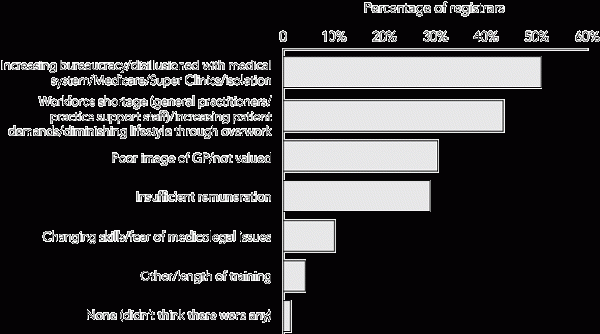
Obstacles to general practice selected by respondents were, in descending order of frequency: increasing bureaucracy, workforce shortages, the poor image of GPs and poor remuneration (Box 2).
Increased exposure to general practice via rural clinical schools and clinical attachments as a medical student and pre-vocational doctor has been shown to be a positive influence on future GP career choices.2,4 We found the first 3 years after graduation were the most important in making career decisions, supporting earlier research5 and highlighting the potential benefits that exposure via the Prevocational General Practice Placements Program (PGPPP) brings to general practice. Suggestions that the PGPPP be open to Australian medical graduates in their first and second postgraduate years2 deserve support.
Despite survey limitations of sample size and an over-representation of women registrars, our findings reflect the views of 60% of current WA GP registrars. Fifty-one per cent planned to retire at 65 years or above, and 44% planned to retire before then, with the rest unsure. Involvement of experienced GPs in health care delivery is also waning (as we outline in Retirement intentions of general practitioners aged 45–65 years).6 Recruiting and training new doctors in sufficient numbers to replace retiring experienced colleagues is critical in redressing the balance and meeting future workforce demands. Strategies to make general practice a more attractive career option for new doctors deserve increased priority if general practice is to remain a competitive discipline.
2 Factors considered by general practice registrars to be obstacles to general practice* (n = 69)
Competing interests
Thomas Brett is a director of WAGPET. Robert Moorhead is a former director and training advisor with WAGPET.
Acknowledgements
We acknowledge the support of Western Australian General Practice Education and Training (WAGPET). Thomas Brett, Diane Arnold-Reed, Dana Hince and Robert Moorhead were funded under the Commonwealth Primary Health Care Research Evaluation and Development Strategy Phase II. Cam Phan was funded by the Independent Practitioner Network.
References
- Joyce CM, McNeil JJ, Stoelwinder JU. More doctors, but not enough: Australian medical workforce supply 2001–2012. Med J Aust 2006; 184: 441-446.
- Thistlethwaite JE, Leeder SR, Kidd MR, Shaw T. Addressing general practice workforce shortages: policy options. Med J Aust 2008; 189: 118-121. 0_i1091977
- Australian Medical Workforce Advisory Committee. The general practice workforce in Australia: supply and requirements to 2013. Sydney: AMWAC, 2005. (AMWAC Report 2005.2.) http://www.nhwt.gov.au/documents/Publications/2005/The%20general%20practice%20workforce%20in%20Australia.pdf (accessed Jun 2009).
- Ward AM, Kamien M, Lopez DG. Medical career choice and practice location: early factors predicting course completion, career choice and practice location. Med Educ 2004; 38: 239-248. 0_i1091984
- Edwards C, Lambert TW, Goldacre MJ, Parkhouse J. Early medical career choices and eventual careers. Med Educ 1997; 31: 237-242. 0_i1091985
- Brett TD, Arnold-Reed DE, Hince DA, et al. Retirement intentions of general practitioners aged 45–65 years. Med J Aust 2009; 191: 75-77.<eMJA full text>
Shifting focus to adolescent wellbeing and inclusive participation in the digital age
Allyson R Todd, Elena Wang, Stephanie R Partridge
The clinical presentation, investigation, and management of women diagnosed with endometriosis in Australian general practices, 2011–2021: an open cohort study
Danielle Mazza, Kailash Thapaliya, Sharinne B Crawford, Alissia Hui, Maryam Moradi, Luke E Grzeskowiak
The impact of the Breast Screen NSW transition from film to digital mammography, 2002–2016: a linked population health data analysis
Rachel Farber, Nehmat Houssami, Katy J L Bell
Non‐technical errors associated with deaths in surgical care, Australia, 2012–2019, by surgical specialty (Australian and New Zealand Audit of Surgical Mortality): a retrospective cohort study
Jesse Ey, Victoria Kollias, Octavia Lee, Kelly Hou, Matheesha Herath, John B North, Ellie Treloar, Suzanne Edwards, Martin Bruening, Adam J Wells, Guy J Maddern
The CURE Asthma roadmap
Gary P Anderson, Anthony Flynn, Phil G Bardin, John D Blakey, Shyamali C Dharmage, Paul Foster, Peter G Gibson, Adam Jaffe, Alan James, Christine R Jenkins, Sundram Sivamalai, Peter D Sly, Guy B Marks, Vanessa M McDonald, Judy Wetttenhall
Evidence from Australian cohort studies about asthma trajectories and transitions across the life course: a narrative review
Caroline Lodge, Xin Dai, Ingrid A. Laing, Michael P Menden, Anthony Flynn, Gary P Anderson, Sarath Ranganathan, Shyamali C Dharmage