




Volume 191 - Issue 10
Impact of Australian celebrity diagnoses on prostate cancer screening
Authors: David P Smith, Mark S Clements, Melanie A Wakefield and Simon Chapman
Med J Aust 2009; 191 (10): 574-575. || doi: 10.5694/j.1326-5377.2009.tb03320.x
Published online: 16 November 2009
Published online: 16 November 2009
To the Editor: In 2008, considerable publicity was given to the diagnosis and treatment of prostate cancer in two Australian celebrities: retired Australian Football League player Sam Newman and radio announcer Alan Jones. Newman’s cancer was reported on 5–9 March 2008, culminating in a 12-minute item on the high-rating Australian television program 60 Minutes, when Newman said, “Be tested and enjoy life”. Jones’s announcement of his forthcoming surgery was reported on 3–4 July 2008, and his recovery on 16–27 July. We investigated whether this publicity was associated with changes in the rate of prostate specific antigen (PSA) testing.
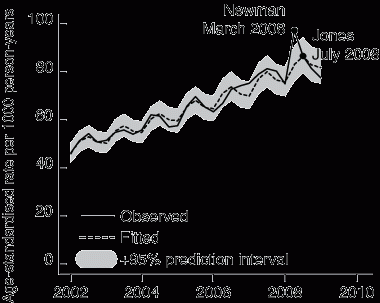
We used Medicare Australia data on claims for Medicare Benefits Schedule item 66655 (which allows “one annual PSA test for an individual without prior prostate disease”) to determine the mean number of PSA tests and age-standardised testing rate between January 2002 and March 2009. We fitted a linear regression model to the log of the age-standardised rates, modelling secular trends using natural splines with two degrees of freedom (splines were piecewise cubic within the data range and otherwise linear), with indicators set for the average effect of the second, third and fourth quarters and an indicator for the second quarter of 2008. We calculated predicted values and prediction intervals (which take into account both uncertainty in the predicted mean and individual variation), excluding observed data for the second quarter of 2008 (Box).
The mean monthly number of PSA tests was 72 064 in the 12 months before April 2008, increasing to 107 633 in April 2008, and 90 813 in July 2008. The seasonally adjusted age-standardised rate of PSA tests rose 17% above the secular trend in the second quarter of 2008 (95% CI, 8%–27%), with the observed data point falling outside the prediction interval (Box). This represented an additional 39 000 PSA tests during the second quarter of 2008.
These data show that prostate cancer screening increased significantly in the quarter after media coverage of Newman’s prostate cancer diagnosis. Screening seemed to have returned to the expected seasonal rate by the time of Jones’s diagnosis, in the third quarter of 2008.
The impact of celebrity cancer diagnoses on population screening has been demonstrated previously, most recently by an increase in breast cancer screening following news of pop singer Kylie Minogue’s breast cancer diagnosis in 2005.2 In a survey of US men, almost a third stated they would be more likely to have a PSA test after hearing celebrities endorse prostate cancer screening.3 In addition, coverage of melanoma by 60 Minutes in 1987 was followed by a 167% increase in melanoma detection in the subsequent 3 months.
Whether the additional 39 000 PSA tests performed in the second quarter of 2008 result in a surge in diagnoses of prostate cancer remains to be seen. Despite continuing uncertainty about the benefits of PSA testing, but unequivocal evidence of harms,,6 Australian men’s willingness to be screened for prostate cancer appears to have been boosted by this celebrity endorsement.
Age-standardised* prostate-specific antigen testing rates in Australia (assessed quarterly)
References
- Horner MJ, Ries LA, Krapcho M, et al. SEER cancer statistics review, 1975–2006. Bethesda, Md: National Cancer Institute, 2009. http://seer.cancer.gov/csr/1975_2006/index.html (accessed Sep 2009).
- Chapman S, McLeod K, Wakefield M, Holding S. Impact of news of celebrity illness on breast cancer screening: Kylie Minogue’s breast cancer diagnosis. Med J Aust 2005; 183: 247-250. 0_i1091866
- Larson RJ, Woloshin S, Schwartz LM, Welch HG. Celebrity endorsements of cancer screening. J Natl Cancer Inst 2005; 97: 693-695. 0_i1091868
- Theobald T, Marks R, Hill D, Dorevitch A. “Goodbye Sunshine”: effects of a television program about melanoma on beliefs, behavior, and melanoma thickness. J Am Acad Dermatol 1991; 25: 717-723. 0_pgfId-1966880
- Andriole GL, Grubb RL III, Buys SS, et al. Mortality results from a randomized prostate-cancer screening trial. N Engl J Med 2009; 360: 1310-1319. 0_pgfId-1966888
- Schroder FH, Hugosson J, Roobol MJ, et al. Screening and prostate-cancer mortality in a randomized European study. N Engl J Med 2009; 360: 1320-1328. 0_i1091875
From Ambition to Action: Closing Policy, Equity and Implementation Gaps in the Australian Cancer Plan's ‘Enhanced Consumer Experience’
Carla Thamm, Elise Button, Oluwaseyifunmi A. Agbejule, Reegan Knowles, Karen van Gorp, Mark B. Pinkham, Meinir Krishnasamy, Alexandra L. McCarthy, Raymond J. Chan
Sovereignty and Survival: Understanding Lung Cancer Outcomes for Aboriginal and Torres Strait Islander People in Australia, a Case–Control Study
Alice R. T. Bergin, Luc te Marvelde, Roger L. Milne, Benjamin J. Solomon, Kris Ivanova, Peter Savas, Stephen J. Luen, Jay Hamann, Andrea Casey, Nicole Watt, Sue M. Evans, Gail Garvey, Sherene Loi
The Changing Indications for Adult Liver Transplantation in Australia: A Narrative Review
Fadak Mohammadi, Alan J. Wigg, Ken Liu, Simone I. Strasser
Uneven Ground: Survival Differences Among Victorian Lung Cancer Patients by Location of Residence (2011–2023): A Retrospective Cohort Study
Evangeline Samuel, Eldho Paul, Mike Lloyd, Sanuki Tissera, Craig Underhill, Sagun Parakh, Phillip Parente, Inger Olesen, Javier Torres, Katharine See, Gavin M. Wright, David Langton, Thomas John, Matthew Conron, James Bartlett, Nicola Atkin, Nikolajs Zeps, Susan V. Harden, Wasek Faisal, John R. Zalcberg, Rob G. Stirling
Early-Onset Colorectal Cancer With Liver-Only Metastases: A Retrospective Cohort Study Integrating Prospectively Collected Real-World Clinical and Molecular Data From an Australian National Database (2009–2024) to Guide Treatment Planning
Savio G. Barreto, Christos S. Karapetis, Shahid Ullah, Matthew Burge, Susan Caird, Angus Campbell, Azim Jalali, Ross Jennens, Muhammad A. Khattak, Belinda Lee, Stephanie H. Lim, Shehara Mendis, Louise Nott, Timothy J. Price, Jeremy D. Shapiro, Jeanne Tie, Javier Torres, Colin Williams, Rachel Wong, Vanessa Wong, Peter Gibbs
Australian Pathways for Specialist Pain Management and Early Palliative Care for People With Pancreatic Cancer: Developed Using a Community Consensus Approach
Jennifer Philip, Melanie R. Lovell, Kylee Bellingham, Gail Garvey, Gregory B. Crawford, Nicole M. Rankin, Kara Burns, Isabel Young, Vivienne Milch, Dorothy Keefe, Katrina Anderson, James Lawson, Meinir Krishnasamy