




Volume 189 - Issue 8
Epidemiology of sexually transmitted infections on the Anangu Pitjantjatjara Yankunytjatjara Lands: results of a comprehensive control program — a postscript
Authors: Rae-Lin Huang, Paul J Torzillo and Adrienne C Kirby
Med J Aust 2008; 189 (8): 446. || doi: 10.5694/j.1326-5377.2008.tb02118.x
Published online: 20 October 2008
Published online: 20 October 2008
To the Editor: In the preceding article, we report on a substantial rise in prevalence rates of gonorrhoea in a population in remote Central Australia.1 This rise occurred in the context of a sustained major reduction in sexually transmitted infections (STIs) in the region, achieved by a comprehensive program of STI control, described in the article1 and previously.2
We found that the gonorrhoea outbreak was not due to penicillin resistance of the causative organism, and we hypothesise that it was due to the introduction and dominance of a more infectious clone.3,4 This rise in gonorrhoea in a region widely acknowledged to have the most successful STI control program in the country prompted several commentators to argue that both this program, and screening as a measure for STI control in remote Indigenous communities, had failed, and to advocate a range of other approaches.5
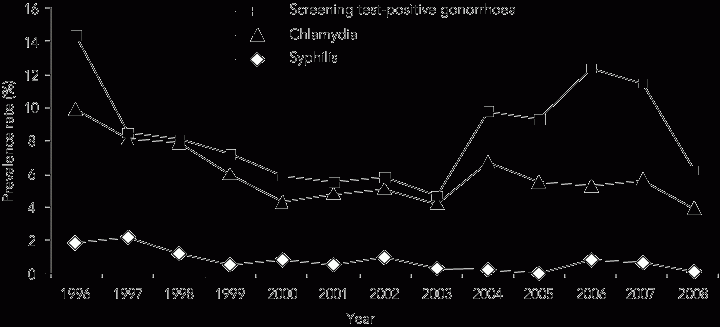
We recently completed the analysis of the 2008 annual population-wide STI screen, which achieved a 78% participation rate among eligible participants. These data strongly suggest that the gonorrhoea outbreak seen over the previous 4 years has been controlled (Box). Furthermore, the current prevalence rates are among the lowest seen in the past decade. These findings suggest that a comprehensive STI control program, such as that delivered by the Nganampa Health Council, can not only reduce STI rates, but also control outbreaks, provided the program is sustained.
During most of the past decade, the prevalence of syphilis remained below 1%, of chlamydial infection below 6%, and of screening test-positive gonorrhoea below 8%, as measured during the annual population-wide screens.
This program should be replicable in other regions, if appropriate resources and expertise are applied, thus providing an opportunity to improve an important area of Indigenous health using current public health knowledge.
References
- Huang R-L, Torzillo PJ, Hammond VA, et al. Epidemiology of sexually transmitted infections on the Anangu Pitjantjatjara Yankunytjatjara Lands: results of a comprehensive control program. Med J Aust 2008; 189: 442-445.
- Miller PJ, Torzillo PJ, Hateley W. Impact of improved diagnosis and treatment on prevalence of gonorrhoea and chlamydial infection in remote aboriginal communities on Anangu Pitjantjatjara Lands. Med J Aust 1999; 170: 429-432. 0_i1091847
- Choudery B, Risley CL, Ghani AC, et al. Identification of individuals with gonorrhoea within sexual networks: a population-based study. Lancet 2006; 368: 139-146. 0_i1091849
- Sarafian SK, Knapp JS. Molecular epidemiology of gonorrhea. Clin Microbiol Rev 1989; 2 Suppl: S49-S55. 0_i1091851
- Bowden FJ, Fethers K. “Let’s not talk about sex”: reconsidering the public health approach to sexually transmissible infections in remote Indigenous populations in Australia. Med J Aust 2008; 188: 182-184. 0_i1091853
Costs of Delivering the Hep B PAST Model of Care in Remote Australia: A Retrospective Pre–Post Study
Hoa Nguyen, Anh Le Tuan Nguyen, Paula Binks, Melita McKinnon, Emily Vintour-Cesar, Karen Wills, Nicola Stephens, Benjamin Cowie, Joshua S. Davis, Yuejen Zhao, Peter Nihill, Julie A. Campbell, Andrew J. Palmer, Jane Davies, Barbara de Graaff
Buruli Ulcer Acquired From Ringtail Possum Rescue
Daniel P. O'Brien, Naomi Clarke, Sara Bonnici, Mohammad A. Hussain
Q Fever Visceral Abscesses After Contact With Native Australian Marsupials
Samantha J. Laws, Enzo Binotto, James Stewart, Jennifer Ho, Trent Yarwood, Josh Hanson, Simon Smith
Hospital-Admitted Injection-Related Infections Among Incarcerated People Who Inject Drugs in Australia: A Retrospective Cohort Study
Andrew Palmer, Matthew Carter, Jeremy Yeo, Cecilia Shim, Jason Connor, Jeremy Hayllar, Gerald Holtmann, Naomi Moy, Elliott G. Playford, Naomi Runnegar, Paul J. Clark
The Live Attenuated Influenza Vaccine in Australia: An Additional Tool for Influenza Prevention
Cyra Patel, Alexis Pillsbury, Tran Nguyen, Xia Wang, Helen E. Quinn, Clayton K. Chiu, Allen C. Cheng, Katie L. Flanagan, Zhicheng Wang
Reflex Testing for Hepatitis D Infection: A Unique Opportunity to Reduce Hepatitis D-Related Chronic Liver Disease Deaths in Australia
Jessica Howell, Lauren Andersson, Miriam T. Levy, James O'Beirne, Leon Adams, Katharine Irvine, Avik Majumdar, Golo Ahlenstiel, Kathy Jackson, Krispin Hajkowicz, Joseph Doyle, Jane Davies, Sarah Cherian, Wayne Dimech, Alexander J. Thompson