




Volume 188 - Issue 1
Commercialism, choice and consumer protection: regulation of complementary medicines in Australia
Authors: Ken J Harvey, Viola S Korczak, Loretta J Marron and David B Newgreen
Med J Aust 2008; 188 (1): 21-25. || doi: 10.5694/j.1326-5377.2008.tb01498.x
Published online: 7 January 2008
Published online: 7 January 2008
Complementary and alternative medicines (CAMs) are being used increasingly in Australia, often in conjunction with conventional medicines.1 While the demand for CAMs is growing, the regulatory framework is weak. The electronic lodgement facility, introduced in 1996, has made it easier to place new CAMs on the Australian Register of Therapeutic Goods (ARTG). Concern about the regulation of CAMs has been growing among organisations such as CHOICE.2
Here, we review the regulatory requirements for CAMs, compare weight-loss products listed on the ARTG with registered pharmaceutical products, analyse complaint procedures and advocate policy change. We have focused on weight-loss products because of widespread concern about an obesity “epidemic”, extensive advertising of the products and the large number on the market.
Regulation of therapeutic goods in Australia
In 1989, the federal Parliament passed the Therapeutic Goods Act 1989 (Cwlth), which created the ARTG. The ARTG has two parts: one for “registered goods” and the other for “listed goods”. Some goods captured by the Act are classified as “exempt goods” and are not entered in the ARTG (ss. 9A, 18). Box 1 shows the differences between the various categories of therapeutic goods.
“Registered” medicines are considered to be of relatively higher risk and are individually evaluated by the Therapeutic Goods Administration (TGA) for quality, safety and efficacy before market entry. “Listed” medicines are considered to be of relatively lower risk (Box 2).3
Most, but not all, CAMs are listed medicines.4 Initially, the TGA did not require sponsors to have evidence to support claims made about their products. In 1999, concern that improbable therapeutic claims were being made about CAMs led to the introduction of a requirement that sponsors hold substantiating evidence.5 Further, since a report by the Expert Committee on Complementary Medicines in the Health System, a random sample of about 20% of new listings is said to be assessed each year for compliance with TGA requirements.6 Both these measures have been introduced to increase monitoring of CAMs.
In 1991, the government introduced fees and charges to industry for services provided by the TGA, such as ARTG applications, good manufacturing practice inspections and annual licensing. The aim was to achieve 50% cost recovery. In 1998, the government determined that 100% of costs would be recovered.7 Illustrative TGA fees (at 1 July 2007) were $170 200 for registering and evaluating a new prescription medicine (a new chemical entity); $990 for registering and evaluating an over-the-counter product or CAM (plus $6570–$46 000, depending on the number of pages of data submitted); and $540 for listing a medicine. The annual charge for a registered (non-biological) prescription medicine was $3030; for a registered over-the-counter product, conventional or CAM, $920; and for a listed medicine, $690.7
Sponsors self-assess their medicines as being listable using the web-based electronic listing facility (ELF) of the ARTG. The ELF system automatically checks that the ingredients entered are consistent with those allowed in listed medicines and asks the sponsors to certify that they hold evidence to support the indications (and thus claims) made. Sponsors may pick either a coded indication such as “May aid or assist weight loss . . .” or a custom indication entered as free text in a memo field. More than one entry into either field is allowed. After payment of a fee, the ELF system automatically generates an “AUST L” number and a certificate of listing.
Since the introduction of the ELF, the time taken to list a product has been reduced from around 5 months to 10 days or less for about 90% of applications.8
Complaints from the public about listed products need to be submitted to various authorities, as summarised in Box 3.9
In February 2007, the Australian Government reintroduced a provision of the Therapeutic Goods Advertising Code, which had existed before August 2005, prohibiting health care professionals from endorsing therapeutic goods in advertisements to consumers. This provision took effect from 8 March 2007, but allowed existing advertisements to continue for either 2 years after approval (eg, in print) or 1 year if approval had not been required (eg, Internet advertisements).10
An example: weight-loss products
In Australia, both listed and registered weight-loss products are available. To determine the numbers of each and compare them, we asked the TGA to search the ARTG for registered or listed products with the indication “weight loss”, or similar, for the period 1996 to 2006. We then supplemented the list by searching the shelves of pharmacies and health food shops and Australian Internet sites. Because of problems encountered, the TGA made available a subset of the ARTG database so that we could refine their search for weight-loss products. For the registered and listed products found, we compared the therapeutic claims with the published evidence. The website of the Therapeutic Goods Advertising Code Council was used to identify complaints and select illustrative case studies.
Products identified
The initial search output received from the TGA failed to show some registered weight-loss products, such as orlistat (Xenical [Roche]) and sibutramine (Reductil [Abbott]). It also failed to show many listed CAMs that were being actively promoted for weight loss.
Some of these problems resulted because the ELF system allowed sponsors of listed products to enter information into the ARTG in free text without verification by TGA staff. Some non-standard indications had been used for weight-loss products (such as “thermogenic”, “body sculpting”, “reduce carb cravings”), which made a complete search for such products difficult, if not impossible.
Our own search found over 1000 new weight-loss products listed on the ARTG from 1996 to 2006. New listings generally increased over the period, from 45 in 1996 to 144 in 2006. Most contained multiple ingredients (herbs, vitamins, minerals). Homoeopathic products are not included on the ARTG. Over the same period, 10 conventional medicines for weight loss were registered with the ARTG, each containing one ingredient, (orlistat, diethylpropion, phentermine, sibutramine). All these substances are officially scheduled poisons, and products containing them are registered for the management of obesity, unless the product is for export. Those containing orlistat and sibutramine have been fully evaluated. Phentermine-containing medicines were “grandfathered” on to the ARTG because they were already on the Australian market when the Act took effect in February 1991. Diethylpropion is no longer marketed. The safety and efficacy of these agents has been comprehensively reviewed.11
Thus, sponsors could decide not to market products they had placed on the ARTG or to take them off the market but leave them on the ARTG. Taking into account these limitations, we found about 100 times as many listed weight-loss products on the ARTG as registered products. It is not possible to be too specific about numbers because there were confounding factors, such as the inclusion in the listed goods part of the ARTG of prescription-only medicines that were destined for export.
In our opinion, the indications for weight-loss products listed on the ARTG (and thus their promotional claims) were often not in accord with the limited scientific evidence available. Furthermore, the number of such listed products is increasing each year at a much greater rate than registered products. It is possible that this has been influenced by the decision not to evaluate listed products for efficacy and also the lower fees for listing a product compared with registration.
A typical weight-loss product
An example of a publicly available, listed weight-loss product is shown in Box 4. We are unaware of publicly available evidence from clinical trials to support the therapeutic claims made for this product or for many other listed (and homoeopathic) weight-loss products. Several systematic reviews have evaluated the commonly included ingredients and have concluded that, at best, more definitive clinical trials are required before conclusions can be drawn.12,13 While these products are of relatively low risk, some herbal ingredients can cause harm by themselves and also by interacting with conventional medicines; both kinds of event may be under-reported.14,15
The Complaints Resolution Panel found that the claims made about the illustrated product, Xantrax (Hershel-Beck Laboratories), breached the Therapeutic Goods Advertising Code as they were misleading and likely to arouse unwarranted and unrealistic expectations of product effectiveness.16 In our experience, it usually takes 3 to 4 months for submitted complaints to be adjudicated by the Complaints Resolution Panel and several more months before the results are made public. Meanwhile, promotional campaigns continue. In addition, the sanctions imposed appear ineffectual, as shown by the fact that some companies repeatedly breach the Therapeutic Goods Advertising Code. For example, from March 2004 to November 2007, the sponsor of Xantrax, Cat Media Pty Ltd, has had at least 28 complaints about its products, 22 of which have been upheld.16,17 In 2006, the Panel received over 350 complaints, more than twice the number received in 2005. Of these, 170 have been finalised and 100 are still being processed, 60 concerning homoeopathic products and which were referred to the TGA, and 22 referred to other bodies. The system is clearly overloaded and under-resourced. We submitted complaints over 6 months ago that have yet to be addressed. We submitted complaints over 12 months ago that have been referred to other jurisdictions, about which we have heard no more; meanwhile, promotion continues.
Implications
In 2003, the Expert Committee on Complementary Medicines in the Health System was established to reassure the public about the safety and quality of CAMs. The Committee said (Finding 4.1.1) that the “Government needs to take a more active role in ensuring that consumers have access to reliable information about complementary medicines, and the skills to interpret information and make informed decisions”.6 In 2005, the government responded to the expert committee report by accepting, noting or supporting all but one of the 49 recommendations. The TGA established the Complementary Medicines Implementation Reference Group to oversee the implementation and has provided progress reports.18
Despite the widespread use of CAMs, many consumers are unaware that listed medicines do not undergo the same stringent evaluation process as registered medicines, or indeed, that there is a difference between the two. Consumers are not sufficiently protected by regulation in this case. It is difficult to reconcile the therapeutic claims made for many CAMs with the objects of the Act: “to provide for . . . a national system of controls relating to the quality, safety, efficacy and timely availability of therapeutic goods...” (s. 4, our italics).
In an attempt to explain the difference, the TGA produced a pamphlet in 1995 called Buying medicines — what’s on the label for me? It was available in pharmacies and health food shops and is now on the Internet.19 While the content reflects the legal situation, the omission that AUST L listed medicines are not evaluated for efficacy diminishes the utility of the pamphlet for the very people to whom it is directed. This has financial as well as health implications for consumers. Brian Grogan, national president of the Pharmaceutical Society of Australia, has noted:
While those products that lack evidence for effectiveness may not actively harm the physical health of those who take them, they may well be harming patients’ financial health, some of whom may have to forgo other more beneficial evidence-based treatments or other necessities.20
In addition, any herb has many different chemical constituents, the presence and concentration of which vary, depending on the source of the herb, and the extraction and standardisation methods used. Marked variations of chemical constituents have been found in different commercial products that purported to contain the same amount of a particular herb.21 Currently, the TGA accepts crude assays that do not necessarily confirm that one herbal product has the same chemical constituents as another that has been proven to be clinically effective. In addition, the TGA does not require stability data on listed products.
Finally, the large number of repeated breaches of the Advertising Code by certain companies, together with an increasing backlog of complaints, shows that complaint procedures are no substitute for adequate regulation at the time of market entry. Consumers (and health professionals) cannot exercise informed choice about CAMs if they are denied information about the quality and efficacy of these products.
Solutions
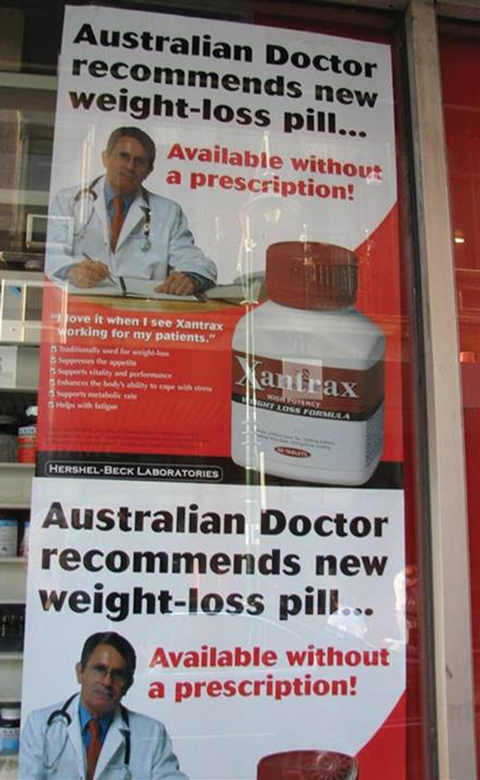 Pharmacy poster for Xantrax.
How could the present situation be improved? We propose the following actions:
AUST L medicines (and homoeopathic medicines) should include on their labels a statement, such as “This medicine has not been evaluated by Australian health authorities for efficacy”.
A campaign to educate the public about such matters is needed. This would best be done by the National Prescribing Service, which is currently conducting a survey of educational needs in relation to CAMs.
Ethical codes of conduct and complaint procedures for CAMs, over-the-counter and prescription drugs should be streamlined, harmonised and brought under one adequately resourced authority. Consistent (and meaningful) sanctions should be imposed on companies that repeatedly breach codes (for example, corrective advertising orders and fines linked to company turnover, with the money used to support the complaint system).
The ARTG database should be updated with respect to listed products. Sponsors should be required to add key evidence supporting each indication on the ARTG and entries should be checked by staff of the regulatory body and coded with respect to therapeutic indication. This information should be publicly available on the Internet.
The TGA should check the analysis of herbal products more thoroughly and allow sponsors to use clinical trial evidence relating to other products only where their own product has been shown to have an identical herbal preparation, extraction and standardisation process.
Finally, we believe that, in the longer term, the listing system should be scrapped, and CAMs (including homoeopathic medicines) should be assessed for efficacy and delisted if evidence is lacking. Public money should be used for this, not listing fees. There is a current perception that 100% cost-recovery by the TGA (as with the Food and Drug Administration in the United States) has led to commercial considerations outweighing the need for consumer protection.22,23
Listed weight-loss products would be a good place to start the regulatory reform, given the increasing problem of obesity in Australia.
1 Contrasting requirements of the Therapeutic Goods Administration (TGA) for different categories of goods
2 Main criteria used by the Therapeutic Goods Administration for listed complementary medicines (with the exception of homoeopathic products)
They may contain only ingredients approved for use in listed medicines (those with well established quality and safety profiles);
They must be labelled and advertised only for indications consistent with low risk (eg, symptomatic relief of non-serious diseases, disorders and conditions) and must not be indicated for the treatment of a serious form of a disease, condition, ailment or defect as specified in the Therapeutic Goods Advertising Code;
There must be evidence (which can be either traditional or scientific), held by the sponsor of the product, to support any claim that the sponsor makes relating to the medicine; and
They do not contain substances that are scheduled in the Standard for the Uniform Scheduling of Drugs and Poisons or otherwise restricted (eg, included in Part 4 of Schedule 4 of the Therapeutic Goods Regulations 1990).
3 Bodies handling complaints about listed products and registered over-the-counter products
4 Xantrax (Hershel-Beck Laboratories), an example of a listed weight-loss product
Camellia sinensis (green tea)
Citrus aurantium fruit (bitter orange)
Paullinia cupana (guarana)
Panax ginseng (Korean ginseng)
Ilex paraguariensis (yerba mate)
11 additional vitamins and minerals
delaying gastric emptying thus prolonging a sense of fullness
suppressing appetite
maintaining healthy energy levels
improving exercise performance
enhancing the body’s ability to cope with stress
supporting healthy metabolism
Competing interests
None identified.
Acknowledgements
We are most grateful for the information provided by officers of the Therapeutic Goods Administration and the Therapeutic Goods Advertising Code Council.
References
- MacLennan AH, Myers SP, Taylor, AW. The continuing use of complementary and alternative medicine in South Australia: costs and beliefs in 2004. Med J Aust 2006; 184: 27-31. 0_i1092069
- CHOICE. Test: slimming pills. http://www.choice.com.au/viewArticle.aspx?id=105065&catId=100232&tid=100008 (accessed Nov 2007).
- Therapeutic Goods Administration. The Therapeutic Goods Administration’s risk management approach to the regulation of therapeutic goods. Version 1. Canberra: Department of Health and Ageing, 2004. http://tga.gov.au/about/tgariskmnt.pdf (accessed Nov 2007).
- Therapeutic Goods Administration. Listed complementary medicines. In: Australian regulatory guidelines for complementary medicines part II (ARGCM). Canberra: Department of Health and Ageing, 2005. http://www.tga.gov.au/docs/html/argcm.htm#argcmp2 (accessed Nov 2007).
- McEwen J. What does TGA approval of medicines mean? Aust Prescriber 2004; 27: 156-158. 0_i1092077
- Expert Committee on Complementary Medicines in the Health System. Report to the Parliamentary Secretary to the Minister for Health and Ageing. Canberra: Commonwealth of Australia, 2003: 22, 115. www.tga.gov.au/docs/pdf/cmreport.pdf (accessed Nov 2007).
- Therapeutic Goods Administration. Submission to the Productivity Commission Review of Cost Recovery by Commonwealth Agencies. Canberra: Department of Health and Ageing, 2000. http://www.pc.gov.au/__data/assets/pdf_file/0019/39250/sub094.pdf (accessed Nov 2007).
- Therapeutic Goods Administration. Summary of fees and charges at 1 July 2007. Canberra: Department of Health and Ageing. http://www.tga.gov.au/fees/fees07.htm (accessed Nov 2007).
- Therapeutic Goods Administration. Making a complaint about advertising. Canberra: Department of Health and Ageing, 2007. http://www.tga.gov.au/docs/html/advcomplaint.htm (accessed Nov 2007).
- Pyne C. Therapeutics products endorsements by doctors to be banned [media release]. Canberra: Department of Health and Ageing, 2007; 7 Feb (CP08/07). http://www.health.gov.au/internet/ministers/publishing.nsf/content/mr-yr07-cp-pyn008.htm (accessed Nov 2007).
- Ioannides-Demos LL, Proietto J, McNeill JJ. Pharmacotherapy for obesity. Drugs 2005; 65: 1391-1418. 0_i1092091
- Egger G, Cameron-Smith D, Stanton R. The effectiveness of popular, non-prescription weight loss supplements. Med J Aust 1999; 171: 604-608. 0_i1092093
- Pittler MH, Ernst E. Complementary therapies for reducing body weight: a systematic review. Int J Obes 2005; 29: 1030-1038. 0_i1092095
- Adverse Drug Reactions Advisory Committee. Adverse reactions to complementary medicines. Aust Adverse Drug React Bull 2005; 24: 1. http://www.tga.gov.au/adr/aadrb/aadr0502.htm (accessed Nov 2007).
- Pittler MH, Schmidt K, Ernst E. Adverse events of herbal food supplements for body weight reduction: systematic review. Obes Rev 2005; 6: 93-111. 0_i1092099
- Therapeutic Products Advertising Complaints. Complaints Resolution Panel determination. Complaint 4-1106 Xantrax. Sydney: Complaints Resolution Panel, 2007. http://www.tgacrp.com.au/index.cfm?pageID=13&special=complaint_single&complaintID=809 (accessed Nov 2007).
- Therapeutic Products Advertising Complaints, Complaints Resolution Panel. Complaints register. Sydney: Complaints Resolution Panel, 2007. http://www.tgacrp.com.au/index.cfm?pageID=13 (accessed Nov 2007).
- Therapeutic Goods Administration. Implementation of the government response to the recommendations of the expert committee on complementary medicine in the health system. Progress report. Canberra: Department of Health and Ageing, 2006. http://www.tga.gov.au/cm/cmreport3.pdf (accessed Nov 2007).
- Therapeutic Goods Administration. Buying medicines: what’s on the label for me? Canberra: Department of Health and Ageing, 2007. http://www.tga.gov.au/docs/html/buymed.htm (accessed Nov 2007).
- Pharmaceutical Society of Australia. Check the evidence before proclaiming a ‘miracle’ [media release]. Sydney: PSA, 2006. http://www.psa.org.au/site.php?id=235 (accessed Nov 2007).
- Jiang B, Kronenberg F, Nuntanakorn P, et al. Evaluation of the botanical authenticity and phytochemical profile of black cohosh products by high-performance liquid chromatography with selected ion monitoring liquid chromatography-mass spectrometry. J Agric Food Chem 2006; 54: 3242-3253. 0_i1092111
- Kmietowicz Z. Repeal law that puts “FDA on the payroll of the industry”, says former NEJM editor. BMJ 2007; 334: 447. http://www.bmj.com/cgi/content/short/334/7591/447-a (accessed Nov 2007).
- Hennessy S, Strom BL. PDUFA reauthorization — drug safety’s golden moment of opportunity? N Engl J Med 2007; 356: 1703-1704. 0_i1092116
Country revealing the way: evaluating Elder‐governed cultural therapy for Aboriginal and Torres Strait Islander young people with mental health conditions
Alasdair Vance, Janet McGaw, Jo Winther, Naomi Tootell, Herb Patten, Sandra Eades
No silver lining with health misinformation: argyria caused by intentional silver consumption
Luke Collins, Logesh Palanikumar, Stephen Bacchi
Hyperkalaemic cardiac arrest due to cream of tartar ingestion
Daniel Yee Lee Ng, Laksmi Govindasamy, Andrew Hughes, Hwee Min Lee
From talk to action: Indigenous Reference Groups drive practice change in kidney transplantation care
Kelli J Owen, Katie Cundale, Jaquelyne T Hughes, Stephen P McDonald, Matilda D'Antoine, Shilpanjali Jesudason
The not‐so‐natural herb: a case of exogenous Cushing syndrome
Yi‐An Pan, David Roberts, Yi‐An Pan, David Roberts
Lead poisoning outbreak from consumption of contaminated Ayurvedic medication
Mark J Ferson, Sinead Flanigan, Toni Cains