




Volume 187 - Issue 2
Every illness is a story
Author: J Jill Gordon
Med J Aust 2007; 187 (2): 132. || doi: 10.5694/j.1326-5377.2007.tb01162.x
Published online: 16 July 2007
Published online: 16 July 2007
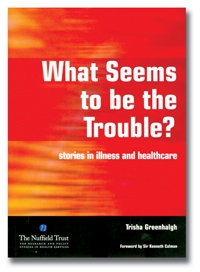
What seems to be the trouble? Stories in illness and healthcare
Trisha Greenhalgh. Oxford: Radcliffe Publishing, 2006 (viii + 112 pp). ISBN 1 84619 122 X.
Her book is not just about individuals. There are stories about systems, too. A chapter on “Stories and organisations” begins with a comment in a hospital visitors’ book. After describing the delays in treatment for his dying father, the writer said, “I am shocked and amazed that you consider the management of my father’s case and the administration of his treatment to be of a good standard”. In the same chapter, a consultant obstetrician tells the story of a teenage girl who froze to death in the grounds of a hospital after being discharged late in the afternoon, following a miscarriage, “Apparently no one — or at least no one on duty at the time — had known that this unfortunate young woman did not have a home to go back to”. The obstetrician was one of a group of health professionals who were opposing an attempt by the National Institute for Clinical Excellence to delete such stories and adopt a more evidence-based approach in their report writing. Facts and figures, the group agreed, are not enough — stories have emotional traction, and emotions drive change.
A chapter on “Stories and research” provides a small dose of narrative theory and some narrative research methods. It’s a bit unnerving to see J K Rowling (author of the Harry Potter childrens’ books) on the same page as Martha Nussbaum (the American philosopher), or to skip from Aristotle to Derrida and Foucault in a book of fewer than 100 pages, but the author has the deft touch of a skilled raconteur. In these and the other chapters on illness, healing, learning and ethics, medical readers will gain practical insights and a better understanding of the narrative approach.
Shifting focus to adolescent wellbeing and inclusive participation in the digital age
Allyson R Todd, Elena Wang, Stephanie R Partridge
The clinical presentation, investigation, and management of women diagnosed with endometriosis in Australian general practices, 2011–2021: an open cohort study
Danielle Mazza, Kailash Thapaliya, Sharinne B Crawford, Alissia Hui, Maryam Moradi, Luke E Grzeskowiak
The impact of the Breast Screen NSW transition from film to digital mammography, 2002–2016: a linked population health data analysis
Rachel Farber, Nehmat Houssami, Katy J L Bell
Non‐technical errors associated with deaths in surgical care, Australia, 2012–2019, by surgical specialty (Australian and New Zealand Audit of Surgical Mortality): a retrospective cohort study
Jesse Ey, Victoria Kollias, Octavia Lee, Kelly Hou, Matheesha Herath, John B North, Ellie Treloar, Suzanne Edwards, Martin Bruening, Adam J Wells, Guy J Maddern
The CURE Asthma roadmap
Gary P Anderson, Anthony Flynn, Phil G Bardin, John D Blakey, Shyamali C Dharmage, Paul Foster, Peter G Gibson, Adam Jaffe, Alan James, Christine R Jenkins, Sundram Sivamalai, Peter D Sly, Guy B Marks, Vanessa M McDonald, Judy Wetttenhall
Evidence from Australian cohort studies about asthma trajectories and transitions across the life course: a narrative review
Caroline Lodge, Xin Dai, Ingrid A. Laing, Michael P Menden, Anthony Flynn, Gary P Anderson, Sarath Ranganathan, Shyamali C Dharmage