




Volume 184 - Issue 5
Understanding the placebo effect
Author: Edzard Ernst
Med J Aust 2006 || doi: 10.5694/j.1326-5377.2006.tb00197.x
Published online: 9 February 2006
Published online: 9 February 2006
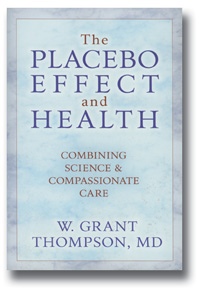
The placebo effect and health. Combining science and compassionate care.
W Grant Thompson. New York: Prometheus Books, 2005 (350 pp). ISBN 1 59102 275 4.
Understanding the placebo effect is difficult. There are, it seems, more definitions on offer than research groups investigating it and all are unsatisfactory in one way or another. Difficulties increase when trying to answer some of the many questions that placebos pose. Do we need placebos to generate a placebo effect? What elements constitute a placebo response? Are placebo effects always beneficial? Are some situations more placebo-prone than others? What ethical implication does the use of a placebo have in research or clinical practice?
Grant Thompson, a clinician, researcher and science writer, addresses these and other questions with analytical clarity. Well read and up-to-date on recent developments, he makes complex things understandable without oversimplifying them. His book is extensively referenced and helped by a detailed index a text that can be used for reference as well as for reading. The story that Thompson develops before his readers eyes is coherent and exciting.
There are of course many books on placebo, but this one is among the better ones in its class. It is not aimed at the specialist researcher nor at the uninformed layperson. For the many people who find themselves between these two extremes The placebo effect and health will be useful. Its strength lies in that it is easy to read, even when the subject matter is complex.
As the placebo effect is responsible for so much of the success of medical interventions, it seems a good idea to know what it is about.
Edzard ErnstDirector, Complementary Medicine Peninsula Medical School, Exeter, UK
Country revealing the way: evaluating Elder‐governed cultural therapy for Aboriginal and Torres Strait Islander young people with mental health conditions
Alasdair Vance, Janet McGaw, Jo Winther, Naomi Tootell, Herb Patten, Sandra Eades
No silver lining with health misinformation: argyria caused by intentional silver consumption
Luke Collins, Logesh Palanikumar, Stephen Bacchi
Hyperkalaemic cardiac arrest due to cream of tartar ingestion
Daniel Yee Lee Ng, Laksmi Govindasamy, Andrew Hughes, Hwee Min Lee
From talk to action: Indigenous Reference Groups drive practice change in kidney transplantation care
Kelli J Owen, Katie Cundale, Jaquelyne T Hughes, Stephen P McDonald, Matilda D'Antoine, Shilpanjali Jesudason
The not‐so‐natural herb: a case of exogenous Cushing syndrome
Yi‐An Pan, David Roberts, Yi‐An Pan, David Roberts
Lead poisoning outbreak from consumption of contaminated Ayurvedic medication
Mark J Ferson, Sinead Flanigan, Toni Cains