




Volume 184 - Issue 5
The MP3 surgeon and the opera fan
Author: Richard H Riley
Med J Aust 2006; 184 (5): 255-256. || doi: 10.5694/j.1326-5377.2006.tb00225.x
Published online: 6 March 2006
Published online: 6 March 2006
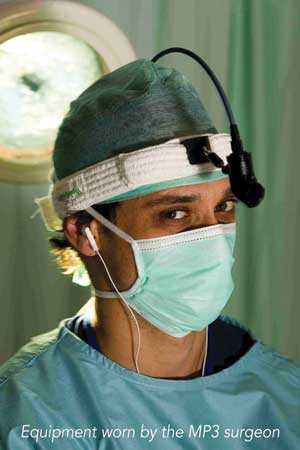 To the Editor: Music is often played in operating theatres, for a variety of reasons. It has been shown to decrease the anaesthetic requirements of patients1 and the autonomic reactivity of surgeons,2 and not to interfere with laparoscopic task performance under non-clinical conditions.3 However, I have witnessed several events that have “pushed back the boundaries” of this common practice.
In one case, a surgeon requested that a videocassette player and monitor be moved into the operating suite before a major operation. Thinking that this might be for educational purposes before use of a new technique, the nursing staff obliged. After the operation was under way, the surgeon directed that a commercial videocassette of an opera be taken from his briefcase and played during the operation. The anaesthetic team were concerned about this, and the video player was turned off when the operation became more difficult.
In another case, a surgeon undertook an operation while listening through ear-bud headphones to low-level music from his digital music player. Before the operation began, the anaesthetist questioned the surgeon about the wisdom of this practice and asked several times if it might interfere with communication or concentration. The operation proceeded without incident with the surgeon listening to his music.
These examples may represent extremes of practice, but they do remind us that we should remain vigilant and not allow developments in entertainment technology to interfere with patient care. Further studies are required to determine the effect of these practices on technical performance and decision-making of surgeons and also communication between staff in the operating suite.
Acknowledgements
I thank Dr Scott Aaronson (model) and Mr Brydon Dunstan (photographer) for their assistance.
References
- Ayoub CM, Rizk LB, Yaacoub CI, et al. Music and ambient operating room noise in patients undergoing spinal anesthesia. Anesthesia Analgesia 2005; 100: 1316-1319.
- Allen K, Blascovich J. Effects of music on cardiovascular reactivity among surgeons. JAMA 1994; 272: 882-884. 0_i1091546
- Moorthy K, Munz Y, Undre S, Darzi A. Objective evaluation of the effect of noise on the performance of a complex laparoscopic task. Surgery 2004; 136: 25-30; discussion, 31. 0_CHDCHEEF
Non-Technical Errors Associated With Deaths in Surgical Care, Australia, 2012–2019, by Surgical Specialty (Australian and New Zealand Audit of Surgical Mortality)
Jesse Ey, Guy J. Maddern
Localised Herpes Simplex Following Midline Laparotomy
Jessica S. Bulluss, Paul Chee, Matthew J. Verheyden
Non‐technical errors associated with deaths in surgical care, Australia, 2012–2019, by surgical specialty (Australian and New Zealand Audit of Surgical Mortality): a retrospective cohort study
Jesse Ey, Victoria Kollias, Octavia Lee, Kelly Hou, Matheesha Herath, John B North, Ellie Treloar, Suzanne Edwards, Martin Bruening, Adam J Wells, Guy J Maddern
Changes in patient management after preoperative MRI for newly diagnosed breast cancer: a multicentre prospective observational study
Michael L Marinovich, Nehmat Houssami, Andrew Spillane, Gregory B Mann, Donna Taylor, Michelle Reintals, Nadine Phillips, Max K Bulsara, Patsy Siok Hwa Soon, Tracey Dickens, Christobel M Saunders
The first Australian evidence‐based guidelines on male infertility
Darren J Katz, Liza O’Donnell, Robert I McLachlan, Tim J Moss, Clare V Boothroyd, Veena Jayadev, Sarah R Catford
The first live term birth following uterus transplantation in Australia
Rebecca Deans, Brigitte Gerstl, Antonia W Shand, Sarah Lyons, Aaron Budden, Helen L Barrett, Grant Luxton, Mangalee Fernando, Kenneth Yong, Karen Keung, Kaushalya Arulpragasam, Henry Pleass, King Man Wan, Eva Kehag, Jana‐Emily Pittman, Mianna Lotz, Maria Fenn, Erin Nesbitt‐Hawes, Lily Byun, Katrina Tang, Mats Brannstrom, Jason Abbott