




Volume 182 - Issue 3
Teaching on the run tips 7: effective use of questions
Authors: Fiona R Lake, Alistair W Vickery and Gerard Ryan
Med J Aust 2005; 182 (3): 126-127. || doi: 10.5694/j.1326-5377.2005.tb06615.x
Published online: 7 February 2005
Published online: 7 February 2005
Setting
When teaching in the clinical setting, you often quiz students, the junior medical officer and registrar on patients they present. Sometimes it works well, sometimes it makes the trainees clam up, sometimes you are not sure it is hitting the mark and wonder what they have learned. You wonder whether there are ways to make questioning more effective.
Your students and trainees learn better when they are involved in the teaching episode,1-3 and an effective way to involve them is to ask questions. By using questions you are able to:
stimulate and engage learners;
find out their learning needs and knowledge level, so that what you teach them is relevant and pitched at an appropriate level;
promote higher-order thinking (ie, clinical reasoning);
monitor how learners are progressing; and
encourage reflection.
Types of questions
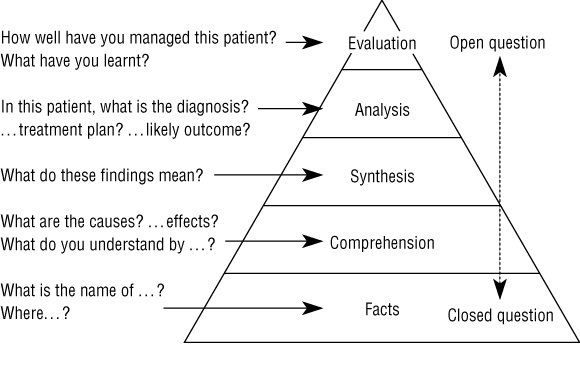
When using questions to test knowledge, we should recognise the concept of a hierarchy of knowledge,4 from low level (facts) to high level (synthesis and analysis) (Box).4,5 The kind of questions used — whether “closed” (ie, requiring a single correct answer) or “open” (requiring the learner to combine pieces of information and formulate an answer) — pitches the discussion at different levels.6 Questions used should be appropriate to the learner’s level of knowledge. However, we should be attempting to promote thinking in all, from the medical student to the registrar.
Promoting higher-order thinking and reasoning
When teaching, clinicians often ask questions aimed at elucidating low level knowledge. In 1933, John Dewey, one of the most influential thinkers on education in the 20th century, proposed that thinking and problem-solving occurred not when answering a question posed by a teacher, but when attempting to solve a problem important to the learner.7 We learn more from what we “don’t know” than what we “do know”. So shifting from asking “What is the cause of . . .?” to “What are you uncertain about?” moves away from simple factual recall and promotes thinking. A strategy to introduce this approach is SNAPPS, as described in “Tips 4”,8 in which the learner probes the teacher about the learner’s areas of uncertainty.
Other types of questions
When questioning a student, involve others by deflecting back to the group to promote thinking (“What do the rest of you think?”). Use questions to clarify points (“Can you explain that again?”) and encourage students to elaborate (“Can you expand on that?”).
Good habits when questioning
Use the learner’s name.
Use the “pose, pause, pounce” technique — pose a question to the group, pause long enough for all the group to consider the answer, then direct it to someone at random.
Spread the questions around to involve everyone — don’t let a few dominate. Start at one end, then the other, and randomly move to the middle. It keeps learners engaged.
Remember that questioning can be intimidating. Provide a supportive atmosphere by being friendly, by encouraging questions and making it clear that any response is acceptable (nothing is “too stupid”).
When you ask a question, don’t get embarrassed by the silence that follows and rush to rephrase it or answer it yourself. Just pause, and they will get embarrassed before you do.
Expect the unexpected. Brief the patient and learners first, because you don’t want to upset patients with an unexpected answer (“cancer”) or embarrass learners if they don’t know.
Remember the principle espoused by David Pencheon, a UK public health doctor: the three most important words in education are “I don’t know”,9 whether they come from the teacher or the learner.
Coping with different levels of learners
In the clinical setting, groups often include students, junior doctors and registrars. The challenge is to involve them all, but teach each at his or her appropriate level. Set the ground rules first, so everyone knows what is expected of them. The most junior learners may be asked to focus on interpreting the history or clinical signs, the most senior on applying evidence-based therapy. Avoid asking a more junior person a question their senior couldn’t answer. Deflect questions from junior staff onto seniors. Get the registrar to explain to the students his or her reasoning.
Take-home message
When using questions:
Be aware that the type of question asked (“open” or “closed”) pitches it at certain levels.
Promote thinking and problem-solving by focusing on what learners don’t know (areas of uncertainty) rather than what they do know (factual recall).
Use names, and then “pose, pause, pounce”.
Clarify, elaborate and deflect.
Establish a supportive environment in which everyone can say “I don’t know”, even the teacher.
Remember that these principles also apply to other settings such as tutorials.10
Competing interests
None identified.
Acknowledgements
We would like to thank the teachers and participants in Teaching on the Run courses for their input, and the Medical Training Review Panel, Australian Department of Health and Ageing, for funding support.
References
- Lake FR, Ryan G. Teaching on the run tips 3: planning a teaching episode. Med J Aust 2004; 180: 643-644. BEIGIFHD
- Kaufman DM. ABC of learning and teaching in medicine. Applying educational theory in practice. BMJ 2003; 326: 213-216.
- Gordon J. ABC of learning and teaching in medicine. One to one teaching and feedback. BMJ 2003; 326: 543-545. i1085733
- Miller GE. The assessment of clinical skills/competence/performance. Acad Med 1990; 65(9 Suppl): S63-S67. i1085735
- Peyton JWR, Allery L. Setting objectives. In: Peyton JWR, editor. Teaching and learning in medical practice. Rickmansworth, UK: Manticore Europe Limited, 1998: 57-67. i1085737
- Douglas CK, Hosokawa MC, Lawler FH. Learning in the clinical setting. In: A practical guide to clinical teaching in medicine. New York: Springer, 1988: 7-18. i1085739
- Connell KJ, Bordage G, Chang RW, et al. Measuring the promotion of thinking during precepting encounters in outpatient settings. Acad Med 1999; 74(10 Suppl): S10-S12. i1085741
- Lake FR, Ryan G. Teaching on the run tips 4: teaching with patients. Med J Aust 2004; 181: 158-159. i1085743
- Smith R. Thoughts for new medical students at a new medical school. BMJ 2003; 327: 1430-1433. i1085745
- Jaques D. ABC of learning and teaching in medicine. Teaching small groups. BMJ 2003; 326: 492-495. i1085747