




Volume 181 - Issue 1
Emergency response to the Canberra bushfires
Authors: Drew B Richardson and Sashi Kumar
Med J Aust 2004; 181 (1): 40-42. || doi: 10.5694/j.1326-5377.2004.tb06159.x
Published online: 5 July 2004
Published online: 5 July 2004
On 18 January 2003, Canberra experienced major bushfires. Over 6 hours, The Canberra Hospital Emergency Department treated 139 patients, 105 with fire-related problems (mostly ophthalmological and respiratory), representing an additional workload of one patient every 4 minutes above average. Only 15% required hospital admission. We believe this is the largest single emergency department response to a disaster since Cyclone Tracy devastated Darwin in 1974, although the total severity of injury was relatively low. Major issues were communication difficulties and transport, with most patients (including the two most critically ill) arriving by private vehicle. Overall, medical outcomes were excellent, and the hospital system coped well.
On Saturday, 18 January 2003, bushfires hit Canberra, the national capital of Australia. Driven by hot westerly winds, wildfire swept through most of the urban bushland in the southern suburbs, crossed the bush–urban interface, and penetrated deeply into the westernmost urban area, destroying 501 homes and causing four deaths (Box 1). We describe the response at The Canberra Hospital, which is the regional major trauma service and the community hospital for the southern suburbs of the city.
1 Canberra, 18 January 2003
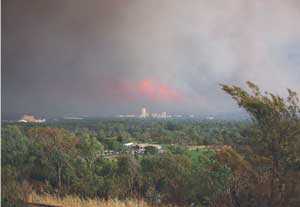
View south-west from Red Hill, showing fires burning on Mount Taylor, within the southern suburbs of Canberra. Woden Town Centre is in the centre of the skyline, with The Canberra Hospital on the left. (Photo courtesy of Brian Gunning, published at http://canberrafires.xsnet.org.)
Canberra, in the Australian Capital Territory, is a planned city with a population of about 300 000. It is roughly divided into northern and southern sections by Lake Burley Griffin and features large tracts of bushland within urban areas. The Canberra Hospital is one of two public hospitals in the city. It is a modern, tertiary hospital of 483 beds, of which 362 were nominally available, and an Emergency Department (ED) which treats 52 000 adult and paediatric patients annually. The hospital has a regularly reviewed external disaster plan, which had been tested in a tabletop exercise 2 months before the bushfires. That exercise concerned a bombing causing multiple burns, but, like previous exercises, involved multiple casualties from one site rather than the effects of a geographically extensive disaster.
The fires caused more property damage than any single recorded Australian fire except that at Mount Macedon in Victoria on “Ash Wednesday” (16 February 1983), when 628 homes and seven lives were lost.1 However, there were multiple fires at multiple sites on Ash Wednesday, as well as in Tasmania on 7 February 1967, which caused much more damage overall than the Canberra fires. ACT police took an aggressive approach to evacuation, which contributed to an extremely low ratio of deaths to property damage (Box 2).
The Canberra Hospital responseOn the basis of available information, the ED staff specialist activated the “Standby Code Brown” (external disaster) procedure at 14:30 on 18 January. The Chief Minister of the ACT declared a state of emergency at 14:45.2 The first patient with a major fire-related presentation (exacerbation of chronic lung disease) arrived at 15:35, and the first patient with burns at 16:30.
At 17:00, “Code Brown” was activated in response to three events in rapid succession: unexpected radio communication from a helicopter about to land with three injured fire fighters, loss of all computing facilities due to network outage, and loss of the power supply to the medical imaging department. Disaster mode was maintained until 09:00 the next morning.
Patients
The patients treated at The Canberra Hospital represented all the cases of serious injury and most cases of significant injury from the fires. Minor injuries were treated by general practitioners in private surgeries and evacuation centres, and almost no fire-related cases were seen at Calvary Hospital, the public hospital on the north side of Canberra, during the first day.
Our description of patients is based on data from the Emergency Department Information System (EDIS), medical records, and the debriefing process. As part of the response, clerical staff identified disaster-related cases on arrival; these were later audited by the authors and other ED staff. Usually, the relationship to the fires was obvious, but, in doubtful cases, the definition was a clinical decision that the patient would not have presented had the fires not occurred.
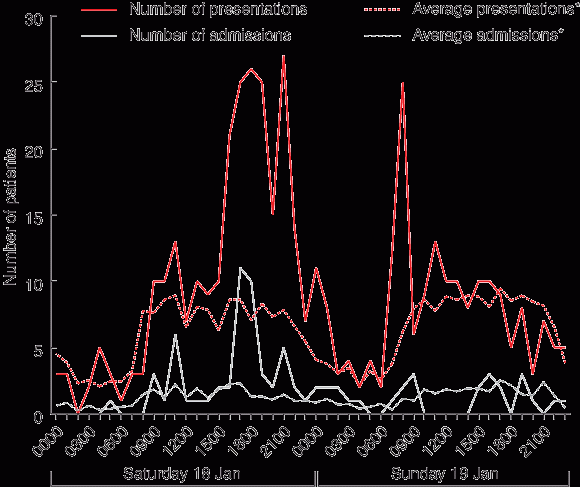
Over the 6 hours from 16:00 to 22:00, the ED treated 139 patients, 105 of whom had fire-related problems (Box 3). This represents 90 more patients than average, or one additional patient every 4 minutes. As in similar Australian fires, respiratory and ophthalmological problems were more prevalent than burns3,4 (Box 4). Only two patients required transport to interstate burns centres, and there were no deaths in hospital.
Unlike many disasters, a significant feature was the continuation of “background” ED workload (Box 5). Even during the critical 6 hours, there were 34 non-fire-related presentations, and the expected fall in other workload did not occur until the following day. There was little opportunity to divert patients elsewhere, as The Canberra Hospital is the major tertiary hospital in the region and offers the only paediatric, acute orthopaedic, neurosurgical and major trauma services.
Twenty-one people presented requesting supplies of their usual medications, as their homes had been destroyed or were inaccessible. These requests were concentrated in the first 16 hours. Medications commonly required were insulin, antipsychotics, antihypertensives and home oxygen. This was also reported as a major problem by a general practitioner (GP) working in one of the evacuation centres. The hospital’s GP liaison was contacted about this problem on the morning after the fires, after which GPs visited the evacuation centres and provided prescription and other services.
Staffing
The fires occurred during school holidays and the hospital’s medical changeover period, when junior staff move to new positions, often interstate. Many regular staff were out of the city, and many of the previous year’s staff had already left.
During the disaster, the ED medical workforce was boosted by staff working overtime and by 14 staff not rostered to the ED that day, including four from outside the hospital. Some of the staff contacted were unable to attend because of fire in or near their homes, and some responded without returning home, working while unsure whether their properties had survived. A major contribution was also made by a small number of relevant hospital specialists (plastic surgery, general surgery, respiratory medicine) and outsiders, including an emergency physician who travelled from Sydney.
Issues and lessons
The major issues that became apparent from the disaster were transport and communication difficulties, both of which are well recognised.
Use of private transport: Sixty percent of disaster patients and 30% of those who required hospital admission arrived by private vehicle (including the two most critically ill). Although this made little difference to the hospital response on this occasion, it might be a major problem when multiple hospitals are involved, and pre-hospital personnel have the task of balancing workload between institutions. The experience was similar in the Granville rail disaster (1977)5 and Cyclone Tracy,6 and had been specifically predicted as a problem in the most recent Canberra Hospital disaster exercise.
The high use of private transport during this disaster is an important lesson for the national capital, where exposure to chemical, biological or radiological weapons is considered a real threat. As there appears to be no realistic prospect of containing an exposed population, services must plan around patients presenting by private transport and requiring decontamination at hospitals.7
Communication difficulties: Communication was hampered by disruption of the mobile phone network, and also by the lack of a television, radio or adequate mobile phone coverage in the disaster control room, which was therefore moved to a more appropriate location. It should perhaps be noted that mobile phones were not a significant means of communication when the disaster plan was last activated (the landslide at the Thredbo ski resort, 19978). Communication lines with the ACT Emergency Control Centre remained open, but little or no information relevant to the hospital response was available, as the Emergency Services Bureau experienced significant command and control problems.2 In addition, it was found that the key hospital staff were unfamiliar with the two-way radios provided as part of the disaster plan, and that there was no STD telephone in the room designated for relatives, both of which increased the load on the hospital switchboard.
Electricity supply: Fluctuations in the electricity supply caused by the fires led to frequent power outages. In retrospect, the hospital should have continued to use its emergency generators until the disaster was over.
Operating theatre standby for “major cases”: All non-urgent surgery was cancelled, and operating theatres set up to receive “major cases”. This proved unnecessary, as no such cases presented, and also significantly delayed surgery, particularly acute orthopaedic surgery, increasing hospital bed use.
Emergency department triage officer: Within the ED, it was found that experienced triage nurses provided a more appropriate triage service than the ED registrars designated in the disaster plan. While senior medical input may be required (for example, when a decision is needed about withholding care because of “expectant death”), triage and other tasks should generally be allocated to the most experienced staff.
External liaison: A need for prescription and other GP services at evacuation centres became apparent. GP after-hours services should be opened early, and GPs should be asked to attend evacuation centres early in the course of a disaster.
Photographic documentation: A less important failure was the lack of any photographic documentation of the disaster response for historical and teaching purposes. Although volunteers, such as medical students, were available, none were allocated to “camera duty”.
Hospital evacuation: Fire came to within 2 km of the hospital campus (Box 1), but little thought was given to the possibility that it might reach the hospital. Although unlikely, this is a potentially catastrophic event which should be included in future planning. In light of The Canberra Hospital experience, detailed plans were drawn up for the evacuation of Calvary Hospital when fire threatened the northern suburbs of Canberra a few days later.
Conclusions
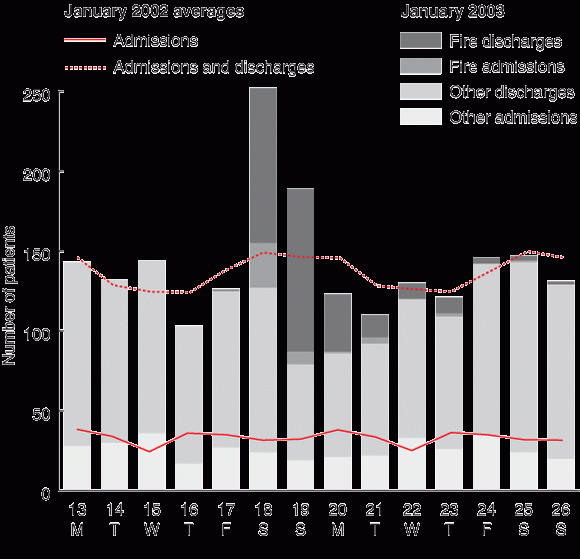
By definition, a disaster is an event that overwhelms available resources. Many internal and external hospital disasters have been described, with different workloads falling on a range of hospital services. In this case, the major burden clearly fell on the ED. The overall ED workload on 18 January was 252 presentations, almost 7 standard deviations above the daily mean of 137 for the period 1998–2002. However, the number of admissions (52) was less than 3 standard deviations above the mean for this period (34), and, measured by admissions, this was only the 14th-busiest day in the past 5 years.
To our knowledge, this is the highest number of patient presentations from a single event treated in one ED since Cyclone Tracy devastated Darwin in 1974.3,5,6,9 It represents one of the largest responses to a disaster ever by a single Australian hospital, although injuries were less severe overall than in many other disasters.
Overall, The Canberra Hospital coped well, despite significant disruption of staffing and infrastructure. Disaster conditions exposed some weaknesses in previous planning, particularly patient transport and the possibility of hospital evacuation, but the medical outcomes of the response were excellent. Most of the problems which occurred involved interdepartmental or interagency issues.
2 Significant single urban or rural fires in Australia in the past 40 years1
Date |
Location |
Deaths |
Homes lost |
Ratio |
|||||||
16 Feb 1983 |
Mt Osmond, SA |
9 |
100 |
1:11 |
|||||||
16 Feb 1983 |
Beaconsfield, VIC |
21 |
238 |
1:11 |
|||||||
7 Feb 1967 |
Hobart, TAS |
20 |
310 |
1:16 |
|||||||
14 Jan 1964 |
Dandenong, VIC |
8 |
454 |
1:57 |
|||||||
16 Feb 1983 |
Mt Macedon, VIC |
7 |
628 |
1:90 |
|||||||
8 Jan 1994 |
Como, NSW |
1 |
101 |
1:101 |
|||||||
18 Jan 2003 |
Canberra, ACT |
4 |
501 |
1:133 |
|||||||
4 Major fire-related presentations at The Canberra Hospital, 18–19 January 2003
Condition |
Presentations |
Admissions |
|||||||||
Breathing problems/smoke inhalation |
65 |
10 |
|||||||||
Eye problems (irritation, ulcer, foreign body) |
43 |
0 |
|||||||||
Trauma (falls and motor vehicle) |
45 |
6 |
|||||||||
Burns |
24 |
10 |
|||||||||
Medication issues* |
21 |
0 |
|||||||||
Accommodation and chronic disease† |
5 |
5 |
|||||||||
Other |
30 |
5 |
|||||||||
Total |
233 |
36 |
|||||||||
*Supply of usual medications required by people unable to return home. † Person with chronic disease requiring emergency accommodation. |
|||||||||||
Competing interests
None identified.
References
- Cheney NP. Bushfires – an integral part of Australia’s environment. Year Book Australia 1995. Canberra: Australian Bureau of Statistics, 1995. (Catalogue No. 1301.0.) i1085573
- McLeod R. Inquiry into the operational response to the January 2003 bushfires in the ACT. Canberra: Australian Capital Territory Government, 2003. Publication No 03/0537. i1085575
- Bacon AK. Medical aspects of the “Ash Wednesday bushfires”. Aust Fam Phys 1983; 12: 838-839. i1085577
- Rogers JS. Ophthalmological aspects of the bush fire tragedy in Hobart and surrounding districts. Med J Aust 1967; 1: 461-462. i1085579
- Christopher PJ, Selig M. Medical aspects of the Granville rail disaster. Med J Aust 1977; 2: 383-386. i1085581
- Gurd CH, Bronwich A, Quinn JV. The health management of Cyclone Tracy. Med J Aust 1975; 1: 641-644. i1085583
- Greenberg MI, Hendrickson RG. Report of the CIMERC/Drexel University Emergency Department Terrorism Preparedness Consensus Panel. Acad Emerg Med 2003; 10: 783-788. i1085585
- Harris RD. Medical log: forward command Thredbo. Med J Aust 1997; 167: 627-629. i1085587
- Carr VJ, Lewin TJ, Carter GL, Webster RA. Patterns of service utilisation following the 1989 Newcastle earthquake: findings from phase 1 of the Quake Impact Study. Aust J Public Health 1992; 16: 360-369. i1085589
‘Once Bitten’: A Case of Tetanus Following Snakebite in Australia
Adrian A. S. Doherty, Naomi N. E. Clarke, Sarah Fletcher, Sarah Huffam, Camille V. Awburn, Eugene Athan
Epidemiology and Quality of Care for Aboriginal and Torres Strait Islander Peoples Treated by Emergency Medical Services for Stroke in Victoria, Australia: Retrospective Analysis of Linked Data
Candice Menezes, Ziad Nehme, Luke J. Burchill, Tegwyn McManamny, Angela Dos Santos, Michelle Crilly, Luke P. Dawson, Benjamin Clissold, David Anderson, Emily Nehme
Intranasal Adrenaline Use for the Management of Insect Venom-Induced Anaphylaxis
Thomas J. Young, Wilhelmina R. F. Johnson, Braydon L. Pennington, Troy Wanandy, Wun Y. Lau, Thanh-Thao A. Le
Gabapentinoid Poisoning Presentations to Victorian Emergency Departments: A 15-Year Trend Analysis
Bishaal Tej Gurung, Amy McNeilage, Angus Skeen, Tina Lam, Joanna F. Dipnall, Jane Hayman, Suzanne Nielsen, Ting Xia
They Brought the Hospital to Me
Hugh N. Burrill
Predictors of Ambulance Transport to Hospital for Older People Living in Tasmanian Aged Care Facilities: A Retrospective Cohort Study
Sharon Andrews, Pieter F. Fouche, Belinda Flanagan, Michael McDermott, Melanie Greenwood