




Volume 180 - Issue 3
Surveillance for Barrett’s oesophagus: if you do it, do it properly
Authors: Gautam Ramnath and Peter Bampton
Med J Aust 2004; 180 (3): 139-140. || doi: 10.5694/j.1326-5377.2004.tb05840.x
Published online: 2 February 2004
Published online: 2 February 2004
Gautam Ramnath,* Peter Bampton†
* Gastroenterology Registrar, † Head of Endoscopy, Department of Gastroenterology and Hepatology, Flinders Medical Centre, Bedford Park, SA 5042. peter.bamptonATflinders.edu.au
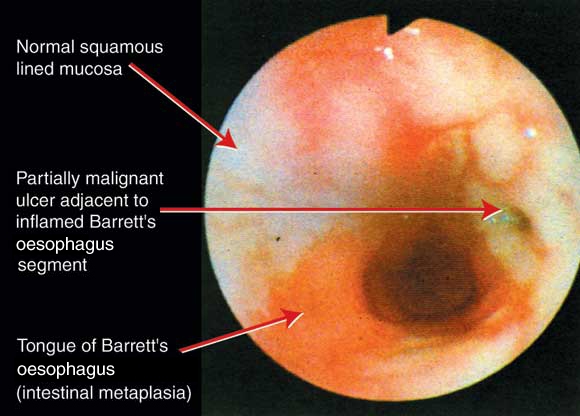
To the Editor: Reflux oesophagitis is an increasingly common medical condition, and up to 10% of all patients with reflux oesophagitis have associated columnar-lined oesophagus, or Barrett’s oesophagus (Box 1).1 This is associated with an increased risk of adenocarcinoma in Australian data of 1 in 176 patient-years.2 Current surveillance guidelines for Barrett’s oesophagus recommend second-yearly endoscopy with quadrantic biopsies at 2–3 cm,3,4 although recent reviews have suggested that the time interval can be extended.1 No prospective study has demonstrated that screening for Barrett’s oesophagus improves survival in the screened population. All the evidence is based on retrospective reviews. If, however, screening is to be of benefit, then adequate tissue sampling is required, otherwise the screening test provides false reassurance and is a poor use of endoscopy resources.
We retrospectively audited the endoscopies performed for Barrett’s oesophagus (with intestinal metaplasia) surveillance at our institution over 5 years (1996–2001). In this period, 253 endoscopies were performed as surveillance procedures for Barrett’s oesophagus. We reviewed the endoscopy and histopathology reports to determine whether an adequate number of biopsies had been taken.
We found that quadrantic biopsies (defined as four biopsies per 2 cm or less) at every 2–3 cm were performed in 27 of 72 (38%) short-segment, 27 of 150 (25%) long-segment (3–10 cm), and 1 of 13 (8%) extensive (> 10 cm) Barrett’s oesophagus. An acceptable number of biopsies were taken from 40% of patients. The number of biopsies taken per centimetre of Barrett’s oesophagus was inversely proportional to the length of Barrett’s oesophagus.
The median interval between surveillance procedures was 12 months. In most surveillance procedures (137/217; 63%) the endoscopy was performed following medical review in the outpatient department rather than because of planned call-back, although in only a few cases did it appear to be due to alarm symptoms such as dysphagia or weight loss. There was little consistency in recommendations among the medical staff. Only one cancer was identified through surveillance in this period, with another presenting in a patient previously on the call-back system who had been lost to follow-up. Three high-grade dysplasias were found.
Our retrospective audit revealed that the endoscopists were not following biopsy guidelines, and revealed significant variances in practice. Previously, we found a similar picture with post-polypectomy surveillance; with re-education and development of a prospective review of all cases, we have been able to greatly improve this aspect of practice.5
We were surprised at the result of our audit, and invite other endoscopy units to perform a similar audit of their own practice. It has encouraged us to develop a process similar to the one we have adopted to improve post-polypectomy surveillance. This should improve our practice and enable more efficient utilisation of the endoscopy facility.
References
- Spechler S. Clinical practice. Barrett’s esophagus. N Engl J Med 2002; 346: 836-842.
- Hillman LC, Chiragakis L, Clarke AC, et al. Barrett’s esophagus: macroscopic markers and the prediction of dysplasia and adenocarcinoma. J Gastroenterol Hepatol 2003; 18: 526-533. i1082900
- Sampliner RE. Practice guidelines on the diagnosis, surveillance, and therapy of Barrett’s esophagus. The Practice Parameters Committee of the American College of Gastroenterology. Am J Gastroenterol 1998; 93: 1028-1032. i1082902
- Digestive Health Foundation. Gastro-oesophageal reflux in adults — a guideline for clinicians. 3rd ed. Sydney: Gastroenterological Society of Australia, 2001: 18-19. i1082904
- Bampton PA, Sandford JJ, Young GP. Applying evidence-based medicine improves use of colonoscopy resources in patients with a moderate risk of colorectal neoplasia. Med J Aust 2002; 176: 155-157. <eMJA full text>
Early-Onset Colorectal Cancer With Liver-Only Metastases: A Retrospective Cohort Study Integrating Prospectively Collected Real-World Clinical and Molecular Data From an Australian National Database (2009–2024) to Guide Treatment Planning
Savio G. Barreto, Christos S. Karapetis, Shahid Ullah, Matthew Burge, Susan Caird, Angus Campbell, Azim Jalali, Ross Jennens, Muhammad A. Khattak, Belinda Lee, Stephanie H. Lim, Shehara Mendis, Louise Nott, Timothy J. Price, Jeremy D. Shapiro, Jeanne Tie, Javier Torres, Colin Williams, Rachel Wong, Vanessa Wong, Peter Gibbs
Australian Pathways for Specialist Pain Management and Early Palliative Care for People With Pancreatic Cancer: Developed Using a Community Consensus Approach
Jennifer Philip, Melanie R. Lovell, Kylee Bellingham, Gail Garvey, Gregory B. Crawford, Nicole M. Rankin, Kara Burns, Isabel Young, Vivienne Milch, Dorothy Keefe, Katrina Anderson, James Lawson, Meinir Krishnasamy
Cause‐specific mortality among Queensland people with cirrhosis, by cirrhosis aetiology and decompensation status, 2007–22: a retrospective cohort study
Vikas Bhasker, Jessica R Fong, Paul J Clark, Gunter F Hartel, Richard Skoien, James O’Beirne, Elizabeth E Powell, Patricia C Valery
Clinical practice guidelines for hepatocellular carcinoma surveillance for people at high risk in Australia: summary of recommendations
Jacob George, Nicole L Allard, Stuart K Roberts, Leon A Adams, Jane Davies, Behzad Hajarizadeh, Jennifer H MacLachlan, Suzanne E Mahady, Rosalie Altus, Catherine Brown, David C Fry, Belinda Greenwood‐Smith, Natali Smud, Patricia C Valery, Nafisa Yussf, Kate Broun, Denise Campbell, Karen Canfell, Chelsea Carle Harrison, Victoria Freeman, Paul Grogan, Catherine Holliday, Suzanne Hughes, Anna Kelly, Cathelijne Kemenade, Claire Latumahina, Amanda McAtamney, Megan Varlow, Joachim Worthington, Susan Yuill, Eleonora Feletto
Assessment of metabolic dysfunction‐associated fatty liver disease in primary care: a consensus statement summary
Leon A Adams, William W Kemp, Kate R Muller, Elizabeth E Powell, Stuart K Roberts, Luis Calzadilla Bertot, Stephanie Best, Gary Deed, Jon D Emery, Samantha L Hocking, Graham R Jones, John S Lubel, Sinead Sheils, Stephen M Twigg, Gerald F Watts, Jacob George
Treatment outcomes for people with hepatitis C referred to tertiary care in Victoria, 2021–22: a retrospective observational study
Elly Layton, Nicole Matthews, Brendan Quinn, Nasra Higgins, Gabrielle Lindeman, Mielle Abbott, Jennifer MacLachlan, Elizabeth Birbilis, Margaret E Hellard, Joseph Doyle, Benjamin C Cowie, Mark Stoové