




Volume 177 - Issue 10
Randomisation in clinical trials
Authors: Elaine M Beller, Val Gebski and Anthony C Keech
Med J Aust 2002; 177 (10): 565-567. || doi: 10.5694/j.1326-5377.2002.tb04955.x
Published online: 18 November 2002
Published online: 18 November 2002
Randomisation is the process of assigning clinical trial participants to treatment groups. Randomisation gives each participant a known (usually equal) chance of being assigned to any of the groups. Successful randomisation requires that group assignment cannot be predicted in advance.
Why randomise?
If, at the end of a clinical trial, a difference in outcomes occurs between two treatment groups (say, intervention and control) possible explanations for this difference would include:
the intervention exhibits a real effect;
the outcome difference is solely due to chance; or
there is a systematic difference (or bias) between the groups due to factors other than the intervention.
Randomisation aims to obviate the third possibility. Allocation of participants to specific treatment groups in a random fashion ensures that each group is, on average, as alike as possible to the other group(s). The process of randomisation aims to ensure similar levels of all risk factors in each group; not only known, but also unknown, characteristics are rendered comparable, resulting in similar numbers or levels of outcomes in each group, except for either the play of chance or a real effect of the intervention(s).
Statistical analyses of clinical trials assume that randomisation was used and was "successful". The analytic tests used give the likelihood of chance explaining a difference of at least the magnitude observed. If this likelihood is small, we conclude that the observed difference was due to a real effect of the intervention. Successful randomisation allows for valid statistical interpretation of "raw" results (ie, estimates that are unadjusted for other patient characteristics). However, successful randomisation does not guarantee perfect balance in risk factors between groups (due to the play of chance), so adjusted analyses can also help in further interpretation of outcome results.
In a clinical trial report, it is important to document that random allocation of treatment assignment was successfully achieved. The CONSORT statement1 suggests that the sequence generation, allocation concealment and implementation be reported (Box 1).
Sequence generation
Simple randomisation
Simple randomisation is the most basic method of random treatment assignment. This can be thought of as tossing a coin for each trial participant, A being allocated with "heads", B with "tails". However, it is not usually performed using a real coin-toss, as issues of concealment, validation and reproducibility arise (see below). Simple randomisation is usually achieved using a sequence of random numbers from a statistical textbook, or a computer-generated sequence.
Permuted block randomisation
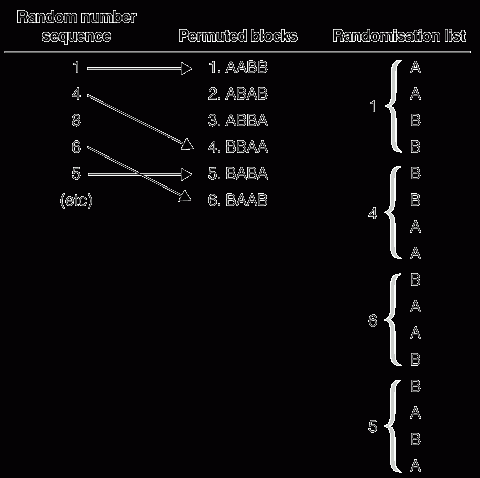
In a large trial (at least 1000 subjects), simple randomisation should give a balance in number of patients allocated to each of the groups in the trial, but for a "small" study the numbers allocated to each group may not be well balanced. In small trials, to maintain good balance, blocked randomisation may be used. "Blocks" having equal numbers of As and Bs (A = intervention and B = control, for example) are used, with the order of treatments within the block being randomly permuted (Box 2). A block of four has six different possible arrangements of two As and two Bs.2,3 A random number sequence is used to choose a particular block, which sets the allocation order for the first four subjects. Similarly, treatment group is allocated to the next four patients in the order specified by the next randomly selected block. The process is then repeated. Permuted block randomisation ensures treatment group numbers are evenly balanced at the end of each block.
Stratified allocation
Stratified block randomisation can further restrict chance imbalances to ensure the treatment groups are as alike as possible for selected prognostic variables or other patient factors. A set of permuted blocks is generated for each combination of prognostic factors. For example, in a trial of chemotherapy for breast cancer, suitable stratification factors might be menopausal status and oestrogen-receptor status. A set of permuted blocks is generated for those women who are premenopausal and oestrogen-receptor negative, another set for those who are premenopausal and oestrogen-receptor positive, and so on. Stratification can add to the credibility of a trial, as it ensures treatment balance on these known prognostic factors, allowing easy interpretation of outcomes without adjustment.
Dynamic (adaptive) random allocation methods
Simple and block randomisation methods are defined, and allocation sequences set up, before the start of the trial. In contrast, dynamic randomisation methods allocate patients to treatment group by checking the allocation of similar patients already randomised, and allocating the next treatment group "live" to best balance the treatment groups across all stratification variables. Minimisation3 is one such method, and can be implemented using a manual card system, but dynamic methods are best implemented on computer (Box 3).
Inappropriate randomisation methods
Methods of allocation such as alternate allocation to treatment group, or methods based on patient characteristics such as date of birth, order of entry into the clinic or day of clinic attendance, are not reliably random. Such allocation sequences are predictable, and not easily concealed, thus reducing the guarantee that allocation has indeed been random, and that no potential subjects have been excluded by foreknowledge of the intervention.
Concealment of the allocation process
It is very important that those responsible for recruiting people into a trial are unaware of the group to which a participant will be allocated, should that subject agree to be in the study. This avoids both conscious and unconscious selection of patients into the study. "Allocation concealment" is the term used to describe this process and underpins successful randomisation strategies.4,5 For multicentre clinical trials, central randomisation by telephone, interactive voice response system, fax or the Internet are ideal methods for allocation concealment. The clinician or data manager at the participating site assesses eligibility, gains consent, and makes the decision to enrol a patient, then calls the randomisation service to get the treatment allocation. Central randomisation also enables trial coordinators to monitor randomisation rates, and have a record of all allocated patients for potential follow-up.
For single-centre clinical trials, it is usually possible to identify a staff member not involved with the trial who can keep the randomisation list or envelopes, preferably in a location away from the clinic or ward where patients are being assessed. For example, pharmacy staff may be able to undertake randomisation. They should be instructed to keep the list private, and to only reveal a treatment allocation after receiving information demonstrating that the patient is eligible and has consented to the trial.
In situations where remote randomisation may not be feasible or desirable, a set of tamper-evident envelopes may be provided to each participating site. The envelopes should look identical, and each should have the trial identification and a sequential number on it. Inside is the treatment allocation and usually a trial identifier for the patient (eg, unique sequential number). After assessing eligibility and consent, as described above, the next envelope in sequence is opened. Care needs to be taken that the envelopes are opaque and well sealed, and that the sequence of opening the envelopes is monitored regularly. For example, the patient identifiers could be written on the envelope, and the contents of the envelope, along with the date and time of randomisation, transcribed to the randomisation form where eligibility assessment was recorded. Stratified randomisation is still possible using randomisation envelopes by having a set of envelopes for each combination of stratification factors. A screening log should be considered to help ensure that eligible patients were not missed, and were not excluded on the basis of study staff somehow knowing the next treatment allocation.
Concealment through sequence generation
Allocation concealment may be thwarted by an inappropriate choice of randomisation sequence generation. For example, a permuted block design with a fixed block size of four, in an unblinded study6 where treatment group is revealed at the time of randomisation, may make it easy to predict the next allocation once three patients have been randomised. For this reason, details of block size should not be revealed to investigators or other study staff. A varying block size can also be used (eg, blocks of size 4, 6 and 8 randomly arranged). Dynamic allocation methods provide a more secure method of allocation concealment.
Implementation
The trial statistician (or others not directly involved in recruiting patients to the trial) commonly generates the randomisation sequence. Methods that allow a permanent record of the sequence created are important to validate its randomness later if required (whereas a coin toss can be replaced without record). A clinical trial report should clarify who generated the sequence, the method used, and how concealment was achieved and monitored. There should be some demonstration that randomisation was successful. This is usually achieved by providing a table in a report comparing the major baseline demographic and prognostic characteristics of the two treatment groups.
1: CONSORT checklist of items to include when reporting a trial1
Section and topic |
Item no. |
Descriptor |
|||||||||
Methods |
|||||||||||
Randomisation |
|||||||||||
Sequence generation |
8 |
Method used to generate the random allocation sequence, including details of any restriction (eg, blocking, stratification) |
|||||||||
Allocation concealment |
9 |
Method used to implement the random allocation sequence (eg, numbered containers or central telephone), clarifying whether the sequence was concealed until interventions were assigned |
|||||||||
Implementation |
10 |
Who generated the allocation sequence, who enrolled participants, and who assigned participants to their groups |
|||||||||
2: The permuted block method of randomisation for a block size of four, with A and B being treatment groups (A = intervention and B = control, for example)
A random number sequence is generated from a statistical textbook or computer. Each possible permuted block is assigned a number (1 to 6 in the above example). Using each number in the random number sequence in turn selects the next block, determining the next four participant allocations. Numbers in the random number sequence greater than the number of permuted block combinations (7, 8, 9 and 0 in the above example) are not used to select blocks.
3: Example of randomisation using the minimisation method in a trial of chemotherapy for breast cancer, with stratification factors of clinic site, oestrogen receptor status (ER+ or ER–) and menopausal status
Status after 34 participants have been randomised to the trial
Characteristic |
Treatment A |
Treatment B |
|||||||||
Site 1 |
7 |
8 |
|||||||||
Site 2 |
10 |
9 |
|||||||||
ER+ |
5 |
6 |
|||||||||
ER– |
12 |
11 |
|||||||||
Premenopausal |
8 |
9 |
|||||||||
Postmenopausal |
9 |
8 |
|||||||||
Total |
17 |
17 |
|||||||||
The next participant (no. 35) is from Site 2, ER+, postmenopausal. Subtotals for treatment allocation to this profile of characteristics are 10 + 5 + 9 = 24 for Treatment A and 9 + 6 + 8 = 23 for Treatment B (note subjects are counted more than once). Participant no. 35 would therefore be allocated to Treatment B. When the tallies on A and B are equal within a profile, the next participant is randomly allocated. This process is equivalent to a permuted block size of two within the profile. |
|||||||||||
4: Checklist for choosing a randomisation strategy
How many subjects and clinical sites are planned?
Are 24-hour randomisation services required?
How will randomisation be implemented: central, remote local, bedside?
Who will generate the sequence and by which method: random number lists, computer?
Is a stratified or simple randomisation needed?
If stratified, how many strata and levels within each stratum are required?
What balancing strategy should be chosen: simple, permuted blocks, minimisation?
What measures will be taken to guarantee allocation concealment?
Who is going to monitor successful implementation (the balance of treatment allocation, unblinding rates) during recruitment?
Should a screening log of eligible subjects be collected to ensure patients are not excluded by foreknowledge of treatment allocation?
Queensland Clinical Trials Centre, University of Queensland, Herston, QLD.
Elaine M Beller, MAppStat, Director of Biostatistics.NHMRC Clinical Trials Centre, University of Sydney, Camperdown, NSW.
Val Gebski, MStat, Principal Research Fellow; Anthony C Keech, FRACP, MScEpid, Deputy Director.Correspondence: Associate Professor Anthony C Keech, NHMRC Clinical Trials Centre, University of Sydney, Locked Bag 77, Camperdown, NSW 1450. enquiryATctc.usyd.edu.au
AntiSpam note: To avoid spam, authors' email addresses are written with AT in place of the usual symbol, and we have removed "mail to" links. Replace AT with the correct symbol to get a valid address.
References
- Moher D, Schulz KF, Altman DG. The CONSORT statement: revised recommendations for improving the quality of reports of parallel group randomized trials. Ann Intern Med 2001; 134: 657-662. i1067547
- Keech A. Random allocation. Introduction to clinical trials. Clinical trials research methodology. Statistical methods in clinical trials. The ICH GCP guidelines. Hong Kong: The Clinical Trials Centre, 1998. i1067549
- Pocock S. Clinical trials. A practical approach. New York: John Wiley, 1984. i1067551
- Schulz KF, Chalmers I, Hayes RJ, Altman DG. Empirical evidence of bias. Dimensions of methodological quality associated with estimates of treatment effects in controlled trials. JAMA 1995; 273: 408-412. i1067553
- Moher D, Pham B, Jones A, et al. Does quality of reports of randomised trials affect estimates of intervention efficacy reported in meta-analyses? Lancet 1998; 352: 609-613. i1067555
- Gebski V, Beller E, Keech AC. Randomised trials: elements of a good study. Med J Aust 2001; 175: 272-274. CACHFEBA
Using generative artificial intelligence in clinical practice: a narrative review and proposed agenda for implementation
Ian A Scott, Sandeep Reddy, Tanya Kelly, Tim Miller, Anton Vegt
The CURE Asthma roadmap
Gary P Anderson, Anthony Flynn, Phil G Bardin, John D Blakey, Shyamali C Dharmage, Paul Foster, Peter G Gibson, Adam Jaffe, Alan James, Christine R Jenkins, Sundram Sivamalai, Peter D Sly, Guy B Marks, Vanessa M McDonald, Judy Wetttenhall
CURE Asthma: a unique opportunity for Australia
Anthony Flynn, Wendy Edmondson, Alan James, Caroline Lodge, Vanessa M McDonald, Christine R Jenkins, John Blakey, Gary P Anderson
Evidence from Australian cohort studies about asthma trajectories and transitions across the life course: a narrative review
Caroline Lodge, Xin Dai, Ingrid A. Laing, Michael P Menden, Anthony Flynn, Gary P Anderson, Sarath Ranganathan, Shyamali C Dharmage
Technological advances in the search for a CURE for asthma
Sara Quon, Timothy M Johanson, Ridhima Wadhwa, Alen Faiz, Anthony Flynn, Gary P Anderson, Amanda J Cox, Nicholas P West, Michael P Menden, Rhys S Allan
Protecting public interest journalism as a public health good
Bronwyn Fredericks, Neha Lalchandani, Melissa A Sweet, Alex Cramb, Carmel Williams