




Volume 220 - Issue 6
Interventions for reducing the prescribing of pharmaceutical opioids in Australia: are they effectively reducing opioid harm?
Authors: Suzanne Nielsen and Ting Xia
Med J Aust 2024; 220 (6): 311-312. || doi: 10.5694/mja2.52259
Published online: 1 April 2024
Published online: 1 April 2024
Capturing the intended and unintended outcomes of interventions is important for fully assessing their impact
In response to concerns about prescription opioid overuse and related harms, a series of interventions to control their supply have been undertaken in Australia. In the analysis reported in this issue of the MJA,1 Koch and colleagues examined the impact of recent Pharmaceutical Benefits Scheme (PBS) changes, including halving pack sizes for immediate release opioids, typically used for treating acute pain; limiting repeat opioid prescriptions; and subsidising only smaller pack sizes of immediate release opioids. The authors found that in the year following these changes the reduction in opioid prescribing was greater than expected based on prior trends alone. They also found some evidence for a shift from PBS‐subsidised to private opioid prescriptions, which may explain some reductions in the dispensing of opioids, but not in overall supply.1
The study by Koch and colleagues is one of a series of recent assessments of interventions for restricting pharmaceutical opioid supply in Australia with the aim of reducing community levels of prescribed opioids and, consequently, opioid‐related harm. As discussed below, findings regarding the effectiveness of such interventions have been mixed, and those of Koch and his colleagues are similarly complex.
Some interventions that target supply, such as codeine rescheduling, appear to have been effective in reducing opioid harm without having unintended outcomes. Evidence is growing that codeine rescheduling reduces its supply and harm without substitution by other opioids,2 but its success is an exception.
Other interventions for reducing opioid supply are more difficult to view as successes. For example, the reformulation of oxycodone as a “tamper‐resistant” product (ie, a product that cannot be easily injected or snorted) may have driven increased heroin‐related harm in Australia and the United States.3,4,5 Similarly, the introduction of prescription drug monitoring programs, while still in their infancy in Australia, have not reduced prescribing of high‐dose opioids or high‐risk combinations, such as opioids with benzodiazepines, beyond background trends of declining use.6 More concerningly, evidence of possible substitution prescribing of non‐monitored medicines has been reported, including clear increases in the prescribing of tricyclic antidepressants and pregabalin following the introduction of a prescription drug monitoring program in Victoria.6 We clearly need rigorous evaluations to understand the full clinical implications of introducing such changes nationally.
Taken together, these studies raise the question of whether we have high quality evidence regarding the impact of opioid policy in Australia. As indicated by the findings of Koch and colleagues,1 the conclusions that researchers can draw from studies based on PBS data alone are becoming more limited, given the shift to supplying opioids on private prescriptions. This means that analyses of primary care prescribing data7 or community pharmacy‐based data8 may be increasingly important for understanding the complete picture of opioid prescribing.
Possibly more important are studies that provide information about the impact of interventions for limiting opioid medication supply on clinical decision making and outcomes; investigations from the prescriber9 and patient perspectives10 are critical.
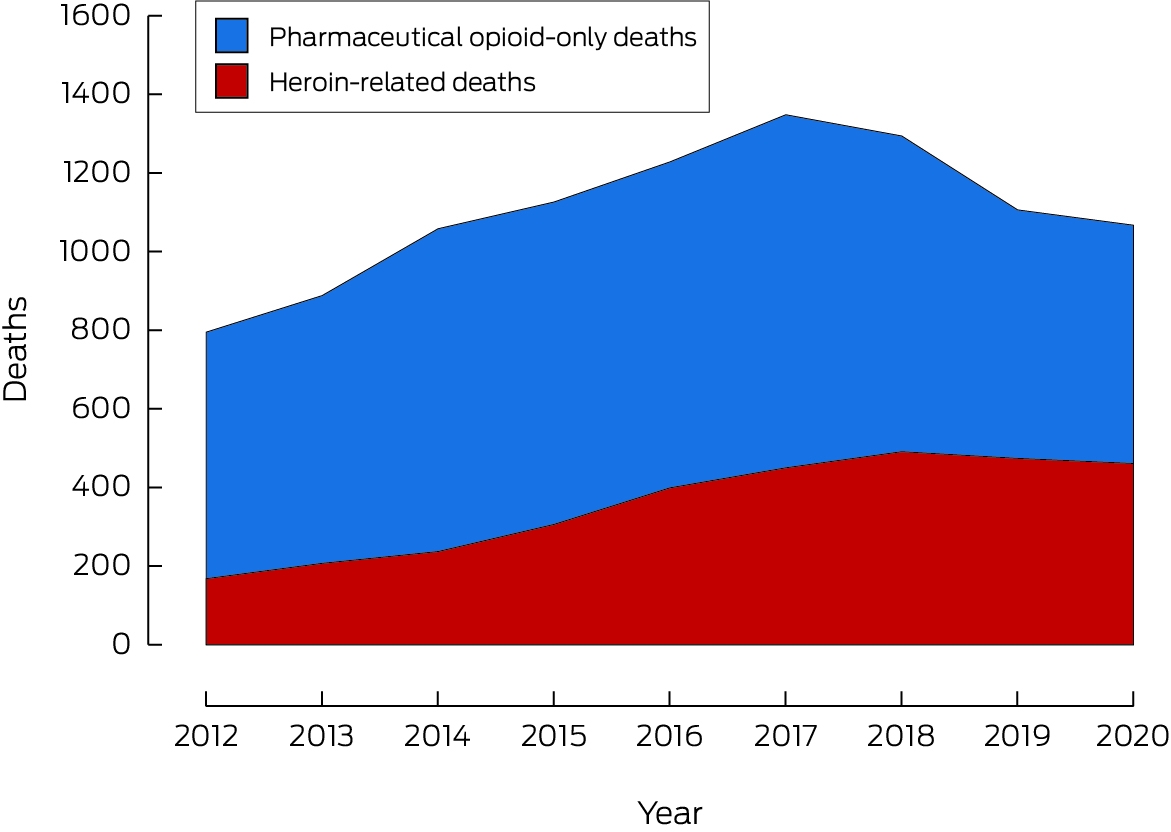
Opioid prescribing is undoubtedly declining,1,6 the result of a concert of interventions in recent years. One remaining challenge is to assess whether these interventions have achieved their broader goal of reducing opioid‐related deaths. Since a peak in 2017, prescription opioid‐related mortality has declined in Australia11 (Box). This peak was several years after the 2014 oxycodone reformulation, suggesting that the formulation change was not primarily responsible for reducing opioid‐related mortality in Australia. The decline in prescription opioid‐related mortality commenced soon after codeine rescheduling, but preceded the implementation of other policies, such as prescription monitoring programs. Given the limited time since the implementation of prescription monitoring and the PBS prescribing changes, their impact on mortality is not yet clear.
We must also pay attention to the rise in the number of heroin‐related deaths, which have almost trebled in Australia since 2012.11 This rise indicates the importance of capturing the intended and unintended outcomes of interventions for constraining opioid medication supply, in order to fully assess their impact on the health of all Australians.
Competing interests
No relevant disclosures.
References
- Koch FC, Olivier J, Brett J, et al. The impact of new prescribing restrictions for PBS‐subsidised opioid medications and the introduction of half‐pack sizes, Australia, 2020–21: interrupted time series analysis. Med J Aust 2024; 220: 315‐322.
- Dobbin M, Nielsen S, Schumann JL. Commentary on McCoy et al.: More pieces of the mosaic describing outcomes of the Australian up‐scheduling of over‐the‐counter codeine to prescription only. Addiction 2022; 117: 687‐689.
- Lam T, Kuhn L, Hayman J, et al. Recent trends in heroin and pharmaceutical opioid‐related harms in Victoria, Australia up to 2018. Addiction 2020; 115: 261‐269.
- Jauncey M, Livingston M, Salmon AM, Dietze P. The impact of OxyContin reformulation at the Sydney Medically Supervised Injecting Centre: pros and cons. Int J Drug Policy 2018; 53: 17‐22.
- Powell D, Pacula RL. The evolving consequences of oxycontin reformulation on drug overdoses. Am J Health Econ 2021; 7: 41‐67.
- Nielsen S, Picco L, Russell G, et al. Changes in opioid and other analgesic prescribing following voluntary and mandatory prescription drug monitoring program implementation: a time series analysis of early outcomes. Int J Drug Policy 2023; 117: 104053.
- Busingye D, Daniels B, Brett J, et al. Patterns of real‐world opioid prescribing in Australian general practice (2013–18). Aust J Prim Health 2021; 27: 416‐424.
- Lam T, Xia T, Biggs N, et al. Effect of discharge opioid on persistent postoperative opioid use: a retrospective cohort study comparing tapentadol with oxycodone. Anaesthesia 2023; 78: 420‐431.
- Haines S, Savic M, Carter A. Healthcare providers beliefs about the meanings and impacts of prescription drug monitoring program alerts. Addict Res Theory 2023; https://doi.org/10.1080/16066359.2023.2271833
- Haines S, Savic M, Nielsen S, Carter A. Opioid‐related policy changes: experiences and perspectives from people who use opioids to manage non‐cancer chronic pain. Drug Alcohol Rev 2023; 42: 1482‐1492.
- Chrzanowska A, Man N, Sutherland R, et al. Trends in overdose and other drug‐induced deaths in Australia, 2002–2021 [Drug Trends Bulletin Series]. Sydney: National Drug and Alcohol Research Centre, UNSW Sydney, 2023. Here: Overdose deaths involving opioids, by exclusive opioid type, age and intent. https://drugtrends.shinyapps.io/deaths_2021 (viewed Nov 2023).
Provenance: Commissioned; not externally peer reviewed.
Gabapentinoid Poisoning Presentations to Victorian Emergency Departments: A 15-Year Trend Analysis
Bishaal Tej Gurung, Amy McNeilage, Angus Skeen, Tina Lam, Joanna F. Dipnall, Jane Hayman, Suzanne Nielsen, Ting Xia
Hospital-Admitted Injection-Related Infections Among Incarcerated People Who Inject Drugs in Australia: A Retrospective Cohort Study
Andrew Palmer, Matthew Carter, Jeremy Yeo, Cecilia Shim, Jason Connor, Jeremy Hayllar, Gerald Holtmann, Naomi Moy, Elliott G. Playford, Naomi Runnegar, Paul J. Clark
The Management of Withdrawal From Alcohol and Other Drugs in Australian Custodial Settings: A Consensus Statement
Grace FitzGerald, Jocelyn Chan, Jon Cook, Mark Stoove, Michael Curtis, Suzanne Nielsen, Rebecca J. Winter, Thileepan Naren
Impact of Prescription Drug Monitoring Program Implementation on Rates and Characteristics of People Seeing Multiple Prescribers in Primary Care: A Controlled Interrupted Time-Series Analysis
Louisa Picco, Monica Jung, Grant Russell, Samanta Lalic, Mahbod A. Fini, Dan I. Lubman, Rachelle Buchbinder, Ting Xia, Suzanne Nielsen
Early Cessation of Acetylcysteine Treatment After Paracetamol Overdose (NACSTOP 2): A Non-Inferiority Randomised Controlled Trial
Anselm Wong, Richard McNulty, Sarah E. Hodgson, Naren Gunja, Andis Graudins
The risk of death after hospitalisation following intentional self‐poisoning: a retrospective observational study (PAVLOVA‐2)
Firouzeh Noghrehchi, Nicholas A Buckley, Rose Cairns