




Medical education
Snapshot
Volume 219 - Issue 1
Groove sign in eosinophilic fasciitis
Authors: Xingyu Li and Dong‐Lai Ma
Med J Aust 2023; 219 (1): 15-15. || doi: 10.5694/mja2.51983
Published online: 3 July 2023
Published online: 3 July 2023
A 33-year-old man presented with a four-month history of polyarthralgia, cutaneous oedema and induration of extremities after swimming
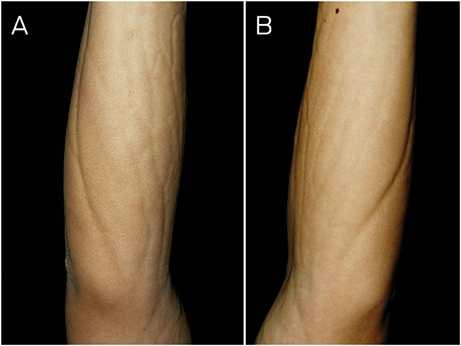
A 33‐year‐old man presented with a four‐month history of polyarthralgia, cutaneous oedema and induration of extremities after swimming. Linear depressions along superficial veins were seen on the forearms and shins, better visualised with elevation of the limbs, consistent with the groove sign (Figure, A and B). Laboratory tests revealed peripheral eosinophilia, elevated C‐reactive protein and hypergammaglobulinaemia. Biopsy revealed myofascial thickening with infiltration by multiple inflammatory cells, suggesting eosinophilic fasciitis. After six months of oral corticosteroids, cutaneous swelling and eosinophilia resolved, but the groove sign was still present at follow‐up 16 years later.
Eosinophilic fasciitis is a rare chronic scleroderma‐like syndrome, characterised by cutaneous induration, eosinophilia, hypergammaglobulinaemia and elevated inflammatory markers.1 About 10% of patients with eosinophilic fasciitis have haematological disorders, and hypergammaglobulinaemia may be predictive.2 Groove sign is characteristic of eosinophilic fasciitis, contributing to early diagnosis. The epidermis and upper dermis are spared from fibrosis, whereas the connective tissue surrounding veins is immovable, so when lifting the limbs, peripheral venous pressure decreases and the superficial skin is tethered inwards.3
Competing interests
No relevant disclosures.
References
- Pinal‐Fernandez I, Selva‐O’ Callaghan A, Grau JM. Diagnosis and classification of eosinophilic fasciitis. Autoimmun Rev 2014; 13: 379‐382.
- Mango RL, Bugdayli K, Crowson CS, et al. Baseline characteristics and long‐term outcomes of eosinophilic fasciitis in 89 patients seen at a single center over 20 years. Int J Rheum Dis 2020; 23: 233‐239.
- Fruchter R, Mazori DR, Femia AN. Groove sign of eosinophilic fasciitis. J Clin Rheumatol 2017; 23: 169.
Reorienting Allied Health Into Community-Based Care for People Experiencing Trauma and Social Disadvantage
Simon Rosenbaum, Grace McKeon, Gulsah Kurt, Oscar Lederman, Kemi Wright, Sabuj Kanti Mistry, Jackie E. Curtis, Philip B. Ward, Zachary Steel, Hamish Fibbins, Rachel Morell, Melissa C. Eaton, Andrew Watkins, Ben Harris-Roxas, Brendan Goodger, Eleanor Beck, Megan Teychenne, Joseph Firth, Davy Vancampfort, David Burns, Russell Roberts, Tristan Favaloro, Danielle Weber, Rosanna Barbero, Vasili Maroulis, Melissa Holmes, Stefan Mackenzie, Chiara Mastrogiovanni, Afsana Anwar, Uzma Choudhry, Catherine Sherrington, Jane Currie, Thomas Gadsden, Scott Teasdale
Psychosocial Hazards for Healthcare Workers: Supporting the Second Victim Also Helps the Primary Victims
Sarah Michael
Shifting focus to adolescent wellbeing and inclusive participation in the digital age
Allyson R Todd, Elena Wang, Stephanie R Partridge
Shifting focus to adolescent wellbeing and inclusive participation in the digital age
Jodie Bailie, Helen Dickinson, Briony Lipton, Marissa Shields
The CURE Asthma roadmap
Gary P Anderson, Anthony Flynn, Phil G Bardin, John D Blakey, Shyamali C Dharmage, Paul Foster, Peter G Gibson, Adam Jaffe, Alan James, Christine R Jenkins, Sundram Sivamalai, Peter D Sly, Guy B Marks, Vanessa M McDonald, Judy Wetttenhall