




Volume 218 - Issue 9
Scombroid poisoning: a traveller's tale
Authors: Natalie SY Lee and Susan C Chu
Med J Aust 2023; 218 (9): 394-394. || doi: 10.5694/mja2.51924
Published online: 15 May 2023
Published online: 15 May 2023
A 23-year-old previously well Australian woman with no known allergies developed an erythematous, non- pruritic and non- tender rash while in Bali
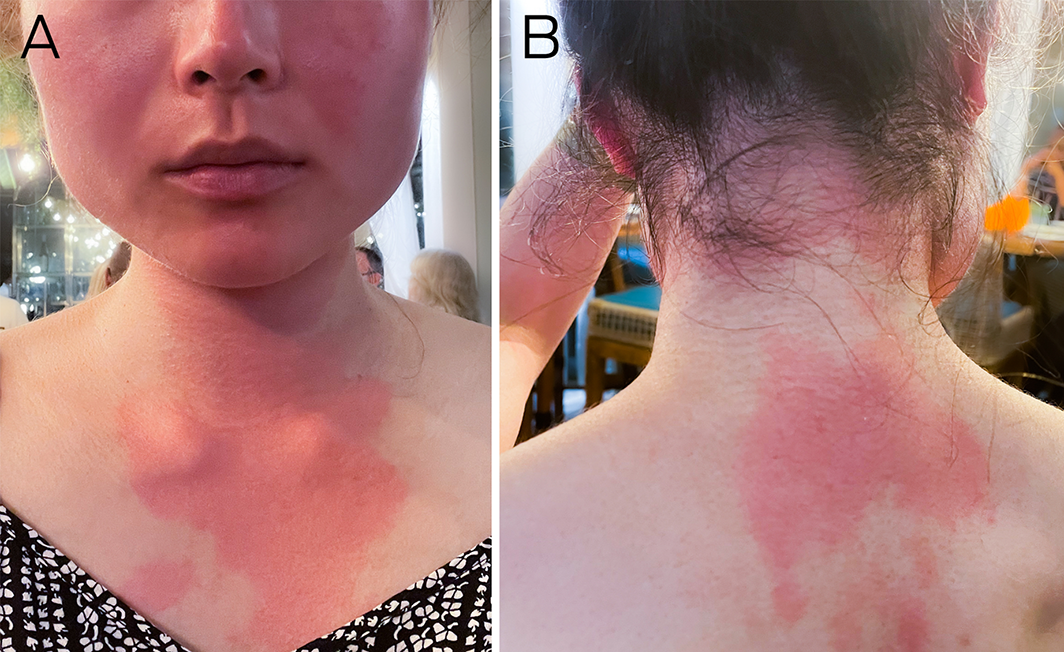
A 23‐year‐old previously well Australian woman with no known allergies developed an erythematous, non‐pruritic and non‐tender rash while in Bali. The rash appeared on the face and ears ten minutes after ingesting a tuna steak, spreading to the neck, chest, back and upper limbs within 20 minutes (Figure, A and B). This was associated with conjunctival injection, headache, tachycardia and light‐headedness. The patient's mother, a general practitioner, made a clinical diagnosis of scombroid poisoning1,2 and immediately administered an oral antihistamine. The rash and symptoms resolved after four hours, and the restaurant was notified. Scombroid poisoning may occur after the consumption of fish, such as tuna, salmon, mackerel, sardines and anchovies, that have been improperly refrigerated. Patients should be advised to avoid ingesting fish, particularly species with dark flesh, that have not been adequately stored.
Competing interests
No relevant disclosures.
References
- Predy G, Honish L, Hohn W, Jones S. Was it something she ate? Case report and discussion of scombroid poisoning. CMAJ 2003; 168: 587‐588.
- Smart DR. Scombroid poisoning. A report of seven cases involving the Western Australian salmon, Arripis truttaceus. Med J Aust 1992; 157: 748‐751.
Gabapentinoid Poisoning Presentations to Victorian Emergency Departments: A 15-Year Trend Analysis
Bishaal Tej Gurung, Amy McNeilage, Angus Skeen, Tina Lam, Joanna F. Dipnall, Jane Hayman, Suzanne Nielsen, Ting Xia
Self-Poisoning With Prazosin and Its Off-Label Use in Australia, 2014–2024: Analysis of NSW Poisons Information Centre Data
Olivia B. E. Lal, Nicholas A. Buckley, Rose Cairns
The risk of death after hospitalisation following intentional self‐poisoning: a retrospective observational study (PAVLOVA‐2)
Firouzeh Noghrehchi, Nicholas A Buckley, Rose Cairns
The public health impacts of mining in Australia
Javier Cortes‐Ramirez, Ruby N Michael, Leisa‐Maree Toms, Melissa Haswell
No silver lining with health misinformation: argyria caused by intentional silver consumption
Luke Collins, Logesh Palanikumar, Stephen Bacchi
Hyperkalaemic cardiac arrest due to cream of tartar ingestion
Daniel Yee Lee Ng, Laksmi Govindasamy, Andrew Hughes, Hwee Min Lee