




Medical education
Snapshot
Volume 218 - Issue 8
Hemichorea–hemiballismus due to hyperglycaemia
Authors: Manon Levy and Lucien Marchand
Med J Aust 2023; 218 (8): 351-351. || doi: 10.5694/mja2.51908
Published online: 1 May 2023
Published online: 1 May 2023
A 77-year-old man with a history of type 2 diabetes was admitted to hospital for acute hyperglycaemia
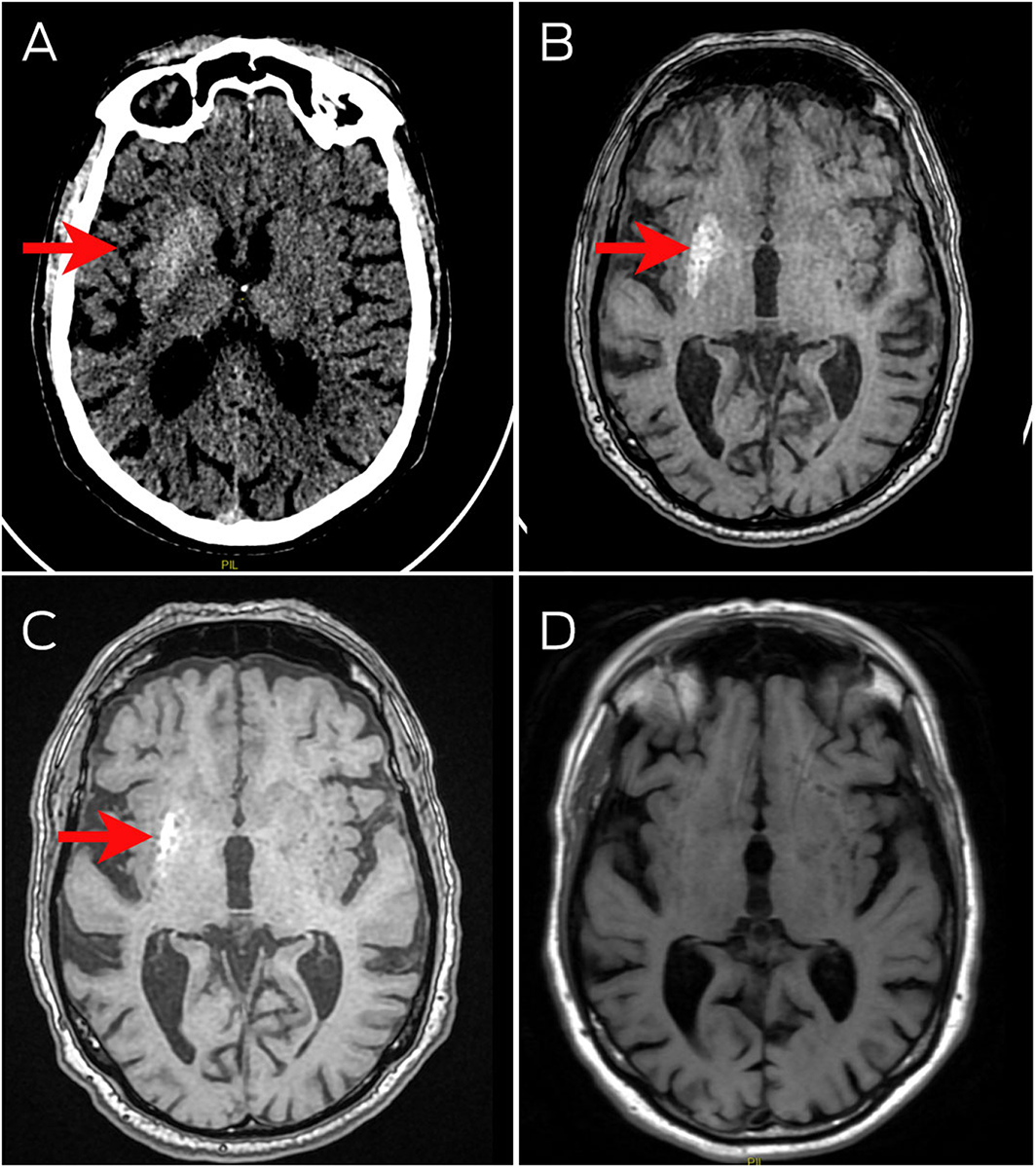
A 77‐year‐old man with a history of type 2 diabetes was admitted to hospital for acute hyperglycaemia (glucose, 577mg/dL; glycated haemoglobin, 139mmol/mol), with positive ketonaemia (2mmol/L). Forty‐eight hours later, he had psychomotor agitation and involuntary, poorly patterned movements affecting the left hemibody, suggesting a hemichorea diagnosis. An unenhanced computed tomography scan found hyperdensity of the right striatum (Figure, A). Magnetic resonance imaging found a T1 hypersignal of the right putamen (Figure, B). Hemichorea–hemiballismus due to hyperglycaemia was diagnosed, as neurological work‐up ruled out other toxic, vascular, infectious, inflammatory or neoplastic causes. He was discharged ten days later, with initial improvement of abnormal movements.
After three weeks, he had a recrudescence of hemichorea–hemiballismus despite euglycaemia and required treatment with tetrabenazine and haloperidol. Two months later, he no longer displayed abnormal movements, the T1 hypersignal had decreased (Figure, C), and neurological treatments could be gradually discontinued (stopped at six months). At ten months, the T1 hypersignal disappeared (Figure, D).
Hemichorea–hemiballismus related to hyperglycaemia (non‐ketotic in most cases) is part of the spectrum of diabetic striatopathy, a rare disorder with a largely unknown pathophysiology (petechial haemorrhage, ischaemia or mineral deposition are among the suggested mechanisms). Antichorea treatments are required in patients unresponsive to aggressive glucose control.1
Competing interests
No relevant disclosures.
Acknowledgements
We are indebted to Hélène Boyer for the English revisions. We thank Amandine Benoit, Cédric Luyton and Laurène Chevallier, who were also involved in the care of the patient.
References
- Chua CB, Sun CK, Hsu CW, et al. “Diabetic striatopathy”: clinical presentations, controversy, pathogenesis, treatments, and outcomes. Sci Rep 2020; 10: 1594.
When ‘Liver Enzymes’ Are Not Hepatic: Late-Onset Pompe Disease
Shauna Madigan, Georgina England, Wayne Rankin
Primary Hyperparathyroidism in Adults: Recent Developments in Diagnosis and Management
Elizabeth Wootton, Sunita M. C. De Sousa, Richard L. Prince, Donald S. A. McLeod, David A. Pattison, Mathis Grossmann
Severe Hypoglycaemia Secondary to Chronic Opioid-Induced Hypothalamic–Pituitary–Adrenal Axis Suppression: An Under-Recognised Phenomenon
Michael Do, Annabelle Hayes, Malgorzata Brzozowska
Rethinking diabetes care for Indigenous Australians: the need for Indigenous‐codesigned and led diabetes models of care
Natalie Nanayakkara, Sharon Atkinson‐Briggs, Alicia J Jenkins, Neale D Cohen
The first Australian evidence‐based guidelines on male infertility
Darren J Katz, Liza O’Donnell, Robert I McLachlan, Tim J Moss, Clare V Boothroyd, Veena Jayadev, Sarah R Catford