




Medical education
Lessons from practice
Volume 217 - Issue 3
A case of neurosyphilis with multiple cranial neuropathies in an immunocompetent patient
Authors: Julia Lim and Cameron Shaw
Med J Aust 2022; 217 (3): 131-132. || doi: 10.5694/mja2.51633
Published online: 11 July 2022
Published online: 11 July 2022
A 65-year-old man presented to the emergency department with right facial weakness and transient dysphagia
Clinical record
A 65‐year‐old man presented to the emergency department with right facial weakness and transient dysphagia. He had no past medical history of note, including no history of opportunistic infection. He was in a monogamous relationship with his male partner over the past 2years and had engaged in regular unprotected sexual intercourse. In the 5weeks prior to presentation, he had also developed diffuse left‐sided facial pain, affecting all three branches (V1–V3) of the trigeminal nerve. Examination was in keeping with right lower motor neuron facial nerve palsy with right‐sided hypoesthesia in the V3 distribution. There were no meningeal signs. Three weeks later, he subsequently reported a transient 24‐hour episode of vertigo. Repeat examination was unremarkable apart from an improving residual right facial asymmetry. There was no suggestion of optic nerve involvement based on history or examination findings, including fundoscopy.
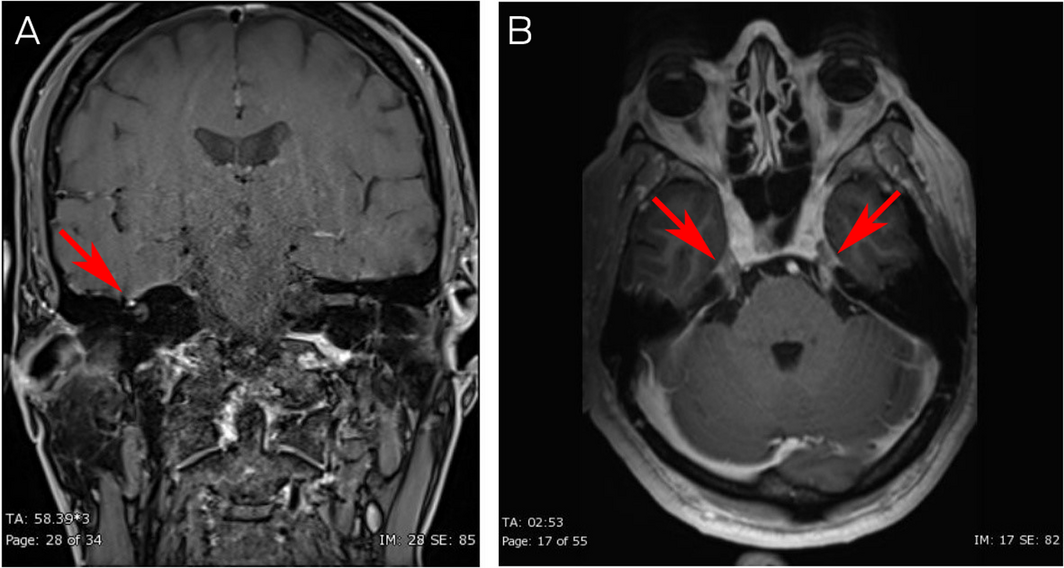
Laboratory investigation revealed a reactive Treponema pallidum particle agglutination assay (TPPA) and fluorescent treponemal antibody absorption (FTA‐ABS) test with serum rapid plasma reagin (RPR) of 1:32 (negative <1:1). Serial human immunodeficiency virus (HIV) screen was negative at 8weeks and 5 months from initial syphilis diagnosis using fourth generation HIV enzyme immunoassay antigen‐antibody screen, other infective and inflammatory screening investigations were all unremarkable. Lumbar puncture had an opening pressure of 26cmH2O (reference interval [RI], 10–25cmH2O). Cerebrospinal fluid (CSF) examination showed pleocytosis with mononuclear cell of 100μL (RI, <5μL) and erythrocyte 1μL (RI, <5μL) and elevated protein (0.97g/L, RI, 0.15–0.45g/L). CSF FTA‐ABS was reactive with a CSF‐Venereal Disease Research Laboratory (VDRL) titre of 16 (normally undetectable). Contrast‐enhanced magnetic resonance imaging brain scan demonstrated enhancement of the right internal acoustic canal and the bilateral trigeminal nerves (left more than right) (Box). Nerve conduction studies revealed abnormal blink reflex with R2 latency on the right, suggesting afferent limb pathology in the right trigeminal nerve. Auditory assessment revealed mild bilateral sensorineural hearing loss at 2, 3 and 4kHz, which may suggest possible bilateral vestibulocochlear nerve involvement.
In light of these findings, a diagnosis of early neurosyphilis was made. The patient denied ever being treated for syphilis before, but he had been sexually active previously with a male partner who had tested positive for syphilis 2years ago. Upon tracing his previous serology, he has had three negative syphilis screens using chemiluminescent microparticle immunoassay (CMIA) over a 6‐month period, but no RPR was performed. He was treated for his current presentation with a 15‐day course of intravenous penicillin G (24×106U/day). Five months later, his serum RPR showed a titre of 1:2 (a more than fourfold decline), indicating a complete response. At this point in time he had made a full recovery and reported no residual neurological deficits.
Discussion
The incidence of syphilis is on the rise along with its identified complications. In 2019 in the United States, more than 129000 cases of syphilis were reported, in which 41.6% were exclusive to men who have sex with men.1 In Australia, apart from men who have sex with men, syphilis is increasing in prevalence in the general population, particularly in women of reproductive age and in Aboriginal and Torres Strait Islander communities.2 The prevalence of neurosyphilis in the post‐antibiotic era has been reported to be 0.84%, and the risk factors include men who have sex with men and being HIV‐positive.3 Neurosyphilis can occur at any stage of the disease, with symptom onset ranging from days to years after initial infection. It is classified into early and late forms. Early neurosyphilis manifestations include asymptomatic neurosyphilis which if untreated, can progress to symptomatic meningitis presenting as cranial neuropathies or meningovascular syphilis. Late neurosyphilis is characterised by general paresis and tabes dorsalis. Neurosyphilis involving cranial neuropathies most commonly presents as isolated ocular syphilis or otosyphilis with HIV co‐infection.4,5
We have described an uncommon presentation of neurosyphilis in a HIV‐negative patient manifesting with sequential cranial neuropathies. We hypothesise that our patient had asymptomatic meningitis, which progressed to cranial neuropathies but without clinical meningism. The exact timing of his acquisition of syphilis remains unclear. Given the rise in syphilis incidence in Australia, a high index of suspicion is required in a patient presenting with cranial neuropathies, particularly in men who have sex with men, even in the absence of HIV co‐infection. Diagnosis of neurosyphilis should not be missed as it is highly treatable and could result in serious sequelae if untreated. Mainstay treatment is preferably with intravenous penicillin G.
Lessons from practice
- • Neurosyphilis should be considered in a patient presenting with cranial neuropathies, particularly with risk factors such as men who have sex with men or who have human immunodeficiency virus (HIV) co‐infection.
- • Social history, particularly sexual history, is imperative in the diagnosis of neurosyphilis and allows for appropriate contact tracing.
- • Neurosyphilis can occur at any stage, with symptom onset ranging from days to years after initial infection.
- • Diagnosis of neurosyphilis should not be missed as it is highly treatable and effective treatment can prevent long term complications.
Competing interests
No relevant disclosures.
References
- Centers for Disease Control and Prevention. Sexually transmitted disease surveillance 2019. Atlanta, GA: CDC, 2019. https://www.cdc.gov/std/statistics/2019/default.htm (viewed Mar 2022).
- Australasian Society for HIV, Viral Hepatitis and Sexual Health Medicine. Australian STI management guidelines for use in primary care: syphilis. ASHM, 2021. https://sti.guidelines.org.au/sexually‐transmissible‐infections/syphilis/ (viewed Mar 2022).
- de Voux A, Kidd S, Torrone EA. Reported cases of neurosyphilis among early syphilis cases — United States, 2009 to 2015. Sex Transm Dis 2018; 45: 39‐41.
- Oliver SE, Aubin M, Atwell L, et al. Ocular syphilis — eight jurisdictions, United States, 2014–2015. MMWR Morb Mortal Wkly Rep 2016; 65: 1185‐1188.
- Ramchandani MS, Litvack JR, Marra CM. Otosyphilis: a review of the literature. Sex Transm Dis 2020; 47: 296‐300.
Provenance: Not commissioned; externally peer reviewed.
Costs of Delivering the Hep B PAST Model of Care in Remote Australia: A Retrospective Pre–Post Study
Hoa Nguyen, Anh Le Tuan Nguyen, Paula Binks, Melita McKinnon, Emily Vintour-Cesar, Karen Wills, Nicola Stephens, Benjamin Cowie, Joshua S. Davis, Yuejen Zhao, Peter Nihill, Julie A. Campbell, Andrew J. Palmer, Jane Davies, Barbara de Graaff
Buruli Ulcer Acquired From Ringtail Possum Rescue
Daniel P. O'Brien, Naomi Clarke, Sara Bonnici, Mohammad A. Hussain
Q Fever Visceral Abscesses After Contact With Native Australian Marsupials
Samantha J. Laws, Enzo Binotto, James Stewart, Jennifer Ho, Trent Yarwood, Josh Hanson, Simon Smith
Hospital-Admitted Injection-Related Infections Among Incarcerated People Who Inject Drugs in Australia: A Retrospective Cohort Study
Andrew Palmer, Matthew Carter, Jeremy Yeo, Cecilia Shim, Jason Connor, Jeremy Hayllar, Gerald Holtmann, Naomi Moy, Elliott G. Playford, Naomi Runnegar, Paul J. Clark
The Live Attenuated Influenza Vaccine in Australia: An Additional Tool for Influenza Prevention
Cyra Patel, Alexis Pillsbury, Tran Nguyen, Xia Wang, Helen E. Quinn, Clayton K. Chiu, Allen C. Cheng, Katie L. Flanagan, Zhicheng Wang
Reflex Testing for Hepatitis D Infection: A Unique Opportunity to Reduce Hepatitis D-Related Chronic Liver Disease Deaths in Australia
Jessica Howell, Lauren Andersson, Miriam T. Levy, James O'Beirne, Leon Adams, Katharine Irvine, Avik Majumdar, Golo Ahlenstiel, Kathy Jackson, Krispin Hajkowicz, Joseph Doyle, Jane Davies, Sarah Cherian, Wayne Dimech, Alexander J. Thompson