




Volume 216 - Issue 8
Skeletons in the closet: time to give human bones acquired by health practitioners for educational purposes the respect they deserve
Authors: Jonathan Coman, Simon S Craig and Anne‐Maree Kelly
Med J Aust 2022; 216 (8): 392-396. || doi: 10.5694/mja2.51477
Published online: 2 May 2022
Published online: 2 May 2022
Health authorities need to develop a nationally consistent, sensible, ethical and jurisdictionally feasible process for disposal of educational human bone sets
Health authorities need to develop a nationally consistent, sensible, ethical and jurisdictionally feasible process for disposal of educational human bone sets
The study of anatomy is integral to the study of medicine. It lies at an interface between the need for body parts for research and education and the ethical responsibility to show respect for the dead.1 In the 20th century, human skeletons were acquired on a mass scale as medical students were encouraged to purchase sets of human bones. Attempts to institute a legal market were overtaken by traders using illicit international sources, particularly India, as demand outstripped supply.2 The ethical, legal and practical issues were largely ignored.3
Although guidelines exist for the management, return or disposal of curated collections of human remains, the lawful disposal of human remains (including bone sets) can be problematic for doctors.4 A legal framework for disposal of legally acquired human remains that are in private ownership in Australia has not been articulated.
Little is known about the number of human skeletons in private possession in the Australian medical community. Also, there are scarce data about doctors’ knowledge of their origins, the legal framework for possession and ongoing use, and attitudes towards relinquishment.
Ethical framework
The ethical principle of autonomy asserts that people should have the right to make decisions about matters that affect them, including how their body is used or disposed of after death. On this basis, explicit consent would be required for human remains to be used for educational or scientific purposes. There is substantial anecdotal evidence that consent for people’s bones being used as educational bone sets was not obtained. Medical ethicists assert that in the absence of consent, anatomical specimens (including bone sets) should be destroyed.5 The competing claim used to justify their use — that the benefit to society of educating health practitioners outweighs individual autonomy — is hard to justify, especially because high quality replica bones (eg, by three‐dimensional printing) are now available.6
The ethical principles extend to how bone sets are stored and circulated. The fragmentation and conservation of body parts (eg, into bone sets) objectifies the remains.7 Bone sets are often stored and change hands like objects, with little thought to respect or dignity for the person to whom they belonged. A related issue is whether it is ethical to gift bones to someone else. The principles of autonomy and justice suggest that this is not the case. The holder of the bones does not have consent to hold them or to pass them on, irrespective of the intended usage.
Legal framework
It is not illegal in Australia to own human bones. The handling of human tissues in Australia is governed by the Human Tissue Act 1982 (Vic) and jurisdictional equivalents.8 While there are some minor variations between the Acts, none of them specifically address private ownership of human remains for educational purposes. Importantly, the Acts make it clear that it is illegal to sell or buy human tissue (including bones) except by a holder of a permit under the Act. It is not illegal to gift human bones to someone else.
There is a legislative requirement in Australia that human remains must be identified before cremation or burial.8 This information is impossible to obtain for purchased bone sets due to a lack of documentation or knowledge of their origin. A potential role for coroners in authorising burial or cremation has been raised, but whether they have jurisdiction is unclear.
Donation to authorised institutions such as anatomy schools has been suggested as an alternative method of disposal.9 There is no readily available information on whether this is feasible in Australia or on what scale.
The disposal of bones by unauthorised cremation (eg, fire in a backyard), burial or disposal in garbage (or similar) runs the risk of triggering a homicide investigation.10,11 This is not only costly to the community but may cause inconvenience, cost and anxiety to the disposer while investigations that establish the origin of the bones are undertaken.
Key findings of research
Three studies were conducted exploring inter‐related issues about the possession and disposal of human bones. We surveyed medical practitioners, coroners and anatomy schools. The research was approved by the Monash Health Human Research Ethics Committee (LNR/17/MonH/242).
Survey of medical practitioners
We conducted an internet survey of doctors working in two large metropolitan health services in Melbourne, Australia, exploring prevalence, knowledge and attitudes towards the personal possession of human skeletal remains. The survey was deployed using SurveyMonkey and was conducted between July and September 2017 (Supporting Information, table 1). Quantitative data were analysed using IBM SPSS Statistics for Mac (version 23). Qualitative analysis of free text responses was performed using thematic analysis.
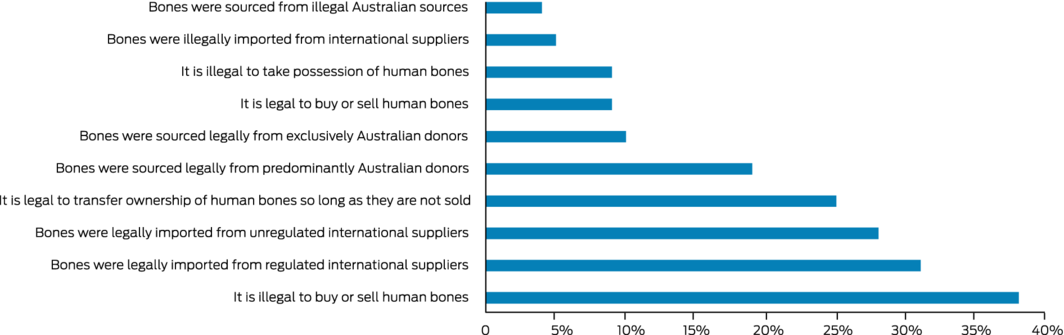
The demographic data of respondents are shown in the Supporting Information, table 2. Despite a low response rate (373/3774, 10%), we identified several interesting findings (Box 1 and Box 2). Forty‐four per cent of respondents (163/373) had acquired human bones for their medical studies. This was more common in doctors aged over 45 years. Of those who had acquired human bones, 50% (81/163) still had them in their possession. Of those who retained the bones, 33% (27/82) reported that they had considered relinquishment and 40% (33/82) were either somewhat or very unwilling to relinquish them. Reasons for retaining bones included (multiple options were possible) continued educational use (34/82, 42%), wanting to give them to a relative studying health science (32/82, 39%), sentimental value (25/82, 30%), and that biological bones were difficult to replace (21/82, 26%). Regarding intended methods of relinquishment, 19% (14/75) intended to gift them to a health science student, 29% (22/75) planned to donate them to a university, and 52% (29/75) reported not knowing what to do.
Of doctors who had relinquished bones, 38% (31/82) had been gifted to either a relative or another health science student, 33% (27/82) had been sold, 11% (9/82) were returned to a previous owner, and 7% (6/82) had been donated to a university. In a few cases, bones had been donated to a hospital, thrown out, lost or stolen.
Survey of coroners
Coroners in all Australian jurisdictions were surveyed and asked two questions:
- ▪ What is the recommended process for relinquishment of human bone sets in that jurisdiction?
- ▪ If it is via coronial services:
- ▶ what processes are required of a health professional or their family?
- ▶ what processes do coronial services undertake?
Responses were received from six jurisdictions (6/8, 75%) (Box 3). They demonstrate variation in practice and processes and lack of a clear national approach.
In Queensland and South Australia, disposition of bone sets is not dealt with by coronial processes. Processes in New South Wales, Victoria, Tasmania and Western Australia are broadly similar. Bones sets are surrendered to coroners or police along with a statement of the circumstances. The bones are examined to confirm they are human, their age, gender and ethnicity, when death occurred, and whether the bones are identifiable. After this, disposal can be authorised, either by donation to a university or by cremation.
Some coroners expressed doubt about whether they had jurisdiction because it was likely that death occurred outside their state and at an unknown (likely distant) time.
Survey of anatomy schools
An online survey was sent to all Australian anatomy schools focusing on acceptance of donated human bone sets, with responses received from 24. Twenty‐one schools (21/24, 87.5%) reported that if they were contacted by a doctor or their family with a request to donate a bone set, it would be accepted. Three schools (3/24, 12.5%) did not accept donations. Reasons for non‐acceptance included limited storage, lack of a forensic anthropologist, absence of an anatomy museum, and that relinquishment to the coronial service was more appropriate.
Several schools required a formal statement regarding original acquisition and intention of donation. Most reported that bones would be examined by a forensic anthropologist to exclude Australian Indigenous origin. Importantly, it was reported that acceptance of donation depended on the condition of the bones and the school’s need for bones for teaching purposes.
Time for change
Our research shows that there is a significant but unquantified number of human bone sets circulating in private ownership within the Australian medical community. There are strong ethical reasons why this number should be reduced, preferably by voluntary relinquishment.
Our survey of doctors had a low response rate, which is not unusual in anonymous internet‐based or email surveys.12 Nevertheless, our findings suggest that doctors lack knowledge regarding the ethical and legal issues relating to possession of human bones and approaches to their legal disposal. Free‐text responses demonstrated a range of emotional and other responses and uncovered at least one unauthorised disposal. The attitudes reported by doctors suggest that bone sets could potentially circulate in the community indefinitely, with no prospect of respectful disposal. We also found jurisdictional variation in authorised disposal processes. The responses of anatomy schools suggest that while they accept occasional donations of bone sets, this is not a suitable model for large‐scale relinquishment.
Determining the origin of human remains is important, particularly whether they are of First Nations origin. The Commonwealth Aboriginal and Torres Strait Islander Heritage Protection Act 1984 includes specific provisions relating to the discovery, assessment and disposal of human remains of First Nations people.13 Key principles include consultation with local First Nations people to determine the proper actions to be taken, returning the remains, or otherwise taking direction as to their appropriate disposal or storage. States and territories have legislative frameworks, some of which consider human remains under law protecting objects of significance, while others involve coronial and public health legislation.14
Coordinated and accessible programs for managing the legacy of human bone use in education are lacking. To address this effectively, health authorities need to review legislation and develop a sensible, ethical and jurisdictionally feasible process for disposal of educational human bone sets. This will require consultation and cooperation between coroners, police, universities and doctors.
Once a nationally consistent process has been developed and legislated, specific information for doctors or their surviving relatives should be made freely available and widely publicised. Finally, the medical profession and health authorities should initiate a campaign to encourage doctors to dispose of privately held human remains.
Let them rest in peace.

Box 2 – Representative quotes from surveyed medical practitioners
|
|
Survey responses |
||||||||||||||
|
|
|||||||||||||||
|
Knowledge regarding origins of bones |
|
||||||||||||||
|
No knowledge |
“I don’t know. I thought they were from organ donors.” |
||||||||||||||
|
Indian subcontinent |
“When I was at medical school most students had human bones believed to have come from India.” |
||||||||||||||
|
“I think that the skull I had may have come from India. I bought it from another medical student.” |
|||||||||||||||
|
Other sources |
“I bought my bones from the daughter of a doctor who trained in the 1940s. They were said to have come from a French battlefield.” |
||||||||||||||
|
Ethical and legal issues* |
|
||||||||||||||
|
Acknowledging an illegal trade |
“When the bones were sourced there were no legal or illegal implications. It was just the done thing at the time.” |
||||||||||||||
|
“I know that in 1976, when I bought mine, the bones came via very unethical processes, which we didn’t think about then, but of which I am acutely conscious now.” |
|||||||||||||||
|
Acceptable to use if freely donated |
“I have no issue with the use of human bones that have been freely donated by the person for study before they died. I would not have bought the bones originally if I thought they were obtained illegally.” |
||||||||||||||
|
“I cannot see an ethical problem with using human bones donated for educational purposes by a person who is able to freely give informed consent.” |
|||||||||||||||
|
Respect and sentimental value |
|
||||||||||||||
|
Family heirloom |
“I still have my bones and hope my daughter will use them if she wants to do medicine as well. I realise they are probably from India and I always respect my bones, but three members of my family have used these bones for education in the medical field, and unfortunately reproduction bones are just not detailed enough.” |
||||||||||||||
|
“Mine were given to me by my father who was a surgeon.” |
|||||||||||||||
|
“I had a set of bones that my mother used in medicine that she gave me, including a very complete set of skull bones.” |
|||||||||||||||
|
Human bones as a prized possession |
“They are special and should go to a student that would treasure them as I have.” |
||||||||||||||
|
“I’m very grateful to have been able to study anatomy using real bones — they are far superior to the plastic sets I have seen, and they have great sentimental value to me.” |
|||||||||||||||
|
“I was given a human skull to study for my part 1 specialist anatomy exam. I was full of reverence and awe for it. It made very personal an otherwise tedious and dry subject and gave it gravitas.” |
|||||||||||||||
|
Emotional reactions |
|
||||||||||||||
|
Uncomfortable |
“My family and I were very unhappy about having the bones. I tried to donate them to the university but they did not want them. We ended up making a large bonfire and cremating them, then scattered them in a garden.” |
||||||||||||||
|
“I felt uncomfortable possessing the bones for some time and wish there was some respectful way of dealing with them.” |
|||||||||||||||
|
|
|||||||||||||||
|
* The terms “legal” and “illegal” were not specifically defined in the survey. |
|||||||||||||||
Box 3 – Summary of coronial responses
|
Jurisdiction |
Response |
||||||||||||||
|
|
|||||||||||||||
|
New South Wales |
Once the bone sets have been examined, it has been the NSW coroner’s practice to release the sets to the University of Sydney’s Anatomy Department under the guidance of its anthropologist. |
||||||||||||||
|
Queensland |
These matters are generally not dealt with through the coronial process in Queensland. The relinquishment of these resources is not considered to constitute a reportable death, neither is it regarded as a law enforcement matter. When the existence of such skeletons is brought to the attention of the police, they will refer the owner to a school of anatomy. However, police and coroners will be engaged should the school of anatomy identify an issue with the bones. |
||||||||||||||
|
South Australia |
The coroner has not had an instance of this within recent memory. It is likely to fall outside the coroner’s jurisdiction as it would not constitute a reportable death. No recommendation regarding disposal. |
||||||||||||||
|
Tasmania |
The health professional contacts the coroner’s office and provides details of the remains they have. Arrangements will then be made for police to attend and speak with the health professional in order to obtain details, if known, in regards to the remains, such as identity, place of death, cause of death, how and when the bones were obtained by that practice and for what purpose. The coroner will undertake an investigation in accordance with the relevant Act. The bones will be examined to confirm they are human and to provide a report containing as much information as possible such as gender, age range, likely timeframe since death occurred, detail of any injury or abnormality, and any other pertinent marks or features that may assist with identification. Once established that it is not possible to determine the identity of the bones, even by way of DNA, the coroner will authorise the release the bones to be respectfully disposed of by the Department of Health and Human Services. |
||||||||||||||
|
Victoria |
Bones may be relinquished to police or the coroner’s court. The relinquisher provides a statement about how they came into their possession and their use. The bones are examined to determine that the circumstances of death are not suspicious and that the body is not of Indigenous Australian origin. Once satisfied, the coroner will give a direction for the disposal of the bones by cremation. |
||||||||||||||
|
Western Australia |
The relinquishment of teaching is usually handed to police stations. Bones are admitted to the State Mortuary with a form outlining the material facts as to how the bones were located and where. The bones are examined by an anthropologist, who prepares a report for the coroner, determining likely origin of bones. The coroner determines whether they have jurisdiction. |
||||||||||||||
|
|
|||||||||||||||
|
|
|||||||||||||||
Competing interests
No relevant disclosures.
Acknowledgements
We thank Julian Savulescu for his insights regarding the ethics issues raised.
References
- Jones DG. The ethical awakening of human anatomy: reassessing the past and envisioning a more ethical future. In: Squires K, Errickson D, Márquez‐Grant N editors. Ethical approaches to human remains: a global challenge in bioarchaeology and forensic anthropology. Springer International Publishing, 2019: 73–94.
- Carney S. The red market: on the trail of the world’s organ brokers, bone thieves, blood farmers, and child traffickers. New York: Harper Collins Publishing, 2011.
- Fineman M. Living off the dead is a dying trade in Calcutta. Los Angeles Times 1991; 19 Feb. https://www.latimes.com/archives/la‐xpm‐1991‐02‐19‐wr‐1711‐story.html (viewed June 2020).
- Woodhead M. Medical skeletons prove hard to get rid of. Australian Doctor 2014; 17 Dec. https://www.ausdoc.com.au/news/medical‐skeletons‐prove‐hard‐get‐rid (viewed June 2020).
- Jones DG, Whitaker M. The contested realm of displaying dead bodies. J Med Ethics 2013; 39: 652–653.
- Smith ML, Jones JFX. Dual‐extrusion 3D printing of anatomical models for education. Anat Sci Educ 2018; 11: 65–72.
- Claes T, Deblon V. When nothing remains: anatomical collections, the ethics of stewardship and the meanings of absence. J Hist Collect 2018; 30: 351–362.
- Human Tissue Act 1982 (Vic).
- Bhardwaj DN, Millo T, Lalwani S. Skeleton used for anatomical study brought for medico‐legal autopsy: a case report. Med Sci Law 2007; 47: 86–87.
- Chisholm A. Bones used for teaching by Warrandyte doctor subject of coronial inquest. Herald Sun 2014; 16 Dec. https://www.heraldsun.com.au/leader/east/bones‐used‐for‐teaching‐by‐warrandyte‐doctor‐subject‐of‐coronial‐inquest/news‐story/beb8a4fb6045fb4b630165338b34e261 (viewed June 2020).
- Woo H. Is it time to take out your skeleton in the closet? KevinMD 2015; 24 Oct. https://www.kevinmd.com/blog/2015/10/is‐it‐time‐to‐take‐out‐your‐skeleton‐in‐the‐closet.html (viewed June 2020).
- Cunningham CT, Quan H, Hemmelgarn B, et al. Exploring physician specialist response rates to web‐based surveys. BMC Med Res Methodol 2015; 15: 32.
- Aboriginal and Torres Strait Islander Heritage Protection Act 1984 (Cth) s 3(1).
- Buchanan K. Australia. In: Protection of Indigenous heritage in selected jurisdictions. Law Library of Congress, 2019. https://www.loc.gov/item/2019668147/ (viewed June 2020).
Linked content
-
MJA Letter: Skeletons in the closet: time to give human bones acquired by health practitioners for educational purposes the respect they deserve
Provenance: Not commissioned; externally peer reviewed.
Rapid Growth in Diagnostic CT Knee Imaging in Australia: Implications for Imaging Stewardship
Hanwen Chen, Rachelle Buchbinder, Sean Docking, Ian A Harris
Disease‐specific survival for people with chronic myeloid leukaemia, South Australia, 1980–2020: a retrospective cohort study
Kerri Beckmann, Brendon J Kearney, Naranie Shanmuganathan, David Yeung, Tim Hughes
Technological advances in the search for a CURE for asthma
Sara Quon, Timothy M Johanson, Ridhima Wadhwa, Alen Faiz, Anthony Flynn, Gary P Anderson, Amanda J Cox, Nicholas P West, Michael P Menden, Rhys S Allan
Who gets asthma, and why?
Denby J Evans, Peter D Sly, Paul Foster, Chantal Donovan
The first Australian evidence‐based guidelines on male infertility
Darren J Katz, Liza O’Donnell, Robert I McLachlan, Tim J Moss, Clare V Boothroyd, Veena Jayadev, Sarah R Catford
Sex differences in management and outcomes of people with ST‐elevation myocardial infarction, New South Wales, 2011–2020: a retrospective cohort study
Samia Kazi, Simone Marschner, Haeri Min, Desi Quintans, James JH Chong, Ehsan Khan, David B Brieger, Clara K Chow