




Volume 216 - Issue 6
Realising the potential: leveraging clinical quality registries for real world clinical research
Authors: Susannah Ahern, Belinda J Gabbe, Sally Green, Carol L Hodgson, Erica M Wood, John R Zalcberg OAM and Tsharni Zazryn
Med J Aust 2022; 216 (6): 273-277. || doi: 10.5694/mja2.51443
Published online: 4 April 2022
Published online: 4 April 2022
Broader use of clinical quality registry infrastructure will enhance research- driven improvements in health care
Broader use of clinical quality registry infrastructure will enhance research‐driven improvements in health care
Clinical or patient registries are organised systems that use “observational study methods to collect uniform data (clinical and other) to evaluate specified outcomes for a population defined by a particular disease, condition, or exposure, and that serves one or more stated scientific, clinical, or policy purposes”.1 Clinical quality registries (CQRs) in Australia refer specifically to clinical registries that regularly provide feedback to participating sites and clinicians regarding performance against clinical quality indicators, with the aim of reducing variation and improving overall patient outcomes.2 They are recognised as important quality improvement initiatives by the Australian Commission on Safety and Quality in Health Care, which released a framework for clinical registries in 2014.2 The Commission has over 90 clinical registries listed in Australia, across diverse clinical areas, surgeries, procedures and devices on its Australian Register of Clinical Registries.3 Nationally, the importance of maximising the impact of CQRs in achieving better health outcomes was recently recognised by the release of the National Clinical Quality Registry and Virtual Registry Strategy.4 However, while CQRs produce technical reports and their data are used for secondary research purposes, their role as an effective research tool in their own right in Australia has received limited specific attention, resulting in a significant unrealised potential in Australian clinical research infrastructure.
Developing and maintaining CQRs allows for the systematic collection of outcome data, and embedding research into CQRs creates efficiencies in the collection and use of outcome data for multiple purposes. There is a clear overlap between measuring quality in health care through CQRs and using their infrastructure for health care improvement. Utilising the existing large‐scale data collection that is the core business of CQRs, and asking more specific questions about existing and emerging health care practices in terms of their safety, efficacy, comparative outcomes and use in different populations, provides a cost‐effective and efficient mechanism for improving health care. However, as long as CQRs are inconsistently funded by both health care and research funders, this potential remains largely unrealised.
Registry‐based clinical trials: advantages and limitations
During the past decade, the need for a research approach that combines scientific rigour yet is inclusive of real world patients and clinical practice has become increasingly clear. The necessity to minimise the time and costs associated with interventional trials while still maintaining scientific standards has led to interest in leveraging existing forms of high quality data collection to support research in broader, more representative population groups and through usual care processes. A method to achieve this is through a registry‐based trial. Registry‐based trials may utilise a CQR for the recruitment of participants into a trial, and/or for access to baseline and/or outcome data. As CQRs systematically collect prospective data regarding a significant number of people, conditions, devices and treatments of interest, they are a potentially rich clinical infrastructure which can be leveraged to support a range of research methodologies. This includes cohort sub‐studies, post‐marketing surveillance activities, and clinical trials.
The potential advantages of registry‐based clinical trials to evaluate interventions compared with standard randomised controlled trials (RCTs) have been well documented.5,6,7,8,9 A major benefit is that registry‐based trials can represent broader population groups. Additionally, design elements aimed at improving the scientific rigour of RCTs can be applied to registry‐based trials — including the ability to randomise participants to different trial arms, single or double blinding, per‐protocol statistical analysis, and adjudication of outcome measures — depending on the registry infrastructure and the research question requirements. CQRs may also link to other registries (including death and cancer registries) and biobanks, collect longer term follow‐up than traditional RCTs, and have enhanced data integrity through longer term data storage and management. As a result, registry‐based trials can appropriately sit alongside evidence generated by the existing observational and interventional study types, as well as evidence generated from other newer trial types such as pragmatic trials and platform trials to support regulatory, clinical and policy decision making.
Where registry‐based trials are particularly suited is in comparative studies of real world outcomes of different existing clinical care practices.5 A 2020 scoping review noted, based on a strict definition of a registry‐based RCT, that there were 17 outcome trials in the literature published between 1996 and 2017, predominantly from European countries or the United States, and one from Australia.5 This highlights the extent of the missed opportunity of registry‐based trials, from both a lack of explicit support from research funding bodies until very recently, and challenges with implementation. Establishing the number of registry‐based trials being conducted in Australia (or elsewhere) is not easily determined. Not all trials listed in the Australian New Zealand Clinical Trials Registry note whether a registry is being used as part of the research, and some Australian trials are listed on international trial registries (such as ClinicalTrials.gov) instead. Based on available data, at least 20 registry‐based trials (using clinical registries or CQRs) are currently being conducted in Australia. Box 1 provides a list of these trials identified in the Australian New Zealand Clinical Trials Registry (using the search term “registry” and study type “interventional”) that have documented that they are using a CQR listed on the Australian Register of Clinical Registries for their recruitment and/or baseline and/or outcome data.
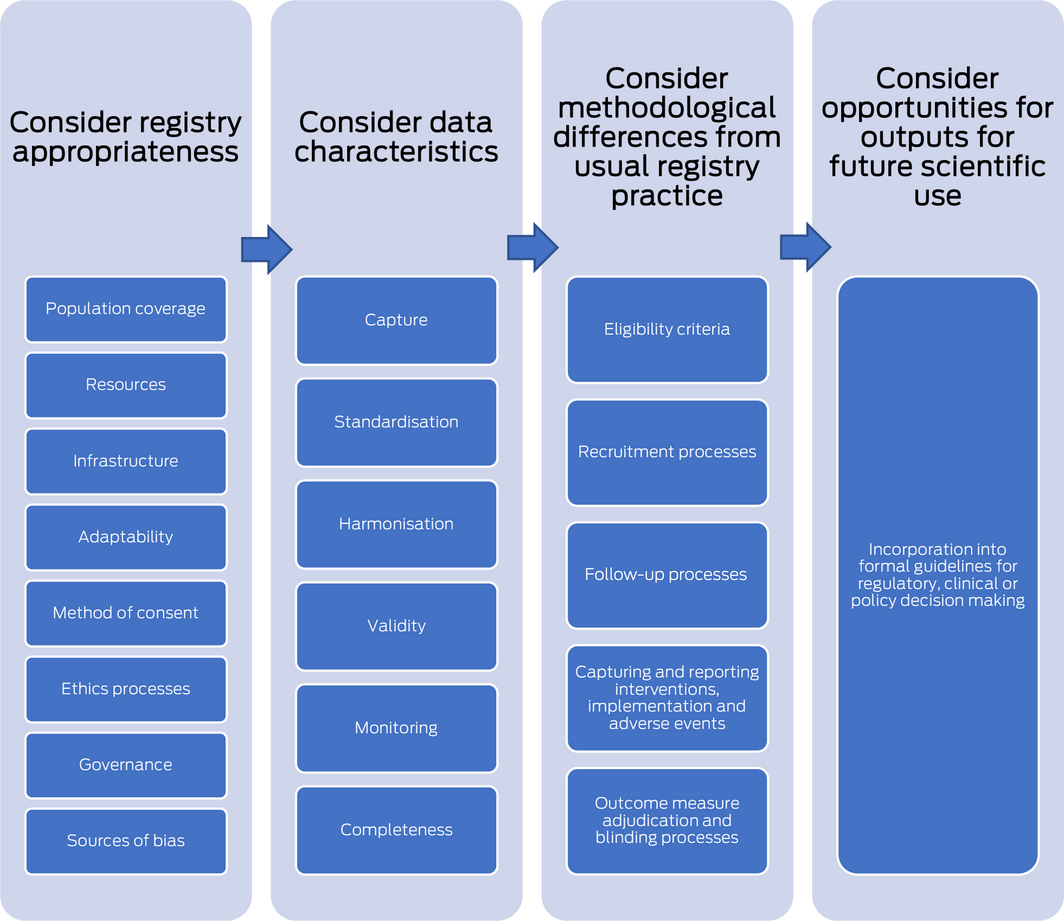
As with all research, appropriate ethical considerations (including consent) are required, and the study design chosen to answer the research questions must be fit for purpose. Registry‐based trials have several different characteristics, some of which may pose methodological and other challenges or uncertainty compared with traditional trial methods. Additionally, within this relatively new area of research methodology, no agreed approaches, or standardised methods to undertake registry‐based trials yet exist, and their processes, data and reporting are neither uniform nor standardised.5,7 This is currently limiting the potential use and uptake of registry‐based trials as a scientifically validated approach to answering research questions. Some of the specific methodological and other considerations for registry‐based trials are highlighted in Box 2.
The way forward for registry‐based trials in Australia
Research needs for data quality and integrity, and the broad range of research questions that potentially could be answered with the use of CQRs, should drive further investment into such infrastructure in Australia. The opportunities afforded by using CQRs for timely and cheaper trials (as some or all of the required infrastructure is or may be separately funded) — and importantly, reduced duplication of effort — has the potential to significantly expand Australia’s clinical research capability. CQRs can investigate variations in health care processes and can provide insights into whether evidence (from research) is being implemented in practice. They can also support implementation planning and monitoring for drugs and devices. The post‐marketing role of CQRs for drugs and devices has been acknowledged in Australia by the Pharmaceutical Benefits Advisory Committee (eg, with the Australian Cystic Fibrosis Data Registry) and by the Therapeutic Goods Administration (eg, with the Australian Orthopaedic Association National Joint Replacement Registry), as described in the Therapeutic Goods Administration’s 2021 clinical evidence guidelines.10,11,12 Registry‐based longitudinal collection of patient‐reported experience and outcome measures can enhance current standards of care as well as provide patient‐derived information that is often required in a traditional RCT, increasing the knowledge available for future clinical decision making. Where these data are already collected as part of the CQR, this can be an efficiency gain for the trial, although it may require additional costs if such measures are not already routinely collected by the CQR.
The important role of CQRs in regulatory decision making has been recognised by the major regulators in Europe and the US for over a decade. The European Medicines Agency recently released guidelines on registry‐based studies for drug marketing authorisation applicants planning such studies, and the US Food and Drug Administration has developed policies regarding the use of real world data and evidence to support efficacy claims.13,14 A recent US publication calls for a better alignment of the regulatory policies underpinning the use of registries for post‐marketing surveillance with the methodology and approaches to such surveillance (particularly with regard to device‐to‐device comparisons), to better facilitate research into comparative effectiveness.15 To further Australia’s contribution to international action in this area, a similar approach would be beneficial. In particular, the following questions need to be answered:
- ▪ What key features must exist in a registry to make it appropriate for registry‐based trials?
- ▪ What types of interventions are appropriate to be evaluated in registry‐based trials?
- ▪ What does good clinical research practice look like in a registry‐based trial?
- ▪ How are registry‐based trials viewed by regulators, funders and clinicians in terms of excellence, validity, scientific value, cost‐effectiveness, policy, and guideline development?
- ▪ What is the importance of secondary use of registry data for clinical trials from a consumer perspective?
Addressing these methodological and broader considerations will allow existing and new CQR infrastructure to more extensively support and enhance research‐driven improvements in health care for the Australian community. Realising the research potential of CQRs within Australia will be an important objective in sustaining a flourishing clinical research sector, in what will be a fiscally constrained post‐pandemic clinical research landscape.
Box 1 – BOX - Currently listed Australian New Zealand Clinical Trials Registry trials using a registry listed on the Australian Register of Clinical Registries
|
Trial acronym |
Trial ID (ACTRN/NCT) |
Registry * |
Patient population |
Comparison |
Current status |
|
|
|||||
|
BEST‐Fluids |
ACTRN12617000358347 |
Australia and New Zealand Dialysis and Transplant Registry |
End‐stage kidney disease receiving a deceased donor kidney transplant |
Two standard care approaches |
Active, not recruiting |
|
BLENDER |
NCT03841084 |
Australian and New Zealand extracorporeal membrane oxygenation registry |
Severe acute respiratory and/or cardiac failure or following refractory cardiac arrest |
An alternate therapy v standard care |
Recruiting |
|
CRISTAL |
ACTRN12618001879257 |
Australian Orthopaedic Association National Joint Replacement Registry |
Total hip arthroplasty and total knee arthroplasty |
An alternate therapy v standard care |
Stopped early |
|
DETECT |
ACTRN12611000538943 |
Australia and New Zealand Dialysis and Transplant Registry |
Colorectal cancer in people with chronic kidney disease |
Testing a screening test kit |
Completed |
|
DIAAMOND: Ava FIRST; Ava NEXT |
ACTRN12619001042134; ACTRN12619001043123 |
Aplastic Anaemia and Other Bone Marrow Failure Syndromes Registry |
Treatment‐naive and relapse/ refractory severe aplastic anaemia |
Addition of a therapy in combination with standard care |
Recruiting |
|
DISTINCT |
ACTRN12621000069853 |
Australian Orthopaedic Association National Joint Replacement Registry |
Femoral neck fractures |
An alternative therapy v standard care |
Recruiting |
|
ECMO‐Rehab |
NCT05003609 |
Australian and New Zealand extracorporeal membrane oxygenation registry |
Patients in ICU receiving extracorporeal membrane oxygenation for between 24 and 72 hours |
Early rehabilitation v standard care |
Not yet recruiting |
|
FAN Trial |
ACTRN12618001124224 |
Australian and New Zealand Fontan Registry |
Fontan‐associated nephropathy |
An alternative therapy v standard care |
Not yet recruiting |
|
FRAIL‐M |
ACTRN12619001199101 |
Myeloma and Related Diseases Registry |
Multiple myeloma |
Alternative therapies |
Recruiting |
|
MINOCA‐BAT |
ACTRN12618001858280 |
Coronary Angiogram Database of South Australia |
Myocardial infarction with non‐obstructed coronary arteries |
Alternative therapies |
Recruiting |
|
My‐PROMPT |
ACTRN12618001878268 |
Myeloma and Related Diseases Registry |
Newly diagnosed multiple myeloma |
An alternative feedback approach v standard feedback approach |
Active, not recruiting |
|
PEPTIC |
ACTRN12616000481471 |
Australian and New Zealand Intensive Care Society registries |
Patients who are mechanically ventilated with 24 hours of intensive care unit admission |
Two standard care approaches |
Completed |
|
PROpatient |
ACTRN12619001126101 |
Upper Gastrointestinal Cancer Registry |
Upper gastrointestinal cancer |
A symptom monitoring and care coordination intervention v standard care |
Recruiting |
|
P2S |
ACTRN12617001205325 |
Australian Stroke Clinical Registry |
First episode of acute stroke or other indexed stroke event |
An alternative therapy v standard care |
Completed |
|
RASKAL |
ACTRN12621000205831 |
Australian Orthopaedic Association National Joint Replacement Registry |
Total knee arthroplasty |
Alternative surgery techniques |
Recruiting |
|
STELAR |
ACTRN12619001072101 |
Australian Stroke Clinical Registry |
Hospitals that have provided data to the Australian Stroke Clinical Registry for at least 6 months |
An alternative feedback approach v usual feedback approach |
Completed |
|
SWIFT |
ACTRN12620001061921; ACTRN12618001976279 |
Australia and New Zealand Dialysis and Transplant Registry |
Kidney failure managed with chronic haemodialysis |
Addition of a therapy in combination with standard care v standard care |
Not yet recruiting |
|
SABRE |
ACTRN12620000321943 |
Australia and New Zealand Dialysis and Transplant Registry |
Patients receiving satellite haemodialysis |
Addition of a therapy v standard care |
Not yet recruiting |
|
No acronym |
ACTRN12615001369516 |
Prostate Cancer Outcomes Registry – Victoria |
Prostate cancer |
Alternative feedback approaches v standard feedback approach |
Completed |
|
No acronym |
ACTRN12610000337077 |
Australian Stroke Clinical Registry |
Registered case on the stroke registry |
An alternative feedback approach v standard feedback approach |
Completed |
|
|
|||||
Competing interests
No relevant disclosures.
References
- Gliklich RE, Leavy MB, Dreyer NA, editors. Registries for evaluating patient outcomes: a user’s guide. 4th ed. Rockville, MD: Agency for Healthcare Research and Quality, 2020. https://effectivehealthcare.ahrq.gov/products/registries‐guide‐4th‐edition/users‐guide (viewed Aug 2021).
- Australian Commission on Safety and Quality in Health Care. Framework for Australian clinical quality registries. Sydney: ACSQHC, 2014. https://www.safetyandquality.gov.au/sites/default/files/migrated/Framework‐for‐Australian‐Clinical‐Quality‐Registries.pdf (viewed Aug 2021).
- Australian Commission on Safety and Quality in Health Care. Australian Register of Clinical Registries. https://www.safetyandquality.gov.au/australian‐register‐clinical‐registries (viewed Aug 2021).
- Australian Government Department of Health. National Clinical Quality Registry and Virtual Registry Strategy 2020–2030. Canberra: Commonwealth of Australia, 2020. https://www1.health.gov.au/internet/main/publishing.nsf/Content/national_clinical_quality_registry_and_virtual_registry_strategy_2020‐2030 (viewed Aug 2021).
- Karanatsios B, Prang K‐H, Verbunt E, et al. Defining key design elements of registry‐based randomised controlled trials: a scoping review. Trials 2020; 21: 552–574.
- Liu JB, D’Angelica MI, Ko CY. The randomized registry trial: two birds, one stone. Ann Surg 2017; 265: 1064–1065.
- Li G, Sajobi TT, Menon BK, et al. Registry‐based randomized controlled trials ‐ what are the advantages, challenges, and areas for future research? J Clin Epidemiol 2016; 80: 16–24.
- Anderson BR, Gotlieb EG, Hill K, et al. Registry‐based trials: a potential model for cost savings? Cardiol Young 2020; 30: 807–817.
- Mathes T, Buehn S, Prengel P, Pieper D. Registry‐based randomized controlled trials merged the strength of randomized controlled trails and observational studies and give rise to more pragmatic trials. J Clin Epidemiol 2018; 93: 120–127.
- Federal Register of Legislation. National Health (Highly Specialised Drugs Program) Special Arrangement 2021 (PB 27 of 2021). Registered 9 Feb 2022. https://www.legislation.gov.au/Details/F2022C00177 (viewed Feb 2022).
- Therapeutic Goods Administration. How the TGA uses Australian joint replacement registry data. Medical Devices Safety Update 2018; 6(3): 1‐4. https://www.tga.gov.au/sites/default/files/medical‐devices‐safety‐update‐volume‐6‐number‐3‐may‐2018.pdf (viewed Feb 2022).
- Therapeutic Goods Administration. Clinical evidence guidelines: medical devices. Version 3.0, Nov 2021. Canberra: Commonwealth of Australia, 2021. https://www.tga.gov.au/resource/clinical‐evidence‐guidelines‐medical‐devices (viewed Feb 2022).
- European Medicines Agency. Guideline on registry‐based studies. Amsterdam: EMA, 2021. https://www.ema.europa.eu/en/guideline‐registry‐based‐studies‐0 (viewed Dec 2021).
- US Food and Drug Administration. Real‐world evidence. https://www.fda.gov/science‐research/science‐and‐research‐special‐topics/real‐world‐evidence (viewed Aug 2021).
- Kramer DV, Cohen DJ, Parasidis EP. Comparative effectiveness research and cardiovascular device registries: aligning policy and methods. Circ Cardiovasc Qual Outcomes 2021; 14: e007911.
Provenance: Not commissioned; externally peer reviewed.
Interpreting Australian Stillbirth Rate Trends: Implications for Surveillance and Continuous Quality Improvement
Aleena M. Wojcieszek, Kirstine Sketcher-Baker, Christine Andrews, Michael Coory, Imogen Kettle, Melissa Malivoire, David Ellwood, Vicki Flenady
Paracetamol in Pregnancy: Uncertain Evidence, Certain Consequences
David J. Tunnicliffe, Miranda Cumpston, Debra Kennedy, Margie Danchin, Armando Teixeira-Pinto
Fatty Liver Disease in Australia: A Narrative Review on the Epidemiology, Natural History, Prognostication and Management in People With Metabolic Dysfunction
Karl Vaz, Daniel Clayton-Chubb, William W. Kemp, Stuart K. Roberts, Ammar Majeed
Birth prevalence, clinical sequelae, and management of congenital cytomegalovirus infections in Australia, 1999–2023: a national prospective study
Ece Egilmezer, Suzy M Teutsch, Carlos Nunez, Stuart T Hamilton, Adam W Bartlett, Pamela Palasanthiran, Elizabeth J Elliott, William D Rawlinson
The number of cancer‐related deaths that could be attributable to spatial disparities in survival in Australia, 2010–2019: a retrospective population‐based cohort study
Charlotte K Bainomugisa, Jessica Cameron, Paramita Dasgupta, Peter Baade
Mandatory research projects during medical specialist training in Australia and New Zealand
Paulina Stehlik, Caitlin Brandenburg, David A Henry