




Volume 215 - Issue 6
Why we should and how we can increase medical school admissions for persons with disabilities
Authors: Liz Fitzmaurice, Kenneth Donald, Carl Wet and Dinesh Palipana
Med J Aust 2021; 215 (6): 249-251.e1. || doi: 10.5694/mja2.51238
Published online: 20 September 2021
Published online: 20 September 2021
Correction(s) for this article:
Erratum | Published online: 15 November 2021
Medical students with disabilities bring lived experience as patients, with a positive impact on school culture and learning
Medical students with disabilities bring lived experience as patients, with a positive impact on school culture and learning
In 2015, Dinesh Palipana was readmitted to the third year of the Griffith University School of Medicine (GUSOM) medical program, 5 years after sustaining traumatic quadriplegia. Academics and university disability services worked together with hospital clinicians to plan his clinical rotations and problem solve any potential challenges. The clinical skills and assessment team designed and implemented reasonable adjustments for his annual objective structured clinical examinations, which did not undermine the technical standards of the stations. An external medical educator was responsible for the quality assurance of the examinations. Palipana met with the Australian Health Practitioner Regulation Agency (AHPRA) before his readmission, and recalls the ongoing communication with AHPRA was consistently professional, respectful and logical throughout medical school and since graduation.
In 2016, Palipana graduated from GUSOM and has since gone on to work in one of Australia’s busiest emergency departments. AHPRA has fully registered Palipana, with the appropriate condition that he practises within his physical limitations. Indemnity insurers have insured his practice. He was awarded the Medal of the Order of Australia for services to medicine in 2018 and has recently become the 2021 Queensland Australian of the Year.
The present model for medical school admissions
In Australia, all tertiary institutions are bound by the Disability Standards for Education 2005,1 which define the rights of people with disabilities to access and participate in education, including admission to an institution, participation in courses and programs and use of facilities and services. The Standards clarify the obligations of education and training providers under the Disability Discrimination Act 1992,2 which makes it unlawful to treat a person with a disability less favourably than a person without a disability in the same or similar circumstances.
While Palipana was successfully participating in the GUSOM year 3 program, Medical Deans Australia and New Zealand (MDANZ) published a document seeking to define the inherent requirements of studying medicine in Australia and New Zealand, including documenting the required minimal thresholds of fine and gross motor skills.3 While the document aimed to provide “the greatest access for students with a disability while ensuring safe clinical training”,3 the Australian Medical Association (AMA) reflected “the actual requirements and language used in the document appear to contradict this objective and may well be seen as discriminatory for those with a physical disability”.4 As confirmation of the AMA’s reflection, Palipana’s physical impairment precludes him from meeting the document’s mandated physical requirements.
If the practical consequence of the MDANZ inherent requirements document contradicts its aim, it is important to consider whether framing the document through the lens of the deficit medical model is causing this discrepancy. In which case, is there a more appropriate model for considering who can enter medical school?
The challenge
The medical model is the appropriate framework to define and manage physical or medical impairments. The problem arises when the model is extrapolated to persons with disabilities, inferring there is a direct correlation between physical impairment and disability. In contrast, the distinction between impairment and disability is highlighted by the life of Professor Stephen Hawkins, who became a world‐renowned astrophysicist despite living most of his adult life with motor neuron disease. He acknowledged that the privilege of easy access to excellent medical care and a modified home environment, along with personal assistance and assistive technology, including a speech synthesiser, enabled him to live with dignity and have a full and rich life.5
Importantly, many people with significant disabilities do not perceive themselves as unhealthy. In a nationwide survey of Australians with severe or profound disabilities, 58% of respondents rated their health as good, very good, or excellent.6 These respondents had learned to live with their significant impairments and did not see them as adversely affecting their health. Furthermore, in the 21st century, advancements in technical assistance have a positive impact on the ability of persons with disabilities to participate in society more fully.
The concept that all medical students graduate with the ability and personality traits to enter any branch of medicine needs to be challenged.7 Some graduates may never practise clinically, regardless of whether they have a disability. Medical registration lies outside the governance of medical schools and never posed a barrier for Palipana.
Medical schools must recognise that technical assistance is affecting the practice of medicine. For example, many doctors are benefiting from the use of microscopes and robots in surgery; this is not limited to those with disabilities. In creating reasonable adjustments in medical education for persons with disabilities, medical schools are recognising that ever‐evolving technical assistance is both possible and appropriate for medical students and graduate doctors.
Moreover, environmental factors affect the practice of all doctors. All safe and effective medical practitioners work within their scope of practice in an appropriate setting. In addition, we recognise that some personalities are more suited to the high pace of the emergency department, while others will find their place in psychiatry or pathology, for example. Therefore, it is not a big leap to recognise the impact of personal factors when considering persons with disabilities entering the profession.
If medical schools aim to be more inclusive, then a medical model focusing on impairment cannot be used to determine medical school admissions. Instead, a model acknowledging personal and environmental factors must be adopted.
A better future
Beginning in 2019, MDANZ has been looking to support medical schools build “greater inclusivity within their culture, systems, and environment”,7 and published, in 2019, Inclusive medical education: Guidance on medical program applicants and students with disabilities.7 This is a significant document, both in terms of its commitment to inclusivity and its practical guidance to medical schools, on engaging with and supporting applicants and students with disabilities.
Proposed new framework
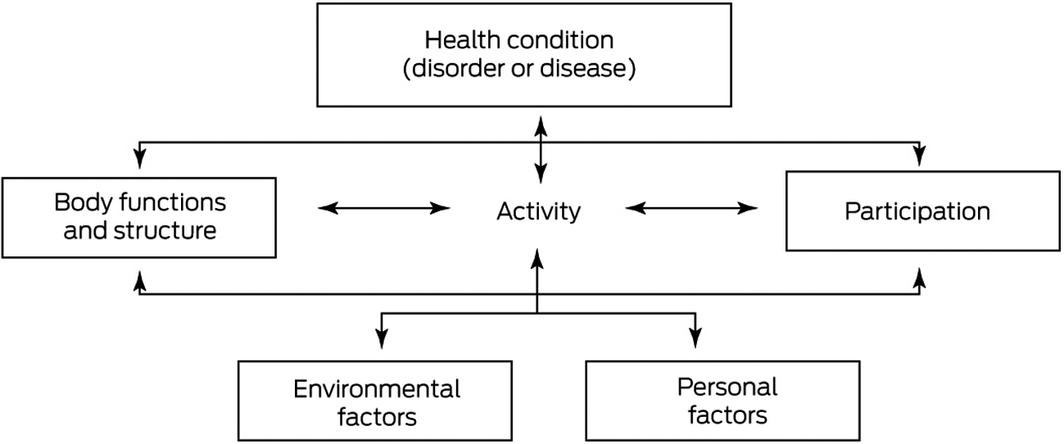
The MDANZ guidance uses the International Classification of Functioning, Disability and Health (ICF) model,5 providing medical educators with internationally recognised language around disability and with a conceptual basis to describe and measure disability. The ICF model acknowledges that disability arises from interactions “of health conditions with contextual factors — environmental and personal factors,” which have either a positive or negative impact on a person’s ability to function.5 It enables its users to quantify functional capacity in terms of “more” or “less” rather than binary “yes” or “no” categories, while retaining the flexibility of thresholds in relation to policies and legislation.5
In acknowledging a person’s health condition but also recognising the positive and negative impacts of environmental and personal factors, the ICF model can help guide admissions to medical schools and participation in activities and assessments within a medical program (Box).
Applying the ICF model
Taking Dinesh Palipana as an example, he has a spinal cord lesion at C6/7 (health condition), which means he has no sensation or ability to move below this level (bodily function and structures). However, he is determined and resilient and has a commitment to innovate and work collaboratively to succeed (personal factors). He has a dedicated support team (environmental factors). GUSOM provided a supportive environment where success was possible, including providing a self‐opening door and a raised computer desk for study (environmental factors). As assessment exams are the common path to graduation, the assessment team considered appropriate reasonable adjustments at the time of admission and throughout the program (environmental factors). All these factors together allowed Palipana to fully participate in all activities of the medical program, including going into theatres on surgical rotations (activities) and to successfully graduate.
Benefits of an inclusive workforce
The medical profession will be richer for including and valuing otherwise qualified persons with disabilities. This is for three reasons. First, their lived experience and empathy with the patient journey can enhance what they offer their patients, as a medical student with a disability has an insider’s view of the patient experience.8,9
Second, increasing the numbers of doctors with disabilities will embed the reality of the continuum of functional capacity for those with disabilities and medical conditions, clarifying that impairment does not equate with incapacity. Having colleagues with disabilities will help reduce the sense of “them” (the patients with a disability) and “us” (the able‐bodied doctors who they rely on for their good health) and will challenge the unconscious bias that goes along with that divide.
Third, having peers with disabilities will help prepare medical students to treat patients with disabilities. In a survey of American medical students, 81% of students reported inadequate competence to treat patients with disabilities. The authors posit that competence would be improved by interaction with peers and colleagues with disabilities.10
Conclusion
The medical model defines impairment but not disability, and therefore, it is unhelpful when considering medical school admissions. The progressive MDANZ’s Inclusive Medical Education guidance provides medical schools with a “fit‐for‐purpose” conceptual framework for considering otherwise qualified applicants with a disability. This guidance will make our medical schools more inclusive and will benefit all.
Competing interests
Both Dinesh Palipana and Liz Fitzmaurice were on the Working Party that produced the MDANZ Inclusive medical education document.
References
- Department of Education Skills and Employment, Australian Government. Disability Standards for Education 2005. https://www.dese.gov.au/disability‐standards‐education‐2005 (viewed Sept 2020).
- Disability Discrimination Act 1992. https://www.legislation.gov.au/Details/C2016C00763 (viewed July 2020).
- Medical Deans Australia and New Zealand. Inherent requirements for studying medicine in Australia and New Zealand; July 2017. https://medicaldeans.org.au/md/2020/12/Inherent‐Requirements‐FINAL‐statement_July‐2017.pdf (viewed July 2020).
- Zorbis J. Australian Medical Association: comment on the Medical Deans inherent requirements for studying medicine in Australia and New Zealand [letter]. Canberra: AMA, 2016. https://www.ama.com.au/sites/default/files/documents/AMA_to_MDANZ_re_Inherent_requirements_3_Jun_16.pdf (viewed July 2020).
- World Health Organization; World Bank. World report on disability. WHO, 2011. https://www.who.int/disabilities/world_report/2011/en/ (viewed July 2020).
- Australian Bureau of Statistics. Disability, ageing and carers, Australia: summary of findings, 2018. https://www.abs.gov.au/ausstats/abs@.nsf/mf/4430.0 (viewed July 2020).
- Medical Deans Australia and New Zealand. Inclusive medical education: guidance on medical program applicants and students with a disability. https://medicaldeans.org.au/md/2021/04/Inclusive‐Medical‐Education‐Guidance‐on‐medical‐program‐applicants‐and‐students‐with‐a‐disability‐Apr‐2021‐1.pdf (viewed Apr 2021).
- Wainapel SF. Unjustified barriers to medical school applicants with physical disabilities. AMA J Ethics 2015; 17: 157–159.
- DeLisa JA, Thomas P. Physicians with disabilities and the physician workforce: a need to reassess our policies. Am J Phys Med Rehabil 2005; 84: 5–11.
- Schwartz CM, Zetkulic M. You belong in the room: addressing the underrepresentation of physicians with physical disabilities. Acad Med 2019; 94: 17–19.
Provenance: Not commissioned; externally peer reviewed.
Shifting focus to adolescent wellbeing and inclusive participation in the digital age
Allyson R Todd, Elena Wang, Stephanie R Partridge
The clinical presentation, investigation, and management of women diagnosed with endometriosis in Australian general practices, 2011–2021: an open cohort study
Danielle Mazza, Kailash Thapaliya, Sharinne B Crawford, Alissia Hui, Maryam Moradi, Luke E Grzeskowiak
The impact of the Breast Screen NSW transition from film to digital mammography, 2002–2016: a linked population health data analysis
Rachel Farber, Nehmat Houssami, Katy J L Bell
Non‐technical errors associated with deaths in surgical care, Australia, 2012–2019, by surgical specialty (Australian and New Zealand Audit of Surgical Mortality): a retrospective cohort study
Jesse Ey, Victoria Kollias, Octavia Lee, Kelly Hou, Matheesha Herath, John B North, Ellie Treloar, Suzanne Edwards, Martin Bruening, Adam J Wells, Guy J Maddern
The CURE Asthma roadmap
Gary P Anderson, Anthony Flynn, Phil G Bardin, John D Blakey, Shyamali C Dharmage, Paul Foster, Peter G Gibson, Adam Jaffe, Alan James, Christine R Jenkins, Sundram Sivamalai, Peter D Sly, Guy B Marks, Vanessa M McDonald, Judy Wetttenhall
Evidence from Australian cohort studies about asthma trajectories and transitions across the life course: a narrative review
Caroline Lodge, Xin Dai, Ingrid A. Laing, Michael P Menden, Anthony Flynn, Gary P Anderson, Sarath Ranganathan, Shyamali C Dharmage