




Volume 215 - Issue 6
A hospital‐wide response to multiple outbreaks of COVID‐19 in health care workers: lessons learned from the field
Authors: Diana Egerton-Warburton, Lisa Kuhn and Daphne Flynn
Med J Aust 2021; 215 (6): 286-286.e1. || doi: 10.5694/mja2.51237
Published online: 20 September 2021
Published online: 20 September 2021
To the Editor: We congratulate Buising and colleagues1 on their article published in the MJA and agree that the approach needs to be multidimensional and iterative. To expand upon the multidimensional theme of their article, we would like to emphasise the need for the approach to be multidisciplinary and to include the whole of the health service workforce. The article highlighted the ubiquitous nature of coronavirus disease 2019 (COVID‐19) transmission in health care settings, with 18.3% (or almost one in five) of health care workers infected, and that these workers are traditionally regarded as non‐clinical staff (food services, environmental services, administrative and security staff). The non‐clinician workforce has been overlooked in other research investigating COVID‐19 transmission risk factors.2
At Monash Health, we used multidisciplinary shift briefings to ensure all health service team members were included in the information and safety messages.3 Human factor‐designed briefing cards, based on the airline industry pre‐flight safety cards, were used to ensure consistent messaging (Box and online Supporting Information). The early involvement of a design team, from the Design Health Collab at Monash University, ensured clear and unambiguous messaging to health care workers. The images were designed to represent diversity in gender, race and role to ensure all health care workers would see themselves reflected in the briefing card and that the safety messages were relevant and directed towards them. Providing information that is timely and accessible as well as readable and visually clear is important.4
Commentaries have emphasised the need for clear and concise communication to ensure the safety and wellbeing of health care workers during the COVID‐19 pandemic.5 However, we believe that involving all workers, not just clinicians, in the safety messages and interventions is paramount to the health and safety of non‐clinical health care workers and to the ongoing operation of health care services.
COVID‐19 does not recognise the individual worker role in the health care service and the pandemic has offered us a unique and powerful opportunity to bring together the whole health care workforce and break down traditional barriers. We believe that a multidisciplinary approach is just as vital as a multidimensional one.
Box – Card used to ensure consistent messaging during shift briefings
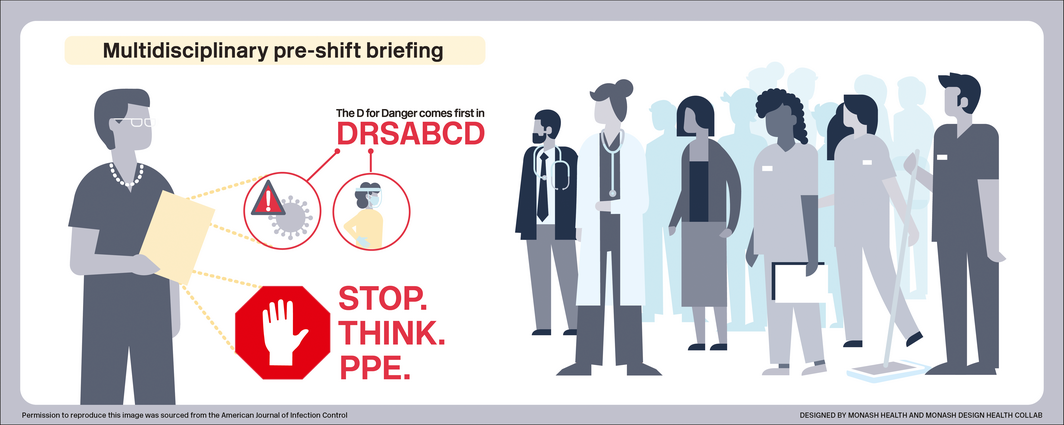
Permission to reproduce this image was obtained from the American Journal of Infection Control.
Competing interests
No relevant disclosures.
References
- Buising KL, Williamson D, Cowie BC, et al. A hospital-wide response to multiple outbreaks of COVID-19 in health care workers: lessons learned from the field. Med J Aust 2021; 214: 101–104. https://www.mja.com.au/journal/2021/214/3/hospital-wide-response-multiple-outbreaks-covid-19-health-care-workers-lessons
- Ran L, Chen X, Wang Y, et al. Risk factors of healthcare workers with Coronavirus Disease 2019: a retrospective cohort study in a designated hospital of Wuhan in China. Clin Infect Dis 2020; 71: 2218–2221.
- Kuhn L, Lim ZJ, Flynn D, et al. Safety briefing and visual design key to protecting health care personnel during the COVID-19 pandemic. Am J Infect Control 2020; 48: 1122–1124.
- Noël G. The role of information design in patient safety: an interview with Jorge Frascara and Keith King. Information Design Journal 2017; 23: 369–375.
- Adams JG, Walls RM. Supporting the health care workforce during the COVID-19 global epidemic. JAMA 2020; 323: 1439–1440.
Linked content
-
MJA Perspective: A hospital‐wide response to multiple outbreaks of COVID‐19 in health care workers: lessons learned from the field
Costs of Delivering the Hep B PAST Model of Care in Remote Australia: A Retrospective Pre–Post Study
Hoa Nguyen, Anh Le Tuan Nguyen, Paula Binks, Melita McKinnon, Emily Vintour-Cesar, Karen Wills, Nicola Stephens, Benjamin Cowie, Joshua S. Davis, Yuejen Zhao, Peter Nihill, Julie A. Campbell, Andrew J. Palmer, Jane Davies, Barbara de Graaff
Buruli Ulcer Acquired From Ringtail Possum Rescue
Daniel P. O'Brien, Naomi Clarke, Sara Bonnici, Mohammad A. Hussain
Q Fever Visceral Abscesses After Contact With Native Australian Marsupials
Samantha J. Laws, Enzo Binotto, James Stewart, Jennifer Ho, Trent Yarwood, Josh Hanson, Simon Smith
Hospital-Admitted Injection-Related Infections Among Incarcerated People Who Inject Drugs in Australia: A Retrospective Cohort Study
Andrew Palmer, Matthew Carter, Jeremy Yeo, Cecilia Shim, Jason Connor, Jeremy Hayllar, Gerald Holtmann, Naomi Moy, Elliott G. Playford, Naomi Runnegar, Paul J. Clark
The Live Attenuated Influenza Vaccine in Australia: An Additional Tool for Influenza Prevention
Cyra Patel, Alexis Pillsbury, Tran Nguyen, Xia Wang, Helen E. Quinn, Clayton K. Chiu, Allen C. Cheng, Katie L. Flanagan, Zhicheng Wang
Reflex Testing for Hepatitis D Infection: A Unique Opportunity to Reduce Hepatitis D-Related Chronic Liver Disease Deaths in Australia
Jessica Howell, Lauren Andersson, Miriam T. Levy, James O'Beirne, Leon Adams, Katharine Irvine, Avik Majumdar, Golo Ahlenstiel, Kathy Jackson, Krispin Hajkowicz, Joseph Doyle, Jane Davies, Sarah Cherian, Wayne Dimech, Alexander J. Thompson