




Volume 215 - Issue 2
Time to address the neglected burden of group A Streptococcus
Authors: Jeffrey W Cannon, Julie Bennett, Michael G Baker and Jonathan R Carapetis
Med J Aust 2021; 215 (2): 94-94.e1. || doi: 10.5694/mja2.51149
Published online: 19 July 2021
Published online: 19 July 2021
To the Editor: The toll of group A Streptococcus is dramatically unappreciated, despite increasing evidence of its burden.1 In Australia and New Zealand, we recently demonstrated that group A streptococcal throat and skin infections cause a sizable burden at the population level — cellulitis is the main contributor to the total burden of all group A streptococcal diseases and acute rheumatic fever and rheumatic heart disease contribute disproportionately relative to their frequency of occurrence.2,3
At a global level, the burden of group A Streptococcus is not abating. Global Burden of Disease data suggest that incident cases and deaths due to rheumatic heart disease alone have surpassed those of meningitis (Box). In 2019, more than 85% of rheumatic heart disease cases occurred among people aged under 35 years.4 No other group A streptococcal‐specific endpoints are available from the Global Burden of Disease data, yet all‐cause cellulitis was ranked the 24th most frequently occurring condition in high income countries in 2019.4 Group A Streptococcus causes outbreaks of poststreptococcal glomerulonephritis, contributing to the burden of chronic renal disease, and it is estimated to be the fifth most lethal pathogen on the planet, behind the human immunodeficiency virus (HIV), Mycobacterium tuberculosis, Plasmodium falciparum and S. pneumoniae, yet expenditure on vaccine development is only 0.17% of that spent on vaccines for HIV infection, malaria and tuberculosis.5
The divergence in numbers of cases and deaths due to group A Streptococcus compared with meningitis partially demonstrates the value of vaccination. Another major benefit of vaccination is a substantial reduction in antibiotic consumption. Indeed, pharyngitis is a major driver of antibiotic consumption globally, and an estimated 17% of antibiotic prescriptions for pharyngitis among children in the United States could be prevented by a group A Streptococcus vaccine.6
Two major initiatives aim to progress vaccine development. The Australian Strep A Vaccine Initiative (ASAVI) and the Strep A Vaccine Global Consortium (SAVAC) are addressing technical and investment barriers and leading at least one of the current vaccine candidates to an efficacy trial for pharyngitis prevention by 2024.5 An effective vaccine may prevent health and economic burdens due to the full range of group A streptococcal diseases and associated antibiotic consumption.
Box – Estimated number of new cases (left) and deaths (right) due to meningitis and rheumatic heart disease globally*
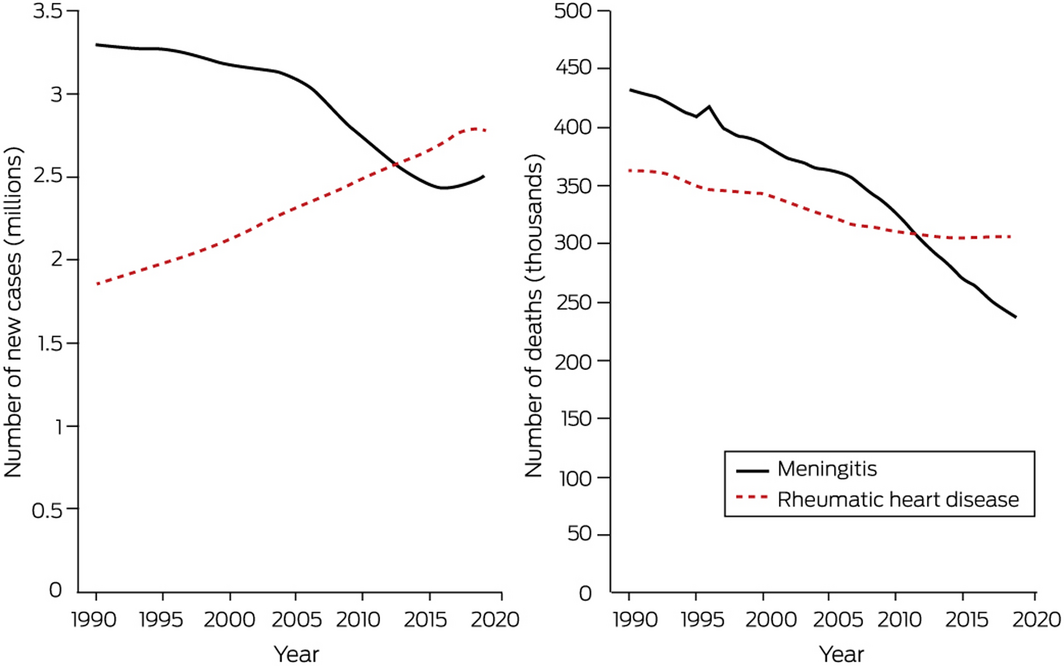
* Data obtained from the Global Burden of Disease study 2019.4
Competing interests
No relevant disclosures.
References
- Barnett TC, Bowen AC, Carapetis JR. The fall and rise of group A Streptococcus diseases. Epidemiol Infect 2019; 147: e4.
- Cannon J, Zhung J, Bennett J, et al. The economic and health burdens of diseases caused by Group A Streptococcus in New Zealand. Int J Infect Dis 2020; 103: 176–181.
- Cannon JW, Jack S, Wu Y, et al. An economic case for a vaccine to prevent group A Streptococcus skin infections. Vaccine 2018; 36: 6968–6978.
- Global Burden of Disease Collaborative Network. Global Burden of Disease study 2019 (GBD 2019) results. Seattle: Institute for Health Metrics and Evaluation, 2020. http://ghdx.healthdata.org/gbd-results-tool (viewed Dec 2020).
- Beaton A, Kamalembo FB, Dale J, et al. The American Heart Association’s call to action for reducing the global burden of rheumatic heart disease: a policy statement from the American Heart Association. Circulation 2020; 142: e358–e368.
- Lewnard JA, King LM, Fleming‐Dutra KE, et al. Incidence of pharyngitis, sinusitis, acute otitis media, and outpatient antibiotic prescribing preventable by vaccination against group A Streptococcus in the United States. Clin Infect Dis 2020; https://doi.org/10.1093/cid/ciaa529 [Epub ahead of print].
Costs of Delivering the Hep B PAST Model of Care in Remote Australia: A Retrospective Pre–Post Study
Hoa Nguyen, Anh Le Tuan Nguyen, Paula Binks, Melita McKinnon, Emily Vintour-Cesar, Karen Wills, Nicola Stephens, Benjamin Cowie, Joshua S. Davis, Yuejen Zhao, Peter Nihill, Julie A. Campbell, Andrew J. Palmer, Jane Davies, Barbara de Graaff
Buruli Ulcer Acquired From Ringtail Possum Rescue
Daniel P. O'Brien, Naomi Clarke, Sara Bonnici, Mohammad A. Hussain
Q Fever Visceral Abscesses After Contact With Native Australian Marsupials
Samantha J. Laws, Enzo Binotto, James Stewart, Jennifer Ho, Trent Yarwood, Josh Hanson, Simon Smith
Hospital-Admitted Injection-Related Infections Among Incarcerated People Who Inject Drugs in Australia: A Retrospective Cohort Study
Andrew Palmer, Matthew Carter, Jeremy Yeo, Cecilia Shim, Jason Connor, Jeremy Hayllar, Gerald Holtmann, Naomi Moy, Elliott G. Playford, Naomi Runnegar, Paul J. Clark
The Live Attenuated Influenza Vaccine in Australia: An Additional Tool for Influenza Prevention
Cyra Patel, Alexis Pillsbury, Tran Nguyen, Xia Wang, Helen E. Quinn, Clayton K. Chiu, Allen C. Cheng, Katie L. Flanagan, Zhicheng Wang
Reflex Testing for Hepatitis D Infection: A Unique Opportunity to Reduce Hepatitis D-Related Chronic Liver Disease Deaths in Australia
Jessica Howell, Lauren Andersson, Miriam T. Levy, James O'Beirne, Leon Adams, Katharine Irvine, Avik Majumdar, Golo Ahlenstiel, Kathy Jackson, Krispin Hajkowicz, Joseph Doyle, Jane Davies, Sarah Cherian, Wayne Dimech, Alexander J. Thompson