




Volume 215 - Issue 10
Angiosarcoma presenting as unexplainable unilateral leg pain and purpuric toes
Authors: Genevieve Ho and Dedee F Murrell
Med J Aust 2021; 215 (10): 456-456. || doi: 10.5694/mja2.51310
Published online: 15 November 2021
Published online: 15 November 2021
An older man presented with increasing pain the in right leg over 3 months, with no relief after femoral artery stenting
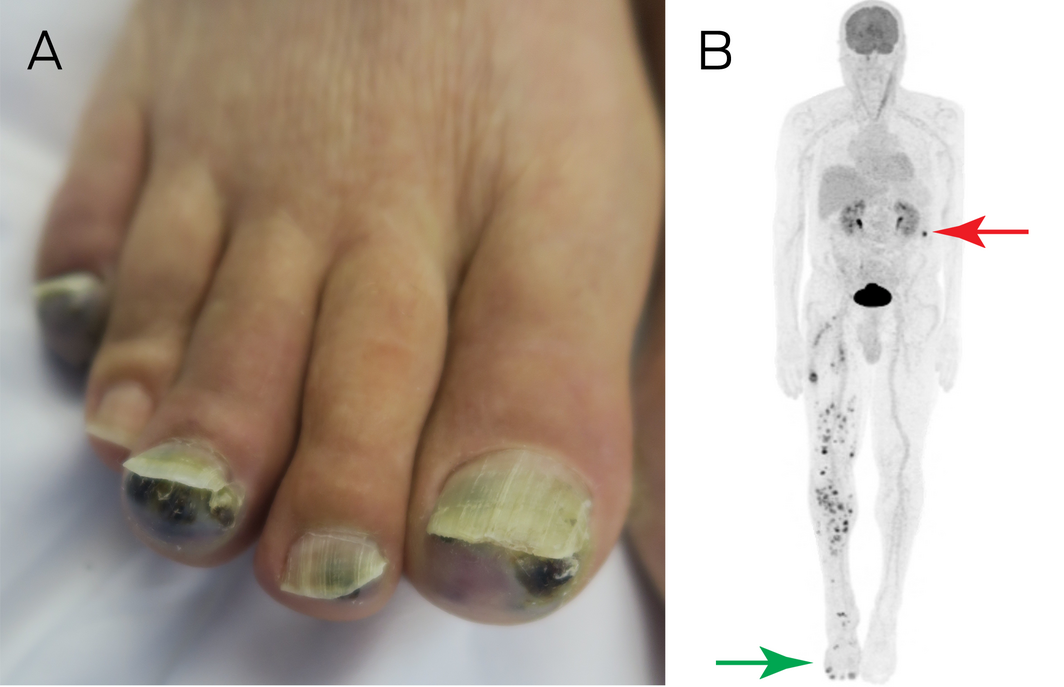
An older man presented with increasing pain the in right leg over 3 months, with no relief after femoral artery stenting. He was non‐diabetic and had a normal nerve conduction study. He developed transient tender purpura on the right anterior thigh, then purple‐black nodules isolated to his toes (Figure, A). He had a strongly positive Ro52 titre, suggesting an underlying immunogenic process (autoimmune, infection, neoplastic).1,2 Fluorodeoxyglucose (FDG)‐positron emission tomography (PET)/computed tomography scan revealed innumerable FDG‐avid lesions in the subcutaneous tissues, muscles and bones of the right lower limb, and a focal serosal deposit (Figure, B). Only the toe lesions were appreciated clinically (Figure, B, green arrow). The image shows a focus of left lateralised abdominal activity, possibly representing a small bowel serosal deposit (Figure, B, red arrow). Skin biopsy of a toe lesion revealed angiosarcoma.
Competing interests
No relevant disclosures.
References
- Hervier B, Rimbert M, Colonna F, et al. Clinical significance of anti‐Ro/SSA‐52 kDa antibodies: a retrospective monocentric study. Rheumatology (Oxford) 2009; 48: 964–967.
- Murng SH, Thomas M. Clinical associations of the positive anti Ro52 without Ro60 autoantibodies: undifferentiated connective tissue diseases. J Clin Pathol 2018; 71: 12–19.
From Ambition to Action: Closing Policy, Equity and Implementation Gaps in the Australian Cancer Plan's ‘Enhanced Consumer Experience’
Carla Thamm, Elise Button, Oluwaseyifunmi A. Agbejule, Reegan Knowles, Karen van Gorp, Mark B. Pinkham, Meinir Krishnasamy, Alexandra L. McCarthy, Raymond J. Chan
Sovereignty and Survival: Understanding Lung Cancer Outcomes for Aboriginal and Torres Strait Islander People in Australia, a Case–Control Study
Alice R. T. Bergin, Luc te Marvelde, Roger L. Milne, Benjamin J. Solomon, Kris Ivanova, Peter Savas, Stephen J. Luen, Jay Hamann, Andrea Casey, Nicole Watt, Sue M. Evans, Gail Garvey, Sherene Loi
The Changing Indications for Adult Liver Transplantation in Australia: A Narrative Review
Fadak Mohammadi, Alan J. Wigg, Ken Liu, Simone I. Strasser
Uneven Ground: Survival Differences Among Victorian Lung Cancer Patients by Location of Residence (2011–2023): A Retrospective Cohort Study
Evangeline Samuel, Eldho Paul, Mike Lloyd, Sanuki Tissera, Craig Underhill, Sagun Parakh, Phillip Parente, Inger Olesen, Javier Torres, Katharine See, Gavin M. Wright, David Langton, Thomas John, Matthew Conron, James Bartlett, Nicola Atkin, Nikolajs Zeps, Susan V. Harden, Wasek Faisal, John R. Zalcberg, Rob G. Stirling
Early-Onset Colorectal Cancer With Liver-Only Metastases: A Retrospective Cohort Study Integrating Prospectively Collected Real-World Clinical and Molecular Data From an Australian National Database (2009–2024) to Guide Treatment Planning
Savio G. Barreto, Christos S. Karapetis, Shahid Ullah, Matthew Burge, Susan Caird, Angus Campbell, Azim Jalali, Ross Jennens, Muhammad A. Khattak, Belinda Lee, Stephanie H. Lim, Shehara Mendis, Louise Nott, Timothy J. Price, Jeremy D. Shapiro, Jeanne Tie, Javier Torres, Colin Williams, Rachel Wong, Vanessa Wong, Peter Gibbs
Australian Pathways for Specialist Pain Management and Early Palliative Care for People With Pancreatic Cancer: Developed Using a Community Consensus Approach
Jennifer Philip, Melanie R. Lovell, Kylee Bellingham, Gail Garvey, Gregory B. Crawford, Nicole M. Rankin, Kara Burns, Isabel Young, Vivienne Milch, Dorothy Keefe, Katrina Anderson, James Lawson, Meinir Krishnasamy