




Volume 214 - Issue 4
Non‐invasive prenatal testing: clinical utility and ethical concerns about recent advances
Authors: Joseph Thomas, James Harraway and David Kirchhoffer
Med J Aust 2021; 214 (4): 168-170.e1. || doi: 10.5694/mja2.50928
Published online: 15 February 2021
Published online: 15 February 2021
Difficulty in achieving proper informed consent for a complex screening test and the varying phenotypic outcomes leaves pregnant women in a precarious situation when results are abnormal
The combined first trimester screening test for Down syndrome, involving a nuchal translucency scan and biochemistry at 11–13 weeks, improved detection rates to 90% when compared with the sensitivity of screening by age‐related a priori risk of around 30% for a false positive rate of 5%.1 The advent of non‐invasive prenatal testing (NIPT) in 2010 as a screening test for the common trisomies was revolutionary, with sensitivity, specificity and detection rates unmatched by the combined first trimester screening programs. NIPT was found to achieve a detection rate for Down syndrome of 99.7%, with a false positive rate of 0.04%.2 However, some NIPT providers now additionally offer extended panels and low resolution whole genome sequencing (WGS) including sex chromosome aneuploidies, rare autosomal aneuploidies, and subchromosomal deletions, duplications and recurrent microdeletions. This comes at a cost of a higher false positive rate and lower positive predictive value.3 Moreover, the expanded panels and WGS NIPT raise issues of clinical utility and ethical concerns.4,5
Clinical utility
Screening not diagnosis
NIPT is based on the detection of cell‐free fetal DNA in the maternal circulation. The placental origin of cell‐free fetal DNA means that NIPT can only be a screening test and is not diagnostic.6 NIPT findings can be confounded by confined placental mosaicism, cell‐free fetal DNA from a demised co‐twin placenta, maternal chromosomal changes or malignancy.6,7 Moreover, a NIPT result will be issued even if the fetus is demised. The current NIPT tests available are for specific chromosomal aneuploidy, extended panels of targeted conditions and low resolution WGS.
Targeted and low resolution WGS NIPT
Targeted NIPTs (Box 1) interrogate specific chromosomes: standard (usually 13, 18, 21, X and Y) or extended (specific recurrent microdeletions associated with known syndromes, such as 22q11.2 microdeletion [DiGeorge syndrome]).8 Many abnormalities that can be detected by targeted NIPT have varying clinical outcomes (eg, sex chromosome abnormalities and DiGeorge syndrome). Each of these conditions has varying sensitivity, specificity and positive predictive value.
Other NIPTs interrogate every chromosome (by low resolution WGS). These tests can potentially screen for aneuploidy of every chromosome (all 22 autosomes and the sex chromosomes), and for subchromosomal gains and losses on every chromosome. There is potential utility in detecting rare or novel large subchromosomal imbalances, as they are likely to be associated with abnormal clinical phenotype when present in the fetus, and may indicate a familial balanced rearrangement. The clinical utility of screening for rare autosomal aneuploidies is less certain. Most rare autosomal aneuploidies (95%) are confined to the placenta, and those which are present in the fetus as well as the placenta often result in early fetal demise.9
The resolution of WGS NIPT is likely to increase as deeper sequencing becomes viable and cost‐effective. Whereas prenatal microarray testing of amniotic fluid in Australia is primarily used in the context of a fetal structural abnormality, higher resolution NIPT could become a general screening test. This would, however, increase both the number of variants of uncertain significance and the likelihood that they are detected in an apparently phenotypically normal fetus.3,10
Ethical concerns
Respect for maternal autonomy is an important ethical principle in clinical guidelines for prenatal screening. Recommendation 2 of the Royal Australian and New Zealand College of Obstetricians and Gynaecologists guidelines states: “Screening or diagnostic testing for fetal chromosomal and genetic conditions is voluntary and should only be undertaken as an informed decision by the pregnant woman”.11 In light of the issues surrounding clinical utility and complexity of expanded panels and WGS NIPT, care needs to be taken to ensure that autonomy is respected. Moreover, consent alone cannot be expected to do the ethical heavy lifting, because of (i) the challenges in providing adequate information arising from complexity of the tests; (ii) the risk of power imbalances and “normalisation” of testing; (iii) anxiety resulting from complex and potentially unnecessary medical decisions; (iv) the problem of screening for “normality” and genetic reductionism; and (v) the doctor’s responsibility in determining which NIPT test is clinically indicated.
Complexity endangers informed consent
Respect for autonomy requires that informed consent is obtained. From a medico‐legal perspective, consent must be given voluntarily. The individual must also be sufficiently informed regarding a test or procedure, including the associated risks and benefits. The requisite extent of information provision is generally determined in accordance with what information a reasonable person, in that person’s circumstances, would expect to receive. From an ethical perspective, however, it is the understanding of information that is important, not merely that a person was given the legally required information. Given the complexity of extended panels and WGS NIPT, ensuring understanding means that significant time needs to be invested.
Power imbalances and normalisation
Two additional factors could ethically undermine consent for all NIPT options. First, the power imbalance between a doctor and patient, whereby a patient simply agrees because “doctor knows best” and, second, the impression that NIPT is a normal part of care that it would be foolish to reject.12
The anxiety caused by uncertain results
It is tempting to respect autonomy by being non‐paternalistic and non‐directive in counselling by giving parents all the information from prenatal testing regardless of its nature. However, this shifts the burden of the uncertain results and the resultant anxiety to the parents. Qualitative and quantitative research shows higher levels of decisional regret among parents whose results identified variation of uncertain significance. At least some parents would not have consented to the test if they had known what this would entail. The lack of certainty by clinicians about what these results might actually mean for a future child increased parental distress.13
The meaning of screening and the danger of genetic reductionism
According to the synthesis of screening criteria offered by Andermann and colleagues (Box 2), screening should be used to identify an individual who is high risk for a specific disease or need, thereby filling the perceived gap between standard screening and invasive diagnostics.14 Screening is then followed up with diagnostic tests and appropriate treatment.
The availability of extended panels and WGS NIPT (Box 1) increases the tendency away from screening for diseases guided by public health screening principles. It is difficult to identify a recognised need or define the objectives of the screening beyond merely looking to see if there is anything abnormal. Even if these principles were met, one may be detecting placental pathology, or clinical conditions with highly variable outcomes for the fetus. As the resolution of WGS NIPT increases, so does the likelihood of detecting variants of uncertain significance.
Provision of extended panels and WGS NIPT should be seen in light of the bigger question of how we see genetic information in our society.15 Research shows that many genetic tests are in effect screening for “normality”, which partly explains the anxiety when variants of uncertain significance are reported.13 This approach potentially changes the purpose of screening from screening for a specific disease to screening for normality by identifying any abnormality in the genome.
The error in this thinking is that it assumes that genetic variation is abnormal. Just because a genetic anomaly can be identified does not necessarily mean that it would be phenotypically expressed. Similarly, detection of genes associated with adult onset disease does not necessarily equate to disease, and the possible future development of therapies for currently untreatable conditions cannot be ruled out.
Consent is not sufficient to justify a procedure of questionable clinical utility
Screening should be recommended or chosen only if there is likely to be a proportionate benefit, and there is no disproportionate burden. What is proportionate rests on a number of objective and subjective factors, but the aforementioned public health screening principles provide a good starting point. We agree with national guidelines that recommend against routine screening for recurrent microdeletions, and recommend provision of in‐depth counselling before screening for sex chromosome abnormalities.11
Recommendations
The following recommendations may address the clinical and ethical concerns outlined above.
- Informed consent is required for all NIPT tests, especially in the context of extended panels and WGS NIPT. Clinicians must understand the different abnormalities targeted by extended NIPT panels and be able to assess and communicate the clinical utility of screening in accordance with a particular patient’s needs, desires and circumstances (Box 1).
- If ordering WGS NIPT, given that there may be significant uncertainty as to the actual phenotypic or functional manifestation of a genetic variation in a particular child, the consent process should include helping to contextualise limitations and risks in the broader context of the human experience of risk and uncertainty.
- Genuine shared decision‐making models can empower patient autonomy by helping them to understand the implications of their possible decisions in relation to their values.16 Moreover, decision tools and algorithms that align a variety of scenarios with personal values can facilitate a high quality informed consent process.
- Higher resolution WGS NIPT should only be used for research purposes until we have robust data regarding its clinical utility.
Box 1 – Non‐invasive prenatal testing (NIPT) options: current availability and main advantages and disadvantages
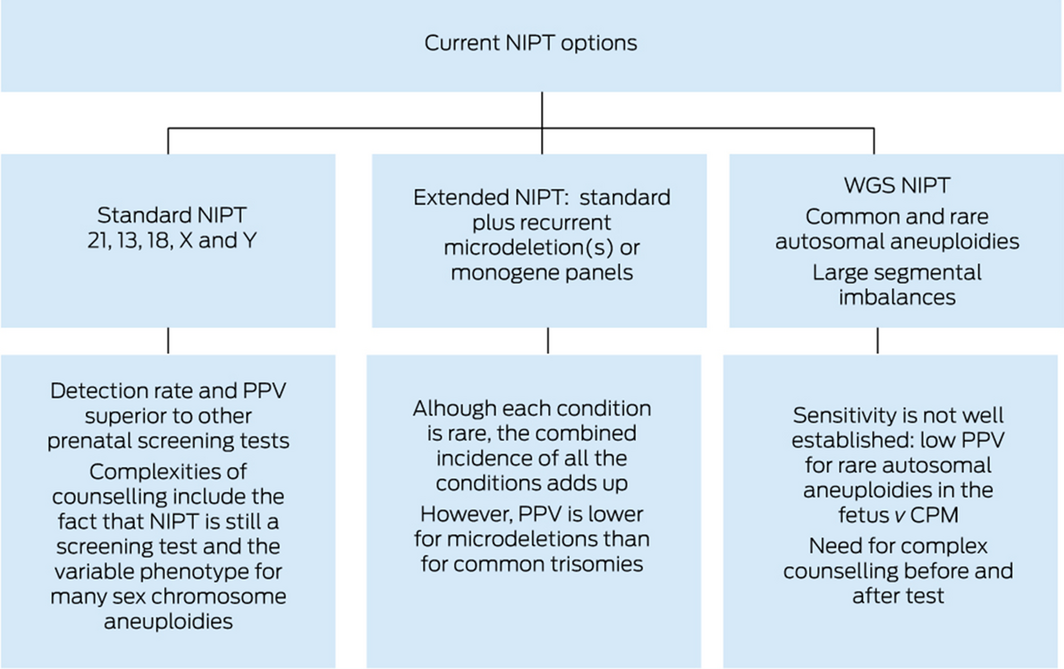
CPM = confined placental mosaicism; PPV = positive predictive value; WGS = whole genome sequencing.
Box 2 – Synthesis of screening criteria12
- The screening program should respond to a recognised need.
- The objectives of screening should be defined at the outset.
- There should be a defined target population.
- There should be scientific evidence of screening program effectiveness.
- The program should integrate education, testing, clinical services and program management.
- There should be quality assurance, with mechanisms to minimise potential risks of screening.
- The program should ensure informed choice, confidentiality and respect for autonomy.
- The program should promote equity and access to screening for the entire target population.
- Program evaluation should be planned from the outset.
- The overall benefits of screening should outweigh the harm.
Competing interests
No relevant disclosures.
Acknowledgements
We thank Sailesh Kumar, Robert Cincotta, Glenn Gardener, Scott Petersen (Mater Centre for Maternal Fetal Medicine, Brisbane) and Larry Bergstrom (Mayo Clinic, United States) for valuable discussions and feedback on the topic.
References
- Nicolaides KH. Patient‐specific risk for chromosomal defects in the 11–13+6 weeks scan. London: Fetal Medicine Foundation, 2004: pp. 13–14.
- Gil MM, Accurti V, Santacruz B, et al. Analysis of cell‐free DNA in maternal blood in screening for aneuploidies: updated meta‐analysis. Ultrasound Obstet Gynecol 2017; 50: 302–314.
- Benn P, Grati FR. Genome‐wide non‐invasive prenatal screening for all cytogenetically visible imbalances. Ultrasound Obstet Gynecol 2018; 51: 429–433.
- Chitty LS, Hudgins L, Norton ME. Current controversies in prenatal diagnosis 2: cell‐free DNA prenatal screening should be used to identify all chromosome abnormalities. Prenat Diagn 2018; 38: 160–165.
- Rieder W, White S, McGillivray G, Hui L. Contemporary prenatal aneuploidy screening practice in Australia: frequently asked questions in the cell‐free DNA era. Aust N Z J Obstet Gynaecol 2018; 58: 397–403.
- Hayata K, Hiramatsu Y, Masuyama H, et al. Discrepancy between non‐invasive prenatal genetic testing (NIPT) and amniotic chromosomal test due to placental mosaicism: a case report and literature review. Acta Med Okayama 2017; 71: 181–185.
- Yu T, Li S, Zhao W, Yu D. [False positive non‐invasive prenatal testing results due to vanishing twins]. Zhonghua Yi Xue Yi Chuan Xue Za Zhi 2019; 36: 327–330.
- Shaffer BL, Norton ME. Cell‐free DNA screening for aneuploidy and microdeletion syndromes. Obstet Gynecol Clin North Am 2018; 45: 13–26.
- Pertile MD, Halks‐Miller M, Flowers N, et al. Rare autosomal trisomies, revealed by maternal plasma DNA sequencing, suggest increased risk of feto‐placental disease. Sci Transl Med 2017; 9: eaan1240.
- Shaw J, Scotchman E, Chandler N, Chitty L. Non‐invasive prenatal testing for aneuploidy, copy number variants and single gene disorders. Reproduction 2020; 160: A1–A11.
- Royal Australian and New Zealand College of Obstetricians and Gynaecologists. Prenatal screening and diagnostic testing for fetal chromosomal and genetic conditions. Sydney: RANZCOG, 2018. https://ranzcog.edu.au/RANZCOG_SITE/media/RANZCOG-MEDIA/Women%27s%20Health/Statement%20and%20guidelines/Clinical-Obstetrics/Prenatal-screening_1.pdf?ext=.pdf (viewed Dec 2020).
- Cernat A, De Freitas C, Majid U, et al. Facilitating informed choice about non‐invasive prenatal testing (NIPT): a systematic review and qualitative meta‐synthesis of women’s experiences. BMC Pregnancy Childbirth 2019; 19: 27.
- Werner‐Lin A, McCoyd JLM, Bernhardt BA. Actions and uncertainty: how prenatally diagnosed variants of uncertain significance become actionable. Hastings Cent Rep 2019; 49 Suppl 1: S61–S71.
- Andermann A, Blancquaert I, Beauchamp S, Dery V. Revisiting Wilson and Jungner in the genomic age: a review of screening criteria over the past 40 years. Bull World Health Organ 2008; 86: 317–319.
- Brownsworld RW. Testing times ahead: non‐invasive prenatal testing and the kind of community we want to be. Mod Law Rev 2018; 18: 646–672.
- Ubel PA, Scherr KA, Fagerlin A. Autonomy: what’s shared decision making have to do with it? Am J Bioeth 2018; 18: W11–W12.
Linked content
-
InSight+: Non-invasive prenatal testing: clinical utility, ethical concerns
-
MJA Ethics and Law: Ethical issues in reproductive genetic carrier screening
Provenance: Not commissioned; externally peer reviewed.
Forty Years in the Making: Reporting on the Co-Creation of a National Roadmap for Birthing on Country Services for the Best Start to Life
Res McCalman, Anneka J. Bowman, Roianne West, Kristie Watego, Jyai Allen, Claire Clack, Sue Kildea, Sue Kruske, Melanie Briggs, Cleone Wellington, Rebecca Coddington, Yu Gao, Isabella Garti, Sascha Kowalenko, Sarah Ireland, Catherine Austin, John D. Boffa, Marah Prior, Kelsie Kahl, Bettina Chaseling, Sarah Khaw, Emily Armstrong, Donna Hartz, Yvette Roe
Temporal Trends in Preterm Birth Associated With Hypertensive Disorders of Pregnancy in Victoria, Australia: A Population-Based Interrupted Time-Series Study
Melvin Marzan, Heng Jiang, Daniel Lorber Rolnik, Joanne M. Said, Lisa Hui
Linguistic Manoeuvres: Obstetric Violence Camouflages Harm and Loss of Consent From Birth
Liz Sutton, Harsha Ananthram, Rebecca Matthews
Linguistic Manoeuvres: Obstetric Violence Camouflages Harm and Loss of Consent From Birth
Bashi Kumar-Hazard, Andrew M. Bisits, Sharon L. Settecasse, Jenny Gamble, Hazel Keedle, Hannah G. Dahlen
Linguistic Manoeuvres: Obstetric Violence Camouflages Harm and Loss of Consent From Birth
Wendy Pollock, Alissa Fleming, Ensieh Fooladi, Joy Kloester, Anne Tremayne, Yasmin Zisin, Bethany Carr, Kym Davey, Suzanne Willey, Jenny Gamble
Getting on the Same Page: Why Australia Needs a National Maternity Early Warning System (MEWS) Chart
Briony A. Cutts, Lucy Bowyer, Nisha Khot, Sandra Lowe, Stefan C. Kane