




Volume 213 - Issue 9
Chimeric antigen receptor T‐cell therapy for haematological malignancies
Authors: Adrian G Selim and Constantine S Tam
Med J Aust 2020; 213 (9): 404-406.e1. || doi: 10.5694/mja2.50783
Published online: 21 September 2020
Published online: 21 September 2020
The advent of CAR T‐cell therapy has seen significant improvements in survival and is a potential cure for patients with advanced haematological malignancies
Cancer immunotherapy is a burgeoning field which, in the last decade, has produced unprecedented improvements in outcomes across a variety of advanced malignancies. The eventual translation of decades of research into clinically available immunotherapies stems from the expanded knowledge of the role that the immune system plays in preventing tumour initiation and progression as well as the mechanisms by which tumours learn to evade this immune surveillance.1
Immunotherapies that have reached the clinic include monoclonal antibodies and, more recently, their augmented counterparts including antibody–drug conjugates and bi‐specific T‐cell engagers. Other treatments are immunomodulatory, meaning that they augment endogenous anti‐tumour immune activity. These include immune checkpoint inhibitors such as pembrolizumab, which are prolonging survival in melanoma and several solid organ malignancies as well as relapsed or refractory Hodgkin lymphoma.
Cellular immunotherapies offer the potential to overcome immune tolerance and generate immune memory.1 Allogeneic stem cell transplantation (ASCT), a largely unmanipulated form of cellular immunotherapy, acts by completely replacing the recipient’s entire haematopoeitic and immune systems, leveraging differences between the recipient and donor to produce a graft‐versus‐tumour effect, with the potential negative consequence of immune attack on recipient’s normal tissues, known as graft‐versus‐host disease, as well as other serious toxicities. ASCT has been the only curative option for many patients with haematological malignancies. However, it is generally considered a consolidative therapy; that is, the patient’s malignancy must be in or near complete remission in order to be effective. This is not always possible in refractory cases. For others, ASCT may be contraindicated because of age or comorbidities.
With advances in genetic manipulation technology, the notion of combining the specificity of a monoclonal antibody with the cytotoxicity and memory of a T‐cell came to fruition in the chimeric antigen receptor (CAR) T‐cell. “Chimeric” here means that the DNA comes from two or more sources; the antigen‐binding domain of the CAR construct is an antibody fragment, tethered to the intracellular signalling domain of the T‐cell receptor, with an additional co‐stimulatory domain acting to improve their expansion and persistence in vivo.
The fundamental steps in generating and delivering CAR T‐cell therapy are summarised in Box 1.2 Specific toxicities are characteristic of CAR T‐cell therapy, the two most important being cytokine release syndrome and neurotoxicity. Cytokine release syndrome is an inflammatory state induced by the rapid proliferation of CAR T‐cells and tumour cell death, releasing an array of inflammatory cytokines. The hallmark is a fever, with the potential for hypotension, hypoxia and organ dysfunction. As one of the key cytokines driving the syndrome is interleukin‐6, its blockade using the interleukin‐6 receptor antagonist tocilizumab is now routinely used for more severe grades of cytokine release syndrome.
The pathogenesis of neurotoxicity has not been fully elucidated; however, it most often manifests with speech disturbance or aphasia, dysgraphia and attention deficits, with more severe manifestations including altered level of consciousness, seizures and, rarely, cerebral oedema. Fortunately, even patients with severe neurotoxicity who are adequately supported in intensive care settings most often have complete neurological recovery.
By far the most successful antigen target of all CAR T‐cell therapies developed to date is the pan‐B‐cell antigen CD19, as it arguably comes closest to the characteristics of an ideal target. CD19 is widely expressed across the full maturation spectrum of B‐cell malignancies, from B‐cell lymphoblastic leukaemia cells to mature B‐cell lymphomas, giving broad applicability. Second, CD19 is only expressed on B‐cells (normal and malignant) and not other tissues. Third, the toxicity resulting from the on‐target, off‐tumour effects, in this case normal B‐cell aplasia, is manageable by immunoglobulin replacement in patients who experience recurrent or severe infections.
The decision for health authorities to fund a personalised, genetically engineered treatment is a complex one, taking into account considerations such as cost, efficacy, safety, the level of evidence and the maturity of outcome data, alternative therapies, equity of access, and resource utilisation. The cost of a single product is measured in hundreds of thousands of dollars and the mechanism by which such therapies will be funded is certainly not self‐evident. In the Australian context, the new therapy is evaluated by the Medical Services Advisory Committee, an independent committee that appraises new medical services proposed for public funding, taking into account all the above‐mentioned considerations, and providing advice to government. Moreover, given the high cost and limited, immature data, regulatory bodies worldwide have come to unprecedented outcomes‐based reimbursement agreements with pharmaceutical companies — such as rebates and staged payments according to defined response criteria — in order to mitigate risk.
Two CAR T‐cell products targeting CD19 were approved by the United States Food and Drug Administration in 2017 and 2018: tisagenlecleucel and axicabtagene ciloleucel. The landmark studies which led to their approval, and a summary of their key outcomes, are shown in Box 2.3,4,5,6 In Australia, tisagenlecleucel is approved by the Therapeutic Goods Administration for paediatric and young adult patients up to 25 years of age with B‐cell lymphoblastic leukaemia that is refractory, in relapse after transplant or in second or later relapse, as well as adult patients with relapsed or refractory diffuse large B‐cell lymphoma after two or more lines of systemic therapy. In April 2019, a joint state and federal government funding initiative commenced for tisagenlecleucel for the B‐cell lymphoblastic leukaemia indication, and in January 2020, the government announced its funding for diffuse large B‐cell lymphoma. Soon after, the Therapeutic Goods Administration approved axicabtagene ciloleucel in February 2020 and the Medical Services Advisory Committee made a positive recommendation for its public funding for the lymphoma indication. Further, Novartis announced an agreement with an Australian cell and gene therapy manufacturing company for manufacture of tisagenlecleucel for the region to commence in late 2020 (https://www.celltherapies.com.au/kymriah-to-be-manufactured-at-cell-therapies-pty-ltd-marking-australias-first-on-shore-commercial-production-of-car-t-therapy/).
In the case of tisagenlecleucel for relapsed or refractory B‐cell lymphoblastic leukaemia, evaluation began with a comparison with best available therapy. In the ELIANA trial4 outcomes compared very favourably with other chemo‐ or immunotherapeutic salvage options such as clofarabine7 and blinatumumab,8 respectively. For example, blinatumomab, a bispecific T‐cell engager, in the paediatric relapsed or refractory setting produced a complete remission rate of 39% within the first two cycles, with a relapse‐free survival at 6 months of 42%, and this therapy is considered to be a bridging therapy to ASCT. Tisagenlecleucel on the other hand can be used as a stand‐alone therapy; however, it is notable that a substantial proportion of responders do relapse, particularly between 6 and 12 months, which raises the question of whether this treatment should also serve as a bridge to ASCT. The available evidence is currently insufficient to confidently provide an answer, and practice therefore varies among treating centres worldwide. However, a major concern is the financial implications of CAR T‐cell therapy as a bridge to ASCT, which itself is a highly resource‐intensive therapy, with some suggestion that the cost‐effectiveness may be unbalanced if this practice were routine.
In the case of high grade B‐cell lymphomas, patient outcomes also appear to be superior to other available treatments in the third line setting. In the ZUMA‐1 trial, the recently updated 3‐year overall survival rate of 47% does likely reflect a significant cure fraction.6 In comparison, the SCHOLAR‐1 retrospective study of the outcomes of patients with refractory diffuse large B‐cell lymphoma showed that this pooled patient population only achieved complete remission rates of 7% with conventional therapies and had a median overall survival of 6.3 months.9
One concern is that the outcomes of the CAR T‐cell trials may not be generalisable to the real‐world population where patient selection may not be as strict as in clinical trials. Interestingly, the real‐world data seems to be conflicted on this, with the US experience from the Center for International Blood and Marrow Transplant Research registry being comparable to trial data for both tisagenlecleucel and axicabtagene ciloleucel, while preliminary United Kingdom experience appears to be considerably worse.10,11,12 The cause of this discrepancy is unclear.
In terms of future directions, many clinical trials are assessing CAR T‐cells in earlier lines of therapy. For example, two trials are randomising patients in first relapse of large B‐cell lymphoma to receive either CAR T‐cell therapy or standard salvage plus autologous stem cell transplant: ZUMA‐7 (NCT03391466) and BELINDA (NCT03570892). The results of these trials, if favourable, could greatly alter treatment paradigms. Other trials are assessing CAR T‐cells in other B‐cell lymphomas, such as follicular non‐Hodgkin lymphoma (ELARA [NCT03568461]) and mantle cell lymphoma.13 The response to KTE‐X19, an anti‐CD19 CAR T‐cell therapy with a manufacturing process that removes circulating tumour cells, seen in the ZUMA‐2 trial in relapsed or refractory mantle cell lymphoma (overall response rate of 93%) is the highest reported response rate in patients with mantle cell lymphoma who failed previous BTK inhibitor treatment, with a high proportion of durable responses in this very challenging malignancy.13
Strategies to improve the availability and timeliness of CAR T‐cell therapy include the development of third party allogeneic CAR T‐cells, which could produce off‐the‐shelf treatments for many patients. Other alterations to the CAR construct aim to improve characteristics such as persistence and safety, as well as addressing the problem of antigen escape, where the malignancy loses the targeted antigen, potentially through multi‐antigen targeting. Others are combining CAR T‐cells with immunomodulatory therapies such as immune checkpoint inhibition to improve efficacy.
Finally, there is great interest in CAR T‐cell therapies for malignancies such as multiple myeloma, acute myeloid leukaemia and T‐cell lymphomas and leukaemias, many of which are at various phases of clinical trials. The furthest advanced are CAR T‐cell therapies targeting B‐cell maturation antigen in multiple myeloma. JNJ‐4528, an investigational B‐cell maturation antigen CAR T‐cell therapy, has recently demonstrated very high response rates in the phase 1b/2 CARTITUDE‐1 study in relapsed or refractory myeloma.14 In the 29‐patient cohort, the overall response rate was 100%, with 69% complete remission, the median time to complete remission being 1 month, and measurable residual disease negativity in all 17 evaluable patients.
These are very promising times in cancer immunotherapy and the task ahead for regulatory authorities will be immense as evidence rapidly accumulates for these high cost therapies. In the meantime, we are pleased to add CD19 CAR T‐cell therapy to our armamentarium and await the results of trials across a wide range of haematological and solid organ malignancies.
Box 1 – Overview of the processes for manufacture and delivery of a chimeric antigen receptor (CAR) T‐cell product
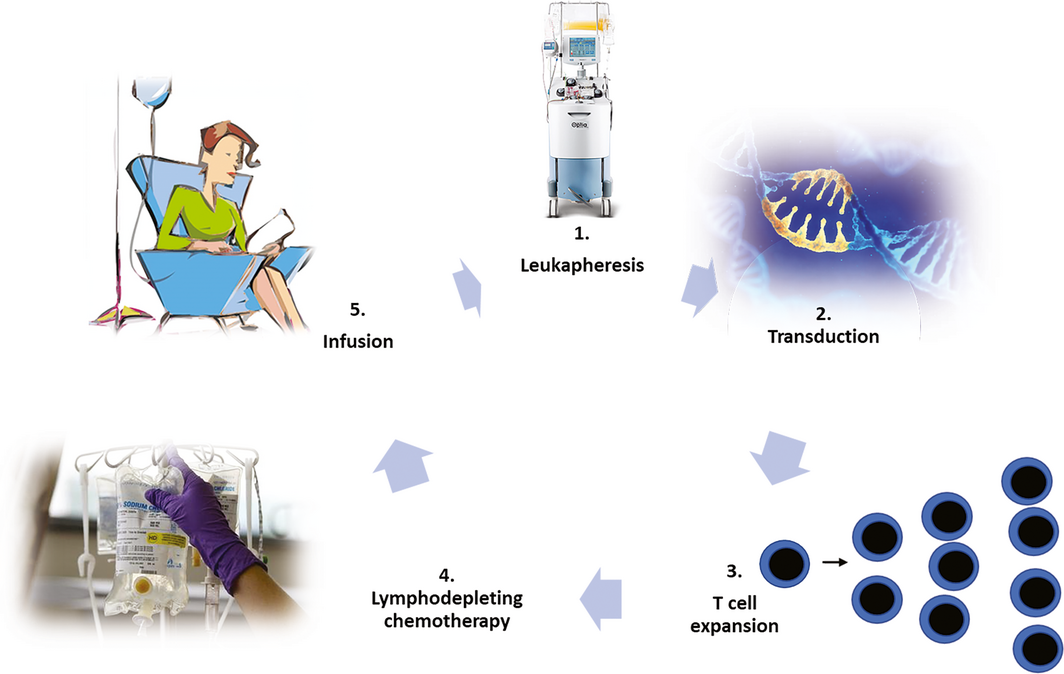
Procurement of T-cells, usually via leukapheresis (1); transduction of the CAR genes via viral vector or non-viral methods (2); ex vivo expansion of the CAR T-cells (3); preconditioning with lymphodepleting chemotherapy (4); and infusion into a patient (5). ◆
Box 2 – Summary of data from pivotal CD19 chimeric antigen receptor (CAR) T‐cell trials
|
Trial name |
CAR T‐cell product |
Disease |
Complete response rate |
Other response parameters |
Safety |
||||||||||
|
|
|||||||||||||||
|
ELIANA4 |
Tisagenlecleucel |
Relapsed or refractory paediatric B‐ALL |
81% |
12‐month OS, 76%; |
Grade ≥ 3 CRS, 47% |
||||||||||
|
JULIET5 |
Tisagenlecleucel |
Relapsed or refractory DLBCL |
38% |
Median OS, 12 months |
Grade ≥ 3 CRS, 23% |
||||||||||
|
Axicabtagene ciloleucel |
Relapsed or refractory DLBCL |
58% |
3‐year OS, 47% |
Grade ≥ 3 CRS, 13% |
|||||||||||
|
|
|||||||||||||||
|
B‐ALL = B‐cell acute lymphoblastic leukaemia; CRS = cytokine release syndrome; DLBCL = diffuse large B‐cell lymphoma; EFS = event‐free survival; NT = neurotoxicity; OS = overall survival. |
|||||||||||||||
Competing interests
Adrian Selim has received honoraria from Novartis. Constantine Tam was a principal investigator on the JULIET study sponsored by Novartis, and receives research funding from Janssen and AbbVie, and honoraria from Janssen, AbbVie, BeiGene, Novartis and Roche.
References
- Maus MV, Levine BL. Chimeric antigen receptor t‐cell therapy for the community oncologist. Oncologist 2016; 21: 608–617.
- Gill S, Maus MV, Porter DL. Chimeric antigen receptor T cell therapy: 25 years in the making. Blood Rev 2016; 30: 157–167.
- Locke FL, Ghobadi A, Jacobson CA, et al. Long‐term safety and activity of axicabtagene ciloleucel in refractory large B‐cell lymphoma (ZUMA‐1): a single‐arm, multicentre, phase 1–2 trial. Lancet Oncol 2019; 20: 31–42.
- Maude SL, Laetsch TW, Buechner J, et al. Tisagenlecleucel in children and young adults with b‐cell lymphoblastic leukemia. N Engl J Med 2018; 378: 439–448.
- Schuster SJ, Bishop MR, Tam CS, et al. Tisagenlecleucel in adult relapsed or refractory diffuse large b‐cell lymphoma. N Engl J Med 2018; 380: 45–56.
- Neelapu S, Rossi J, Jacobson C. CD19‐loss with preservation of other B cell lineage features in patients with large B cell lymphoma who relapsed post–axi‐cel [abstract]. Blood 2019; 134 (Suppl 1): 203.
- Jeha S, Gaynon PS, Razzouk BI, et al. Phase II study of clofarabine in pediatric patients with refractory or relapsed acute lymphoblastic leukemia. J Clin Oncol 2006; 24: 1917–1923.
- von Stackelberg A, Locatelli F, Zugmaier G, et al. Phase I/phase II study of blinatumomab in pediatric patients with relapsed/refractory acute lymphoblastic leukemia. J Clin Oncol 2016; 34: 4381–4389.
- Crump M, Neelapu SS, Farooq U, et al. Outcomes in refractory diffuse large B‐cell lymphoma: results from the international SCHOLAR‐1 study. Blood 2017; 130: 1800–1808.
- Pasquini M, Locke F, Herrera A, et al. Post‐marketing use outcomes of an anti‐CD19 chimeric antigen receptor (CAR) T cell therapy, axicabtagene ciloleucel (axi‐cel), for the treatment of large B cell lymphoma (LBCL) in the United States (US) [abstract]. Blood 2019; 134 (Suppl 1): 764.
- Jaglowski S, Hu Z, Zhang Y, Kamdar M, et al. Tisagenlecleucel chimeric antigen receptor (CAR) T‐cell therapy for adults with diffuse large B‐cell lymphoma (DLBCL): real world experience from the Center for International Blood and Marrow Transplant Research (CIBMTR) Cellular Therapy (CT) Registry [abstract]. Blood 2019; 134 (Suppl 1): 766.
- Kuhnl A, Stewart O, Rowntree CI, Irvine DA. Real‐world data of high‐grade lymphoma patients treated with CD19 CAR‐T in England [abstract]. Blood 2019; 134 (Suppl 1): 767.
- Wang M, Munoz J, Goy A, et al. KTE‐X19 CAR T‐Cell therapy in relapsed or refractory mantle‐cell lymphoma. N Engl J Med 2020; 382: 1331–1342.
- Madduri D, Infante J, Rizvi S, et al. Results from CARTITUDE‐1: a phase 1b/2 study of JNJ‐4528, a CAR‐T cell therapy directed against B‐cell maturation antigen (BCMA), in patients with relapsed and/or refractory multiple myeloma (r/r MM) [abstract]. Blood 2019; 134 (Suppl 1): 577.
Provenance: Commissioned; externally peer reviewed.
Splenic injury in severe cases of the zoonoses Q fever and rickettsial infection: diagnostic challenges
Ashleigh Drury, Philippa Harrison, Aiveen Bannan
Health and economic benefits of improving pre‐hospital identification of stroke in Australian women: a modelling study
Thomas Gadsden, Lei Si, Emily R Atkins, Cheryl Carcel, Xia Wang, Stephen Jan, Mark Woodward, Laura E Downey
Updating the diagnosis and management of elevated serum ferritin levels in the era of routine ferritin testing of blood donors by Australian Red Cross Lifeblood
Gary D Zhang, James Chen, Daniel M Johnstone, Martin B Delatycki, Katie Allen, John K Olynyk
Early cardiovascular collapse after envenoming by snakes in Australia, 2005–2020: an observational study (ASP‐31)
Geoffrey K Isbister, Katherine Z Isoardi, Angela L Chiew, Shane Jenkins, Nicholas A Buckley
Updated recommendations for warfarin reversal in the setting of four‐factor prothrombin complex concentrate
Danielle Robinson, James McFadyen, Eileen Merriman, Chee Wee Tan, Ross Baker, Huyen Tran
Updating the diagnosis and management of iron deficiency in the era of routine ferritin testing of blood donors by Australian Red Cross Lifeblood
Gary D Zhang, Daniel Johnstone, Michael F Leahy, John K Olynyk