




Volume 213 - Issue 7
COVID‐19 social isolation‐induced takotsubo cardiomyopathy
Authors: Jon Rivers and Joshua F Ihle
Med J Aust 2020; 213 (7): 336-336.e1. || doi: 10.5694/mja2.50770
Published online: 5 October 2020
Published online: 5 October 2020
To the Editor: Takotsubo syndrome, also known as stress cardiomyopathy, apical ballooning syndrome, or broken heart syndrome, is a reversible cardiomyopathy frequently precipitated by a stressful event. Its clinical presentation is indistinguishable from a myocardial infarction,1 with electrocardiogram (ECG) changes and elevation in cardiac enzymes. The syndrome was first described in 1991 in Japan and named in reference to the left ventricle morphological features that resemble a pot used for trapping octopuses. Takotsubo syndrome has recently been reported in association with coronavirus disease 2019 (COVID‐19),2 but we report a case of takotsubo cardiomyopathy brought on by the stress of isolation as a result of social distancing.
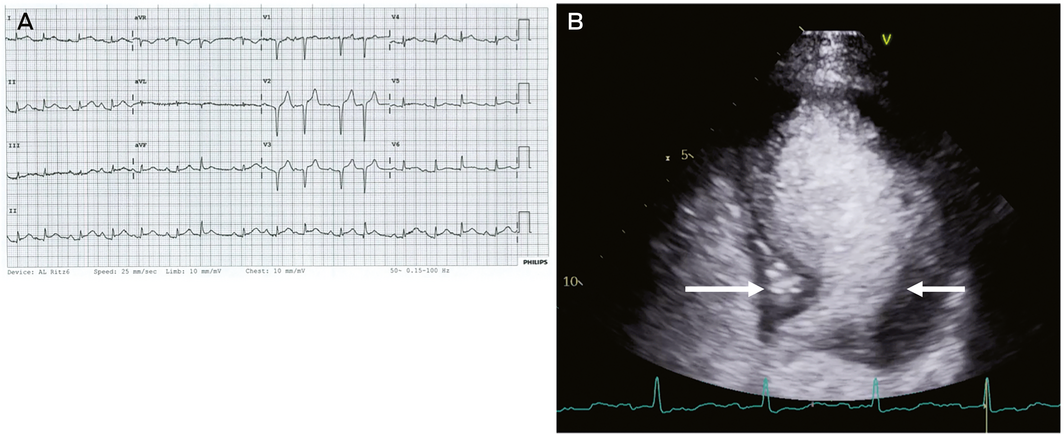
A 71‐year‐old woman presented to the emergency department complaining of chest pain. On arrival, an ECG demonstrated diffuse ST elevation (Box) and troponin was elevated (7800 ng/L). Coronary angiography was performed immediately which did not demonstrate any obstructive lesion and she was admitted to the intensive care unit (ICU) for ongoing haemodynamic support. Echocardiography performed in the ICU showed a dilated left ventricle with an akinetic apex and preserved contraction of the basal segments (Box) suggestive of takotsubo cardiomyopathy. On questioning regarding recent stressors, our patient, who lived alone, reported significant anxiety about not being able to visit family due to social distancing, and was particularly saddened by being unable to see her grandchildren.
Public health interventions undertaken by governments around the world in an attempt to reduce the rate of transmission of COVID‐19, or to “flatten the curve”, have included measures such as social distancing.3 While being effective in the aim of lowering infections, these measures may have many unintended consequences. Social isolation is detrimental to mental health, associated with increased stress levels and anxiety, especially in older people, who may be less able to use technology to stay in contact with friends and family.4 In our patient, this stress was enough to trigger takotsubo cardiomyopathy.
Competing interests
No relevant disclosures.
References
- Prasad A, Lerman A, Rihal CS. Apical ballooning syndrome (Tako‐Tsubo or stress cardiomyopathy): a mimic of acute myocardial infarction. Am Heart J 2008; 155: 408–417.
- Meyer P, Degrauwe S, Van Delden C, et al. Typical takotsubo syndrome triggered by SARS‐CoV‐2 infection. Eur Heart J 2020; 41: 1860.
- Matrajt L, Leung T. Evaluating the effectiveness of social distancing interventions to delay or flatten the epidemic curve of coronavirus disease. Emerg Infect Dis 2020; 26: 1740–1748.
- Jawaid A. Protecting older adults during social distancing. Science 2020; 368: 145–145.
Costs of Delivering the Hep B PAST Model of Care in Remote Australia: A Retrospective Pre–Post Study
Hoa Nguyen, Anh Le Tuan Nguyen, Paula Binks, Melita McKinnon, Emily Vintour-Cesar, Karen Wills, Nicola Stephens, Benjamin Cowie, Joshua S. Davis, Yuejen Zhao, Peter Nihill, Julie A. Campbell, Andrew J. Palmer, Jane Davies, Barbara de Graaff
Buruli Ulcer Acquired From Ringtail Possum Rescue
Daniel P. O'Brien, Naomi Clarke, Sara Bonnici, Mohammad A. Hussain
Q Fever Visceral Abscesses After Contact With Native Australian Marsupials
Samantha J. Laws, Enzo Binotto, James Stewart, Jennifer Ho, Trent Yarwood, Josh Hanson, Simon Smith
Hospital-Admitted Injection-Related Infections Among Incarcerated People Who Inject Drugs in Australia: A Retrospective Cohort Study
Andrew Palmer, Matthew Carter, Jeremy Yeo, Cecilia Shim, Jason Connor, Jeremy Hayllar, Gerald Holtmann, Naomi Moy, Elliott G. Playford, Naomi Runnegar, Paul J. Clark
The Live Attenuated Influenza Vaccine in Australia: An Additional Tool for Influenza Prevention
Cyra Patel, Alexis Pillsbury, Tran Nguyen, Xia Wang, Helen E. Quinn, Clayton K. Chiu, Allen C. Cheng, Katie L. Flanagan, Zhicheng Wang
Reflex Testing for Hepatitis D Infection: A Unique Opportunity to Reduce Hepatitis D-Related Chronic Liver Disease Deaths in Australia
Jessica Howell, Lauren Andersson, Miriam T. Levy, James O'Beirne, Leon Adams, Katharine Irvine, Avik Majumdar, Golo Ahlenstiel, Kathy Jackson, Krispin Hajkowicz, Joseph Doyle, Jane Davies, Sarah Cherian, Wayne Dimech, Alexander J. Thompson