




Medical education
Lessons from practice
Volume 212 - Issue 7
A case of drug reaction with eosinophilia and systemic symptoms (DRESS) without a typical precipitant
Authors: David WJ Griffin, Genevieve E Martin, Catriona McLean, Allen C Cheng and Michelle L Giles
Med J Aust 2020; 212 (7): 300-301.e1. || doi: 10.5694/mja2.50519
Published online: 20 April 2020
Published online: 20 April 2020
An 80- year- old man presented with 2 days of fever and a widespread, itchy, nonblanching, erythematous rash involving more than 50% of body
Clinical record
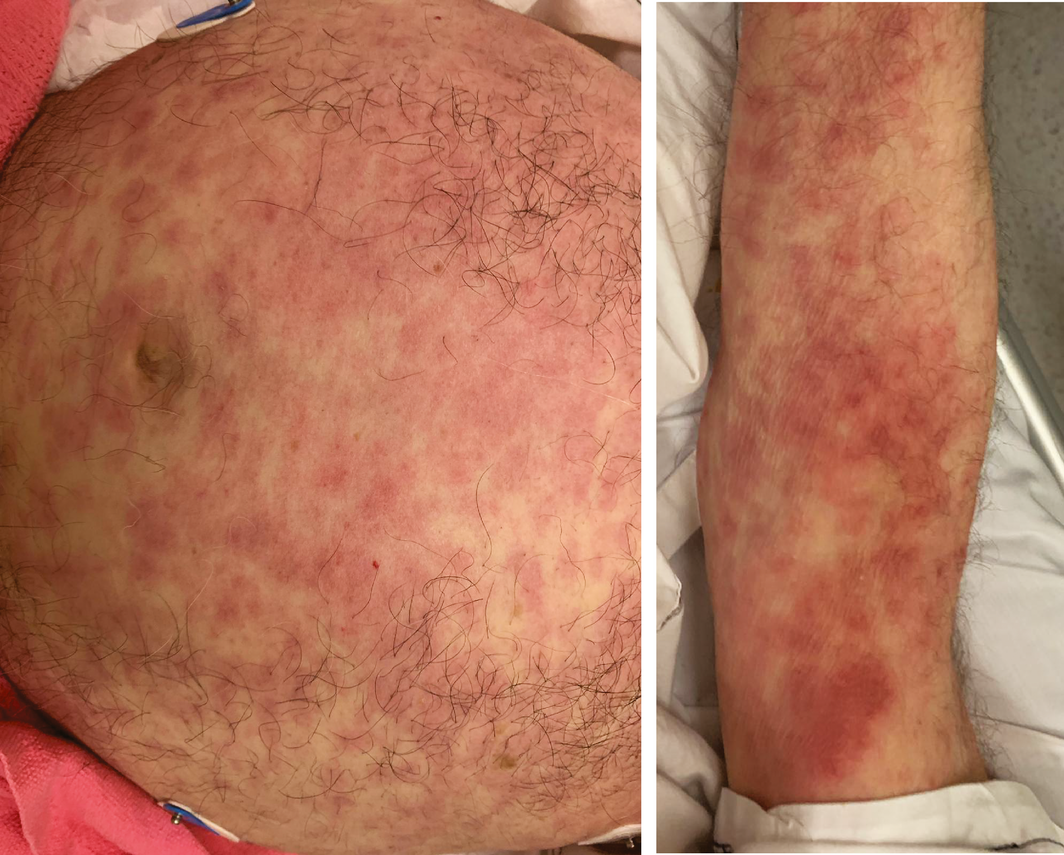
An 80‐year‐old man presented with 2 days of fever and a widespread, itchy, non‐blanching, erythematous rash involving more than 50% of body surface area over arms, legs, abdomen, back and palms, with sparing of the face and soles of feet (Box 1). He had a history of type 2 diabetes mellitus (treated with sitaglipin 100 mg and metformin 1000 mg modified release daily), hypertension (perindopril arginine 2.5 mg daily), vitamin D deficiency (weekly colecalciferol 125 μg oral) and pernicious anaemia.
He received an adjuvanted trivalent influenza vaccine (TIV) (Fluad; Seqirus, Australia) for the first time 7 days earlier, having tolerated a quadrivalent influenza vaccine in 2017. He had no localising infective or rheumatological symptoms and no medication changes in the preceding year.
On examination, he was febrile (39.9°C), tachycardic and hypotensive. He had the above described rash and inguinal and axillary lymphadenopathy. There was no mucosal involvement or facial oedema. Further physical examination was unremarkable.
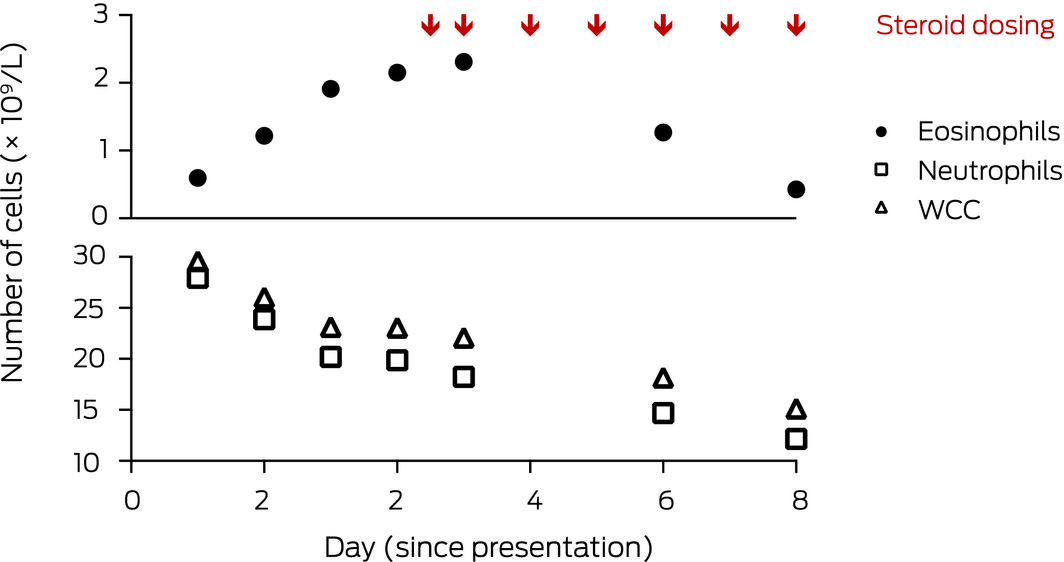
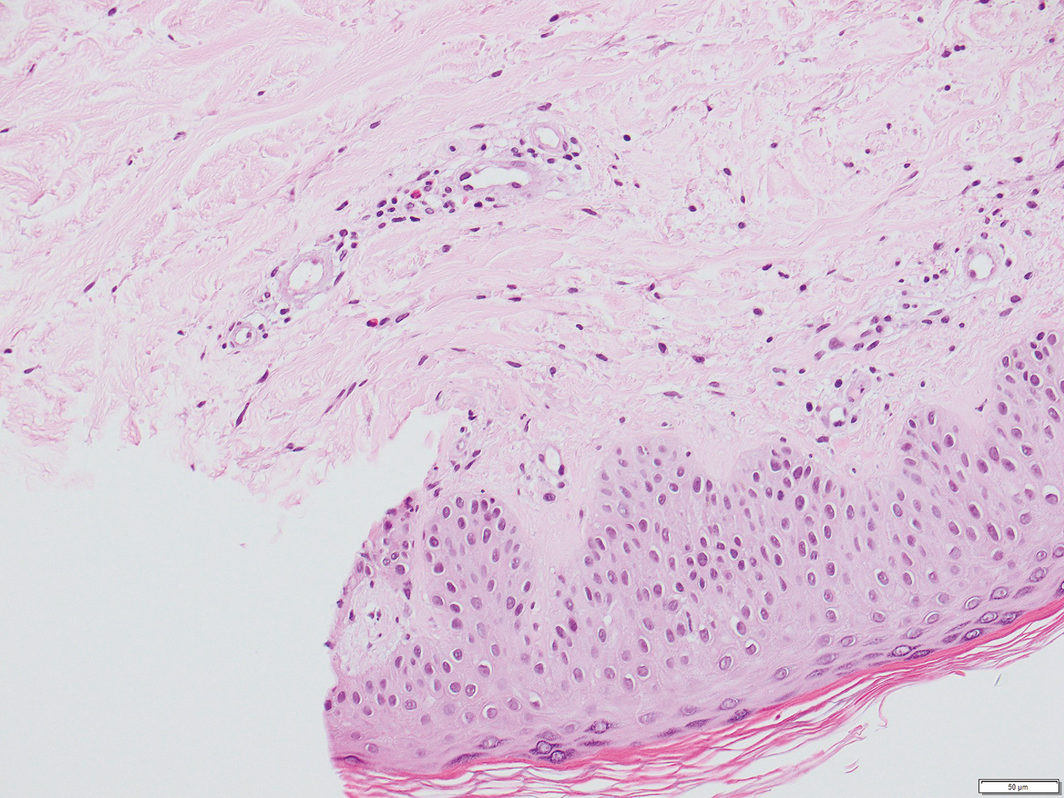
The patient received intravenous fluids, flucloxacillin and ceftriaxone, with a presumptive diagnosis of sepsis. Admission investigations revealed a leucocytosis (29.6 × 10⁹ cells/L; normal range [NR], 2.9–12.7 × 10⁹ cells/L) with neutrophilia (28.0 × 10⁹ cells/L; NR, 1.9–8 × 10⁹ cells/L) and eosinophilia (0.6 × 10⁹ cells/L; subsequent peak 2.3 × 10⁹ cells/L; NR, < 5 × 10⁹ cells/L) (Box 2). There was no lymphocytosis or atypical lymphocytes on blood film. The patient had an acute kidney injury (creatinine 184 μmol/L, baseline 80 μmol/L; NR, 60–110 μmol/L), with bland sediment; liver function was normal. Bacterial cultures of blood and urine were negative. Nasopharyngeal polymerase chain reaction (PCR) was negative for respiratory viruses and Mycoplasma. Blood PCR excluded cytomegalovirus, herpes simplex, varicella zoster, and entero‐ and adenoviruses; human herpes virus‐6 was not specifically tested. Serology was negative for syphilis, human immunodeficiency virus, and viral hepatitis, and revealed previous parvovirus infection. Vasculitic screening was negative. The result of a skin biopsy is shown in Box 3.
A diagnosis of drug reaction with eosinophilia and systemic symptoms (DRESS) was made (Registry of Severe Cutaneous Adverse Reaction [RegiSCAR] score 6, classified as definite1). This was likely triggered by influenza vaccination. All usual medications were continued.
Antimicrobials were ceased after 2 days, with negative bacterial cultures, and the patient started taking 50 mg of prednisolone, tapered over several weeks. He experienced a rapid resolution of fever and progressive normalisation of eosinophilia and neutrophilia (Box 2). Renal function returned to baseline by Day 5 and his rash resolved by Day 7, with the emergence of mild skin desquamation during rash resolution. He remains well 4 months later.
Discussion
DRESS is an uncommon, but potentially life‐threatening, drug‐induced hypersensitivity reaction, with onset usually 2–8 weeks after exposure to the culprit agent. The pathophysiology of DRESS remains unclear, but it involves an aberrant T‐lymphocyte response to an antigen, including drugs and infection.
Influenza infection is associated with significant morbidity and mortality, especially in patients at the extremes of age. Since 2018, high dose or adjuvanted influenza vaccination has been recommended in Australia for individuals aged over 65 years. Fluad is an adjuvanted TIV that contains MF59 — an oil‐in‐water emulsion of squalene (by Novartis) that enhances the cellular and humoral immunogenicity of the vaccine.2 This results in higher antibody responses than non‐adjuvanted vaccines and improved influenza prevention, while maintaining similar safety in older people.3
As an immune stimulant, it makes sense that vaccination could trigger DRESS in certain individuals. Indeed, DRESS following non‐adjuvanted influenza vaccination has been described and may occur early (< 1 week) after vaccine exposure.4,5
In this patient, the strong temporal relationship between vaccination, onset of symptoms and the absence of an alternative trigger suggests a role for adjuvanted TIV as a precipitant of DRESS (Naranjo score 5, classified as probable6). While the mechanism is unclear, we hypothesise this could be a direct reaction to a vaccine component, or that non‐specific immune activation following vaccination could permit a reaction to a medication, as postulated in previous cases in which each individual was coprescribed a drug typically associated with DRESS (allopurinol4 and sulfasalazine5). None of our patient's medications are commonly associated with DRESS, although case reports exist. Alternatively, the vaccine response could facilitate reactivation of latent herpes viruses, as these have been implicated in the pathogenesis of DRESS and have been included in some diagnostic criteria.7
Nevertheless, influenza vaccination is an unusual precipitant of DRESS. Eosinophilic drug reactions following influenza vaccination are rare,8 and large observational studies of adjuvanted TIV given to older individuals have not reported cases of DRESS.9,10
DRESS is an important differential diagnosis in patients presenting with fever and rash. Diagnosis requires a careful history for precipitants, examination for typical features, and investigation to exclude differentials, including infection. While several medications are classically implicated in the pathophysiology of DRESS, rare reports following vaccination are documented. The management of DRESS includes withdrawal of the causative agent, appropriate supportive care (such as fluids and analgesia), and corticosteroids; patients frequently require hospital admission. Overall, influenza vaccination remains a safe and effective means by which to reduce morbidity and mortality in older individuals.
Lessons from practice
- A drug reaction with eosinophilia and systemic symptoms (DRESS) is a rare, potentially life‐threatening condition and an important differential diagnosis in patients with fever, extensive morbilliform or purpuric rash, lymphadenopathy and/or facial oedema. Medication changes in the preceding 2–8 weeks should raise the suspicion for DRESS.
- A diagnosis of DRESS can be made using the RegiSCAR scoring system, which involves examination of the blood and blood film, renal and liver function, skin biopsy, and exclusion of alternative, infective aetiologies. Herpes virus polymerase chain reaction on blood may be a useful adjunct to diagnosis.
- Treatment of DRESS involves cessation of the culprit drug, supportive care, and a weaning course of steroids.
- Enhanced trivalent influenza vaccines are currently recommended for all individuals aged over 65 years in Australia. Vaccination remains a safe and effective means to reduce morbidity and mortality associated with influenza infection.
Box 1 – Images of the rash on presentation to hospital, as seen over the abdomen and arm, showing a violaceous, purpuric, patchy skin eruption with areas of confluence
Box 2 – Eosinophils, neutrophils and total white cell count (WCC) since time of presentation and after the initiation of steroids
Box 3 – Haematoxylin and eosin staining of skin biopsy sample (magnification × 200 actual) showing a dermal inflammatory cell infiltrate of lymphocytes and scattered eosinophils with minimal dermal oedema, consistent with a drug reaction. There were no specific immunofluorescence staining or features of vasculitis (not shown)
Competing interests
No relevant disclosures.
Acknowledgements
We acknowledge the input of Jason Trubiano and Nigel Crawford for valuable discussions in the management of this case.
References
- Kardaun SH, Sidoroff A, Valeyrie‐Allanore L, et al. Variability in the clinical pattern of cutaneous side‐effects of drugs with systemic symptoms: does a DRESS syndrome really exist? Br J Dermatol 2007; 156: 609–611.
- O'Hagan DT, Ott GS, De Gregorio E, Seubert A. The mechanism of action of MF59 — an innately attractive adjuvant formulation. Vaccine 2012; 30: 4341–4348.
- Schaffner W, Chen WH, Hopkins RH, Neuzil K. Effective immunization of older adults against seasonal influenza. Am J Med 2018; 131: 865–873.
- Solak B, Dikicier BS, Kara RO, Erdem T. DRESS syndrome potentially induced by allopurinol and triggered by influenza vaccine. BMJ Case Rep 2016; 2016: bcr2016214563.
- Hewitt N, Levinson M, Stephenson G. Drug reaction with eosinophilia and systemic symptoms associated with H1N1 vaccination. Intern Med J 2012; 42: 1365–1366.
- Naranjo CA, Busto U, Sellers EM, et al. A method for estimating the probability of adverse drug reactions. Clin Pharmacol Ther 1981; 30: 239–245.
- Shiohara T. The role of viral infection in the development of severe drug eruptions. Dermatologica Sinica 2013; 31: 205–210.
- Ramírez E, Medrano‐Casique N, Tong HY, et al. Eosinophilic drug reactions detected by a prospective pharmacovigilance programme in a tertiary hospital. Br J Clin Pharmacol 2017; 83: 400–415.
- Villa M, Black S, Groth N, et al. Safety of MF59‐adjuvanted influenza vaccination in the elderly: results of a comparative study of MF59‐adjuvanted vaccine versus nonadjuvanted influenza vaccine in northern Italy. Am J Epidemiol 2013; 178: 1139–1145.
- Lindert K, Leav B, Heijnen E, et al. Cumulative clinical experience with MF59‐adjuvanted trivalent seasonal influenza vaccine in young children and adults 65 years of age and older. Int J Infect Dis 2019; 85S: S10–S17.
Provenance: Not commissioned; externally peer reviewed.
Intranasal Adrenaline Use for the Management of Insect Venom-Induced Anaphylaxis
Thomas J. Young, Wilhelmina R. F. Johnson, Braydon L. Pennington, Troy Wanandy, Wun Y. Lau, Thanh-Thao A. Le
Gabapentinoid Poisoning Presentations to Victorian Emergency Departments: A 15-Year Trend Analysis
Bishaal Tej Gurung, Amy McNeilage, Angus Skeen, Tina Lam, Joanna F. Dipnall, Jane Hayman, Suzanne Nielsen, Ting Xia
Still Treating Yesterday's Risk? Reconsidering Antiviral Use for Mild-to-Moderate COVID-19 Cases in a Broadly Immune Population
Hadar Mudrik-Zohar, Tim Cutfield, Susan Morpeth, Thomas Hills, Eamon Duffy, Laura J. Edwards, Allen C. Cheng, Steven Y. C. Tong
Birth prevalence, clinical sequelae, and management of congenital cytomegalovirus infections in Australia, 1999–2023: a national prospective study
Ece Egilmezer, Suzy M Teutsch, Carlos Nunez, Stuart T Hamilton, Adam W Bartlett, Pamela Palasanthiran, Elizabeth J Elliott, William D Rawlinson
Concurrent use of hormonal long‐acting reversible contraception by women of reproductive age dispensed teratogenic medications, Australia, 2013–2021
Aaron E Boyce, Tony Caccetta, Jo‐Ann See, Rosemary L Nixon AM
Concurrent use of hormonal long‐acting reversible contraception by women of reproductive age dispensed teratogenic medications, Australia, 2013–2021
Michelle KY Chen, Adrian Lim, Deshan F Sebaratnam