




Medical education
Lessons from practice
Volume 212 - Issue 2
Use of botulinum toxin to heal atypical pressure ulcers in the palm
Authors: Anupam Datta Gupta and David H Wilson
Med J Aust 2020; 212 (2): 65-66.e1. || doi: 10.5694/mja2.50452
Published online: 3 February 2020
Published online: 3 February 2020
A 59-year-old woman attended a spasticity clinic with treatment-resistant
atypical pressure ulcer in the right hand caused by focal spasticity secondary to upper motor neuron lesion
Clinical record
A 59‐year‐old woman attended our spasticity clinic with treatment‐resistant atypical pressure ulcer in the right hand caused by focal spasticity secondary to upper motor neuron lesion. She had suffered subarachnoid haemorrhage from a ruptured arteriovenous malformation and underwent craniotomy. She was deemed not suitable for structured rehabilitation due to her significant disability and was placed in a residential accommodation. The patient was using an electrical wheelchair and was requiring full assistance with her personal care. She had typical, dense post‐stroke right‐sided spastic hemiplegia. In the upper limb, she had shoulder adduction and internal rotation, elbow flexion, wrist palmar flexion with flexed fingers at the metacarpophalangeal and proximal interphalangeal joints. She had a baclofen pump that controlled her lower limb spasticity.
The patient had a clenched fist and spastic fingers, with overgrown nails pressed hard into the palm causing ulceration in the proximal palmar crease and in the metacarpophalangeal crease. The hand smelled offensive. Attempts to open her fingers for cutting nails and cleaning the palm caused severe pain. The patient's carers had attempted to manage her hand with therapy, splinting and dressing, all of which proved unhelpful. This caused significant suffering to the patient and distressed her carers.
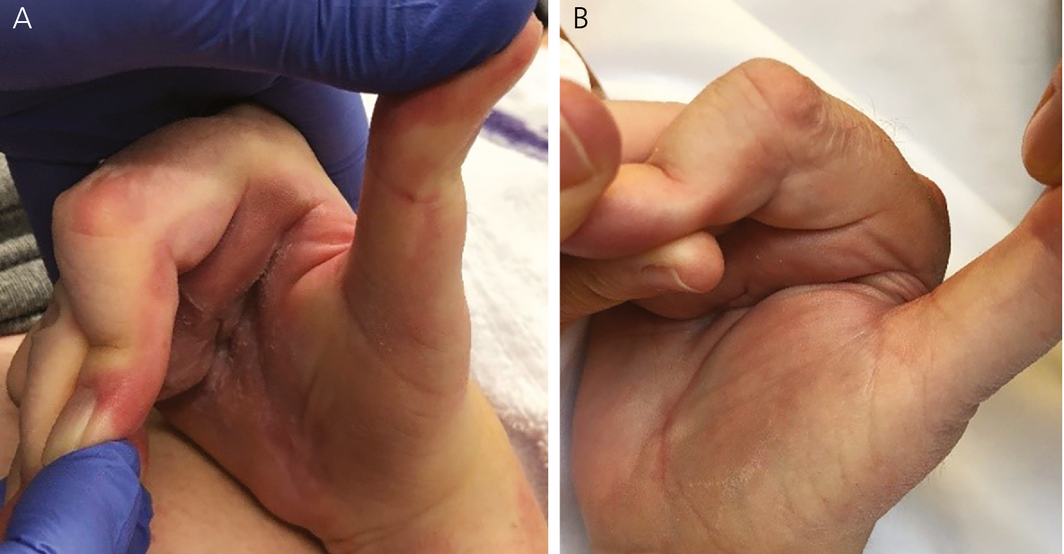
On examination, the patient had significant spasticity, with a Modified Ashworth Scale score of 3 and above in the pectoralis major, elbow flexors (ie, biceps and brachialis), and in the flexor digitorum superficialis muscle. The hand exhibited Grade 3 pressure ulcerations — full thickness skin loss involving necrosis of subcutaneous tissue — in the palm (Box 1, A). The spastic muscles were clinically identified and injected with botulinum toxin under electromyography stimulator guidance. The doses used were 150 units for the pectoralis major, 150 units for elbow flexors and 100 units for the flexor digitorum superficialis muscle.
The effect of the toxin was realised in 8 days. After one session of injection, spasticity was significantly reduced to a Modified Ashworth Scale score of 2. The hand could be opened to allow soft splinting with a sheep skin palmar protector and ulcer treatment could be initiated. Later, the patient was able to wear a posey hand cushion, followed by splinting with a foam tube. The patient underwent hand therapy, mostly passive stretching. Pain scores improved from 10/10 to 2/10 on the Visual Analog Scale, and the finger‐to‐palm distance and the passive range of movement significantly increased, which allowed dressing. The carer burden was also reduced considerably. She needed a second session of injections after 5 months. The ulcers were completely healed by 5 months (Box 1, B). We did not inject her further and she continued with hand therapy.
Discussion
Spasticity is a common manifestation of many neurological conditions, such as stroke (28–37%), cerebral palsy (19–92%), multiple sclerosis (41–69%), and traumatic brain injury (13%).1 Prevalence of spasticity is reported to be 73% in nursing home residents with central nervous system disorders.2 In the hand, spastic and distorted fingers, often with overgrown nails, press unremittingly into the palm and may cause pressure ulceration. Spasticity is the commonest cause of atypical pressure ulcers,3 which are described as such because of the atypical location where the pressure is exerted by the spastic fingers. Hand ulcerations caused by focal spasticity can be notoriously treatment‐resistant and may cause significant suffering to the patient and increased carer burden.4 Individuals living in nursing homes with irrevocable neurological impairment are a vulnerable group likely to develop pressure ulcers related to spasticity.
The examination should include looking for typical upper limb deformity caused by spasticity. It is important to assess muscle tone, power and reflexes, besides the temperature of the hand (usually cold), hyperhidrosis, bromhidrosis (offensive smell), maceration or skin breakdown around the palmar creases, overgrown nails, and skin infection. The systemic causes of exacerbation of spasticity (ie, constipation, urinary tract infections, pain, deep vein thrombosis, or stress5) are also important. It is necessary to identify the spastic muscles (Box 2) and to distinguish between contracture (permanent shortening of muscle due to fibrosis) and spasticity. One way of finding out whether the joint is spastic or contracted is to try passive movement. If the joint can be moved by passive stretching, it is indicative of spasticity. If the joint is in a fixed position with difficulty to move, it is likely to be contracted but should always be referred to the spasticity clinic for specialist assessment.
Spasticity is commonly measured by the Modified Ashworth Scale, as shown in Box 3. The objective assessments of a spastic hand with ulcerations should include the criteria in Box 4.
Botulinum toxin has emerged as the drug of choice in focal spasticity and/or dystonia.6,7 It is safe and better tolerated and the effects can last for months.8 Physicians should consider botulinum toxin for focal spasticity and dystonia in the upper and lower limbs (such as hands and feet) and/or in the neck (cervical) for patients with neurological disorders causing pain, discomfort, deformity, functional limitation (eg, walking), complications such as skin breakdown or increased carer burden (eg, maintaining hygiene). In many cases, when botulinum toxin is combined as an adjuvant treatment with other rehabilitation therapies the effects can be longer lasting.
Patients with atypical ulcers caused by focal spasticity should be referred to a multidisciplinary spasticity clinic consisting of a rehabilitation medicine physician, nursing staff, a physiotherapist and an occupational therapist.
Lessons from practice
- Untreated spasticity in the vulnerable population living in nursing homes may give rise to long‐standing treatment‐resistant palmar ulceration, as the spastic fingers press hard on the palm.
- Botulinum toxin injection should be considered first for toning down moderate to severe spasticity followed by dressing, therapy and splinting for healing of the ulcers.
- Patients with atypical ulcers caused by focal spasticity should be referred to a multidisciplinary spasticity clinic.
Box 1 – Image of the patient's hand exhibiting Grade 3 pressure ulcerations in the palm (A). The patient's hand showing the ulcers completely healed after second session of injections (B)
Box 2 – Identification of spastic muscles from the positioning of the upper limb/hand and from physical examination
Deformity |
Spastic muscles involved | ||||||||||||||
Shoulder adduction/internal rotation |
Pectoralis major, Latissimus dorsi, Teres major and Subscapularis |
||||||||||||||
Elbow flexion |
Biceps and Brachialis |
||||||||||||||
Forearm pronation |
Pronator teres and Pronator quadratus |
||||||||||||||
Wrist palmar flexion |
Flexor carpi radialis, Flexor carpi ulnaris |
||||||||||||||
Thumb‐in‐hand |
Flexor pollicis longus, Adductor pollicis, Flexor pollicis |
||||||||||||||
Brevis, Opponens pollicis, First dorsal interosseous |
|||||||||||||||
Metacarpophalangeal joint flexion |
Lumbricals |
||||||||||||||
Clenched fist |
Proximal interphalangeal joint flexion — Flexor digitorum longus |
||||||||||||||
Distal interphalangeal joint flexion — Flexor digitorum profundus |
|||||||||||||||
Box 3 – Modified Ashworth Scale for the measurement of spasticity
Score |
Description | ||||||||||||||
0 |
No increase in muscle tone |
||||||||||||||
1 |
Slight increase in muscle tone, manifested by a catch and release or by minimal resistance at the end of the range of motion (ROM) when the affected part is moved in flexion or extension |
||||||||||||||
1+ |
Slight increase in muscle tone, manifested by a catch, followed by minimal resistance throughout the remainder (less than half) of the ROM |
||||||||||||||
2 |
More marked increase in muscle tone through most of the ROM, but affected part or parts easily moved |
||||||||||||||
3 |
Considerable increase in muscle tone, passive movement difficult |
||||||||||||||
4 |
Affected part or parts rigid in flexion or extension |
||||||||||||||
Box 4 – Criteria for the assessment of a spastic hand with ulcerations
Outcome measures |
Description | ||||||||||||||
Spasticity |
Modified Ashworth Scale (0–4) |
||||||||||||||
Pain |
Visual Analog Scale (0–10) |
||||||||||||||
Finger‐to‐palm distance |
Fingertip to the palm distance in centimetres |
||||||||||||||
Passive range of movement |
The number of examiner's fingers that could be inserted into patient's palm |
||||||||||||||
Pressure ulcer |
Pressure ulcer grading 1–4 |
||||||||||||||
Carer Burden Scale for Upper Limb/Hand |
Items:
|
||||||||||||||
5‐point Likert scale (0–4)
|
|||||||||||||||
Items scored are summed to give a Carer Burden Scale score (0–16) before and 4 weeks after injection |
|||||||||||||||
Competing interests
No relevant disclosures.
Acknowledgements
We thank Barbara Brougham for her help with the editing of the manuscript.
References
- Gupta AD, Wilson W. Botulinum toxin for spasticity: a case for change to the Pharmaceutical Benefits Scheme. Med J Aust 2018; 208: 379–381. https://www.mja.com.au/journal/2018/208/9/botulinum-toxin-spasticity-case-change-pharmaceutical-benefits-scheme
- Meijer R, Wolswijk A, Eijsden HV. Prevalence, impact and treatment of spasticity in nursing home patients with central nervous system disorders: a cross‐sectional study. Disabil Rehabil 2017; 39: 363–371.
- Jaul E. Cohort study of atypical pressure ulcers development. Int Wound J 2014; 11: 696–700.
- Atiyeh BS, Hayek SN. Pressure sores with associated spasticity: a clinical challenge. Int Wound J 2005; 2: 77–80.
- Nair KP, Marsden J. The management of spasticity in adults. BMJ 2014; 349: g4737.
- Ward AB. A summary of spasticity management — a treatment algorithm. Eur J Neurol 2002; 9 (Suppl): 48–52.
- Tarsy D, Simon DK. Dystonia. N Engl J Med 2006; 355: 818–828.
- Graham LA. Management of spasticity revisited. Age Ageing 2013; 42: 435–441.
Provenance: Not commissioned; externally peer reviewed.
Rapid Growth in Diagnostic CT Knee Imaging in Australia: Implications for Imaging Stewardship
Hanwen Chen, Rachelle Buchbinder, Sean Docking, Ian A Harris
Disease‐specific survival for people with chronic myeloid leukaemia, South Australia, 1980–2020: a retrospective cohort study
Kerri Beckmann, Brendon J Kearney, Naranie Shanmuganathan, David Yeung, Tim Hughes
Technological advances in the search for a CURE for asthma
Sara Quon, Timothy M Johanson, Ridhima Wadhwa, Alen Faiz, Anthony Flynn, Gary P Anderson, Amanda J Cox, Nicholas P West, Michael P Menden, Rhys S Allan
Who gets asthma, and why?
Denby J Evans, Peter D Sly, Paul Foster, Chantal Donovan
The first Australian evidence‐based guidelines on male infertility
Darren J Katz, Liza O’Donnell, Robert I McLachlan, Tim J Moss, Clare V Boothroyd, Veena Jayadev, Sarah R Catford
Sex differences in management and outcomes of people with ST‐elevation myocardial infarction, New South Wales, 2011–2020: a retrospective cohort study
Samia Kazi, Simone Marschner, Haeri Min, Desi Quintans, James JH Chong, Ehsan Khan, David B Brieger, Clara K Chow