





Volume 211 - Issue 9
Residual risk of infection with blood‐borne viruses in potential organ donors at increased risk of infection: systematic review and meta‐analysis
Authors: Karen MJ Waller, Nicole L De La Mata, Patrick J Kelly, Vidiya Ramachandran, William D Rawlinson, Kate R Wyburn and Angela C Webster
Med J Aust 2019; 211 (9): 414-420. || doi: 10.5694/mja2.50315
Published online: 14 October 2019
Published online: 14 October 2019
Organ donations from people at increased risk but with negative test results could expand the donor pool
Abstract
Objective: To estimate the prevalence and incidence of human immunodeficiency virus (HIV), hepatitis C virus (HCV), and hepatitis B virus (HBV) among people at increased risk of infection in Australia; to estimate the residual risk of infection among potential solid organ donors in these groups when their antibody and nucleic acid test results are negative.
Study design: Systematic review and meta‐analysis of reports of the incidence and prevalence of HIV, HCV, and HBV in groups at increased risk of infection in Australia.
Data sources: MEDLINE, government and agency reports, Australasian Society for HIV, Viral Hepatitis and Sexual Health Medicine conference abstracts, the Australian New Zealand Clinical Trial Registry, and National Health and Medical Research Council grants published 1 January 2000 – 14 February 2019; personal communications.
Data synthesis: Residual risk of HIV infection was highest among men who have sex with men (4.8 [95% CI, 2.7–6.9] per 10 000 antibody‐negative persons; 1.5 [95% CI, 0.9–2.2] per 10 000 persons who are both antibody‐ and nucleic acid‐negative). Residual risk of HCV infection was highest among injecting drug users (289 [95% CI, 191–385] per 10 000 antibody‐negative persons; 20.9 [95% CI, 13.8–28.0] per 10 000 antibody‐ and nucleic acid‐negative persons). Residual risk for HBV infection was highest among injecting drug users (98.6 [95% CI, 36.4–213] per 10 000 antibody‐negative people; 49.4 [95% CI, 18.2–107] per 10 000 persons who were also nucleic acid‐negative).
Conclusions: Absolute risks of window period viral infections are low in people from Australian groups at increased risk but with negative viral test results. Accepting organ donations by people at increased risk of infection but with negative viral test results could be considered as a strategy for expanding the donor pool.
Registration: International Prospective Register of Systematic Reviews (PROSPERO), CRD42017069820.
Solid organ transplantation improves the survival and quality of life of the recipients, and is cost‐effective. While the organ donation rate in Australia has increased in recent years, reaching 22.2 deceased donors per million population (dpmp) in 2018, it varies between states1 and is still lower than in many other countries, the leading countries being Spain (46.9 dpmp) and Portugal (34.0 dpmp).2 Increasing donation rates is important for the 1551 Australians on organ waiting lists (April 2019)3 and a priority for the Australian government, which is projected to spend $1.8 billion annually on end‐stage kidney disease alone by 2020.4
Avoiding the inadvertent transmission of infectious disease or cancer is a key consideration when selecting donors, and screening tests for blood‐borne viruses (BBVs) may not detect recently acquired infections. During the “eclipse period”, the results of antibody and nucleic acid test assays are both negative despite the presence of virus, while during the “window period” nucleic acid but not antibody is detectable. The risk of undetected infection poses a biovigilance and clinical dilemma when potential donors with behaviours that increase the risk of BBV infection are referred to donation services; in Australia, they are typically rejected as organ donors, although the organ needed and other factors can influence the decision.5,6 If the risks of infection could be minimised, many rejected candidates would be highly suitable donors, as they are often younger and have fewer comorbid conditions than other organ donors.7,8 American studies have found a survival benefit for kidney transplant recipients who accepted organs from donors with increased infection risk compared with those waiting for a donor with baseline risk.9,10
In the United States, estimates of the magnitude of the risk of window period infections among donors at increased risk have been low.11,12,13 Australian transplantation guidelines apply American estimates of residual risk,14 but their applicability in Australia is uncertain, as viral prevalence and transmission differ between countries. The epidemiology of BBVs in Australia reflects the effects of a range of public health policies and interventions designed to minimise transmission — including early adoption of needle syringe exchange programs that reduced the spread of the human immunodeficiency virus (HIV)15 — as well as patterns of risk behaviour, population groups at risk, and access to health care that differ from those of other countries.
In this investigation, we synthesised data on the published prevalence and incidence of HIV, hepatitis C virus (HCV), and hepatitis B virus (HBV) among people at increased risk of infection in Australia. We then estimated the residual risk of each infection in potential donors from these groups when their antibody and nucleic test results are negative.
Methods
Study selection
We undertook a systematic review and meta‐analysis of studies that reported original estimates of the prevalence or incidence of HIV, HCV, or HBV in populations in Australia at higher risk of infection. Risk groups of interest were defined according to national transplantation guidelines:14 injecting drug users (IDUs), sex workers, men who have sex with men (MSM), people with a history of imprisonment, people with partners at high risk (people without known risk behaviours who have sexual partners with known BBV infections or risk factors), and people who have had percutaneous exposure to BBV‐infected blood. Exclusion criteria were studies without objective HIV, HCV, or HBV diagnoses (ie, self‐reported diagnoses or modelled data); studies published prior to 1 January 2000 (to ensure our analysis is current); an alternative BBV diagnosis (eg, studies of HCV incidence in HIV‐positive patients); and insufficient data available for inclusion in the meta‐analysis. The protocol for our systematic review was registered with PROSPERO (CRD42017069820) on 31 July 2017.
Search strategy
We searched Ovid MEDLINE with combinations of keywords for epidemiologic outcomes (incidence, prevalence), BBVs, and locations (Supporting Information, table 1). We restricted our search to human studies published in English between 1 January 2000 and 14 February 2019. For grey literature reports, we searched government and agency reports, Australasian Society for HIV, Viral Hepatitis and Sexual Health Medicine conference abstracts (www.ashm.org.au), the Australian New Zealand Clinical Trial Registry (www.anzctr.org.au), and National Health and Medical Research Council grant lists (www.nhmrc.gov.au). The reference lists of retrieved publications were inspected for additional studies. Titles and abstracts were screened before two authors (KW, NLD) independently screened the full text of items for their eligibility for our analysis.
Data abstraction
The following data were extracted into a standardised spreadsheet: recruitment years, setting, sampling method, inclusion criteria, risk group definition, demographic information, testing method, outcomes data relevant to our analysis. We recorded data for active HBV infections (HBV surface antigen [HBsAg] or DNA detected) and exposures (HBV core antibody [HBcAb] detected) separately. When data on key parameters were not reported, they were obtained by back‐calculation or from the study authors, if possible. Reports in different publications on common participant groups were identified to avoid duplication of results; estimates based on the largest sample size or the most recent report were accepted for our analysis. Some articles included several groups at increased risk of infection or reported more than one estimated parameter of BBV epidemiology.
Critical appraisal
Studies were appraised with the Joanna Briggs Institute Critical Appraisal Checklist for Studies Reporting Prevalence Data,16 reduced to include nine of the original ten criteria (item 10, on subgroups, was not applicable to our study). Studies were judged as being at high, low, or unknown risk of bias in each domain according to pre‐defined criteria. Studies that reported testing but did not specify testing type were assumed to have objective and reliable measurements (domains 6 and 7).
Prevalence and incidence estimates
The pooled prevalence and incidence of HIV, HCV, and HBV infections in each risk group were estimated by meta‐analysis with random effects when an adequate number of studies was available. Pooled prevalence estimation employed Freeman–Tukey double arcsine transformation to account for zero prevalence estimates and to stabilise variance. Viral incidence in the baseline population was calculated by assuming that the number of notifications during one year approximated the number of incident infections during this period and that the whole population was at risk for one year. We calculated Poisson exact 95% confidence intervals (CIs) for pooled incidence, including the baseline population, and exact 95% CIs for binomial distributions for pooled prevalence.
For groups at increased risk for which there were few or no studies reporting HIV, HCV, or HBV incidence, pooled incidence was estimated from pooled prevalence with previously described methods.12,13 Briefly, the ratio of pooled incidence to pooled prevalence of a particular infection in one group at increased risk was assumed to be equivalent to that for other groups at increased risk. The risk group with the largest number of studies reporting the incidence and prevalence of a BBV infection served as the reference for deriving the pooled incidence of the infection in a second risk group for which the prevalence was known; for example:

We calculated the 95% CI for the derived incidence estimate assuming the exact Poisson distribution (further details: Supporting Information, supplementary methods).
Residual risk estimation
The residual risk of infection — the expected number of new infections currently in the window period, based on the calculated incidence rate — was estimated assuming that time from infection was exponentially distributed, based on the calculated incidence rate. The estimated pooled incidence over one year was then applied to the relevant window period to estimate the expected number of people with new infections per 10 000 potential donors in each group at increased risk:

The window periods applied were the reported upper bounds for HIV, HCV, and HBV with antibody (enzyme‐linked immunosorbent assay, ELISA) and nucleic acid testing.17 The 95% CIs for residual risk infections were estimated from the lower and upper bounds of the estimated pooled incidence.
Other analyses
Heterogeneity of studies was expressed with the I2 statistic. Sensitivity analyses excluded studies deemed on data appraisal to be atypical. Publication bias was assessed for each combination of virus and risk group in funnel plots. All analyses were undertaken in Stata 15 (StataCorp).
Results
Study selection
In total, 10 123 publications were retrieved from Ovid MEDLINE, and a further 138 were identified in the grey literature. After title and abstract screening, 380 articles were independently reviewed by two authors for eligibility. Fifty‐four unique groups of participants were identified in 75 eligible reports (Supporting Information, table 2) that included 137 estimates of BBV incidence or prevalence in 89 samples of groups at increased risk of infection (Box 1).
Study characteristics
Most of the 89 samples of people at increased infection risk comprised injecting drug users (32 samples), men who have sex with men (28 samples), or prisoners (22 samples); none included people who had had percutaneous exposure to BBVs. Fifty of the 89 participant samples (56%) were from metropolitan areas, and 58 (62%) from New South Wales or Victoria, but all Australian states, apart from Tasmania, were represented. Fifty‐nine participant groups (66%) were recruited prospectively, and 75 (84%) by convenience sampling. Study inclusion criteria usually included participant risk behaviours having been active currently or during the past 12 months (65 of 89, 73%) (Supporting Information, table 2).
Incidence and prevalence estimates were most frequently reported for HCV (54 estimates) and HIV (45 estimates); HBV serology‐based estimates were reported infrequently (19 each for HBcAb and HBsAg). Incidence studies usually included participant groups at greatest epidemiologic risk of incident infection: 11 of 13 HIV estimates were for men who have sex with men, and 9 of 15 HCV estimates were for injecting drug users (Box 1).
When reported, there was considerable overlap between risk behaviours: in eight of 12 injecting drug user groups in which it was assessed, at least 25% of participants had been imprisoned, while the prevalence of injecting drug use exceeded 25% in each of the 14 prisoner participant groups in which this behaviour was examined. For 33 participant samples, however, only one risk behaviour was reported (Supporting Information, table 3).
The risk of bias for the total of 1233 assessed criteria in the studies reporting viral incidence and prevalence estimates was low for 1023 assessments (83%), unclear for 141 (11%), and high for 69 (6%). Poor reporting of concomitant risk behaviours (ie, identification of confounders) was the most frequent source of potential bias (high risk of bias, 49 estimates [36%]; unclear risk, 21 estimates [15%]). The characteristics of study participants were not always compared with those of people who declined participation (representativeness of sample; unclear risk, 40 estimates [29%]), nor those of participants available for follow‐up and those lost to follow‐up (appropriateness of data analysis; high risk, five estimates [4%]; unclear risk, 62 estimates [45%]) (Supporting Information, table 4).
There was no evidence of publication bias (P > 0.10; except for the prevalence of HCV in injecting drug users: P = 0.084) (Supporting Information, table 5).
Residual infection risk
Residual risk of window period HIV infection was highest among men who have sex with men (4.8 [95% CI, 2.7–6.9] per 10 000 antibody‐negative people; 1.5 [95% CI, 0.9–2.2] per 10 000 people who were also nucleic acid‐negative). The residual risks of HIV infection in other risk groups, including injecting drug users, were lower than one per 10 000 persons. The estimated residual risk for the baseline population was an order of magnitude lower than that for any risk group (Box 2).
Residual risk of window period HCV infection was highest among injecting drug users (289 [95% CI, 191–386] per 10 000 antibody‐negative injecting drug users; 20.9 [95% CI, 13.8–28.0] per 10 000 who were also nucleic acid‐negative). The residual risks of HCV among prisoners, sex workers, and those with partners at high risk were lower than for antibody‐negative injecting drug users (75–150 per 10 000; 5–11 per 10 000 who were also nucleic acid‐negative). The residual risk of HCV in the general community was two to three orders of magnitude lower (0.9 [95% CI, 0.9–1.0] per 10 000 antibody‐negative persons; 0.1 [95% CI, 0.1–0.1] per 10 000 who were also nucleic acid‐negative) (Box 2).
Single studies reported HBcAb incidence in men who have sex with men and in injecting drug users. Residual risk of window period HBV infection was highest among injecting drug users (98.6 [95% CI, 36.4–213] per 10 000 antibody‐negative people; 49.4 [95% CI, 18.2–107] per 10 000 people who were also nucleic acid‐negative) (Box 2).
No studies reported HBsAg incidence in groups at increased risk; pooled incidence rates were calculated for HBsAg prevalence studies using the HBcAb ratio of pooled incidence to pooled prevalence. Residual risks of active HBV infection were highest for prisoners (11.5 [95% CI, 3.6–27.3] per 10 000 antibody‐negative people; 5.7 [95% CI, 1.8–13.7] per 10 000 people who were also nucleic acid‐negative). For the baseline population, residual risk of active HBV infection was 0.3 (95% CI, 0.3–0.3) per 10 000 antibody‐negative people and 0.2 (95% CI, 0.2–0.2) per 10 000 people who were also nucleic acid‐negative (Box 2).
The expected number of HIV, HCV, and HBV window period infections in people with negative antibody and nucleic acid test results in the groups at highest infection risk is graphically depicted in Box 3. In most instances, residual risks were calculated from pooled incidence rates derived from pooled prevalence rates because insufficient incidence study estimates had been reported; however, this does not affect the interpretation of residual risk. Further details on prevalence, incidence and residual risk estimates, and sensitivity analyses are provided in the online Supporting Information (figures 1–3, tables 6 and 7, supplementary results).
Discussion
The residual risks of selected blood‐borne viral infections in Australians at increased risk of infection but with negative antibody and nucleic acid test results are low in absolute terms (less than 1%).
The residual risk of HIV infection is 4.8 per 10 000 antibody‐negative people in the group at greatest increased risk, men who have sex with men. The residual risks were lower for injecting drug users (0.6 per 10 000 antibody‐negative people); this is unsurprising, as unprotected anal intercourse is the dominant mode of HIV transmission in Australia.20 These residual risk levels are substantially lower than reported overseas (men who have sex with men with negative serum antibody test results: USA, 10.2 per 10 000; Canada, 5.8 per 10 000; injecting drug users with negative antibody test results: USA, 12.1 per 10 000; Canada, 6.6 per 10 000).12,21 In a sensitivity analysis that excluded possible sources of bias (less recent participant group, studies including people using pre‐exposure prophylaxis), study heterogeneity was lower, improving our confidence in our risk estimates without substantially changing our findings (Supporting Information, supplementary results; tables 5 and 6). The incidence of HIV in Australia is expected to fall with the uptake of increasingly effective anti‐retroviral therapy and of pre‐exposure prophylaxis,22,23 so our estimates are probably conservative (ie, residual risk is overestimated).
The absolute residual risk for HCV infection was highest among injecting drug users, reflecting the epidemiology of the virus in Australia,20 but even in this group was only 21 per 10 000 people with negative nucleic acid test results. The estimated residual risks of HCV infection in Australia were similar to those reported by studies overseas.13,21 Pharmaceutical Benefits Scheme‐funded therapies available to all Australians since 2016 have substantially reduced HCV prevalence among people who inject drugs,24,25 and are therefore expected to further reduce the incidence and the residual risk of HCV infection. The clinical significance of HCV transmission by transplantation has diminished with the advent of curative therapy; indeed, livers and kidneys from HCV‐positive donors have been transplanted to HCV‐negative recipients without adverse effects.26
Undetected transmission of HBV to non‐immune patients can have devastating consequences, and data on the residual risk of HBV infection have not previously been reported. The residual risk was low in absolute terms, and was highest among injecting drug users (99 per 10 000 antibody‐negative people), consistent with transmission patterns in Australia.20 Organ recipients with adequate HBsAb titres — because they were vaccinated, as clinical practice guidelines recommend before transplantation,27 or were previously exposed to HBV — are effectively protected against infection. Transmission can also be mitigated in non‐immune recipients by immunoglobulin treatment immediately before and after transplantation, and active infection can be effectively suppressed after transplantation by antiviral therapy.
Our findings have important implications for donation referral and transplantation practice. All potential donors with behaviours that increase their risk of infection should undergo prospective antibody and nucleic acid assessment before being considered for donation. Nucleic acid testing is not uniformly available across Australia, but its importance for estimating residual infection risk is clear. We have previously reported that potential donors from specific risk groups are often rejected without viral screening;5 accepting such donors could expand the donor pool in New South Wales by about five donors per year (providing organs to as many as 30 additional recipients).
Our risk estimates are based on Australian data and are conservative, so they can be confidently employed for decision‐making. The risks must be assessed in the context of risks inherent to remaining on the transplant waiting list. The preferences and risk acceptance thresholds of organ recipients must also be considered, and risk literacy education may be appropriate for both patients and clinicians. The cost of treating HCV infections in Australia has not been estimated, but transplantation of kidneys from HCV‐positive people and subsequent antiviral therapy for the recipient has been found to be cost‐effective overseas.28,29
Studies are needed in areas for which data are sparse, such as the incidence of HBV in risk groups, and the incidence of BBVs in sex workers and people with partners at high risk. The impact of new therapies on the incidence of infection in risk groups should be monitored, and patient perceptions of the competing risks of inadvertent viral transmission and waiting for organs from people at baseline risk of infection assessed.
Limitations
We did not assess the residual risks associated with rare viral variants (very low risk), specimen or laboratory error (extremely low risk), viruses other than HIV, HCV and HBV (not assessed by screening algorithms), or emerging viruses of unknown potential (eg, the novel arenavirus described in 200730). Further, the low rate in Australia of occult HBV infections (HBV viraemia in HBsAg‐negative people) was not considered.31 We defined groups at increased risk of infection according to international and national transplantation guidelines, excluding other groups at increased risk, such as neonates with infected mothers, household contacts of infected people, and people with haemophilia (as the blood pool in Australia is regarded as secure from viral contamination). We did not estimate compound risks (eg, the risk of acquiring several BBVs from a single donor in a risk group), or how risks are affected by potential donors having several risk behaviours (eg, injecting drug users in prison).
Our meta‐analysis was also limited by the quantity and quality of the included studies. For instance, studies typically reported antibody test results as markers of HCV infection, despite nucleic acid testing being a better measure of active infection. We relied upon derived incidence estimates for many subgroups in which incidence was not reported, and this approach may be imprecise. Study heterogeneity was considerable. In certain situations, the risks of infection would be lower than we have estimated; for example, when potential donors are known to employ risk mitigation strategies, or when prolonged hospitalisation limits the period of exposure, reducing the length of the window period. Our estimates are therefore conservative (ie, overestimate the risk).
Interpreting our findings regarding the residual risk of HBV infection in people with negative test results was difficult. First, the amount of available data was limited. Second, two serology markers are available: HBcAb indicates recent exposure to HBV, HBsAg active infection. As exposure to HBV causes acute viraemia, HBcAb is a valid marker of residual risk. We reviewed studies reporting any HBV serology measure, but based our discussion of incidence on HBcAb, which may be a conservative approach. Third, only 5% of adults exposed to HBV develop chronic infections, but 90% of neonates.32 Incidence estimates derived from prevalence data may therefore be too high, as the ratio of exposed to infected people may differ between risk groups.
Conclusion
Our estimates of the residual risks of window period viral infections in people at increased infection risk in Australia, derived from a systematic review and meta‐analysis of published data, were, not unexpectedly, higher than the corresponding baseline population risks. However, the absolute risks were low, particularly for people with negative prospective nucleic acid test results. Given more effective treatments for HIV, HCV and HBV infections, organ donation by people at increased risk of infection but with negative viral test results could be considered as a strategy for expanding the donor pool.
Box 1 – PRISMA flowchart of search for publications regarding epidemiology of blood‐borne viruses in people at particular risk of infection
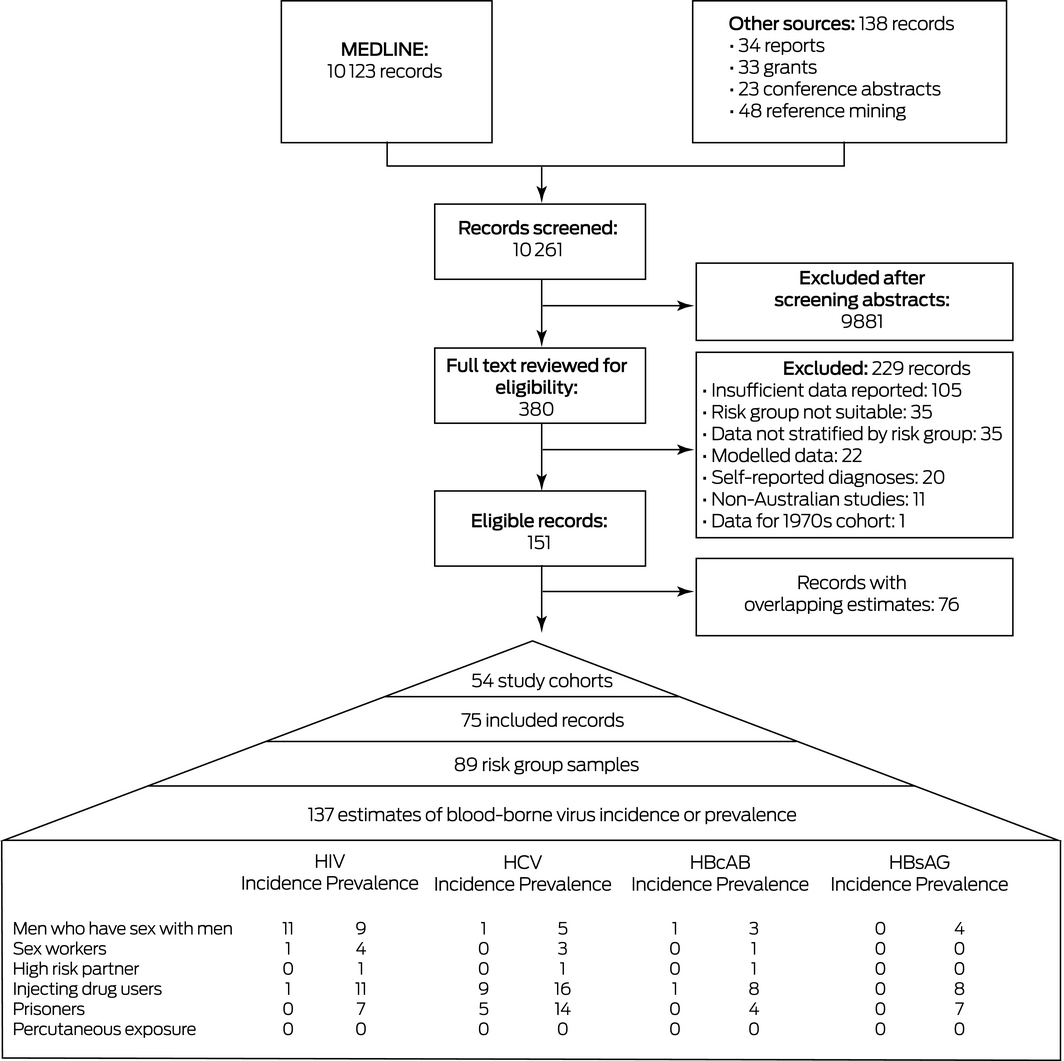
HIV = human immunodeficiency virus; HBcAb = hepatitis B core antibody; HBsAg = hepatitis B surface antigen; HCV = hepatitis C virus.
Box 2 – Residual infection risk estimates, by virus and risk group (all eligible studies)
|
Risk group |
Number of studies |
Persons* |
Infections* |
Person‐years (py)† |
Pooled prevalence |
Pooled incidence, per 100 py (95% CI) |
Residual risk, per 10 000 persons |
||||||||
|
Incidence |
Prevalence |
ELISA§ |
NAT¶ |
||||||||||||
|
|
|||||||||||||||
|
HIV |
|
|
|
|
|
|
|
|
|
||||||
|
Baseline** |
— |
— |
24 127 200 |
1013 |
24 127 200 |
NC |
0.004 (0.004–0.004) |
0.03 (0.02–0.03) |
0.01 (0.01–0.01) |
||||||
|
Men who have sex with men |
11 |
9 |
16 019††,‡‡ |
529‡‡ |
62 812 |
5.2% (2.5–8.8%) |
0.79 (0.44–1.15) |
4.8 (2.7–6.9) |
1.5 (0.9–2.2) |
||||||
|
Sex workers |
1 |
4 |
3719 |
11 |
— |
0.2% (0.0–0.7%) |
0.03 (0.00–0.80)§§ |
0.2 (0.0–4.8) |
0.1 (0.0–1.5) |
||||||
|
High risk partner |
0 |
1 |
522 |
1 |
— |
0.2% (0.0–1.1%) |
0.03 (0.00–0.80)§§ |
0.2 (0.0–4.8) |
0.1 (0.0–1.5) |
||||||
|
Injecting drug users |
1 |
11 |
39 814 |
318 |
— |
0.7% (0.1–1.4%) |
0.11 (0.00–0.95)§§ |
0.6 (0.0–5.7) |
0.2 (0.0–1.8) |
||||||
|
Prisoners |
0 |
7 |
10 160 |
50 |
— |
0.2% (0.0–0.5%) |
0.03 (0.00–0.80)§§ |
0.2 (0.0–4.8) |
0.1 (0.0–1.5) |
||||||
|
HCV |
|
|
|
|
|
|
|
|
|
||||||
|
Baseline** |
— |
— |
24 127 200 |
11 949 |
24 127 200 |
NC |
0.05 (0.05–0.05) |
0.9 (0.9–1.0) |
0.1 (0.1–0.1) |
||||||
|
Men who have sex with men |
1 |
5 |
2021 |
54 |
— |
4.0% (0.3–11%) |
0.9 (0.3–2.2)§§ |
18 (5.4–43) |
1.3 (0.4–3.1) |
||||||
|
Sex workers |
0 |
3 |
390 |
46 |
— |
18% (0.5–49%) |
4.1 (2.5–6.3)§§ |
78 (48–120) |
5.6 (3.4–8.6) |
||||||
|
High risk partner |
0 |
1 |
50 |
11 |
— |
22% (12–36%) |
5.1 (3.3–7.5)§§ |
97 (63–143) |
7.0 (4.5–10) |
||||||
|
Injecting drug users |
9 |
16 |
2138‡‡,¶¶ |
436‡‡ |
2771 |
66.0% (57.0–73.8%) |
15.3 (10.1–20.5) |
289 (191–386) |
20.9 (13.8–28.0) |
||||||
|
Prisoners |
5 |
14 |
1117‡‡ |
155‡‡ |
1758 |
38.9% (25.4–53.3%) |
7.7 (5.2–10.3) |
147 (98.2–195) |
10.6 (7.0–14.1) |
||||||
|
HBcAb |
|
|
|
|
|
|
|
|
|
||||||
|
Men who have sex with men |
1 |
3 |
11 035 |
1151 |
— |
9.6% (3.2–18.9%) |
2.2 (0.8–4.7)§§ |
26.2 (9.6–56.7) |
13.1 (4.8–28.4) |
||||||
|
Sex workers |
0 |
1 |
1089 |
25 |
— |
2.3% (1.5–3.4%) |
0.5 (0.1–1.6)§§ |
6.3 (1.1–20) |
3.1 (0.5–9.8) |
||||||
|
High risk partner |
0 |
1 |
471 |
4 |
— |
0.8% (0.2–2.2%) |
0.2 (0.0–1.1)§§ |
2.2 (0.0–13.0) |
1.1 (0.0–6.5) |
||||||
|
Injecting drug users |
1 |
8 |
1859 |
683 |
— |
36.3% (27.7–45.4%) |
8.2 (3.0–17.9)§§ |
98.6 (36.4–213) |
49.4 (18.2–107) |
||||||
|
Prisoners |
0 |
4 |
1434 |
291 |
— |
19.5% (10.3–30.7%) |
4.4 (1.6–9.6)§§ |
53.1 (19.6–115) |
26.6 (9.8–57.6) |
||||||
|
HBsAg |
|
|
|
|
|
|
|
|
|
||||||
|
Baseline** |
— |
— |
24 127 200‡‡ |
6555‡‡ |
24 127 200 |
NC |
0.03 (0.03–0.03) |
0.3 (0.3–0.3) |
0.2 (0.2–0.2) |
||||||
|
Men who have sex with men |
0 |
4 |
4287 |
106 |
— |
1.5% (0.1–4.2%) |
0.3 (0.0–1.4)§§ |
4.1 (0.4–16.2) |
2.0 (0.2–8.1) |
||||||
|
Injecting drug users |
0 |
8 |
31 138 |
1287 |
— |
3.5% (0.9–7.9%) |
0.8 (0.2–2.0)§§ |
9.6 (2.5–24.5) |
4.8 (1.3–12.3) |
||||||
|
Prisoners |
0 |
7 |
2599 |
134 |
— |
4.2% (2.5–6.4%) |
1.0 (0.3–2.3)§§ |
11.5 (3.6–27.3) |
5.7 (1.8–13.7) |
||||||
|
|
|||||||||||||||
|
CI = confidence interval; ELISA = enzyme‐linked immunosorbent assay; HIV = human immunodeficiency virus; HBcAb = hepatitis B core antibody; HBsAg = hepatitis B surface antigen; HCV = hepatitis C virus; NAT = nucleic acid testing; NC = not calculated.* Reported data are from prevalence estimate reports (insufficient incidence studies), unless otherwise indicated. † Only reported when the number of studies reporting incidence was adequate. ‡ Reported data are from are from prevalence studies. § Window periods: HIV, 22 days; HBV, 44 days; HCV, 70 days.17 ¶ Window periods: HIV, 7 days; HBV, 22 days; HCV, 5 days.17 ** Baseline risk for the general population: number of incident infections assumed to be number of notifications in one year.18 Person‐years at risk is assumed to be the total population in Australia (24 127 200 at 30 June 201619) for one year. †† Two studies missing data on total number of patients from incidence cohorts. ‡‡ Reported data from incidence studies. §§ Incidence estimates derived from prevalence data. ¶¶ One study missing data on total number of patients for incidence estimate. |
|||||||||||||||
Box 3 – Residual infection risk per 10 000 persons with negative antibody and nucleic acid test results
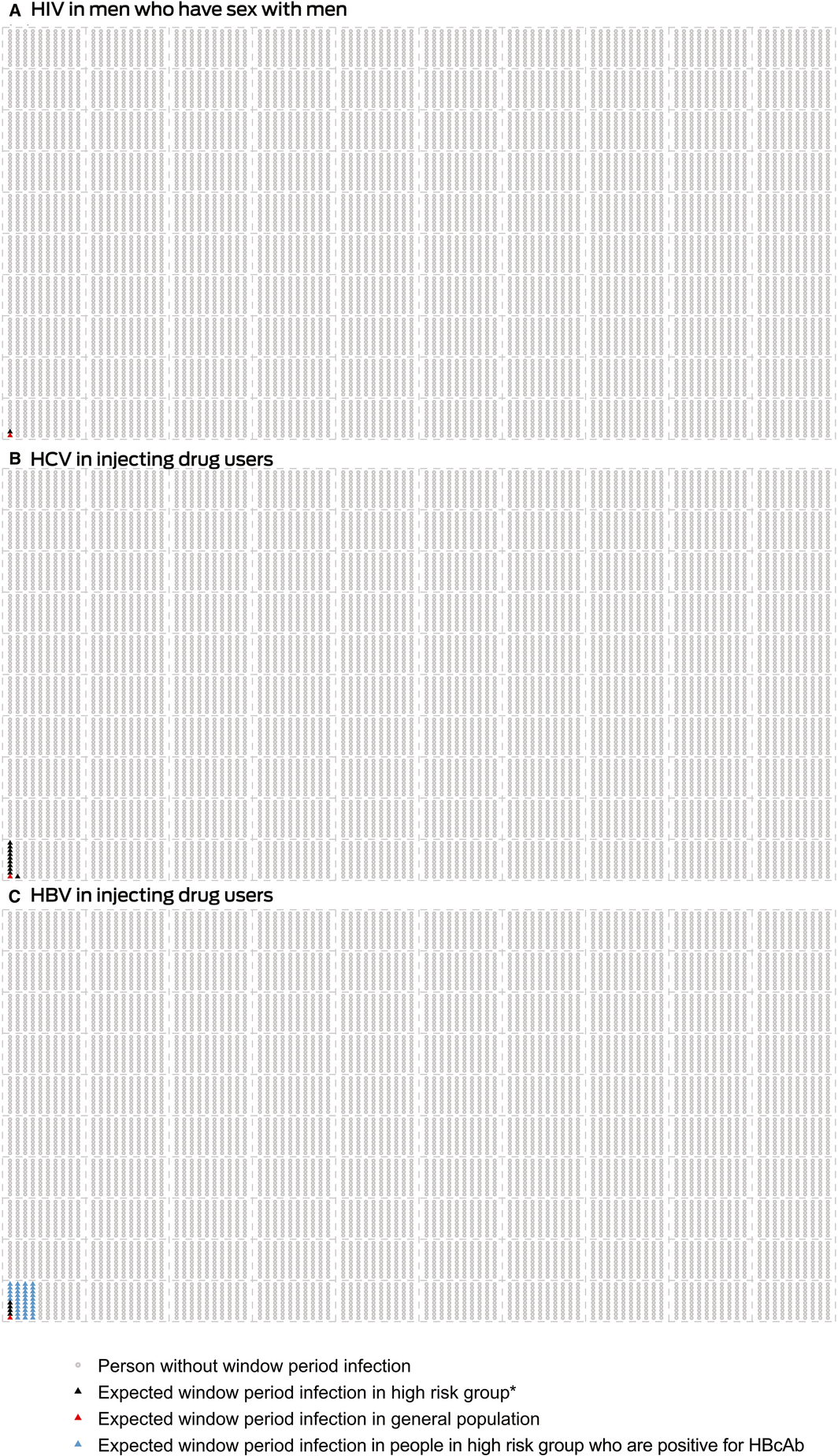
HBcAb = hepatitis B virus core antibody; HBV hepatitis B virus; HCV = hepatitis C virus; HIV = human immunodeficiency virus. Each plot represents 10 000 individuals with negative viral test results. For each virus, the baseline population is compared with the group at highest risk of infection with the virus. * For HBV, black triangles depict infections based on positive surface antigen detection.
Competing interests
No relevant disclosures.
Acknowledgements
We thank Jenny Iversen and Hamish McManus, who contributed by personal communication unpublished data that were included in our meta‐analysis. Karen Waller is funded by a National Health and Medical Research Council Postgraduate Scholarship (APP1168202).
References
- Organ and Tissue Authority. Australian donation and transplantation activity report 2018. Feb 2019. https://donatelife.gov.au/file/1765/download?token=DCH5rpBf (viewed May 2019).
- International Registry in Organ Donation and Transplantation (IRODaT). Final numbers 2017. Updated Dec 2018. http://www.irodat.org/img/database/pdf/IRODaT%20Newsletter%202017.pdf (viewed May 2019).
- Australia and New Zealand Organ Donation Registry (ANZOD). Australian waiting list. Updated Feb 2019. https://www.anzdata.org.au/anzod/reports/organ-waiting-list (viewed May 2019).
- Cass A, Chadban S, Gallagher M, et al. The economic impact of end‐stage kidney disease in Australia: projections to 2020. Sydney: Kidney Health Australia, 2010. https://kidney.org.au/cms_uploads/docs/kha-economic-impact-of-eskd-in-australia-projections-2020.pdf (viewed May 2019).
- Waller K, Rosales B, Thomson I, et al. Donor referrals at increased risk for blood borne viruses in New South Wales, 2010–2015 [abstract]. Transplantation Society of Australia and New Zealand annual scientific meeting, Brisbane, 7–9 May 2017. Transplant Direct 2017; 3 (10 Suppl 1): S14. https://www.ncbi.nlm.nih.gov/pmc/articles/PMC5636211/pdf/txd-3-s1.pdf (viewed May 2019).
- Kucirka LM, Namuyinga R, Hanrahan C, et al. Provider utilization of high‐risk donor organs and nucleic acid testing: results of two national surveys. Am J Transplant 2009; 9: 1197–1204.
- Pruett TL, Clark MA, Taranto SE. Deceased organ donors and PHS risk identification: impact on organ usage and outcomes. Transplantation 2017; 101: 1670–1678.
- Trotter P, Summers D, Robb M, et al. Deceased organ donor with a history of increased risk behaviour for the transmission of blood‐borne viral infection: the UK experience. Transplantation 2017; 101: 1679–1689.
- Bowring MG, Holscher CM, Zhou S, et al. Turn down for what? Patient outcomes associated with declining increased infectious risk kidneys. Am J Transplant 2018; 18: 617–624.
- Kizilbash SJ, Rheault MN, Wang Q, et al. Kidney transplant outcomes associated with the use of increased risk donors in children. Am J Transplant 2019; 19: 1684–1692.
- Ison MG. Nucleic acid testing of organ donors: is the glass half empty or half full? Am J Transplant 2015; 15: 1743–1745.
- Kucirka LM, Sarathy H, Govindan P, et al. Risk of window period HIV infection in high infectious risk donors: systematic review and meta‐analysis. Am J Transplant 2011; 11: 1176–1187.
- Kucirka LM, Sarathy H, Govindan P, et al. Risk of window period hepatitis‐C infection in high infectious risk donors: systematic review and meta‐analysis. Am J Transplant 2011; 11: 1188–1200.
- Transplantation Society of Australia and New Zealand. Clinical guidelines for organ transplantation from deceased donors, version 1.2. Updated Dec 2018. https://www.tsanz.com.au/Clinical%20Guidelines%20-Dec%202018.pdf (viewed May 2019).
- Dolan K, MacDonald M, Silins E, Topp L. Needle and syringe programs: a review of the evidence. Canberra: Australian Department of Health and Ageing, 2005. https://www.health.gov.au/internet/main/publishing.nsf/content/83AAED699516CE2DCA257BF0001E7255/$File/evid.pdf (viewed May 2019).
- Munn Z, Moola S, Riitano D, Lisy K. The development of a critical appraisal tool for use in systematic reviews addressing questions of prevalence. Int J Health Policy Manag 2014; 3: 123–128.
- Humar A, Morris M, Blumberg E, et al. Nucleic acid testing (NAT) of organ donors: is the “best” test the right test? A consensus conference report. Am J Transplant 2010; 10: 889–899.
- Kirby Institute. HIV, viral hepatitis and sexually transmissible infection in Australia: annual surveillance report 2017. Sydney: Kirby Institute, UNSW, 2017. https://kirby.unsw.edu.au/sites/default/files/kirby/report/SERP_Annual-Surveillance-Report-2017_compressed.pdf (viewed May 2019).
- Australian Bureau of Statistics. 3101.0. Australian demographic statistics, June quarter 2016. 15 Dec 2016. http://www.ausstats.abs.gov.au/ausstats/subscriber.nsf/0/6DAF7F7C4A59465DCA25808900122564/$File/31010_jun%202016.pdf (viewed May 2019).
- Kirby Institute. HIV, viral hepatitis and sexually transmissible infections in Australia: annual surveillance report 2016. Sydney: Kirby Institute, UNSW, 2016. https://kirby.unsw.edu.au/sites/default/files/kirby/report/SERP_Annual-Surveillance-Report-2016_UPD170627.pdf (viewed May 2019).
- The CST/CNTRP increased risk donor working group. Guidance on the use of increased infectious risk donors for organ transplantation. Transplantation 2014; 98: 365–369.
- Grulich AE, Guy R, Amin J, et al; Expanded PrEP Implementation in Communities New South Wales (EPIC‐NSW) research group. Population‐level effectiveness of rapid, targeted, high‐coverage roll‐out of HIV pre‐exposure prophylaxis in men who have sex with men: the EPIC‐NSW prospective cohort study. Lancet HIV 2018; 5: e629–e637.
- Medland NA, Chow EPF, Read THR, et al. Incident HIV infection has fallen rapidly in men who have sex with men in Melbourne, Australia (2013–2017) but not in the newly‐arrived Asian‐born. BMC Infect Dis 2018; 18: 410.
- Iversen J, Dore G, Catlett B, et al. Association between rapid utilisation of direct hepatitis C antivirals and decline in the prevalence of viremia among people who inject drugs in Australia. J Hepatol 2019; 70: 33–39.
- Heard S, Iversen J, Geddes L, Maher L. Australian Needle Syringe Program Survey national data report 2014–2018: prevalence of HIV, HCV and injecting and sexual behaviour among NSP attendees. Sydney: Kirby Institute, UNSW Sydney, 2019. https://kirby.unsw.edu.au/sites/default/files/kirby/report/ANSPS_National-Data-Report-2014-2018.pdf (viewed July 2019).
- Goldberg DS, Abt PL, Blumberg EA, et al. Trial of transplantation of HCV‐infected kidneys into uninfected recipients. N Engl J Med 2017; 376: 2394–2395.
- Australian Technical Advisory Group on Immunisation. Recommended vaccines for people before and after a solid organ transplant. In: ATAGI. Australian immunisation handbook. Canberra: Australian Department of Health, 2018. Updated 5 June 2018. https://immunisationhandbook.health.gov.au/resources/handbook-tables/table-recommended-vaccines-for-people-before-and-after-a-solid-organ (viewed July 2019).
- Kadatz K, Klarenbach S, Gill J, Gill JS. Cost‐effectiveness of using kidneys from hepatitis C nucleic acid test‐positive donors for transplantation in hepatitis C‐negative recipients. Am J Transplant 2018; 18: 2457–2464.
- Gupta G, Zhang Y, Carrol NV, Sterling RK. Cost‐effectiveness of hepatitis C‐positive donor kidney transplantation for hepatitis C‐negative recipients with concomitant direct‐active antiviral therapy. Am J Transplant 2018; 18: 2496–2505.
- Palacios G, Druce J, Du L, et al. A new arenavirus in a cluster of fatal transplant‐associated diseases. N Engl J Med 2008; 358: 991–998.
- Martinez MC, Kok CC, Baleriola C, et al. Investigation of occult hepatitis B virus infection in anti‐HBc positive patients from a liver clinic. PLoS One 2015; 10: e0117275.
- Yuen MF, Chen DS, Dusheiko GM, et al. Hepatitis B virus infection. Nat Rev Dis Primers 2018; 4: 18035.
Non-Technical Errors Associated With Deaths in Surgical Care, Australia, 2012–2019, by Surgical Specialty (Australian and New Zealand Audit of Surgical Mortality)
Jesse Ey, Guy J. Maddern
Localised Herpes Simplex Following Midline Laparotomy
Jessica S. Bulluss, Paul Chee, Matthew J. Verheyden
Non‐technical errors associated with deaths in surgical care, Australia, 2012–2019, by surgical specialty (Australian and New Zealand Audit of Surgical Mortality): a retrospective cohort study
Jesse Ey, Victoria Kollias, Octavia Lee, Kelly Hou, Matheesha Herath, John B North, Ellie Treloar, Suzanne Edwards, Martin Bruening, Adam J Wells, Guy J Maddern
Changes in patient management after preoperative MRI for newly diagnosed breast cancer: a multicentre prospective observational study
Michael L Marinovich, Nehmat Houssami, Andrew Spillane, Gregory B Mann, Donna Taylor, Michelle Reintals, Nadine Phillips, Max K Bulsara, Patsy Siok Hwa Soon, Tracey Dickens, Christobel M Saunders
The first Australian evidence‐based guidelines on male infertility
Darren J Katz, Liza O’Donnell, Robert I McLachlan, Tim J Moss, Clare V Boothroyd, Veena Jayadev, Sarah R Catford
The first live term birth following uterus transplantation in Australia
Rebecca Deans, Brigitte Gerstl, Antonia W Shand, Sarah Lyons, Aaron Budden, Helen L Barrett, Grant Luxton, Mangalee Fernando, Kenneth Yong, Karen Keung, Kaushalya Arulpragasam, Henry Pleass, King Man Wan, Eva Kehag, Jana‐Emily Pittman, Mianna Lotz, Maria Fenn, Erin Nesbitt‐Hawes, Lily Byun, Katrina Tang, Mats Brannstrom, Jason Abbott