




Volume 211 - Issue 9
Increasing illicit use of nitrous oxide in presentations to NSW emergency departments
Authors: Anna Bethmont, Claire E Harper, Betty SH Chan, Andrew H Dawson and Jeremy McAnulty
Med J Aust 2019; 211 (9): 429-429.e1. || doi: 10.5694/mja2.50377
Published online: 4 November 2019
Published online: 4 November 2019
To the Editor: Recreational use of nitrous oxide is increasing among regular drug users in Australia1 and internationally.2 In a New South Wales survey of participants who had used ecstasy or other stimulants in the past 6 months, 75% of respondents reported recent use of nitrous oxide in 2018, up from 20% in 2013.3 Nitrous oxide use while bingeing on stimulants rose from 4% of respondents in 2013 to 16% in 2017.4,5 Access to nitrous oxide has been facilitated by businesses offering 24/7 delivery of large quantities of canisters, ostensibly for whipping cream.6
We examined presentations to 60 emergency departments (EDs) across NSW from January 2012 to December 2018 (covering about 82% of all NSW ED presentations) in which the patient reported inhaling nitrous oxide outside a therapeutic setting. We extracted records from the Rapid Emergency Department Data for Surveillance (REDDS) dataset in which the person was aged 16 years or over and “nitrous oxide” or related terms were mentioned in the presenting problem, nursing assessment or diagnosis fields. We manually reviewed records for inclusion; this method may underestimate true presentation counts.
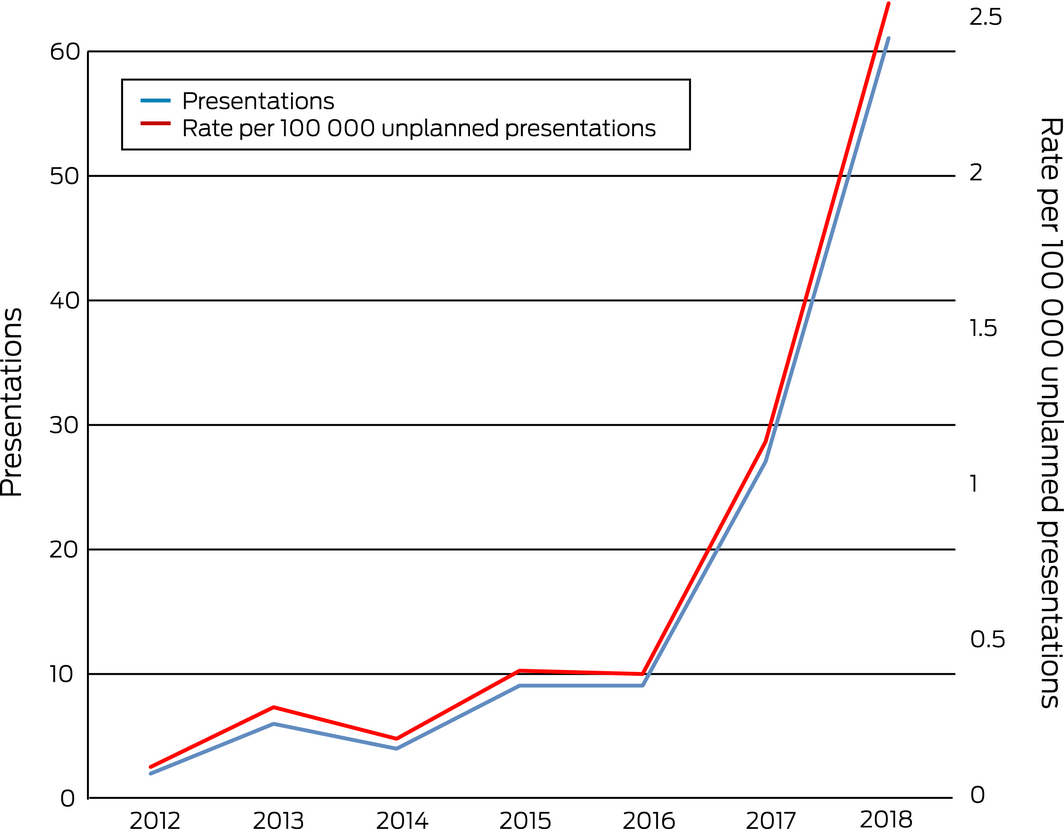
ED presentations fitting the criteria were infrequent (n = 118) but increased over time, particularly from 2016 to 2018 (Box). Most presentations were in persons aged 16–30 years (n = 98, 83%) and just over half were men (n = 66, 56%). Almost half indicated polydrug use (n = 54, 46%), and one quarter indicated chronic or heavy use of nitrous oxide (n = 28, 24%). Consistent with the case literature,7 presenting problems and diagnoses included injury (n = 15, 13%), neurological symptoms (n = 14, 12%), loss of consciousness or syncope (n = 13, 11%), respiratory arrest (n = 2, 2%), self‐harm or suicidal ideation (n = 16, 14%), or other mental health conditions (n = 28, 24%).
This increase in presentations may reflect changes in the underlying population or in data collection, rather than changes in drug use. However, the trend is consistent with drug use survey findings,1,3 suggesting that recreational nitrous oxide use may be an emerging health problem in Australia. Clinicians should include nitrous oxide use as part of a drug history, consider potential use among young patients presenting with neurological symptoms resembling B12 deficiency, and educate users on the health impacts, harm minimisation strategies and available support services. NSW Health is educating at‐risk groups through multilingual fact sheets8 and targeted social media and other messaging.
This report is the result of an investigation carried out by the NSW Ministry of Health under the provisions of the NSW Health Administration Act 1982; therefore, specific ethics approval was not required. Data were sourced from the REDDS, which is maintained by the Ministry of Health, and were analysed by Ministry of Health staff for the purpose of the investigation.
Competing interests
No relevant disclosures.
Acknowledgements
We thank the Rapid Surveillance, Centre for Epidemiology and Evidence, NSW Ministry of Health, for their assistance in extracting and analysing the ED data.
References
- Peacock A, Gibbs D, Karlsson A, et al. Australian drug trends 2018: key findings from the National Ecstasy and Related Drugs Reporting System (EDRS) interviews. Sydney: National Drug and Alcohol Research Centre, UNSW Australia, 2018. https://ndarc.med.unsw.edu.au/resource/australian-drug-trends-2018-key-findings-national-ecstasy-and-related-drugs-reporting (viewed June 2019).
- Winstock A, Barratt M, Ferris J, Maier L. Global Drug Survey 2017: global overview and highlights. London: Global Drug Survey, 2017. https://www.globaldrugsurvey.com/wp-content/themes/globaldrugsurvey/results/GDS2017_key-findings-report_final.pdf (viewed June 2019).
- Gibbs D, Peacock A. New South Wales drug trends 2018: key findings from the National Ecstasy and Related Drugs Reporting System (EDRS) interviews. Sydney: National Drug and Alcohol Research Centre, UNSW Sydney, 2018. https://ndarc.med.unsw.edu.au/resource/new-south-wales-drug-trends-2018-key-findings-ecstasy-and-related-drugs-reporting-system (viewed June 2019).
- Entwistle G, Burns L. NSW trends in ecstasy and related drug markets 2013: findings from the Ecstasy and Related Drugs Reporting System (EDRS). Sydney: National Drug and Alcohol Research Centre, UNSW Sydney, 2013. https://ndarc.med.unsw.edu.au/resource/nsw-trends-ecstasy-and-related-drug-markets-2013-findings-ecstasy-and-related-drugs; (viewed Sept 2019).
- O'Donnell C, Uporova J. NSW trends in ecstasy and related drug markets 2017: findings from the Ecstasy and Related Drugs Reporting System (EDRS). Sydney: National Drug and Alcohol Research Centre, UNSW Sydney, 2017. https://ndarc.med.unsw.edu.au/resource/nsw-trends-ecstasy-and-related-drug-markets-2017-findings-ecstasy-and-related-drugs; (viewed Sept 2019).
- Thomas J, Jones R. Doctors warn of dangerous rise in use of “nangs”. ABC News 2017; 19 Oct. https://www.abc.net.au/news/2017-10-16/doctors-warn-of-dangerous-use-of-nangs-or-nitrous-oxide/9046574 (viewed June 2019).
- Garakani A, Jaffe RJ, Savla D, et al. Neurologic, psychiatric, and other medical manifestations of nitrous oxide abuse: a systematic review of the case literature. Am J Addict 2016; 25: 358–369.
- NSW Health. Nitrous oxide: the facts [fact sheet]. Sydney: NSW Health. https://yourroom.health.nsw.gov.au/resources/publications/Pages/nitrous-oxide-drug-facts-english.aspx (viewed June 2019).
Designing Housing to Reduce Overcrowding-Related Harms: Rheumatic Heart Disease as the Canary in the Coal Mine
Simon Quilty, Veronica Matthews, Angus Baumann, James Marangou, Bo Remenyi, Gavin Wheaton, Serena Morton Nabanunga, Norman Frank Jupurrurla, Simon Robinson, Steve Mintern, Cary Duffield, Joshua R. Francis, Paul C. Memmott
Australian Climate Leadership in 2026: COP-Out or Step-Up for Health?
Catherine G. A. Pendrey, Angie Bone, Aletha Ward, Francis Nona, Michelle Isles, Paul M. Kelly, Nicholas J. Talley
The impact of the Breast Screen NSW transition from film to digital mammography, 2002–2016: a linked population health data analysis
Rachel Farber, Nehmat Houssami, Katy J L Bell
Shifting focus to adolescent wellbeing and inclusive participation in the digital age
Allyson R Todd, Elena Wang, Stephanie R Partridge
The CURE Asthma roadmap
Gary P Anderson, Anthony Flynn, Phil G Bardin, John D Blakey, Shyamali C Dharmage, Paul Foster, Peter G Gibson, Adam Jaffe, Alan James, Christine R Jenkins, Sundram Sivamalai, Peter D Sly, Guy B Marks, Vanessa M McDonald, Judy Wetttenhall
Protecting public interest journalism as a public health good
Bronwyn Fredericks, Neha Lalchandani, Melissa A Sweet, Alex Cramb, Carmel Williams