




Volume 211 - Issue 8
Baby boomers and booze: we should be worried about how older Australians are drinking
Author: Tim Roselli
Med J Aust 2019; 211 (8): 381-381.e1. || doi: 10.5694/mja2.50352
Published online: 21 October 2019
Published online: 21 October 2019
To the Editor: We welcome the research letter by Roche and Kostadinov,1 who have reported an increasing trend in risky alcohol consumption among adults aged over 50 years. The Report of the Chief Health Officer Queensland in 20162 presented the trends for lifetime risky drinking3 and found a similar trend of risky drinking for males aged 65 years and older.
While agreeing with the authors' overall message, there are concerns on the method used to assess trend, in particular, the highly significant P values for the relatively small change in prevalence. Population‐weighted counts, as presented in the research, are used to ensure that prevalence estimates are representative of the national population, but are inappropriate to use when determining the precision of the estimate. Using the weighted counts to calculate the χ2 statistic for trend effectively assumes that the population is the sample size (ie, 8 015 139 in 2016), when in fact the sample size was 23 772 in 2016.4 The effect of this is an overprecise estimate that results in a highly significant P value. Using the authors' table, a simple linear regression with prevalence as the outcome and year as the predictor can be used as a quick face validity check. This results in non‐significant trends for both risky and high risk groups; however, when these groups are combined a significant result is observed (significance level P < 0.05).
My research into lifetime risky drinking also encountered this issue of incorporating population weights into trend analysis and this was resolved by using various regression techniques.5 Another advantage of using regression is the ability to incorporate interactions in models to test differences in trend between subgroups. Using this technique identified a statistical difference in lifetime risky drinking trends between people aged 18–29 years and people aged 65 years and older (P < 0.001) (Box).
I believe that the authors' findings are important, but we need to take care that results are not discredited by choice of methodology.
Interactive data visualisations of alcohol consumption and other risk factors trends for Queensland can be found at the Queensland health website.6
Box – Trends in prevalence of lifetime risky drinking, by age group, Queensland, 2010–2018*
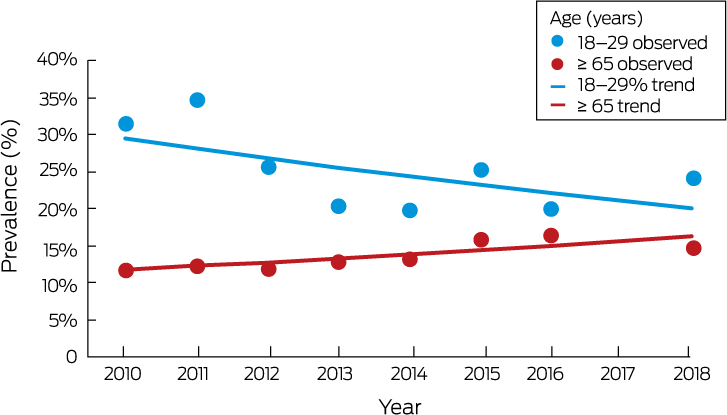
* Reproduced from Queensland Health's website.6
Competing interests
No relevant disclosures.
Acknowledgements
The views in this letter represent the views of the author and not necessarily those of the Queensland Department of Health.
References
- Roche AM, Kostadinov V. Baby boomers and booze: we should be worried about how older Australians are drinking. Med J Aust 2019; 210: 38–39. https://www.mja.com.au/journal/2019/210/1/baby-boomers-and-booze-we-should-be-worried-about-how-older-australians-are
- Queensland Health. The health of Queenslanders 2016. Report of the Chief Health Officer Queensland. Brisbane: Queensland Government, 2016. https://www.health.qld.gov.au/__data/assets/pdf_file/0017/537101/cho-report-complete.pdf (viewed Jan 2019).
- National Health and Medical Research Council. Australian guidelines to reduce health risks from drinking alcohol. Canberra: NHMRC, 2009. https://nhmrc.gov.au/about-us/publications/australian-guidelines-reduce-health-risks-drinking-alcohol (viewed Jan 2019).
- Australian Institute of Health and Welfare. National drug strategy household survey 2016: Data quality statement (Identifier No. 682686). Canberra: AIHW, 2017. https://meteor.aihw.gov.au/content/index.phtml/itemId/682686 (viewed Jan 2019).
- Department of Health. Trends in preventive health risk factors, Queensland 2002 to 2013. Brisbane: Queensland Government, 2014. https://www.health.qld.gov.au/__data/assets/pdf_file/0025/442636/trends-qld-2002-2013.pdf (viewed Jan 2019).
- Queensland Health. Headline preventive health indicators and trends [website]. Brisbane: Queensland Government, 2019. www.health.qld.gov.au/research-reports/population-health/preventive-health-surveys/data-trends (viewed Jan 2019).
Linked content
-
MJA Research Letter: Baby boomers and booze: we should be worried about how older Australians are drinking
-
MJA Letter: In Reply
Interpreting Australian Stillbirth Rate Trends: Implications for Surveillance and Continuous Quality Improvement
Aleena M. Wojcieszek, Kirstine Sketcher-Baker, Christine Andrews, Michael Coory, Imogen Kettle, Melissa Malivoire, David Ellwood, Vicki Flenady
Paracetamol in Pregnancy: Uncertain Evidence, Certain Consequences
David J. Tunnicliffe, Miranda Cumpston, Debra Kennedy, Margie Danchin, Armando Teixeira-Pinto
Fatty Liver Disease in Australia: A Narrative Review on the Epidemiology, Natural History, Prognostication and Management in People With Metabolic Dysfunction
Karl Vaz, Daniel Clayton-Chubb, William W. Kemp, Stuart K. Roberts, Ammar Majeed
Birth prevalence, clinical sequelae, and management of congenital cytomegalovirus infections in Australia, 1999–2023: a national prospective study
Ece Egilmezer, Suzy M Teutsch, Carlos Nunez, Stuart T Hamilton, Adam W Bartlett, Pamela Palasanthiran, Elizabeth J Elliott, William D Rawlinson
The number of cancer‐related deaths that could be attributable to spatial disparities in survival in Australia, 2010–2019: a retrospective population‐based cohort study
Charlotte K Bainomugisa, Jessica Cameron, Paramita Dasgupta, Peter Baade
Mandatory research projects during medical specialist training in Australia and New Zealand
Paulina Stehlik, Caitlin Brandenburg, David A Henry