




Volume 211 - Issue 11
Ophthalmia and the toponymy of outback Australia
Author: D Ashley R Watson
Med J Aust 2019; 211 (11): 503-506.e1. || doi: 10.5694/mja2.50412
Published online: 9 December 2019
Published online: 9 December 2019
A 19th century explorer and a 20th century surveyor each suffered blinding ophthalmia during their outback travels and took the most unusual step of naming outback places after their afflictions
A 19th century explorer and a 20th century surveyor each suffered blinding ophthalmia during their outback travels and took the most unusual step of naming outback places after their afflictions
Two men — one a 19th century explorer and the other a 20th century surveyor of the Australian outback — suffered blinding ophthalmia during crucial times in their exploits. Each then undertook a distinctive step in toponymy (the study or science of place names) by naming places in the Australian landscape after their afflictions, each place given a different name. Ophthalmia Range was named by Ernest Giles in 1876 after suffering debilitating conjunctivitis, known as ophthalmia in the 19th century. Sandy Blight Junction was named by Len Beadell in 1960 when he too suffered from this disease, also known as “blight” or “sandy blight”. While there has been speculation that what these men suffered was actually trachoma, this cannot be proven. This is both the story of how these places acquired their names and a study of what motivated these men to undertake such unique acts.
Ernest Giles
The explorer William Ernest Powell Giles was born in Bristol, England in 1835 and educated at Christ's Hospital School, Hertford and London.1 His father, William Giles, was the innkeeper of the Marine Mansion, Brighton, until he migrated with his wife to the colony of South Australia in 1849, leaving Ernest in London to finish his schooling. On arriving in the colony the following year, the younger Giles tried his luck, as many did, in the Victorian goldfields, then for a time worked as a postal clerk, then a court clerk in Melbourne until “this prosaic existence, however, became irksome to a nature created for a larger and more exciting sphere”.2 Apart from some work as a stockman and sometime surveyor on cattle stations along the Darling River in the early 1860s, not much else is known of his early adult life until the 1870s, which became his celebrated decade of exploration. From 1872 to 1876, Giles undertook five major organised expeditions to the Australian interior, his main aim being to be the first man to cross the western half of the continent.3
On the fifth and last expedition, from February to September 1876, Giles' party started in Perth and made its way northwards to seek the headwaters of the Ashburton River just south of the Tropic of Capricorn, within the region today known as the Pilbara. The intention was to find a route eastwards across the Gibson Desert, thus linking this expedition with the second expedition where his route westward had been hampered by the inhospitable terrain.
Giles travelled with four other men: Alexander (Alec) Ross, second in command; Peter Nicholls, the cook; Tommy Oldham, an Aboriginal lad; and Saleh, an Afghan camel driver (Box 1). In his earlier expeditions, Giles used horses as beasts of burden, but had switched to solely using camels by the time of this fifth trip.
By early May 1876, the party was nearing the area where Giles thought he would encounter the Ashburton River. It was at this time that he first mentions the condition that all members of the expedition had been suffering:
On the morning of May the 8th there was some appearance of more rain, and as we were camped upon ground liable to be flooded, I decided to be off at once to some higher ground, which we reached in about two miles down the creek. While we were packing up, and during the time we were travelling, the rain came down sufficiently heavily to wet us all thoroughly. We got to the side of a stony hill, put up our tents and tarpaulins, and then enjoyed the rain exceedingly, except that our senses of enjoyment were somewhat blunted, for all of us had been attacked with ophthalmia for several days previously.3
Ophthalmia had been a long used term which, in the 19th century, could refer to almost any form of acute conjunctivitis.
By mid‐May 1876, Giles and his party were high up the Ashburton at what he called a depot, a temporary camp to be used as a base for side trips to points of potential interest. Giles named this site Grand Junction Depot — today found where the Ashburton River meets Brumby Creek — and recorded this area with remarkable accuracy by sextant. Pressing on further east, Giles continued to suffer, stating:
My eyes had been so bad all day, I was in agony; I had no lotion to apply to them. At length I couldn't see at all, and Alec Ross had to lead the camels, with mine tied behind them. I not only couldn't see, I couldn't open my eyes, and had no idea where I was going. That day Alec sighted a range of somewhat high hills to our left; he next saw another range having rounded, dome‐like masses about it, and this lay across our path. Alec ascended one of the hills, and informed me that he saw an extensive mass of hills and ranges in every direction but the east.3
At this time the explorers were located at a point that today is about 15 km out of the town of Newman, where the Great Northern Highway bisects a mountain range at a place known as Cathedral Gorge. Lamenting his misfortune, Giles adds a place name to the Australian outback: “I called this range, whose almost western end Alec ascended, Ophthalmia Range, in consequence of my suffering so much from that frightful malady”.3
Giles and Ross soon returned to their companions at the depot, taking a south‐westerly route, probably following the course of what is today known as Tunnel Creek. Giles then first acknowledges the colonial Australian vernacular: “Everybody had an attack of the blight, as ophthalmia is called in Australia, which with the flies were enough to set any one deranged”.3
With colonial Australia developing its own terminology, “ophthalmia” became “blight”, which soon became “sandy blight”, a term that was used as early as the 1840s.4
Giles and his companions eventually successfully completed the crossing, traversing the Gibson Desert in a south‐easterly direction to arrive at Peake Telegraph Station in South Australia in August 1876.5 A telegram sent from “the Peake” to his sponsor, Thomas Elder, announced their safe return, reported a précis of the expedition, and advised of their expected arrival in Adelaide.6 This report also included the first written mention of Giles' troubles with ophthalmia, later recounted in greater detail in his published journals.3
In the late 1880s and 1890s Giles undertook what ultimately became fruitless financial and exploratory ventures into the otherwise promising goldfields of the Kimberley and Coolgardie regions of Western Australia.7 It was in the latter place that, in 1897, while working as a humble clerk in the local Mines office, Giles succumbed to pneumonia.2
Len Beadell
The second of our explorers, Len Beadell (Box 2), was a Sydney lad whose working life began at the age of 18 in 1941 when he enlisted in the Australian Army. Beadell spent much of the Second World War surveying and mapping parts of coastal New Guinea for military operations, and the immediate post‐war period providing surveying support for a Council for Scientific and Industrial Research (later to be renamed CSIRO) expedition to the Northern Territory.8
In 1947, Beadell was seconded to the Department of Supply and Development for the secret project of surveying land for the Long Range Weapons Establishment at Woomera, including time in Central Australia surveying a safe trajectory path for the rockets to be fired hundreds of miles into no man's land in the general vicinity of where the South Australian, Western Australian and Northern Territory borders meet. This pioneering and demanding work continued until 1963 and ultimately resulted in a legacy where Beadell became renowned as the “last true Australian explorer”.8 Beadell published his memoirs in a series of popular books, one of which, Beating about the Bush, is relevant to our present discussion.9
Beadell led a construction team that, through the 1950s, made several thousand miles of roads that ultimately opened up Central Australia to four‐wheel drive vehicles and allowed vehicular access to and from Aboriginal communities. He called the team the Gunbarrel Road Construction Party, consisting of a small group of men pushing forth in his Land Rover followed by a bulldozer and a grader. Beadell would survey the land miles ahead of the main party, signalling them to advance by reflecting the sun's rays though his pocket mirror. He would often spend days alone, living on scanty and poorly nutritious rations. For his work constructing what became the Gunbarrel Highway, Beadell was awarded the British Empire Medal in 1957.
In 1960, after the summer heat had settled, the construction party started work on a road linking the Gunbarrel Highway with an imagined junction with a proposed east–west road some 300 km to the north. After months of construction, work was halted not far from the Aboriginal community of Kintore. Early in July, Beadell had to return to Adelaide to attend to some affairs while the construction party waited in camp, servicing the vehicles and undertaking sundry other duties.
At this point in Beadell's travels it is important to appreciate his account in his memoir:
Just before starting the journey back from Adelaide, I had the nagging sensation that my eyes had grit behind the lids, and no amount of rinsing would relieve the feeling. Bushmen call the condition ‘sandy blight' because the eyeballs feel as though they are coated with sand. With every blink the lids grate over them, and the inflammation makes the eyes themselves extremely painful, gluing them shut after each night's attempted sleep. By the time I reached Woomera I could hardly see to drive, and so as soon as I could I sought the assistance of the doctor there. I had planned to stay in Woomera for a day, and during this time I made several visits to the hospital for treatment with eye ointment, which gave considerable relief. The doctor urged me to stay until my condition eased, but I couldn't help thinking of the boys back in the bush. By now they would probably have finished tuning up the equipment, and they would probably be ready and willing to shift camp. I also wanted to get back to continue with our huge project …9
We do not know if Beadell had previously suffered similar symptoms — it is not mentioned in any of his other books. Cases of blinding ophthalmia in white Australians had become scarce by the 1960s.10 Nevertheless, it is plausible that, as with Giles, environmental factors, or perhaps secondary infection, had exacerbated or unmasked underlying ophthalmia, possibly trachoma.
Beadell eventually made it back to his co‐workers, having spent over a week seeking comfort at cattle stations and homesteads along the way, while also trying to evade the better judgment of his hosts imploring him to stay put and seek proper medical advice through the Royal Flying Doctor Service. On 27 August 1960, the team set up a new camp near the site of the proposed intersection. Beadell went on to explain how the location in which they were working now bears its name:
For some reason the words “sandy blight” kept repeating themselves in my mind, and it was during the worst period that the name Sandy Blight Junction loomed up as a name for this crossroad.
Some years later I began to notice that name labelled on maps. Every time I see it, memories of that torturous night still materialise in my mind.9
The road‐making team finished their work in 1963, Beadell thenceforth easing into a quieter life in the Facilities Drawing Office of the Weapons Research Establishment until his retirement some years later. He continued to enjoy personal and commercial trips to the desert until he died in 1995.
Discussion
Much of the richness in the toponymy of Giles' and Beadell's stories actually lies in the fact that these men chose different place names (Box 3) for what may have been the same condition.11 For both men, their suffering seemed to reach a peak just as they were endeavouring to undertake crucial tasks within their respective expeditions: Giles seeking some sort of geological feature that would guide him eastward; Beadell attempting to locate the junction with the all‐important proposed road linking Alice Springs with the Western Desert region. And both seem to have hardly thought of anything at the time other than their own physical anguish, described as Giles' “frightful malady” and Beadell's “torturous night”. Interestingly, family and newspaper reports indicate that Beadell's toponymological inspiration may also have also had an element of frivolity. He was variously described as having a playful, optimistic and humorous disposition, traits that perhaps countermanded any opportunity he might have otherwise taken for a more considered and conventional approach to place naming (Connie Beadell, personal communication). Whatever the explanations, the actions of these men were clearly heartfelt responses to suffering and distress.
Box 1 – Ernest Giles' fourth expedition party, 1875
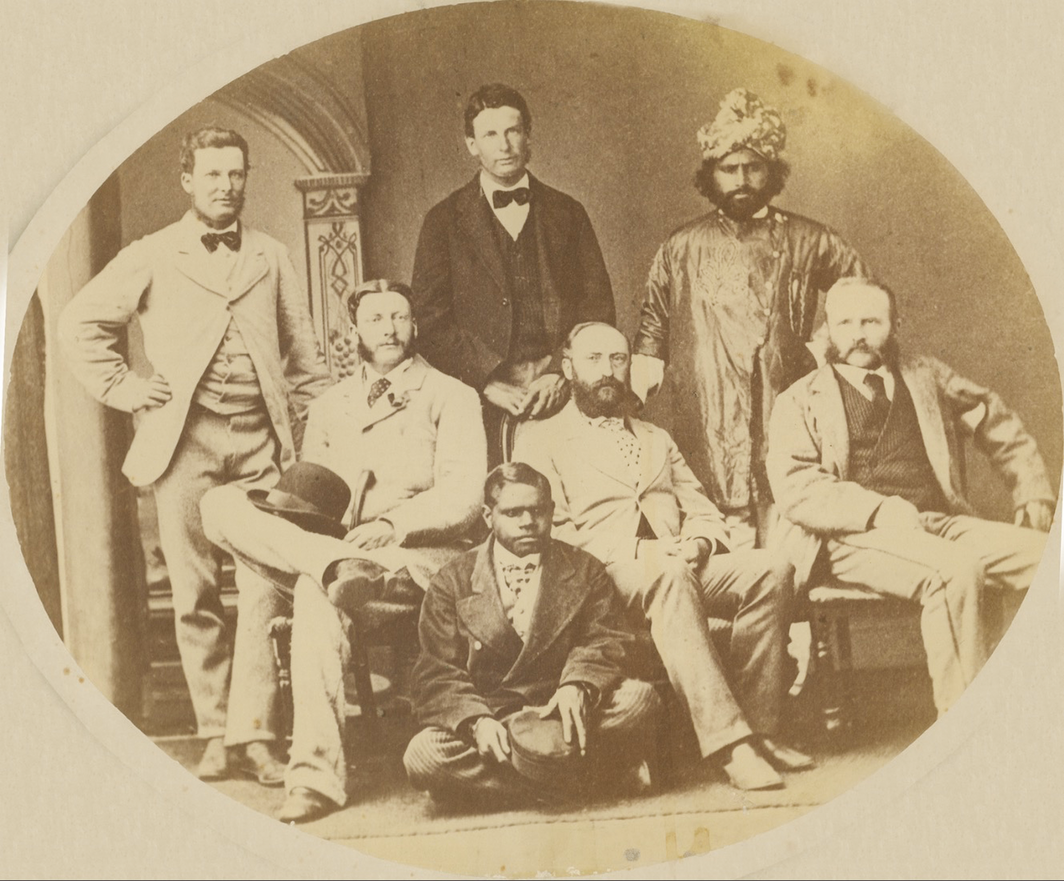
Giles is seated in the middle. Those later accompanying him on the fifth expedition in 1876 are (standing, left to right) Peter Nicholls, Alec Ross, Saleh and (sitting on floor) Tommy Oldham. Seated to the right of Giles is WH Tietkens who attended the same school as Giles in England. Source: State Library of South Australia, B 1035 – out of copyright.
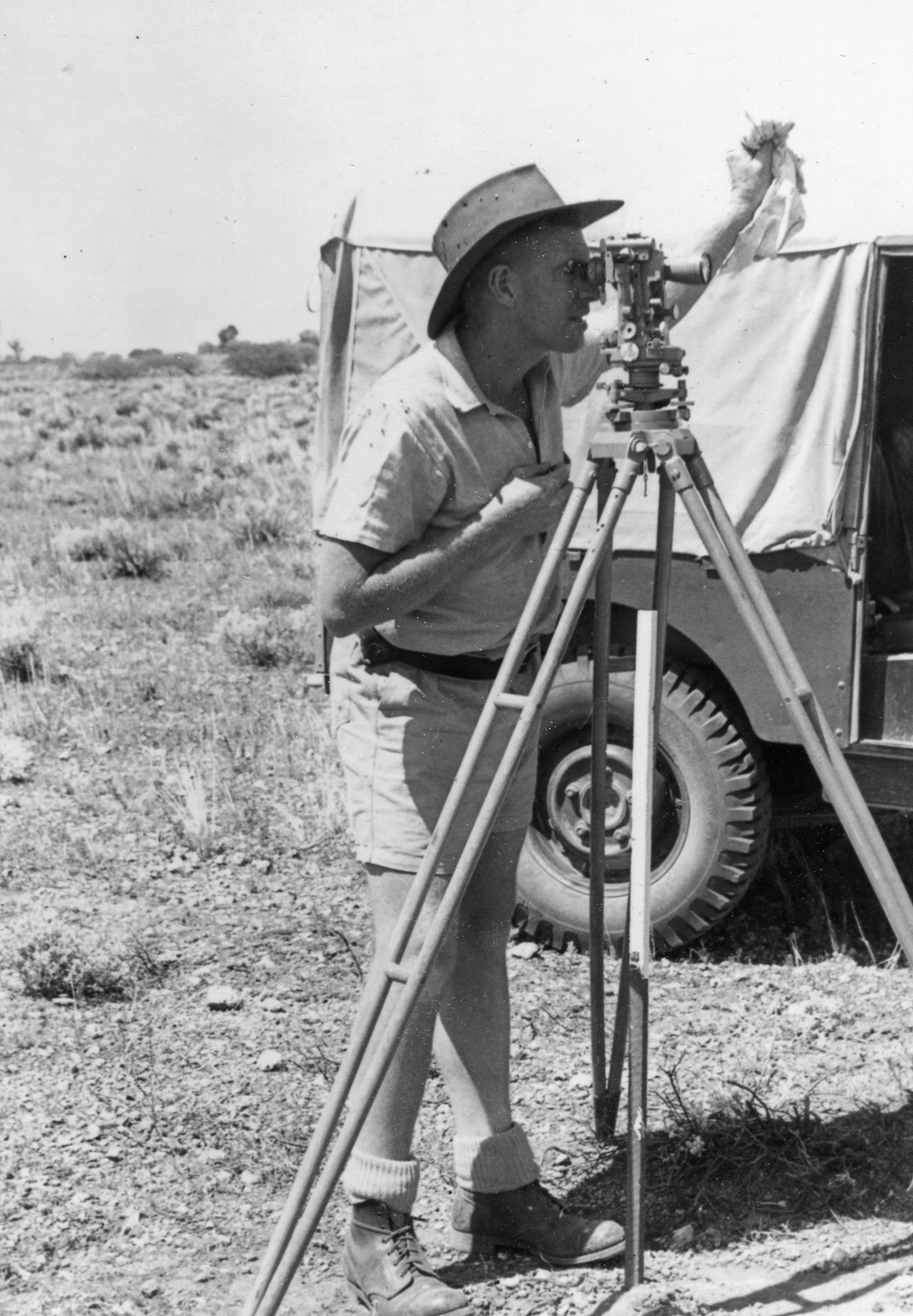
Source: Beadell family archives, with permission from Connie and Gary Beadell.
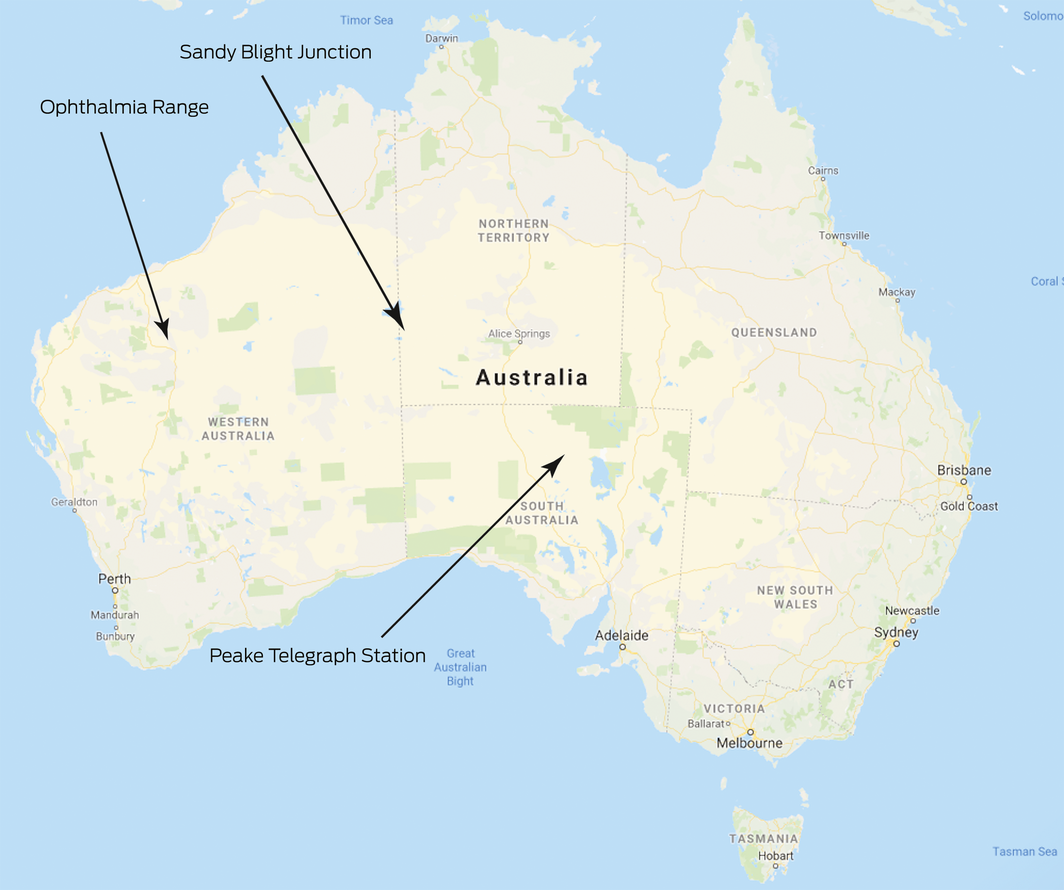
Competing interests
No relevant disclosures.
Acknowledgements
I am very grateful to Dr Dean Beaumont, retired surgeon, Canberra, and to Laureate Professor Hugh Taylor AC, Harold Mitchell Professor of Indigenous Eye Health, University of Melbourne, for their valuable comments on the manuscript. And for the inspiration to write this paper, I owe a salutation to Dr Bob Allan, general practitioner, Echuca.
References
- Green L. Giles, Ernest (1835–1897). Australian Dictionary of Biography. http://adb.anu.edu.au/biography/giles-ernest-3611 (viewed Oct 2019).
- Ernest Giles. Coolgardie Miner; 15 Nov 1897.
- Giles E. Australia twice traversed: the romance of exploration: being a narrative compiled from the journals of five exploring expeditions into and through central South Australia and Western Australia, from 1872 to 1876, by Ernest Giles. London: Sampson Low, Marston, Searle & Rivington, 1889.
- Maitland Mercury and Hunter River General Advertiser; 22 Aug 1849.
- Mr Ernest Giles's expedition. Adelaide Observer; 26 Aug 1876.
- Australian exploration. The Argus; 4 Sept 1876.
- The Kimberley Goldfields. Inquirer and Commercial News; 25 Apr 1888.
- Shephard M. A lifetime in the Bush: the biography of Len Beadell. Adelaide: Corkwood Press, 1998.
- Beadell L. Beating about the Bush. Sydney: Lansdowne, 1976.
- Mann I. Probable origins of trachoma in Australasia. Bull WHO 1957; 16: 1165–1187.
- Taylor HR. Trachoma in Australia. Med J Aust 2001; 175: 371–372. https://www.mja.com.au/journal/2001/175/7/trachoma-australia
Provenance: Not commissioned; externally peer reviewed.
A Diagnostic Headache
Thomas Glynn, Michelle T. Leech, Stacy K. Goergen, Emily Lin, Nadeem Toodayan, Ralph Junckerstorff
Neisseria meningitidis: an uncommon cause of conjunctivitis
Chloe Story, Tina Marinelli, Simeon Crawford, Amrita Ronnachit
Dismantling barriers to research and clinical care for individuals with a vision impairment
Eden G Robertson, Kate Hetherington, Meredith Prain, Julia Hall, Leighton Boyd AM, Rosemary Boyd OAM, Emily Shepard, Hollie Feller, Sally Karandrews, Fleur O'Hare, Kanae Yamamoto, Matthew P Simunovic, Robyn V Jamieson, Alan Ma, Lauren Ayton AM, Anai Gonzalez‐Cordero
The New South Wales Pharmacy Trial for herpes zoster: on the nose?
Christian P Pappas, Timothy R Holmes, Minas T Coroneo
Skin fragility disorder misdiagnosed as child abuse: a cautionary tale
Heather G Mack, Fred K Chen, John R Grigg
Health economic aspects of inherited retinal diseases: looking for cost‐effective treatments
Benjamin Kamien, Rachael Heath Jeffery, Fred K Chen