




Volume 211 - Issue 11
Australian Health Research Alliance: national priorities in data‐driven health care improvement
Authors: Helena J Teede, Alison Johnson, Jim Buttery, Cheryl A Jones, Douglas IR Boyle, Garry LR Jennings and Tim Shaw
Med J Aust 2019; 211 (11): 494-497.e1. || doi: 10.5694/mja2.50409
Published online: 9 December 2019
Published online: 9 December 2019
Unlocking the potential of health data to improve patient outcomes requires the integration of research, health care and education
Unlocking the potential of health data to improve patient outcomes requires the integration of research, health care and education
Data‐driven health care offers great promise in improving quality and efficiency in health care, if its value can be harnessed.1,2 Australia has well established primary care data systems, has broad uptake of electronic medical records in the hospital sector, and has invested in My Health Record — a population‐wide, opt‐out, medical record. Multiple other initiatives in health data have incrementally advanced health care benefit. For example, the NPS MedicineWise Medicine Insight program — a national data initiative in primary care — has used health data to improve outcomes in a diverse range of areas, including cancer care, antibiotics prescribing, and diabetes.3 However, far greater opportunities exist to realise the value of data in improving health care.
In 2017, the Duckett report noted that “The health system is awash with data, but the information is poorly collated, not shared with patients, and often not given to the doctors and hospital managers responsible for keeping patients safe”.4
To unlock the potential of these data and remove the barriers to their use, there needs to be integration of research, health care and education. Engagement of industry and government is also vital2 and this area is a policy priority for the Australian Government.5 Collaboration with broad industry stakeholders will provide access to experts from fields such as engineering, information technology, science and biomedicine. This expertise will accelerate the development of relevant new devices, diagnostics, therapeutics, delivery systems and clinical tools. Yet Australia has arguably lacked the collaborative platforms to bring these relevant stakeholders together and realise this potential.5
The Advanced Health and Research Translation Centres and Centres for Regional Health
The need to improve health care through research was highlighted in both the Strategic Review of Health and Medical Research6 and the Australian Medical Research and Innovation Strategy 2016–2021, which is funded through the Medical Research Future Fund (MRFF).5,7 A key outcome to deliver on this vision of the Strategic Review of Health and Medical Research6 was the establishment of seven Advanced Health and Research Translation Centres (AHRTCs) and two Centres for Regional Health (CIRHs) (online Supporting Information, table 1), which were accredited over the period 2015–2017.
The National Health and Medical Research Council (NHMRC) recognises the AHRTCs and the CIRHs as leaders in providing research‐based health care and education and they are accredited by the NHMRC for this purpose.8
The AHRTCs and CIRHs have together been awarded $300 million in MRFF funding over 10 years from 2018.9 The funds support rapid applied research translation projects and national system level initiatives.
Formation of the Australian Health Research Alliance
The Australian Health Research Alliance (AHRA) was established in 201510 and brings the AHRTCs and CIRHs together nationally across over 90% of NHMRC‐funded health and medical researchers and 80% of hospitals, as well as having significant primary care reach. Each AHRA centre consists of a collaboration of organisations that include large health service providers, universities, medical research institutes, and primary health care providers. These collaborations provide a platform where integration of staff results in a blending of concepts, issues, priorities and activities both within and across each AHRTC and CIRH. These collaborations transcend traditional silos and offer unprecedented opportunities for coordinated national activities now concentrated in five national systems level initiatives, one of which is in data‐driven health care improvement.
Bringing stakeholders together
The AHRA model for bringing stakeholders together aligns with that of the Strategic Review of Health and Medical Research (Box 1).
Governance
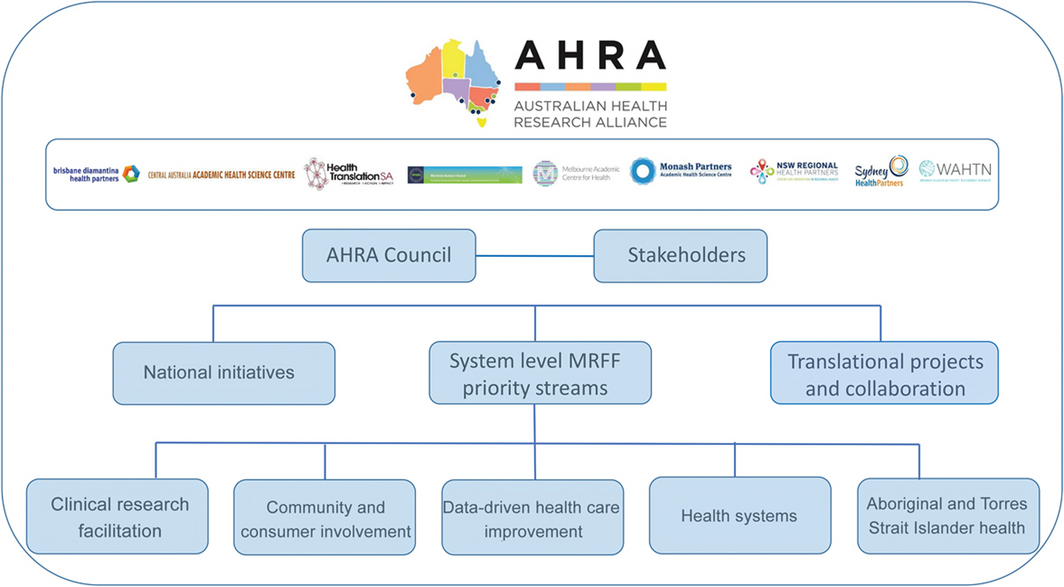
The AHRA governance structure consists of a council comprised of the director of each centre and a series of national committees bringing leading experts together (Box 2).
Establishment of the Australian Health Research Alliance data priorities
To establish agreed national data priorities, the AHRA applied a modified Delphi process and nominal group technique11 to rank research and service priorities as determined by multiple stakeholders (online Supporting Information, table 2).
Previous and current work in this field was captured through stakeholder input, an evidence‐based literature review, and inclusion of government priorities. The process took into consideration other national bodies of work to avoid duplication and optimise collaboration. The relevance of the priorities to AHRA objectives was also considered, including the potential for greatest measurable impact over time. This process resulted in a ranking of eight data priorities (online Supporting Information, table 3).
The AHRA centres have agreed to commence with a focus on the first three of these eight priorities. This work is complemented by, and integrated with, the national Digital Health Cooperative Research Centre (CRC). The Digital Health CRC program supports collaborations between industry, researchers and the community, with a view to increasing commercialisation, international opportunities, market access, and workforce development (www.digitalhealthcrc.com).
Collaboration and engagement with other existing government data activities are also emphasised.
The top three data priorities
Create virtual or actual, health data, research incubator hubs
This approach will provide a method, framework, system and structure that will improve access to, and interaction between, academics, clinicians, community, and data experts. The purpose of these hubs is to increase the use of quality data to inform decision making in the clinical setting. These will be nested within AHRA centres, across their member health care organisations, and will have a focus on community and health care benefit. These hubs will be different to conventional research hubs as they will use data to address current health care questions and priorities for community health benefit. That is, they will focus on the needs of the “demand” side of health care, which is driven by the community, public and private health service providers as well as government, where patient outcomes and benefits are paramount, unlike the “supply” side to health care, which is driven by commercial and industry interests, which are primarily financial and create the potential to have different definitions of value.
The use of AHRA infrastructure will facilitate collaboration across different stakeholders and organisations and enable rapid implementation across a large number of health care settings. The collaboration, and sharing of expertise, will also ensure that data are available quickly, in a format that is relevant to clinicians, patients and academics.
There is a need for research on how to optimise integration across relevant sectors, and to move beyond health data to also link in social data.1,12 Internationally, data hubs such as the nodes of Health Data Research UK12 link under the broader umbrella into a United Kingdom‐wide platform, including the recently announced and funded UK health system data hubs.13 These hubs integrate stakeholders, especially policy makers, academics and health care providers, to move beyond research use of data, to optimise the application and benefit of health data. The AHRA centres are ideally positioned to align values and skills and maximise benefits from health data. These hubs could both leverage considerable infrastructure housed within universities and health services and link nationally through AHRA to share findings and to translate evidence into practice. As an example, in this priority area, Monash Partners is applying internal and MRFF funding in leading and collaborating on a literature review and national and international research and partnership scoping and codesigning an Australian virtual or actual Learning Health System data hub. This approach aligns with the Australian Medical Research and Innovation Priority on a national data management study, and will inform an evidence‐based, consistent framework to inform AHRA centres nationally.14
Integrate large scale datasets
There is a need to integrate data across the primary, acute and subacute care continua to enable research that will drive health care improvement. While the value of integrating and linking health data is recognised, many barriers remain on sharing, integrating and securely storing, accessing, analysing and applying health data to improve health outcomes.15
Examples of progress in this area so far include a national AHRA data sharing accord developed by one of the AHRA centres, Sydney Health Partners, and a project led by the Melbourne Academic Centre for Health to engage all AHRA centres in the joint development of a national framework for improving data quality and linking primary care data. This involves building an understanding of the data currently available in Australia and helping to establish collaborations and working relationships with principal stakeholders in this space, including Primary Health Networks, the CSIRO and the Australian Institute of Health and Welfare. We will use the collaborative strengths and nature of AHRA to work towards harmonisation of data in areas such as the establishment of frameworks for data quality assessment, data linkage, common data modelling, terminology mapping and governance. Other AHRA centre projects that provide exemplars of data integration include projects aimed at reducing clinical variation (eg, a major scale‐up of a lung cancer registry and linkage, alignment and harmonisation of maternal health data, hospital pre‐admission prevention initiatives) and providing pilot hubs for implementing and optimising the use of My Health Record. Issues related to public willingness and confidence to share personal data need to be considered when linking datasets, particularly in relation to data privacy, consent for access and transparency regarding secondary use and who can access data and for what purpose.16 Legislative changes are currently being explored in these areas across state and federal governments; however, lack of harmonisation of effort across governments remains a key barrier for streamlined application of data for health benefit and is an area AHRA is collaborating on to aim to improve nationally.17
Build workforce capacity
The building of workforce capacity will be done by providing multidisciplinary training for undergraduates and graduates in the use of data for health care improvement.18 The Topol review for the National Health Service (NHS) in the UK states that “within 20 years, 90% of all jobs in the NHS will require some element of digital skills. Staff will need to be able to navigate a data‐rich health care environment. All staff will need digital and genomics literacy”.19 We, along with federal data agencies, understand this also applies to the Australian health care workforce20 in their aim to deliver safe seamless and secure use of data to improve health. AHRA activities include developing the vision and priorities, scoping current workforce development activities nationally, a literature review on priorities and effective strategies in workforce development, and a survey on priorities, needs and delivery methods across diverse stakeholders.
A Massive Open Online Course on digital health is now available online (www.coursera.org/learn/healthcare-data). This was led by the University of Sydney and Sydney Health Partners and supported by the Digital Health CRC and Monash Partners. More training programs have been collaboratively developed throughout AHRA centres, with both state and Commonwealth government support. Continuing professional development in health data science is an emerging field, with many universities developing a range of training options from postgraduate degrees and individual subjects to short courses and openly available online resources.
Some AHRA centres have engaged with accredited training bodies, for large‐scale, low cost, access to accredited training programs and data fellowships, which have been codesigned in health service priority areas. Monash Partners, for example, has developed a partnership with federal data agencies to scale current informatics training programs and has a multimillion dollar funded partnership supporting doctoral students and fellows in the use of data for health care improvement. This includes AHRTC health partner organisations as well as the university faculties of Information Technology, Business, and Medicine and Nursing and Health Sciences at Monash University, and is now engaging with the Digital Health CRC and government to expand this further. All priority areas here come from the health system, rather than the academic sector, as an exemplar of demand‐driven activities.
Strengths of the AHRA activities to date include the rigorous process; the diverse range of stakeholders, including consumers, health professionals, and health services; the multidisciplinary national experts and agencies involved; and the collaboration and leveraging of learning nationally and internationally.11 While input from state jurisdictions is increasing, expansion of opportunities here is needed. Implementation is well progressed and three AHRTCs have now engaged in pilot data hub development, most centres are engaged in data integration and harmonisation activities and all are involved in workforce development activities. Implementation will continue to evolve with parallel evaluation that is codesigned and includes clear health impact and workforce development measures.
Conclusion
We propose that the AHRA is uniquely placed to collaborate and drive the optimal use of data collected across the health care system in Australia and that implementing these joint agreed data priorities — collaborating with all relevant agencies and learning and coordinating nationally — is a vital step in delivering improved patient outcomes.
Box 1 – The Australian Health Research Alliance model for bringing stakeholders together
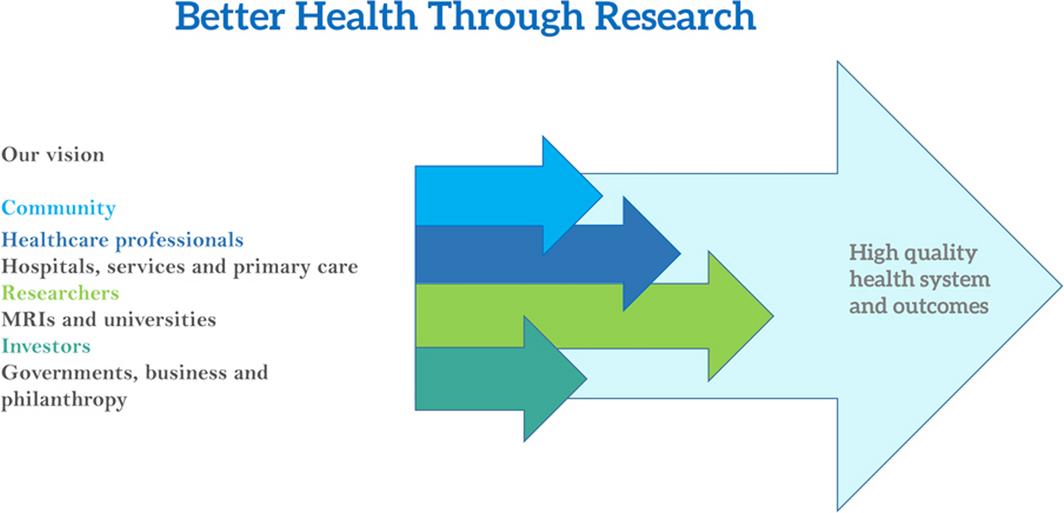
MRIs = medical research institutes. Figure adapted from McKeon et al.6
Competing interests
The authors are leaders across the AHRTC and are embedded within academic and health care organisations.
Acknowledgements
Helena Teede is supported by an MRFF NHMRC Practitioner Fellowship, with funds to the institution. This work is supported by the MRFF through the Australian Health Research Alliance of Advanced Health Research and Translation Centres and Centres for Innovation in Regional Health. Contributions from the expert committee and stakeholders agencies from across the centres are appreciated and acknowledged in this work (https://monashpartners.org.au).
References
- Pavis S, Morris AD. Unleashing the power of administrative health data: the Scottish model. Public Health Res Pract 2015; 25: 4.
- Greenhalgh T, Fahy N, Shaw S. The bright elusive butterfly of value in health technology development: comment on “Providing value to new health technology: the early contribution of entrepreneurs, investors, and regulatory agencies”. Int J Health Policy Manag 2018; 7: 81–85.
- NPS MedicineWise. Approved projects using MedicineInsight data. Quality improvement in primary care projects. Sydney: NPS MedicineWise, 2018. https://www.nps.org.au/approved-projects-using-medicineinsight-data (viewed Feb 2019).
- Duckett S, Jorm C. Strengthening safety statistics. How to make hospital safety data more useful. Grattan Institute, 2017. https://grattan.edu.au/wp-content/uploads/2017/11/893-strengthening-safety-statistics.pdf (viewed Oct 2018).
- Australian Government. Medical Research Future Fund. Australian medical research and innovation priorities, 2016–2018. Commonwealth of Australia, 2016. https://research.unimelb.edu.au/__data/assets/pdf_file/0004/2545645/Australian-Medical-Research-and-Innovation-Priorities-2016-2018.pdf (viewed October 2018).
- McKeon S, Alexander E, Brodaty H, et al. Strategic Review of Health and Medical Research — Better Health Through Research. Final report. Canberra: Commonwealth of Australia, Department of Health and Ageing, 2013. https://cheba.unsw.edu.au/sites/default/files/cheba/blog/Strategic_Review_of_Health_and_Medical_Research_Feb_2013-Summary_Report.pdf (viewed Oct 2018).
- Australian Government. Medical Research Future Fund: Australian medical research and innovation strategy 2016–2021. Commonwealth of Australia; 2016. https://research.unimelb.edu.au/__data/assets/pdf_file/0003/2545635/Australian-Medical-Research-and-Innovation-Strategy-2016-2021.pdf (viewed Oct 2018).
- National Health and Medical Research Council. Recognised Health Research and Translation Centres [website]. https://nhmrc.gov.au/research-policy/research-translation-and-impact/recognised-health-research-and-translation-centres (viewed Oct 2018).
- Department of Health. Health Budget 2019–20. Canberra: Commonwealth of Australia, 2019. https://health.gov.au/internet/budget/publishing.nsf/Content/budget2018;‐ 10 years tfactsheet72.htm (viewed Oct 2019).
- Teede H, Wesselingh S. Turning research intro implementation pull for health benefit. InSight Plus 2018; 15 Oct. https://insightplus.mja.com.au/2018/40/turning-research-push-into-implementation-pull-for-health-benefit (viewed Oct 2018).
- Rankin NM, McGregor D, Butow PN, et al. Adapting the nominal group technique for priority setting of evidence–practice gaps in implementation science. BMC Med Res Methodol 2016; 16: 110.
- Downs J, Gilbert R, Hayes RD, et al. Linking health and education data to plan and evaluate services for children. Arch Dis Child 2017; 102: 599–602.
- Health Data Research UK. Pioneering data research centres to enable cutting‐edge research and innovation to benefit UK patients [press release]. 12 Sept 2019. https://www.hdruk.ac.uk/news/pioneering-data-research-centres-to-enable-cutting-edge-research-and-innovation/ (viewed Oct 2019).
- Department of Health. Australian Medical Research Innovation Priorities 2018–2020. Commonwealth of Australia; 2018. https://beta.health.gov.au/resources/publications/australian-medical-research-and-innovation-priorities-2018-2020 (viewed Oct 2018).
- National Health and Medical Research Council. NHMRC Open Access Policy. NHMRC, 2018. https://www.nhmrc.gov.au/about-us/resources/open-access-policy (viewed Oct 2018).
- Office of the National Data Commissioner. Data sharing and release legislative reforms discussion paper. Canberra: Commonwealth of Australia, 2019. https://www.datacommissioner.gov.au/resources/discussion-paper (viewed Oct 2019).
- Canaway R, Boyle DI, Manski‐Nankervis JA, et al. Gathering data for decisions: best practice use of primary care electronic records for research. Med J Aust 2019; 210 (Suppl): S12–S15. https://www.mja.com.au/journal/2019/210/6/gathering-data-decisions-best-practice-use-primary-care-electronic-records.
- Brunner M, McGregor D, Keep M, et al. An eHealth capabilities framework for graduates and health professionals: mixed‐methods study. JMIR Res Protoc 2018; 20: e10229.
- Topol E. The Topol Review. Preparing the healthcare workforce to deliver the digital future. NHS, Health Education England, 2019. https://topol.hee.nhs.uk/wp-content/uploads/HEE-Topol-Review-2019.pdf (viewed Oct 2019).
- Australian Digital Health Agency. Australia's National Digital Health Strategy. Safe, seamless and secure: evolving health and care to meet the needs of modern Australia. ADHA, 2018. https://conversation.digitalhealth.gov.au/australias-national-digital-health-strategy (viewed Oct 2018).
Provenance: Not commissioned; externally peer reviewed.
Designing Housing to Reduce Overcrowding-Related Harms: Rheumatic Heart Disease as the Canary in the Coal Mine
Simon Quilty, Veronica Matthews, Angus Baumann, James Marangou, Bo Remenyi, Gavin Wheaton, Serena Morton Nabanunga, Norman Frank Jupurrurla, Simon Robinson, Steve Mintern, Cary Duffield, Joshua R. Francis, Paul C. Memmott
Australian Climate Leadership in 2026: COP-Out or Step-Up for Health?
Catherine G. A. Pendrey, Angie Bone, Aletha Ward, Francis Nona, Michelle Isles, Paul M. Kelly, Nicholas J. Talley
The impact of the Breast Screen NSW transition from film to digital mammography, 2002–2016: a linked population health data analysis
Rachel Farber, Nehmat Houssami, Katy J L Bell
Shifting focus to adolescent wellbeing and inclusive participation in the digital age
Allyson R Todd, Elena Wang, Stephanie R Partridge
The CURE Asthma roadmap
Gary P Anderson, Anthony Flynn, Phil G Bardin, John D Blakey, Shyamali C Dharmage, Paul Foster, Peter G Gibson, Adam Jaffe, Alan James, Christine R Jenkins, Sundram Sivamalai, Peter D Sly, Guy B Marks, Vanessa M McDonald, Judy Wetttenhall
Protecting public interest journalism as a public health good
Bronwyn Fredericks, Neha Lalchandani, Melissa A Sweet, Alex Cramb, Carmel Williams