




Medical education
Lessons from practice
Volume 210 - Issue 7
Reversal of dabigatran with idarucizumab in hyperacute stroke: a new paradigm?
Authors: Amy Ting, Abhay R Venkat, Yash Gawarikar and Ronak Patel
Med J Aust 2019; 210 (7): 302-303.e1. || doi: 10.5694/mja2.50122
Published online: 15 April 2019
Published online: 15 April 2019
A 68- year- old man presented with hyperacute stroke one hour after symptom onset
Clinical record
A 68‐year‐old man presented with hyperacute stroke one hour after symptom onset. The clinical picture was that of a right middle cerebral artery syndrome with left sided deficit and a National Institute of Health Stroke Score (NIHHS) of 7 on admission. The NIHHS is based on rapid neurological assessment for hyperacute stroke, ranging from 0 to 42, with higher scores indicating greater stroke severity. Blood pressure on admission was 106/85 mmHg. The patient was taking dabigatran exelate 150 mg twice a day for atrial fibrillation, and had taken the last dose 5 hours before presentation. His pre‐morbid modified Rankin score (mRS) was 0 and admission score was 2 — the mRS reflects functional independence and is rated from 0 to 6, with scores greater than 3 implying assistance with mobility.
His background was significant for a predisposition to carotid disease, given a history of squamous cell carcinoma that required radical neck dissection and radiation in 2007. Computed tomography (CT) stroke imaging with contrast from arch of the aorta to the circle of Willis was performed on arrival. This confirmed a right ipsilateral high grade (50–69%) proximal internal carotid artery stenosis without evidence of ischaemia. The Alberta Stroke Program Early CT score was 10 — this score (0–10) describes anatomical areas of hypoattenuation, with lower scores implying established infarction. Coagulation studies revealed a thrombin clotting time of 193 seconds, consistent with recent dabigatran exelate use. Idarucizumab, a dabigatran reversal agent, was given in two divided doses of 5 mg with a reversal of thrombin clotting time to 18 seconds (Box 1). The patient then received thrombolysis with alteplase at a dose of 0.9 mg/kg in total, with a 10% bolus dose. At 24 hours after thrombolysis, the NIHHS had improved to 1, with only left upper limb drift.
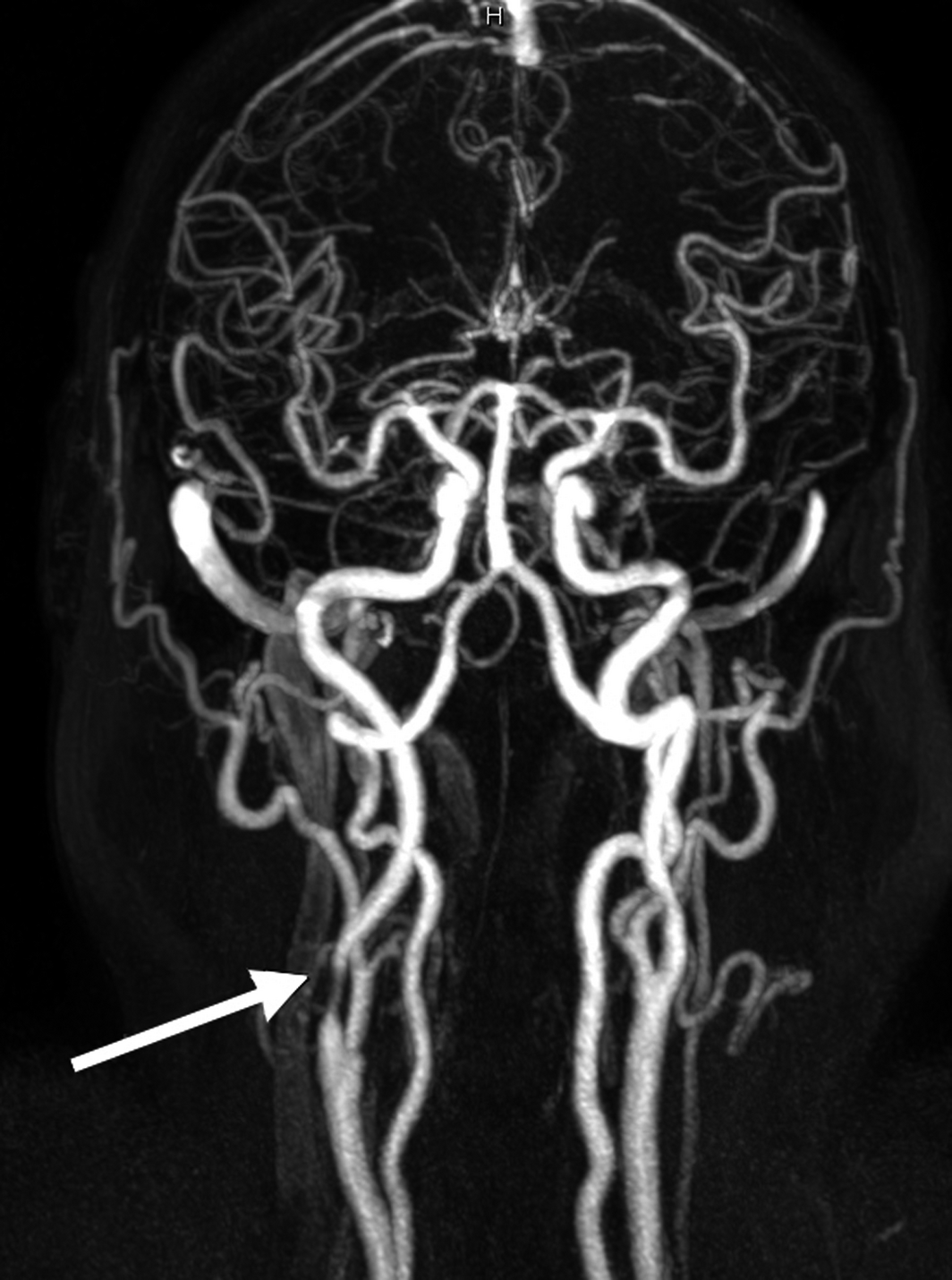
Magnetic resonance imaging angiography of the brain after thrombolysis showed diffusion‐weighted imaging consistent with an anterior circulation watershed infarction as well as high grade ipsilateral carotid stenosis (Box 2). He was transferred to a tertiary hospital for a right carotid endarterectomy one week later. On follow‐up at 30 days, the mRS had returned to 0.
Discussion
Idarucizumab is a humanised monoclonal antibody fragment that binds to dabigatran with a higher affinity than the binding affinity of dabigatran to thrombin, thus neutralising the anticoagulant effect.1 It was first approved in 2015 for reversal of dabigatran in emergency situations such as life‐threatening bleeding or before emergency surgery.2 There have been increasing numbers of case reports on idarucizumab being given to patients who presented with acute stroke symptoms before thrombolysis with good outcomes, but there are limited guidelines on how soon thrombolysis should be given after reversal with idarucizumab.3
Thrombolysis with intravenous alteplase is the gold standard treatment for acute ischaemic stroke to restore perfusion and normal function of ischaemic brain within 4.5 hours.4 Anticoagulated patients who present with acute ischaemic stroke remain a treatment challenge for physicians, as the risks and consequences of intracranial haemorrhage or gastrointestinal bleeding are significant. There have been many case reports on efficacy and safety of dabigatran reversal before thrombolysis, but there are limited guidelines on how soon thrombolysis should be administered after reversal. A 2015 study showed that the anticoagulant effect of dabigatran in 88–98% of patients was completely reversed by idarucizumab within minutes.3 In 2017, a randomised crossover trial showed that a dose of idarucizumab of 2.5 g or 5 g led to immediate, complete and sustained reversal of dabigatran‐induced anticoagulation. This result was independent of age, sex and renal function.5
While thrombolysis in patients with acute stroke who are taking dabigatran remains controversial, this successful case of dabigatran reversal and many other case reports using idarucizumab before thrombolysis prompt for the development of guidelines for acute stroke protocols across the country.
Lessons from practice
-
The treatment of hyperacute stroke involves gaining an accurate history of anticoagulation use, be that a vitamin K antagonist or a novel oral anticoagulant (NOAC), so that coagulation parameters can be assessed to allow the safe initiation of thrombolysis.
-
Thrombin clotting time must be added to coagulation studies in patients taking dabigatran, along with activated partial thromboplastin time and international normalised ratio, and can help in ascertaining compliance.
-
The rapid reversal of dabigatran allows for prompt administration of alteplase, with the use of thrombin clotting time to ensure efficacy of idarucizumab.
-
Given the ease of reversibility, the use of dabigatran can be considered as the preferable NOAC in patients with a bleeding diathesis, such as gastrointestinal or previous intracranial haemorrhage, until other effective NOAC reversing agents become available.
Box 1 – Coagulation profile of patient
|
Coagulation profile |
Reference intervals |
Before idarucizumab |
After idarucizumab |
||||||||||||
|
|
|||||||||||||||
|
PT, seconds |
10–15 |
16 |
13 |
||||||||||||
|
INR, seconds |
0.8–1.4 |
1.3 |
1.1 |
||||||||||||
|
APTT, seconds |
25–36 |
47 |
31 |
||||||||||||
|
TCT, seconds |
13–19 |
193 |
18 |
||||||||||||
|
|
|||||||||||||||
|
APTT = activated partial thromboplastin time. INR = international normalised ratio. PT = prothrombin time. TCT = thrombin clotting time. |
|||||||||||||||
Competing interests
No relevant disclosures.
References
- Ng F, Bice J, Rodda A, et al. Adverse clinical outcomes after dabigatran reversal with idarucizumab to facilitate acute stroke thrombolysis. J Neurol 2017; 264: 591–594.
- Boehringer Ingelheim International. Praxbind prescribing information [Food and Drug Administration's approved drugs database]. Boehringer Ingelheim International; 2015. http://www.Accessdata.Fda.Gov/drugsatfda_docs/label/2015/761025lbl.Pdf (viewed Nov 2017).
- Pollack CV, Reilly PA, Eikelboom J, et al. Idarucizumab for dabigatran reversal. N Eng J Med 2015; 373: 511–520.
- Demaerschalk BM, Kleindorer DO, Adeoye OM, et al; American Heart Association Stroke Council; Council on Epidemiology and Prevention. Scientific rationale for the inclusion and exclusion criteria for intravenous alteplase in acute ischemic stroke: a statement for healthcare professionals from the American Heart Association/American Stroke Association. Stroke 2016; 47: 581–641.
- Glund S, Stangier J, van Ryn J, et al. Effect of age and renal function on idarucizumab pharmacokinetics and idarucizumab‐mediated reversal of dabigatran anticoagulant activity in a randomized, double‐blind, crossover phase Ib study. Clin Pharmacokinet 2017; 56: 41–54.
Provenance: Not commissioned; externally peer reviewed.
Motor Neuron Disease Mortality Trends in Australia From 1986 to 2023: A Population-Based Study
Carol M. Y. Lee, Rupendra N. Shrestha, Julian Gold, Mark Stevenson, Kelly L. Williams, Lyndal Henden, Sandrine K. K. Chan Moi Fat, Zoe Zussa, Amanda Wright, Martin Jude, Mark A. S. Laidlaw, Willem J. R. Fokkink, Dominic B. Rowe
Mild traumatic brain injury and concussion and persisting post‐concussion symptoms: new guidelines to support evidence‐based assessment and management in Australia and Aotearoa New Zealand
Karen M Barlow, Jennie L Ponsford, Alice Theodom, Gill Cowen, Gavin A Davis, Vicki Anderson, Franz E Babl, David Cole, Jennifer Cullen, Stuart R Dalziel, Melinda Fitzgerald, Howard Flavell, Caroline Yates, Rebecca Kimble, John H Olver, Rhonda Orr, Mark Ralfe, Michael Rose, Nick Rushworth, Julia Treleaven, Gary Browne, Nathan Delang, Sarah Harris, Gary Mitchell, Sean Tweedy
The prevalence of and variation in indicators of the quality and safety of long term aged care in Australia, 2019: a cross‐sectional population‐based study
Tesfahun C Eshetie, Gillian E Caughey, Catherine Lang, Olivia Ryan, Renuka Visvanathan, Craig Whitehead, Keith Evans, Janet K Sluggett, Jyoti Khadka, Carolyn Dawkins, Helena Williams, Miranda Starke, Sara Blunt, Anne Liddell, Megan Corlis, Anna Sheppeard, Penelope Lello, Marilyn Thien, Steven L Wesselingh, Maria C Inacio
Health and economic benefits of improving pre‐hospital identification of stroke in Australian women: a modelling study
Thomas Gadsden, Lei Si, Emily R Atkins, Cheryl Carcel, Xia Wang, Stephen Jan, Mark Woodward, Laura E Downey
Symptom burden, quality of life, and diagnostic journey of people with postural orthostatic tachycardia syndrome, Australia, 2021–24: a descriptive patient registry data study
Marie‐Claire Seeley, Gemma Wilson, Eric Ong, Amy Langdon, Jonathan Chieng, Danielle Bailey, Kristina Comacchio, Amanda Page, Dennis H Lau, Celine Gallagher
The intersection of rurality and dementia prevalence in Australia for Aboriginal and Torres Strait Islander and non‐Indigenous peoples
Antonia J Clarke, Marwan Ahmed, Judith M Katzenellenbogen, John Towney (Wiradjuri), Anna H Balabanski, Adrienne Withall (Dharawal Yuin), Kylie Radford, Amy Brodtmann