




Volume 210 - Issue 7
Recognising injuries related to needlestick injury in farmers: the importance of identifying high‐pressure injections with mineral oil
Authors: Elvira Currie, Rhian Cope and Margaret C Hardy
Med J Aust 2019; 210 (7): 333-334.e1. || doi: 10.5694/mja2.50116
Published online: 15 April 2019
Published online: 15 April 2019
Oil in water emulsions are commonly used by Australian farmers to vaccinate sheep and goats against Mycobacterium avium subsp. paratuberculosis, which causes the chronic wasting condition ovine Johne disease in ruminants and camelids.
The Australian Pesticides and Veterinary Medicines Authority (APVMA) is the independent federal authority that regulates the safe supply and use of veterinary medicines and agricultural chemicals for sale in Australia. The APVMA maintains the Australian Adverse Experience Reporting Program, which is a post‐market program that monitors roughly 5500 reports received annually from product registrants, medical and veterinary professionals, and members of the public.
An epidemiological review shows that the peak time of year for high‐pressure oil‐adjuvant injection injuries in Australian adverse experience reports is in spring and summer (October–February), when livestock vaccination programs for young animals are at their peak. Potentially serious long term adverse outcomes, including amputation, are possible without appropriate early intervention as described on the product label.2,3,4 Of the 210 adverse experience reports in humans related to mineral oil injections reported over the life of all registered products, the most common immediate reactions mimicked those of a sharps injury: needlestick injury, a reaction at the injection site, pain and swelling (Australian Adverse Experience Reporting Program data).
In order to be prepared for the high volume season for livestock vaccination programs, the APVMA recommends that medical professionals, particularly those serving populations heavily involved with primary production, revisit best practices for the management of this type of injury (Box).
Health services are encouraged to include “high‐pressure injection injury” as a triage entry option to reduce the potential misinterpretation of a “needlestick injury” entry.4 Appropriate early intervention reduces the risk of subsequent complications and adverse outcomes. Underpinning the entire process is a need for health care professionals to receive appropriate training to recognise injuries of this type and initiate early intervention as per the product label and the manufacturer's instructions.
Box – An example of appropriate triage and treatment for a patient presenting with a high‐pressure injection injury*
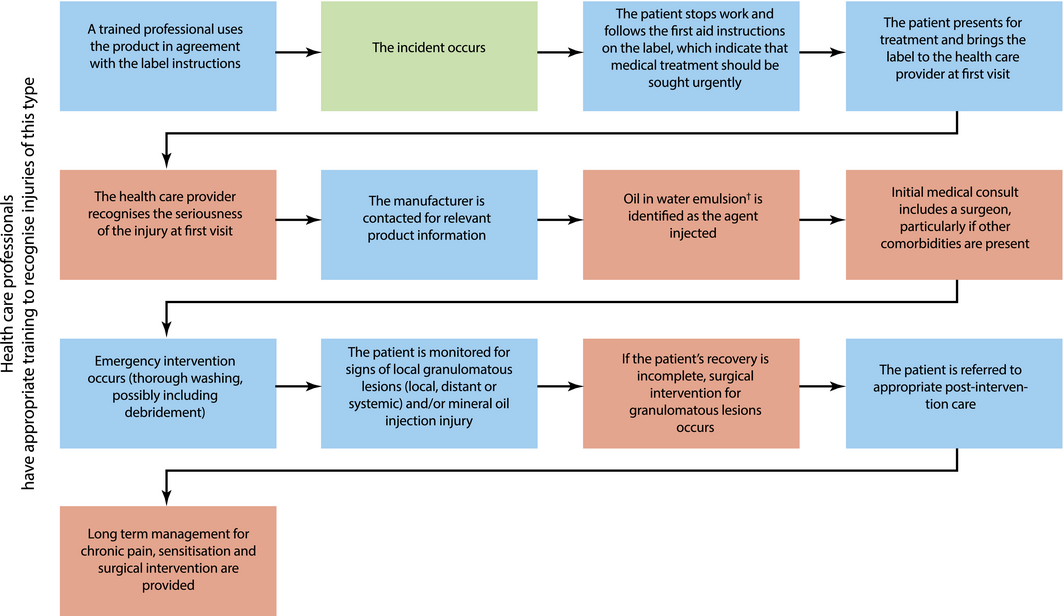
*The green box indicates the occurrence of an injection incident, based on data from the Australian Adverse Experience Reporting Program. Checkpoint steps in the process that can have a significant impact on patient outcomes if omitted are indicated by orange boxes. † This is the most common formulation for injections containing Mycobacteria
Competing interests
No relevant disclosures.
References
- Robertson CE, Ackerman NA, Burke FD, Reilly WJ. Sharps and high‐pressure injection injuries in veterinary and animal workers. Eur J Emerg Med 2016; 23: 8–11.
- Buswell ML, Hourigan M, Nault AJ, Bender JB. Needlestick injuries in agriculture workers and prevention programs. J Agromedicine 2016; 21: 82–90.
- Ryan A, Johnstone B. High‐pressure injection injury: benign appearance belies potentially devastating consequences. Med J Aust 2017; 206: 477. https://www.mja.com.au/journal/2017/206/11/high-pressure-injection-injury-benign-appearance-belies-potentially-devastating
- Rosenwasser M, Wei D. High‐pressure injection injuries to the hand. J Am Acad Orthop Surg 2014; 22: 38–45.
Linked content
-
MJA Letter: Recognising injuries related to needlestick injury in farmers: the importance of identifying high‐pressure injections with mineral oil
Capturing the Benefits of Clinical Quality Registries
Taryn Bessen, Stephen McDonald
Medical Colleges Have an Obligation to Ensure Full Participation in Clinical Quality Registries
Thomas J. Hugh
Getting on the Same Page: Why Australia Needs a National Maternity Early Warning System (MEWS) Chart
Briony A. Cutts, Lucy Bowyer, Nisha Khot, Sandra Lowe, Stefan C. Kane
Data for Equity: Can Linked Administrative Data Inform Pathways to More Equitable Child Health?
Sarah Gray, Shuaijun Guo, Meredith O'Connor, Elodie O'Connor, Katrina Williams, Hannah Badland, Susan Woolfenden, Josie Dickerson, Gerry Redmond, Marnie Downes, Sharon R. Goldfeld
Specialty College Selection: Why Change is Critical to Support a Future Rural Workforce
Matthew R. McGrail, Jenny May AM, Katherine Logan
Differentiated and simplified oral HIV pre‐exposure prophylaxis (PrEP) models hold the key to virtually eliminating HIV transmission in Australia by 2030
Tyson Arapali, Sarah Warzywoda, Anthony K J Smith, Curtis Chan, Timothy R Broady, Erin Sullivan, Catherine MacPhail, Mohamed A Hammoud, Alexander Dowell‐Day, Benjamin R Bavinton