




Volume 210 - Issue 5
Health care in a globalised world: is there more than one type of patient?
Authors: Pupalan Iyngkaran and Michael Jelinek
Med J Aust 2019; 210 (5): 211-212. || doi: 10.5694/mja2.50035
Published online: 18 March 2019
Published online: 18 March 2019
Clinical care guidelines for collecting and using information on the cultural heritage of patients are needed
Clinical care guidelines for collecting and using information on the cultural heritage of patients are needed
We cannot escape globalism or its consequences for medical practice. The article by Morgan and colleagues in this issue of the Journal1 could not have been better timed to initiate a debate about diversity and Western medical paradigms. The authors examined how often and why the cultural heritage of patients — a broad field encompassing ethnic background and national heritage, their religious, cultural and socio‐economic diversity — was cited during medical handovers and in electronic records in a Perth hospital. Aboriginality was mentioned by clinicians much more frequently than other backgrounds. The interpretation and implications of their findings are complex and challenging.
Western health practice is built on scientific evidence about the known, rationalising or debating the uncertain, and clarifying by investigation the unknown. Increasingly heterogeneous patient encounters challenge relying only on scientific evidence about the knowns, as conventional evidence gathering rarely focuses on translational elements (phase 4 clinical research).2,3 New approaches are therefore emerging, such as standardising, coding and classifying heterogeneity (eg, taxonomies), broadening the evidence base, and developing local solutions based on post‐trial evidence.4,5
Understanding the permutations of how scientific tools are applied is itself an art. The main scientific purpose of the doctor–patient interaction is to extract information on health and disease phenotypes from manifestations such as symptoms, signs, and diagnostic correlates of tissue and organ function.4,5 In this context, the only reason a clinician might need to specifically ask about ethnic background would be to gain phenotypic information needed for evidence‐based care. Ethnic phenotypes may be seen as risk factors in disease processes — for example, in cardiovascular disease — although apparently confirmatory data and genetic inferences may be affected by biases or unknown factors, so that the evidence base for assessing ethnicity in clinical practice is tentative.6,7,8 There are nonetheless limited but well defined evidence‐based reasons for acquiring information on ethnic phenotypes when treating certain diseases, and these will undoubtedly increase with time.
The importance of a patient's cultural background for medical practice
Phase 4 studies have indicated that acting on clinical trial‐derived evidence does not achieve the expected outcomes unless the findings have been validated at the community level.2,9 In organised programs with this aim, the art of medical practice becomes evident when assessing non‐phenotypic factors such as rapport, compliance, trust, satisfaction, behavioural change, and personal psychology. Cultural heritage adds greater challenges to doctor–patient communication, including interpreting non‐verbal cues and other cultural differences. Subjectivity and biases are often expressed in clinical care; for example, could over‐reporting underlie recent political discussions about poor Aboriginal health? Nevertheless, routinely obtaining details about ethnic background for informing the art of medical care must be distinguished from using this information clinically, as its significance for disease and management taxonomies is uncertain. Conversely, cultural information other than ethnicity can also influence clinical management, and requires thoughtful extraction and communication.
It is unclear how and by whom such information should be collected, and how often it should be updated. Resolving these questions would be advanced by integrating cultural heritage and related information in a scientific sense, particularly by compartmentalising the process in taxonomies. The process must be defined to ensure accuracy, maintain standards, and guarantee that patients providing information in good faith are not disadvantaged by their doing so.
Towards clinical guidelines for recording cultural heritage
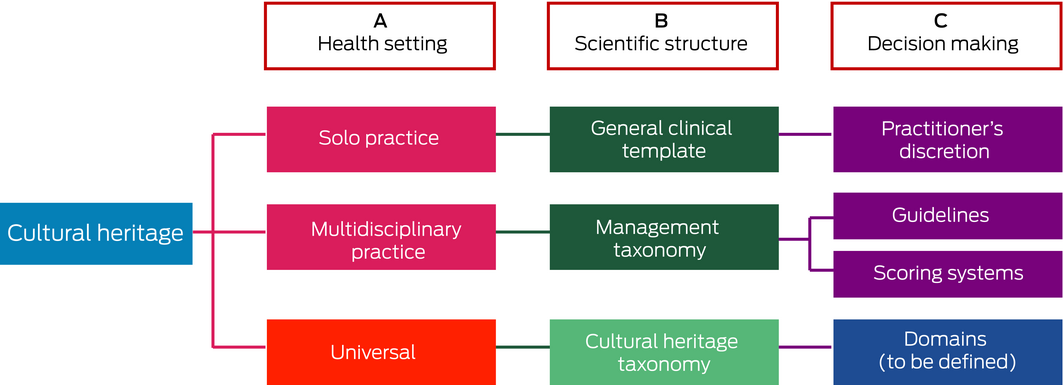
A cultural heritage taxonomy could guide understanding of the various relevant processes and form the basis for clinical guidelines. Information on the socio‐cultural background of patients is routinely obtained when taking a clinical history (Box, A). In solo practice, subjectivity is more likely than in multidisciplinary care, where greater consensus is required. The judicious handling of cultural information can shape health worker–patient relationships, and standards are needed for a unified approach. Medical teaching and health policies deliver the scientific basis for collecting this information with the aim of ensuring that factors which impede optimal health care are identified and addressed. A classification of cultural disadvantages in medical care, complementing health management taxonomies, will be developed with experience across a range of health care settings (Box, B). Finally, subjectivity influences decision making in practice. In theory, domains that might define the taxonomy of cultural influences could include any non‐disease factor that affects outcomes, such as ethnic background (including known genetic associations), socio‐economic and geographic factors, language and culture, social supports, mental health, and medical literacy (Box, C). Corroborating subjective claims and resolving questions in contentious areas, such as ethnic background, are among the challenges for the future.
A cultural heritage taxonomy could support a model of care in which a multidisciplinary team documents and responds to disadvantages or differences that could negatively affect health care. Funding these services would be a political issue influenced by public sentiment. While investigating the role of cultural heritage in medical practice is noble, social attitudes will affect our ability to act upon the outcomes of clinician‐driven studies, and doctors will require a political voice to advocate policies regarding socio‐cultural factors.
In summary, information about cultural heritage is regularly collected during the routine care of patients, but its use is subject to the discretion and biases of practitioners. In multidisciplinary care, a consensus process is required, and we applaud the many examples of optimal health care delivered in socio‐culturally diverse settings. However, comprehensively extending such optimal care requires standards that counter political and societal influences that can reduce its effectiveness (eg, affirmative action creating generic policies for a group at the government level, individual biases from past experiences, resident status of the patient, socio‐cultural miscommunications).
The ideal model of universal health care includes a cultural heritage taxonomy that helps practitioners respond to the diversity of their patients. Without reaching consensus on how and why we collect such information, publications such as the excellent article by Morgan and colleagues1 will remain isolated. Advocacy bodies, including the Royal Australasian College of Physicians (RACP), the Australian Medical Association (AMA), local, state and federal health bodies, as well as administrators and research institutes, could establish pathways for lobbying and deliver a taxonomy for health systems that has broad appeal. It is exciting to see the sprouting of new health science branches for guiding the development of an objective balance in what is currently a highly subjective area of health care.
Competing interests
No relevant disclosures.
References
- Morgan DJR, Harris T, Gidgup R, Whitely M. Identifying the cultural heritage of patients during clinical handover and in hospital medical records. Med J Aust 2019; 210: 220–226.
- Iyngkaran P, Liew D, McDonald P, et al. Phase 4 studies in heart failure: what is done and what is needed? Curr Cardiol Rev 2016; 12: 216–230.
- Krumholz HM, Currie PM, Riegel B, et al. A taxonomy for disease management. Circulation 2006; 114: 1432–1445.
- Sackett DL, Rosenberg WM, Gray JA, et al. Evidence‐based medicine: what it is and what it isn't. BMJ 1996; 312: 71–72.
- Smith R, Rennie D. Evidence based medicine — an oral history. JAMA 2014; 311: 365–367.
- Iyngkaran P, Kangaharan N, Zimmet H, et al. Heart failure in minority populations: impediments to optimal treatment in Australian Aborigines. Curr Cardiol Rev 2016; 12: 166–179.
- MacRae CA, Vasan RS. The future of genetics and genomics: closing the phenotype gap in precision medicine. Circulation 2016; 133: 2634–2639.
- Iyngkaran P, Liew D, Neil C, et al. Moving from heart failure guidelines to clinical practice: gaps contributing to readmissions in patients with multiple comorbidities and older age. Clin Med Insights Cardiol 2018; 12: 1179546818809358.
- Iyngkaran P, Majoni W, Cass A, et al. Northern Territory perspectives on heart failure with comorbidities: understanding trial validity and exploring collaborative opportunities to broaden the evidence base. Heart Lung Circ 2015; 24: 536–543.
Linked content
-
MJA Research: Identifying the cultural heritage of patients during clinical handover and in hospital medical records
-
MJA Podcast: Dr David Morgan and Ms Tania Harris
Provenance: Commissioned; externally peer reviewed.
Dousing the burning inequity of global warming for people experiencing homelessness
Timothy English, Alejandro Vásquez Hernández, Glenn Miller, Nuala Fogarty, Charles Cosgrove, Paul Rosenthal, Matthew Larkin, Jon Swain, Danielle Austin, Jo River
The contribution of evidence‐based practice and the practice‐based evidence approaches to contemporary Australian psychology: implications for culturally safe practice
Paul Gray (Wiradjuri), Dawn Darlaston‐Jones, Pat Dudgeon AM (Bardi), Kate Derry, Joanna Alexi, William Smith (Wiradjuri and Wemba Wemba), Tanja Hirvonen (Jaru and Bunuba), David Badcock, Shraddha Kashyap, Belle Selkirk (Noongar)
Explaining risk in chronic conditions: the Yolŋu science of signs
Emma Haynes, Alison Mitchell, Minitja Marawili (Yolŋu), Dawn C Bessarab (Bardi)
Is it time to retire the label “CALD” in public health research and practice?
Sabine Allida, Della Maneze
What do Aboriginal people in the Northern Territory value during the operation journey? A qualitative study
Edith B Waugh, Marita Hefler, Sophie Pascoe, Mark Mayo, Matthew JL Hare, David A Story, Neil Wilkshire, Peter Henwood, David Croker, Jampijinpa Ross
Fulfilling First Nations health, cultural safety and equity accreditation standards in primary medical education: reflections from a First Nations desktop review team
Paul Saunders, Nicole Mercer, Maria Mackay, Ian Lee, Madelyne Hudson‐Buhagiar, Miriam Cavanagh, Emma Milliss, Melody Muscat, Kathleen Martin, Adam Shipp, Melissa Johnson, Belinda Gibb