




Volume 210 - Issue 3
Increasing registrations on the Australian Organ Donor Register
Authors: Gail Moloney, Michael Sutherland, Maddison Norton, Alison Bowling and Iain Walker
Med J Aust 2019; 210 (3): 143. || doi: 10.5694/mja2.50000
Published online: 18 February 2019
Published online: 18 February 2019
Five years on, 53% of the people we surveyed in New South Wales (n = 802) were unaware that donation decisions were no longer recorded on the driver's licence,2 and less than a third of eligible Australians had registered their decision on the AODR.3 The implications of this are profound. Consent to donate by the next‐of‐kin in the intensive care unit is 90% when decisions are registered on the AODR, but only 44% when the decision is unknown.4
We have responded to the need to increase registration rates by developing5 an immediate registration opportunity, which combines the opportunity to discuss donation in a face to face interaction with the opportunity to register on the AODR immediately.2 Participants’ concerns, fears and questions about donation are prompted through a brief survey about organ donation beliefs, which facilitates discussion and allows misconceptions to be addressed. The participants are then asked if they would like to register on the AODR.
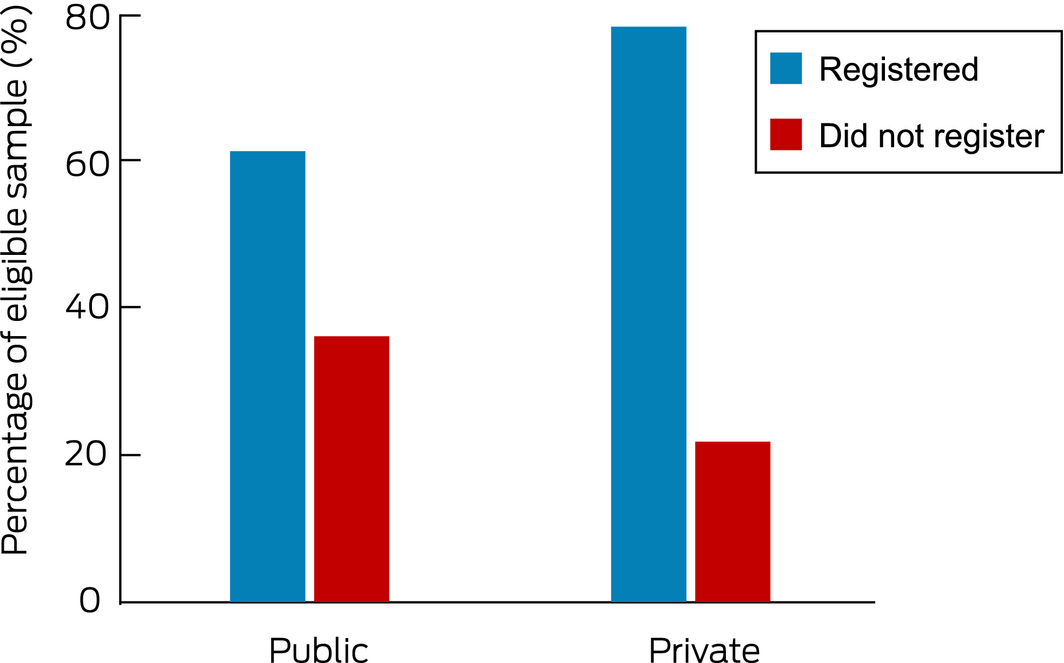
This initiative has been successful in increasing AODR registrations among the general public at a range of locations in NSW in 2017,2 and we had even higher success rates when we rolled this out in two NSW hospital‐based settings (Box). Integral to the success of the immediate registration opportunity is the consistent finding that the public and health care staff simultaneously hold positive beliefs and negative concerns about organ donation. Addressing the tension created by these dichotomous beliefs through face to face interaction, coupled with the ease and immediacy of on‐the‐spot registration, facilitates the registration decision. We believe that offering the immediate registration opportunity nationally in hospital‐based settings and in the community has the potential to increase registrations in the AODR dramatically.
Competing interests
No relevant disclosures.
Acknowledgements
This research was supported by NSW Organ and Tissue Donation Service.
References
- Thomas M, Klapdor M. The future of organ donation in Australia: moving beyond the “gift of life” Department of Parliamentary Services, Parliamentary Library; 2008. http://www.rssfeeds.aph.gov.au/binaries/library/pubs/rp/2008-09/09rp11.pdf (viewed Dec 2018).
- Moloney G, Sutherland M, Norton M, Walker A. When is the gift given? Organ donation, social representations and an opportunity to register. J Community Appl Soc Psychol 2019. In press.
- Department of Human Services. AODR Intent registrations 2018 [website]. https://www.humanservices.gov.au/organisations/about-us/statistical-information-and-data/medicare-statistics/australian-organ-donor-register-statistics/australian-organ-donor-register (viewed Dec 2018).
- Organ and Tissue Authority. Why is registration important? Canberra: OAT; 2017. http://www.donatelife.gov.au/sites/default/files/5_Why%20is%20registration%20important.pdf (viewed Dec 2018).
- Sharpe E, Moloney G, Sutherland M, Judd A. The power of an immediate donor registration opportunity: translating organ donation attitudes into registration behavior. Basic Appl Soc Psych 2017; 39: 49–59.
Reorienting Allied Health Into Community-Based Care for People Experiencing Trauma and Social Disadvantage
Simon Rosenbaum, Grace McKeon, Gulsah Kurt, Oscar Lederman, Kemi Wright, Sabuj Kanti Mistry, Jackie E. Curtis, Philip B. Ward, Zachary Steel, Hamish Fibbins, Rachel Morell, Melissa C. Eaton, Andrew Watkins, Ben Harris-Roxas, Brendan Goodger, Eleanor Beck, Megan Teychenne, Joseph Firth, Davy Vancampfort, David Burns, Russell Roberts, Tristan Favaloro, Danielle Weber, Rosanna Barbero, Vasili Maroulis, Melissa Holmes, Stefan Mackenzie, Chiara Mastrogiovanni, Afsana Anwar, Uzma Choudhry, Catherine Sherrington, Jane Currie, Thomas Gadsden, Scott Teasdale
Psychosocial Hazards for Healthcare Workers: Supporting the Second Victim Also Helps the Primary Victims
Sarah Michael
Shifting focus to adolescent wellbeing and inclusive participation in the digital age
Allyson R Todd, Elena Wang, Stephanie R Partridge
Shifting focus to adolescent wellbeing and inclusive participation in the digital age
Jodie Bailie, Helen Dickinson, Briony Lipton, Marissa Shields
The CURE Asthma roadmap
Gary P Anderson, Anthony Flynn, Phil G Bardin, John D Blakey, Shyamali C Dharmage, Paul Foster, Peter G Gibson, Adam Jaffe, Alan James, Christine R Jenkins, Sundram Sivamalai, Peter D Sly, Guy B Marks, Vanessa M McDonald, Judy Wetttenhall