




Volume 209 - Issue 9
Preventing ovarian failure associated with chemotherapy
Authors: Wanyuan Cui, Catharyn Stern, Martha Hickey, Fiona Goldblatt, Antoinette Anazodo, William S Stevenson and Kelly-Anne Phillips
Med J Aust 2018; 209 (9): 412-416. || doi: 10.5694/mja18.00190
Published online: 5 November 2018
Published online: 5 November 2018
A new PBS indication for goserelin aims to reduce infertility and other health issues for young Australian women who receive chemotherapy
Summary
- Alkylating chemotherapy is often used to treat pre-menopausal women for various malignancies and autoimmune diseases. Chemotherapy-associated ovarian failure is a potential consequence of this treatment which can cause infertility, and increases the risk of other long term adverse health sequelae.
- Randomised trials, predominantly of women undergoing alkylating chemotherapy for breast cancer, have shown evidence for the efficacy of gonadotropin-releasing hormone agonists (GnRHa) in preventing chemotherapy-associated ovarian failure.
- The European St Gallen and United States National Comprehensive Cancer Network guidelines recommend the use of concurrent GnRHa to reduce the risk of ovarian failure for pre-menopausal women undergoing chemotherapy for breast cancer.
- The GnRHa goserelin, a monthly 3.6 mg depot subcutaneous injection, has recently been listed on the Australian Pharmaceutical Benefits Scheme to reduce risk of ovarian failure for pre-menopausal women receiving alkylating therapies for malignancy or autoimmune disease.
- The first dose of goserelin should ideally be administered at least 1 week before commencement of alkylating treatment and continued 4-weekly during chemotherapy.
- Concurrent goserelin use should now be considered for all pre-menopausal women due to commence alkylating chemotherapy (except those with incurable cancer), regardless of their childbearing status, in an effort to preserve their ovarian function. For women who have not completed childbearing, consideration of other fertility preservation options, such as cryopreservation of embryos or oocytes, is also important.
Alkylating chemotherapy drugs, such as cyclophosphamide, are integral to the treatment of many malignancies, including breast cancer, lymphoma and sarcoma, as well as some autoimmune diseases such as systemic lupus erythematosus (SLE). In 2018, it is estimated that over 4500 pre-menopausal Australian women will be diagnosed with breast cancer or haematological malignancies, and most will receive cyclophosphamide with curative intent.1,2
Chemotherapy-associated ovarian failure (COF) is an important long term adverse effect of alkylating agents (Box 1).3 The risk is increased with increasing cumulative dose and increasing age.4 Ovarian failure causes infertility, which is often a major concern for young patients. It may also increase fracture risk due to reduction in bone mineral density, and is associated with cognitive dysfunction, sexual dysfunction and decreased quality of life.5,6 Prevention of COF is thus very important to improve the survivorship experience for young Australian women, regardless of their childbearing plans.
Studies, predominantly in breast cancer patients, have shown that concurrent administration of gonadotropin-releasing hormone agonists (GnRHa) substantially reduces the risk of COF. As a result, use of GnRHa in this setting is recommended in the European St Gallen7 and United States National Comprehensive Cancer Network8 guidelines for pre-menopausal women with breast cancer. On 1 December 2017, the GnRHa goserelin was listed under the Australian Pharmaceutical Benefits Scheme (PBS) for pre-menopausal women receiving treatment with an alkylating agent for malignancy or autoimmune disorders (Box 2).9 This represents a major step forward in achieving equity of access to this drug for Australian women.
This review summarises the evidence for use of GnRHa for prevention of COF and provides important information about practical aspects of prescribing.
Methods
A literature search was conducted using MEDLINE, and EMBASE. The search terms used included “gonadotropin releasing hormone”, “chemotherapy”, “alkylating chemotherapy”, “ovarian function”, “chemotherapy associated ovarian failure” “premature ovarian failure”, “premature ovarian insufficiency” and “menopause”. Only articles in English were included. We reviewed randomised controlled trials (RCTs), case–control trials and meta-analyses designed to look at the efficacy of adding GnRHa to alkylating chemotherapy to preserve ovarian function. We also reviewed additional articles related to the effects of early menopause, as well as the mechanism of action of GnRHa. Case reports, abstracts, conference presentations and posters were not included.
Chemotherapy-associated ovarian failure
Definitions and terms used to describe COF vary in the different studies that have examined the efficacy of GnRHa. Generally, definitions (and study endpoints) included either amenorrhoea or follicle-stimulating hormone (FSH) levels in the post-menopausal range, often at 6 months to 2 years after randomisation, or a combination of these. Unlike spontaneous menopause, ovarian function can resume in some women after chemotherapy treatment even following a prolonged period of amenorrhoea and raised gonadotropin levels.10 Pregnancy was a secondary endpoint in several trials. Overall, pregnancy rates in the trials were low, as would be expected for women with a diagnosis of breast cancer, many of whom likely did not intend pregnancy either because of concerns about their breast cancer prognosis, ongoing breast cancer treatment that contraindicated pregnancy (eg, adjuvant endocrine therapy) or because childbearing was complete before their cancer diagnosis. The terminology used in the relevant trials included treatment-related early menopause, premature ovarian insufficiency and premature ovarian failure. For simplicity, throughout this review, the term COF is used.
COF can cause symptoms related to oestrogen deficiency such as hot flushes, night sweats and vaginal dryness.6,11 Depressive symptoms, fatigue, weight gain and significant decreases in bone mineral density have also been reported in breast cancer patients with COF.5,6,11,12 In patients without cancer, ovarian failure before the age of 40 years, from both surgical and non-surgical causes, is associated with worse cognitive function and increased cardiovascular disease.13,14 An American cohort study observed that prophylactic bilateral oophorectomy in patients before the age of 45 years was associated with higher mortality compared with age-matched women who had not undergone oophorectomy (hazard ratio [HR], 1.67; 95% CI, 1.16–2.40; P = 0.006).14 Prevention of COF is therefore important to avoid these long term health sequelae.
Mechanism of action of GnRHa for ovarian function protection
Alkylating agents, such as cyclophosphamide, cause DNA breaks and, eventually, the apoptosis of the cancer cell.15 In the pre-menopausal ovary, alkylating agents are thought to cause death of mature ovarian follicles via a similar mechanism.15 Death of mature follicles results in exaggerated activation of primordial ovarian follicles.15 These primordial follicles mature and subsequently also undergo apoptosis when exposed to alkylating agents.15 This cycle can result in burnout of both mature and primordial ovarian follicles, leading to ovarian failure.15
GnRH secreted into the hypothalamo-hypophyseal circulation regulates the release of luteinising hormone and FSH from the anterior pituitary, which promotes ovarian follicle development and ovulation.16 Sustained exposure to GnRHa (rather than pulsatile secretion) initially causes transient stimulation of luteinising hormone and FSH release.17 This is then followed by desensitisation of GnRH-mediated secretion, and FSH and luteinising hormone suppression, inducing reversible biochemical castration.17
The exact mechanism by which GnRHa protect ovarian function is not fully understood. The major proposed mechanism is interruption of accelerated recruitment and apoptosis of follicles (Box 3), but a number of alternative mechanisms have also been hypothesised.18 In female Rhesus macaques, GnRHa have been shown to reduce the daily rate of follicular decline and the total number of follicles lost during chemotherapy.19 In humans, most data about concurrent GnRHa use with alkylating agents for prevention of ovarian failure relate to women with breast cancer, lymphoma or SLE.
Clinical evidence for efficacy of GnRHa treatment
Breast cancer studies
The majority of high quality evidence for the efficacy of GnRHa in the prevention of COF comes from studies of pre-menopausal patients with breast cancer.
A meta-analysis published in 201620 included data from seven RCTs and examined the efficacy of GnRHa in preventing COF in pre-menopausal women receiving treatment for early stage breast cancer. It concluded that concurrent GnRHa (goserelin, triptorelin or leuprolide) administration resulted in higher rates of resumption of regular menses, after a minimum of 6 months from the last dose of chemotherapy (odds ratio [OR], 2.41; 95% CI, 1.40–4.15; P = 0.002).20 When including only trials with 12 months minimum follow-up, GnRHa still resulted in a higher rate of resumption of menses (OR, 1.85; 95% CI 1.33–2.59; P = 0.0003). Although menstruation does not always equate to fertility, there were more pregnancies in patients who received GnRHa concurrently with their chemotherapy (OR, 1.85; 95% CI, 1.02–3.36; P = 0.04).20
The two largest RCTs included in the meta-analysis were the POEMS21 and the PROMISE-GIM622 trials. The POEMS open-label trial recruited pre-menopausal women with oestrogen receptor-negative breast cancer, and randomised them to receive either the goserelin or not, concurrent with their curative intent cyclophosphamide-containing chemotherapy. In the intervention arm, goserelin 3.6 mg was injected subcutaneously at least 1 week before commencement of chemotherapy and monthly during chemotherapy. The primary endpoint was assessed at 2 years and defined as the absence of menses in the preceding 6 months and FSH levels in the post-menopausal range. Only 8% of the GnRHa arm experienced COF at 2 years after chemotherapy compared with 22% of those in the control arm (OR, 0.30, 95% CI, 0.09–0.97; one-sided P = 0.02, two-sided P = 0.04).21 More patients in the GnRHa-treated group achieved pregnancies (22/105 [21%] v 12/113 [11%] patients; OR, 2.45; 95% CI, 1.09–5.51; P = 0.03).21 The PROMISE-GIM6 open-label trial of women with oestrogen receptor-positive or oestrogen receptor-negative breast cancer randomised to receive either chemotherapy alone or concurrent with triptorelin also showed efficacy of GnRHa for prevention of COF. The primary endpoint was defined as amenorrhoea as well as FSH and oestradiol levels in the post-menopausal range at 1 year after the end of chemotherapy.22 The initial analysis showed a reduction in COF with GnRHa, from 25.9% to 8.9% (OR, 0.28; 95% CI, 0.14–0.59; P < 0.001).22 After a median follow-up of 7.3 years, this effect was still observed, with higher long term probability of menstrual resumption in the GnRHa-treated group.23 The 5-year cumulative incidence estimate of pregnancy was not statistically different: 2.1% (95% CI, 0.7–6.3%) in the GnRHa arm compared with 1.6% (95% CI, 0.4–6.2%) in the control arm (HR, 2.56; 95% CI, 0.68–9.6; P = 0.20).23
The OPTION trial,24 a more recent RCT, was not included in the 2016 meta-analysis.20 The OPTION trial recruited women with early stage breast cancer randomised to receive goserelin or nothing concurrently with adjuvant or neo-adjuvant chemotherapy. The primary endpoint was defined as no menses for 12–24 months after randomisation, with elevated FSH, and was evaluable in 202 of the 227 patients. The rate of COF was 34.8% in the control arm versus 18.5% in the GnRHa arm (P = 0.048).24 In a pre-planned subgroup analysis, this benefit was most prominent in patients aged under 40 years, where the incidence of COF was 2.6% in the GnRHa arm compared with 20.0% in the control arm (P = 0.038).24 The benefit of GnRHa was not statistically significant in women aged over 40 years, with a COF rate of 42.3% in the GnRHa arm compared with 47.2% in the control group (P = 0.798).24
Regarding the potential impact of GnRHa given during chemotherapy on breast cancer outcomes, an exploratory analysis of patients with oestrogen receptor-negative breast cancer in the POEMS trial showed better 4-year estimated disease-free survival and overall survival in the goserelin arm (HR, 0.49; 95% CI, 0.24–0.97; P = 0.04, and HR, 0.43; 95% CI, 0.18–1.0; P = 0.05, respectively).21 The PROMISE trial,23 which included patients with both oestrogen receptor-negative and oestrogen receptor-positive breast cancer showed no difference in 5-year disease-free survival between the GnRHa and control arms (HR, 1.17; 95% CI, 0.72–1.92; P = 0.52). These results are reassuring regarding the safety of GnRHa use in both oestrogen receptor-positive and oestrogen receptor-negative breast cancer.
Lymphoma studies
Studies exploring the efficacy of GnRHa in haematological malignancies are mostly limited to lymphoma patients. These studies show mixed results. This is likely because of differences in trial design and the heterogeneous chemotherapy regimens received by study participants.25 In the lymphoma trials, the median age of patients was lower than in the breast cancer trials, with subsequent lower risk of COF in the control arms, and thus reduced power for any given sample size.25 Compounding this issue, the sample sizes in the lymphoma trials were small compared with the breast cancer trials, with 129,10 2926 and 1827 participants in the three RCTs.
The largest RCT involved 129 women with Hodgkin and non-Hodgkin lymphoma.10,28 In 63 evaluable women after a median 5 years of follow-up, the COF rate, defined as an elevated FSH level, was 19% (6/31 patients) in the GnRHa group versus 25% (8/32 patients) in the control group (P = 0.763).28 Pregnancy occurred in 53% of the GnRHa group compared with 43% of the control cohort (P = 0.467).28 Surprisingly, five pregnancies occurred in those with protocol-defined COF, suggesting that defining COF by elevated FSH alone is not ideal.29
Pooling of clinical data regarding ovarian failure has been performed in patients with lymphoma, with a meta-analysis including 434 patients treated in the three RCTs and four case–control series.30 The chemotherapy regimens varied between studies, and patients undergoing autologous stem cell transplantation, who would be expected to have a higher rate of infertility,31 were included in one study. Overall, the rate of COF (as defined by the investigators of each study) was lower in patients who used GnRHa concurrently with their chemotherapy (OR, 0.32; 95% CI, 0.13–0.77; P = 0.01).30 However, there was no statistically significant difference in the incidence of spontaneous pregnancy in six evaluable studies, with 22 of 162 patients in the GnRHa group compared with 15 of 136 patients in the control group becoming pregnant (OR, 1.11; 95% CI, 0.55–2.26; P = 0.75).30
Given these mixed results, current research is underway to determine the efficacy of GnRHa in this population of patients.32
Systemic lupus erythematosus studies
The main use of alkylating chemotherapy outside of malignant indications is for autoimmune disorders. There are few studies on the efficacy of GnRHa in this setting; most are in patients with SLE.
SLE is a disease that often affects young women in the second or third decade of life. The rate of COF in patients with SLE undergoing cyclophosphamide therapy ranges widely in different studies.33,34
There are no RCTs of the efficacy of GnRHa for prevention of COF in women with autoimmune diseases. A 2009 meta-analysis of the effect of GnRHa on COF rates included six studies of women with haematological malignancies receiving combination chemotherapy and three studies of women with autoimmune diseases receiving cyclophosphamide.35 Ovarian preservation was defined as the resumption of menstrual cycles and a pre-menopausal FSH level after chemotherapy. Overall, GnRHa improved the rate of ovarian function preservation (estimated summary relative risk [RR], 1.68; 95% CI, 1.34–2.1; P = 0.02). However, there were no improvements in pregnancy rates (estimated summary RR, 1.65; 95% CI, 1.03–2.6; P = 0.37).35
The largest case–control study36 included in the meta-analysis35 studied 40 patients with SLE aged under the age of 35 years treated with standard cyclophosphamide with or without the concomitant goserelin. The primary endpoint was defined as amenorrhoea for more than 12 months and FSH levels in the post-menopausal range. In this non-randomised study, cases and controls were matched based on cumulative cyclophosphamide dose and age. There was a lower prevalence of COF in the GnRHa arm, with 5% of women experiencing ovarian failure compared with 30% in the control arm (OR, 0.09; P < 0.05).36
Goserelin prescribing considerations
The first dose of goserelin should ideally be administered at least 1 week before alkylating treatment commences, as there is an initial surge in FSH levels with the first dose of GnRHa, which is followed by suppression of FSH.17 This is not always possible, as unwell patients may need urgent treatment at the time of diagnosis. Goserelin should be commenced as soon as possible in these patients. The dose for goserelin acetate is 3.6 mg and it is delivered via a depot subcutaneous injection every 28 days during chemotherapy treatment. Although a 3-monthly formulation of goserelin exists, on the basis of the large and positive POEMS and OPTION trials, only the monthly formulation is PBS funded for this indication. Appropriate training of staff administering the depot injection is important and instructional videos can be found online at https://www.azhealth.com.au/resources.
The potential side effects of goserelin include vasomotor symptoms, headaches, sleep disturbance, depression, hot flushes, muscle and joint pain, decreased libido and vaginal dryness.21,37 As described in the POEMS study, the prevalence of these side effects is higher with concurrent use of goserelin than with chemotherapy alone; however, most side effects are only of mild to moderate severity.21 Possible side effects of goserelin include alopecia, arthralgia and rash, which may be difficult to distinguish from active SLE features in this patient group.38 Initially, some women experience vaginal bleeding of variable duration and intensity because of oestrogen withdrawal; following this, however, goserelin should cause amenorrhoea.39 Despite amenorrhoea, information about non-hormonal contraception while on chemotherapy is important for all patients, as pregnancies may still rarely occur in women receiving goserelin and are highly undesirable during chemotherapy.
Conclusion
Ovarian failure can be a devastating consequence of alkylating chemotherapy. It can leave long-lasting effects after treatment cessation and impair quality of life. Although the mechanism of action by which GnRHa protect ovarian function is imperfectly understood, in breast cancer patients treated with alkylating agents, there is an increasing body of evidence that administration of a GnRHa starting at least 1 week before chemotherapy and then continuing throughout chemotherapy can substantially reduce the risk of COF. This has resulted in the recent PBS listing for 6 months of concurrent goserelin use in pre-menopausal women receiving alkylating therapies for malignancy or autoimmune disease.
For the subgroup of women who have not completed their families before alkylating chemotherapy is to be initiated, it is very important to also consider specific fertility preservation options, including cryopreservation of embryos or oocytes or ovarian tissue. However, these fertility preservation methods do not preserve ovarian function and goserelin should therefore still be considered. Women may also ultimately prefer a natural conception that is only achievable if COF is avoided. Prevention of COF with goserelin may also reduce the long term health sequelae of ovarian failure, an aim that cannot be achieved by cryopreservation alone.
Given the importance of starting the first dose of goserelin before the first dose of chemotherapy, clinicians need to know about this newly funded mechanism of prevention of COF so they can take the initiative when seeing pre-menopausal women preparing to undergo alkylating chemotherapy. In most cases, this will be the domain of the specialist prescribing the chemotherapy, or the fertility specialist. However, given the often short time line to start goserelin before chemotherapy treatment, general practitioners, surgeons or nursing staff also need to identify patients who are eligible for goserelin. This multidisciplinary approach will be instrumental in improving the long term outcomes for young women receiving alkylating chemotherapy.
Box 1 – Alkylating chemotherapy agents3
|
Subtype of alkylating chemotherapy |
Commonly used agents |
||||||||||||||
|
|
|||||||||||||||
|
Nitrogen mustard |
Cyclophosphamide |
||||||||||||||
|
Ifosfamide |
|||||||||||||||
|
Melphalan |
|||||||||||||||
|
Chlorambucil |
|||||||||||||||
|
Bendamustine |
|||||||||||||||
|
Aziridine and epoxides |
Thiotepa |
||||||||||||||
|
Mitomycin C |
|||||||||||||||
|
Diaziquone |
|||||||||||||||
|
Alkylsulfonates |
Busulfan |
||||||||||||||
|
Nitrosoureas |
Carmustine |
||||||||||||||
|
Lomustine |
|||||||||||||||
|
Nimustine |
|||||||||||||||
|
Fotemustine |
|||||||||||||||
|
Triazenes and hydrazines |
Procarbazine |
||||||||||||||
|
Dacarbazine |
|||||||||||||||
|
Temozolomide |
|||||||||||||||
|
|
|||||||||||||||
|
|
|||||||||||||||
Box 2 – Pharmaceutical Benefits Scheme listing for goserelin9
Indication:- anticipated premature ovarian failure
- patients must be receiving treatment with an alkylating agent for a malignancy or an autoimmune disorder that has a high risk of causing premature ovarian failure; and
- patient must not receive more than 6 months of treatment for this condition in a lifetime
- patient must be pre-menopausal
Box 3 – Ovarian toxicity mechanism
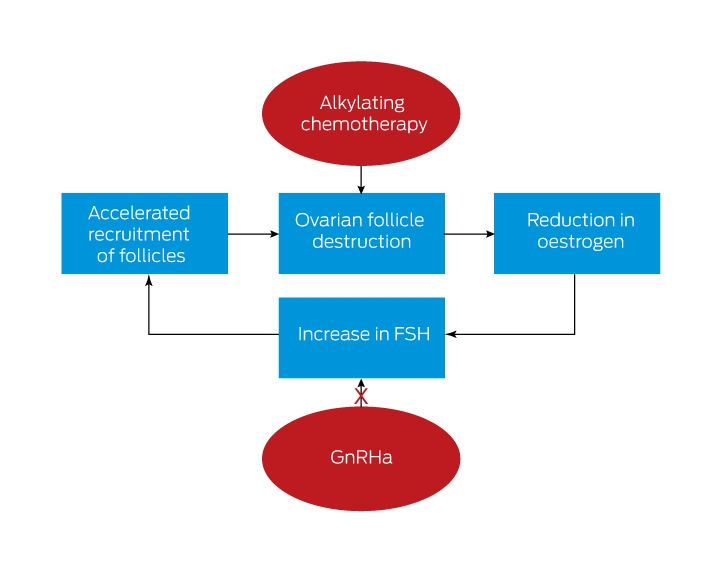
Alkylating chemotherapy causes death of mature follicles. This results in a reduction in oestrogen levels. Via negative feedback, this prompts an increase in follicle-stimulating hormone (FSH) secretion and subsequent accelerated activation of primordial ovarian follicles. These primordial follicles mature, and subsequently also undergo apoptosis when exposed to alkylating agents. Gonadotropin-releasing hormone agonists (GnRHa) suppress FSH secretion and thus stop this cycle of follicle burnout.15
Competing interests
No relevant disclosures.
Acknowledgements
Kelly-Anne Phillips is a National Breast Cancer Foundation Practitioner Fellow. Martha Hickey is a National Health and Medical Research Council Practitioner Fellow. Antoinette Anazodo’s research is supported by Kids Cancer Alliance, Cancer Institute NSW Translational Cancer Research Centre (15/TRC/1-04), and CanTeen funding from the federal Department of Health.
References
- Australian Government Cancer Australia. Lymphoma statistics. https://lymphoma.canceraustralia.gov.au/statistics (viewed Jan 2018).
- Australian Government Cancer Australia. Breast cancer statistics. https://breast-cancer.canceraustralia.gov.au/statistics (viewed Apr 2018).
- Colvin M. Alkylating agents. In: Kufe DW, Pollock RE, Weichselbaum RR, et al, editors. Holland-Frei Cancer Medicine. 6th ed. Hamilton, ON: BC Decker, 2003.
- Sklar CA, Mertens AC, Mitby P, et al. Premature menopause in survivors of childhood cancer: a report from the childhood cancer survivor study. J Natl Cancer Inst 2006; 98: 890-896.
- Logan S, Perz J, Ussher JM, et al. A systematic review of patient oncofertility support needs in reproductive cancer patients aged 14 to 45 years of age. Psychooncology 2017; 27: 401-409.
- Howard-Anderson J, Ganz PA, Bower JE, Stanton AL. Quality of life, fertility concerns, and behavioural health outcomes in younger breast cancer survivors: a systematic review. J Natl Cancer Inst 2012; 104: 386-405.
- Jackisch C, Harbeck N, Huober J, et al. 14th St Gallen International Breast Cancer Conference 2015: Evidence, Controversies, Consensus – Primary Therapy of Early Breast Cancer: opinions expressed by German experts. Breast Care 2015; 10: 211-219.
- National Comprehensive Cancer Network. NCCN clinical practice guidelines in oncology. Fort Washington, PA: NCCN, 2017. https://www.nccn.org/professionals/physician_gls/pdf/aya.pdf (viewed Oct 2017).
- Australian Government Department of Health. The Pharmaceutical Benefits Scheme. Goserelin. www.pbs.gov.au/medicine/item/1454M www.pbs.gov.au/medicine/item/1454M (viewed Dec 2017).
- Demeestere I, Brice P, Peccatori FA, et al. Gonadotropin-releasing hormone agonist for the prevention of chemotherapy-induced ovarian failure in patients with lymphoma: 1-year follow-up of a prospective randomized trial. J Clin Oncol 2013; 31: 903-909.
- Mar Fan HG, Houede-Tchen N, Chemerynsky I, et al. Menopausal symptoms in women undergoing chemotherapy-induced and natural menopause: a prospective controlled study. Ann Oncol 2010; 21: 983-987.
- Shapiro CL, Manola J, Leboff M. Ovarian failure after adjuvant chemotherapy is associated with rapid bone loss in women with early-stage breast cancer. J Clin Oncol 2001; 19: 3306-3311.
- Ryan J, Scali J, Carriere I, et al. Impact of a premature menopause on cognitive function in later life. BJOG 2014; 121: 1729-1739.
- Rocca WA, Grossardt BR, De Andrade M, et al. Survival patterns after oophorectomy in premenopausal women: a population based cohort study. Lancet Oncol 2006; 7: 821-828.
- Roness H, Kalich-Philosoph L, Meirow D. Prevention of chemotherapy induced ovarian damage: possible roles for hormonal and non hormonal attenuating agents. Hum Reprod Update 2014; 20: 759-774.
- Millar RP, Lu Z, Pawson AJ, et al. Gonadotropin-Releasing Hormone Receptors. Endocr Rev 2004; 25: 235-275.
- West CP, Baird DT. Suppression of ovarian activity by zoladex depot (ICI 118630), a long acting luteinizing hormone releasing hormone agonist analogue. Clin Endocrinol 1987; 26: 213-220.
- Kerr JB, Hutt KJ, Michalak EM, et al. DNA damage-induced primordial follicle oocyte apoptosis and loss of fertility require TAp63-mediated induction of Puma and Noxa. Mol Cell 2012; 48: 343-352.
- Ataya K, Rao LV, Lawrence E, Kimmel R. Luteinizing hormone- releasing hormone agonist inhibits cyclophosphamide induced ovarian follicular depletion in Rhesus monkeys. Biol Reprod 1995; 52: 365-372.
- Munhoz RR, Pereira AA, Sasse AD, et al. Gonadotropin-releasing hormone agonists for ovarian function preservation in premenopausal women undergoing chemotherapy for early stage breast cancer: a systematic review and meta-analysis. JAMA Oncol 2016; 2: 65-73.
- Moore HC, Unger JM, Phillips K, et al. Goserelin for ovarian protection during breast-cancer adjuvant chemotherapy. N Engl J Med 2015; 372: 923-932.
- Del Mastro L, Boni L, Michelotti A, et al. Effect of the gonadotropin-releasing hormone analogue triptorelin on the occurrence of chemotherapy-induced early menopause in premenopausal women with breast cancer: a randomized trial. JAMA 2011; 306: 269-276.
- Lambertini M, Boni L, Michelotti A, et al. Ovarian suppression with triptorelin during adjuvant breast cancer chemotherapy and long-term ovarian function, pregnancies, and disease-free survival: a randomized clinical trial. JAMA 2015; 314: 2632-2640.
- Leonard RC, Adamson DJ, Bertelli G, et al. GnRH agonist for protection against ovarian toxicity during chemotherapy for early breast cancer: the Anglo Celtic Group OPTION trial. Ann Oncol 2017; 28: 1811-1816.
- Garrido-Oyarzun MF, Castelo-Branco C. Controversies over the use of GnRH agonists for reduction of chemotherapy-induced gonadotoxicity. Climacteric 2016; 19: 522-525.
- Giuseppe L, Attilio G, Edoardo DN, Loredana G, Cristina L, Vincenzo L. Ovarian function after cancer treatment in young women affected by Hodgkin disease (HD). Hematology 2007; 12: 141-147.
- Waxman JH, Ahmed R, Smith D, et al. Failure to preserve fertility in patients with Hodgkin’s disease. Cancer Chemother Pharmacol 1987; 19: 159-162.
- Demeestere I, Brice P, Peccatori FA, et al. No evidence for the benefit of gonadotropin-releasing hormone agonist in preserving ovarian function and fertility in lymphoma survivors treated with chemotherapy: Final long-term report of a prospective randomized trial. J Clin Oncol 2016; 34: 2568-2574.
- Lambertini M, Falcone T, Unger JM, et al. Correspondence: Debated role of ovarian protection with gonadotrophin-releasing hormone agonists during chemotherapy for preservation of ovarian function and fertility in women with cancer. J Clin Oncol 2017; 35: 804-805.
- Zhang Y, Xiao Z, Wang Y, et al. Gonadotropin-releasing hormone for preservation of ovarian function during chemotherapy in lymphoma patients of reproductive age: a summary based on 434 patients. PLoS One 2013; 8: e80444.
- Salooja N, Szydlo RM, Socie G, et al. Pregnancy outcomes after peripheral blood or bone marrow transplantation: a retrospective survey, Lancet 2001; 358: 271-276.
- Anazodo AC, Stern C, McLachlan RI, et al. A study protocol for the Australasian oncofertility registry: monitoring referral patterns and the uptake, quality and complications of fertility preservation strategies in Australia and New Zealand. J Adolesc Young Adult Oncol 2016; 5: 215-225.
- Boumpas DT, Austin H, Vaughan EM, et al. Risk for sustained amenorrhea in patients with systemic lupus erythematosus receiving intermittent pulse cyclophosphamide therapy. Ann Intern Med 1993; 119: 366-369.
- Blumenfeld Z. Preservation of fertility and ovarian function and minimising gonadotoxicity in young women with systemic lupus erythematosus treated by chemotherapy. Lupus 2000; 9: 401-405.
- Clowse M, Behera M, Anders CK, et al. Ovarian preservation by GnRH agonists during chemotherapy: a metaanalysis. J Womens Health 2009; 18: 311-319.
- Somers EC, Marder W, Christman GM, et al. Use of a gonadotropin-releasing hormone analog for protection against premature ovarian failure during cyclophosphamide therapy in women with severe lupus. Arthritis Rheum 2005; 52: 2261-2767.
- Goldhirsch A, Gelber RD, Castiglione M. The magnitude of endocrine effects of adjuvant chemotherapy for premenopausal breast cancer patients. Ann Oncol 1990; 1: 183-188.
- Katsifis GE, Tzioufas AG. Ovarian failure in systemic lupus erythematosus patients treated with pulsed intravenous cyclophosphamide. Lupus 2004; 13: 673-678.
- United States Food and Drug Administration. Zoladex (goserelin acetate implant) 3.6 mg. https://www.accessdata.fda.gov/drugsatfda_docs/label/2015/019726s059,020578s037lbl.pdf (viewed Sept 2018).
Provenance: Not commissioned; externally peer reviewed.
Forty Years in the Making: Reporting on the Co-Creation of a National Roadmap for Birthing on Country Services for the Best Start to Life
Res McCalman, Anneka J. Bowman, Roianne West, Kristie Watego, Jyai Allen, Claire Clack, Sue Kildea, Sue Kruske, Melanie Briggs, Cleone Wellington, Rebecca Coddington, Yu Gao, Isabella Garti, Sascha Kowalenko, Sarah Ireland, Catherine Austin, John D. Boffa, Marah Prior, Kelsie Kahl, Bettina Chaseling, Sarah Khaw, Emily Armstrong, Donna Hartz, Yvette Roe
Temporal Trends in Preterm Birth Associated With Hypertensive Disorders of Pregnancy in Victoria, Australia: A Population-Based Interrupted Time-Series Study
Melvin Marzan, Heng Jiang, Daniel Lorber Rolnik, Joanne M. Said, Lisa Hui
Linguistic Manoeuvres: Obstetric Violence Camouflages Harm and Loss of Consent From Birth
Liz Sutton, Harsha Ananthram, Rebecca Matthews
Linguistic Manoeuvres: Obstetric Violence Camouflages Harm and Loss of Consent From Birth
Bashi Kumar-Hazard, Andrew M. Bisits, Sharon L. Settecasse, Jenny Gamble, Hazel Keedle, Hannah G. Dahlen
Linguistic Manoeuvres: Obstetric Violence Camouflages Harm and Loss of Consent From Birth
Wendy Pollock, Alissa Fleming, Ensieh Fooladi, Joy Kloester, Anne Tremayne, Yasmin Zisin, Bethany Carr, Kym Davey, Suzanne Willey, Jenny Gamble
Getting on the Same Page: Why Australia Needs a National Maternity Early Warning System (MEWS) Chart
Briony A. Cutts, Lucy Bowyer, Nisha Khot, Sandra Lowe, Stefan C. Kane