




Medical education
Lessons from practice
Volume 209 - Issue 6
Massive oxidative haemolysis and renal failure caused by high dose vitamin C
Authors: Matthew J Rees, Madeleine C Strach, Kate Burbury and Kelly-Anne Phillips
Med J Aust 2018; 209 (6): 248-249. || doi: 10.5694/mja17.00998
Published online: 17 September 2018
Published online: 17 September 2018
A 54-year-old man, who was diagnosed with metastatic prostate cancer in March 2016, received first-line treatment with docetaxel and degarelix
Clinical record
A 54-year-old man, who was diagnosed with metastatic prostate cancer in March 2016, received first-line treatment with docetaxel and degarelix. Despite initial response, the patient had progressive disease and commenced enzalutamide in January 2017.
Concerned about his prognosis, the patient sought concurrent therapy at an integrative health care clinic. Pre-therapy blood tests ordered by the clinic revealed glucose-6-phosphate dehydrogenase (G6PD) deficiency, with a detectable G6PD level < 2.3 U/g (reference interval [RI], 7.0–20.5 U/g).
The patient commenced complementary therapy with zinc chloride, magnesium sulfate, glutathione, methylcobalamin and 30 g of intravenous vitamin C. Two days later, the patient became unwell, with syncope and profound fatigue. Despite these symptoms, 4 days later, he received a further 60 g of intravenous vitamin C. The next day, the patient experienced two syncopal episodes and presented to hospital.
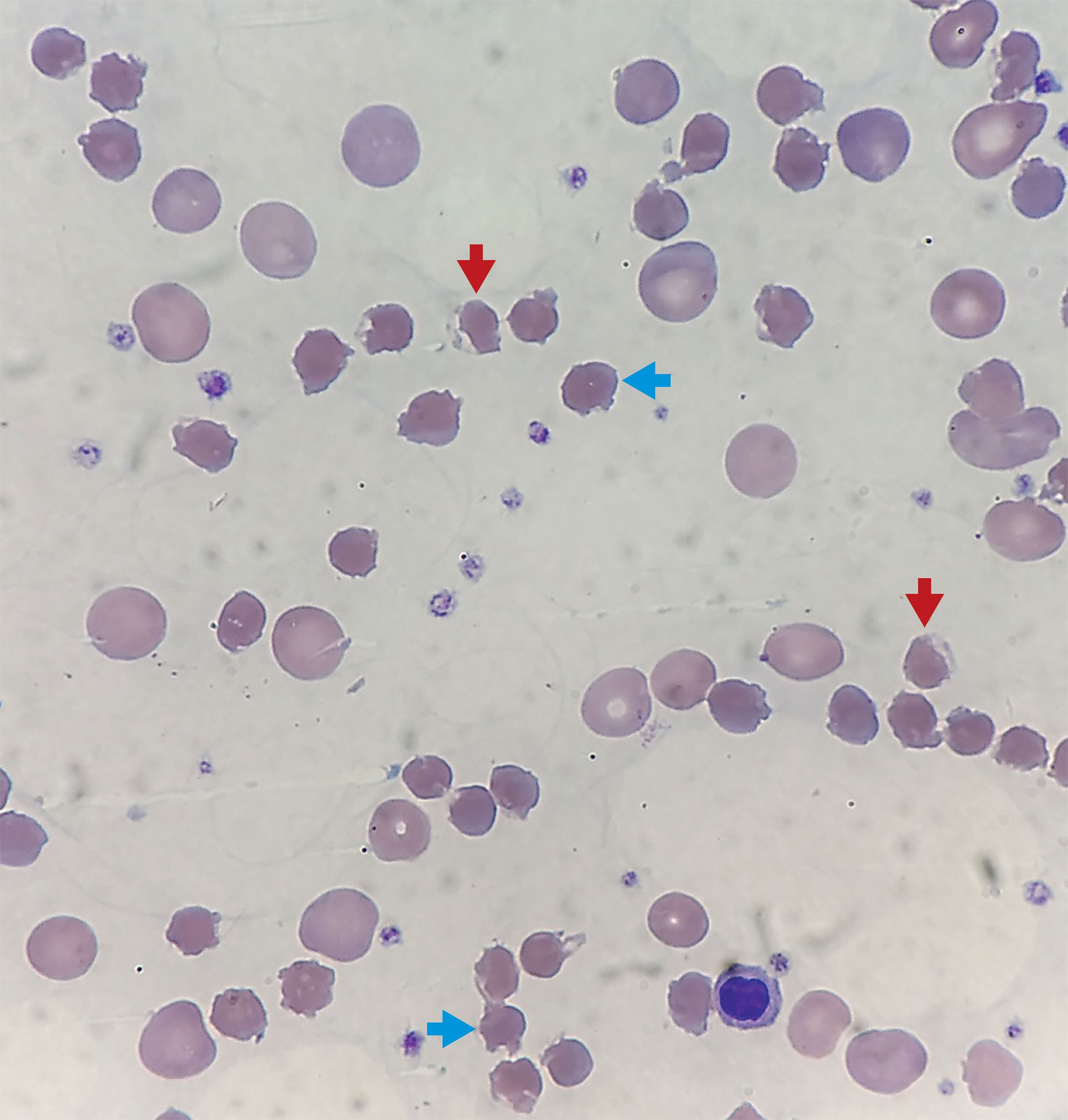
On presentation, the patient’s haemoglobin level was 43 g/L, compared with 110 g/L one month earlier. Subsequent investigations confirmed severe oxidative haemolysis with pathognomonic red cell changes on peripheral blood film (bite cells, spherocytes, polychromasia) (Box), unconjugated hyperbilirubinaemia (bilirubin = 99 μmol/L [RI, 5–21 μmol/L]; conjugated = 20 μmol/L [RI, 0–5 μmol/L]), undetectable haptoglobin (< 0.10 g/L [RI, 0.5–1.5 g/L]), elevated lactate dehydrogenase (2824 IU/L [RI, 60–100 IU/L]), reticulocytosis (13.2% [RI, 0.5–1.5%]; 165 × 109/L [RI, 23–90 × 109/L]), a negative direct antiglobulin test and a positive urinary haemosiderin. A septic screen was performed at presentation and was negative.
The patient received multiple blood transfusions but developed anuric renal failure requiring urgent haemodialysis. A renal ultrasound did not reveal any abnormalities. There was concern about oxalate nephropathy given the high doses of vitamin C; however, urinary oxalate was normal (0.10 mmol/day [RI, < 0.50 mmol/day]). A renal biopsy was not performed due to spontaneous renal recovery. The renal failure was attributed to haem pigment-induced kidney injury.
The patient necessitated red cell transfusion for 8 days, required haemodialysis for 10 days, and was ultimately discharged home after a 21-day hospital admission.
We report on a case of complementary therapy which had near-fatal consequences for a patient after massive oxidative haemolysis induced by high dose vitamin C. This case highlights the material risks of seemingly benign complementary therapies and the need for clinicians caring for patients with cancer to educate them regarding the hazards of unproven, pharmacologically active complementary treatments.
Vitamin C has been proposed as a treatment for many medical conditions, including cancer. Originally popularised by Linus Pauling in the 1970s, preliminary studies were promising, but subsequent clinical trials demonstrated no benefit for patients with cancer.1 Despite this, the use of vitamin C and other complementary medicines is still favoured by many due to their perception as natural and safe, with up to 65% of Australian patients with cancer using complementary therapies and most not informing their doctor.2 This tendency to non-disclosure underscores the importance of routinely asking patients about complementary treatments.
G6PD deficiency is an inherited X-linked disorder caused by a genetic defect in the red blood cell enzyme G6PD. This highly polymorphic enzyme is essential to the production of nicotinamide adenine dinucleotide phosphate, which replenishes glutathione levels in red blood cells to protect them against oxidative stressors. G6PD deficiency is the most common red blood cell enzymopathy; its geographic distribution includes the Mediterranean, Africa, India and South-East Asia. Most affected individuals are asymptomatic; however, when exposed to an oxidative stress, such as acute illness, medications (dapsone, primaquine, rasburicase) or certain foods (fava beans), they can experience a severe haemolytic anaemia.
The severity of haemolysis depends on the variant of G6PD inherited and the gender of the individual. With only one X chromosome, all male red blood cells are G6PD deficient and their phenotype is typically more severe. Females are generally heterozygous and less prone to severe haemolysis, since half of their red blood cells will express a normal G6PD allele. However, skewed X inactivation in female heterozygotes can lead to a high proportion of affected red blood cells and a more severe phenotype. The G6PD Mediterranean variant is the most common abnormal variant in Europe, the Middle-East and India and is associated with severe haemolysis, with less than 10% of enzyme activity. Awareness of this ethnic predisposition is important and it is advisable to screen asymptomatic at-risk individuals before the administration of certain medications. Patients with G6PD deficiency should be counselled on the importance of avoiding food and drug triggers.
The G6PD Deficiency Favism Association provides an excellent list of drugs associated with oxidative haemolysis in patients with G6PD.3 Of all the complementary therapeutics administered to the patient in this case, only vitamin C is associated with a significant risk of oxidative haemolysis.
There have been four published case reports of acute haemolysis induced by high dose vitamin C in patients with G6PD deficiency.4-7 The pathophysiology is uncertain, but it likely involves the production of reactive oxygen species, which rapidly exhaust red blood cells glutathione supply. In one case, haemolysis, acute renal failure and death resulted after the administration of 80 g intravenous vitamin C.6 Our patient survived, but required prolonged hospitalisation and intensive haematological and dialysis support, resulting in substantial costs to the health care system and significant distress to the patient and his family.
Lessons from practice
-
Glucose-6-phosphate dehydrogenase deficiency is an enzymatic disorder of red blood cells most common in people of Mediterranean, African and Asian descent.
-
Affected patients can experience episodic haemolytic anaemia following exposure to infection, drugs or chemicals.
-
Clinicians have a duty of care to dissuade patients from seeking complementary therapies with potential harms and lack of proven benefit.
-
Given the high prevalence of complementary medicine use in patients with cancer, it is important to routinely take a history of complementary therapy use from all patients.
Competing interests
No relevant disclosures.
References
- Creagan ET, Oertel CG, O’Fallon JR, et al. Failure of high-dose vitamin C (ascorbic acid) therapy to benefit patients with advanced cancer. A controlled trial. N Engl J Med 1979; 301: 687-690.
- Xue CC, Zhang AL, Lin V, et al. Complementary and alternative medicine use in Australia: a national population-based survey. J Altern Complement Med 2007; 13: 643-650.
- G6PD Deficiency Favism Association. G6PD deficit — drugs that should be avoided: official list. Associazione Italiana Favismo; 1996–2018. https://www.g6pd.org/en/G6PDDeficiency/SafeUnsafe/DaEvitare_ISS-it (viewed Aug 2017).
- Huang YC, Chang TK, Fu YC, Jan SL. C for colored urine: acute hemolysis induced by high-dose ascorbic acid. Clin Toxicol (Phila) 2014; 52: 984.
- Rees DC, Kelsey H, Richards JD. Acute haemolysis induced by high dose ascorbic acid in glucose-6-phosphate dehydrogenase deficiency. BMJ 1993; 306: 841-842.
- Campbell GD, Steinberg MH, Bower JD. Letter: ascorbic acid-induced hemolysis in G-6-PD deficiency. Ann Intern Med 1975; 82: 810.
- Mehta JB, Singhal SB, Mehta BC. Ascorbic-acid-induced haemolysis in G-6-PD deficiency. Lancet 1990; 336: 944.
Provenance: Not commissioned; externally peer reviewed.
Country revealing the way: evaluating Elder‐governed cultural therapy for Aboriginal and Torres Strait Islander young people with mental health conditions
Alasdair Vance, Janet McGaw, Jo Winther, Naomi Tootell, Herb Patten, Sandra Eades
No silver lining with health misinformation: argyria caused by intentional silver consumption
Luke Collins, Logesh Palanikumar, Stephen Bacchi
Hyperkalaemic cardiac arrest due to cream of tartar ingestion
Daniel Yee Lee Ng, Laksmi Govindasamy, Andrew Hughes, Hwee Min Lee
From talk to action: Indigenous Reference Groups drive practice change in kidney transplantation care
Kelli J Owen, Katie Cundale, Jaquelyne T Hughes, Stephen P McDonald, Matilda D'Antoine, Shilpanjali Jesudason
The not‐so‐natural herb: a case of exogenous Cushing syndrome
Yi‐An Pan, David Roberts, Yi‐An Pan, David Roberts
Lead poisoning outbreak from consumption of contaminated Ayurvedic medication
Mark J Ferson, Sinead Flanigan, Toni Cains