




Volume 209 - Issue 3
New enhanced influenza vaccines for older Australians: what promise do they hold?
Authors: Sarah L Sheridan, Cyra Patel, Kristine Macartney and Allen C Cheng
Med J Aust 2018; 209 (3): 110-112. || doi: 10.5694/mja18.00334
Published online: 16 July 2018
Published online: 16 July 2018
Even modest improvements in influenza vaccine effectiveness are predicted to have an impact on preventing severe disease in older people
New influenza vaccines for older people may provide improved protection against influenza-related disease
Influenza is the leading vaccine-preventable cause of morbidity and mortality each year in Australia.1 Older people are particularly at risk of severe outcomes from influenza, including hospitalisation, pneumonia, acute myocardial infarction and death.1-3 In 2017, the largest influenza season since the 2009 pandemic, 53 983 (22%) of all 249 932 notified influenza cases were in people aged ≥ 65 years (Box 1), and more than 90% of the 1100 influenza-related deaths reported occurred in older adults.4-6 Furthermore, these numbers are widely recognised as an underestimation of the true burden of disease.
Annual seasonal epidemics are caused by influenza A viruses (characterised by surface proteins called haemagglutinin and neuraminidase), namely A/H1N1 and A/H3N2, and B viruses (divided into two lineages, B/Yamagata and B/Victoria). Influenza A subtypes and B lineages are further characterised into strains, with antigenic drift causing the predominant strains to change over time — therefore requiring annual updating of influenza vaccines.
Since 1999, the annual seasonal influenza vaccine has been funded under the National Immunisation Program for people aged ≥ 65 years. Quadrivalent influenza vaccines (QIVs) (containing both A subtypes and both B lineages) replaced trivalent inactivated influenza vaccines (TIVs) (both A subtypes and only one B lineage) in 2016. However, the effectiveness of both the standard dose TIVs and QIVs (that contain 15 μg of haemagglutinin per vaccine strain) in older people has been relatively poor,7,8 particularly against influenza A/H3N2, which consistently causes a higher proportion of disease among ≥ 65-year-olds compared with other age groups (Box 2).5 Immunosenescence — broadly defined as decreased immune responses in older people — likely contributes to lower vaccine effectiveness, meaning that those most affected by influenza are also least likely to gain protection from vaccination.
In response to the severe 2017 influenza season, the Australian Government has funded two new enhanced influenza vaccines for people aged ≥ 65 years which have not previously been used in Australia (Box 3).6 These vaccines, high dose TIV (Fluzone High-Dose; Sanofi, France) and adjuvanted TIV (Fluad; Seqirus, Australia) are now available for the upcoming influenza season.
What are the new enhanced vaccines?
Both new TIVs are only registered and funded for people aged ≥ 65 years. They address the challenge of improving protection against influenza in older people by eliciting greater antibody responses (ie, they are more immunogenic) compared with standard TIVs.9,10 High dose TIV contains four times the haemagglutinin content per strain compared with standard dose influenza vaccines (60 μg v 15 μg per strain, giving a total of 180 μg per 0.5 mL dose). The other new TIV includes a squalene-based MF59 (Novartis, USA) oil-in-water emulsion adjuvant — a compound that enhances the immune response to a vaccine, reducing the amount of antigen needed — with the standard antigen dose.
Vaccine efficacy is usually measured in clinical trials under ideal conditions, whereas vaccine effectiveness is typically measured in observational studies and describes the vaccine’s protectiveness in a more real-world setting. All available clinical trials and most observational studies compared these vaccines with standard TIVs. Thus, rather than reporting the vaccine efficacy or effectiveness in people who received an enhanced vaccine compared with those who received no influenza vaccine, most studies report the relative additional protection compared with a standard TIV.
One clinical trial, in which about 16 000 participants received high dose TIV, found the relative vaccine efficacy of high dose TIV across two influenza seasons, compared with standard TIV, to be 24% (95% confidence interval [CI], 10–37%) against laboratory-confirmed influenza overall, including 23% (95% CI, 6–38%) better against influenza A/H3N2.11 Protection against influenza-related pneumonia was enhanced by 40% (95% CI, 19–55%).12 Post-marketing observational studies largely corroborate the findings of clinical trials reporting a relative effectiveness of high dose TIV compared with standard TIV of 20–22% against probable influenza and influenza-related hospital presentation and/or admission during A/H3N2 dominant seasons.13,14 However, relative vaccine effectiveness varied with influenza season; in some seasons, high dose vaccine was no better than standard dose vaccine.13
While clinical trials have shown superior immunogenicity of the adjuvanted TIV over standard TIV, there are no clinical trials demonstrating efficacy relative to standard TIV. A large post-licensure observational study undertaken among community-dwelling adults aged ≥ 65 years over three influenza seasons found the adjusted relative vaccine effectiveness of adjuvanted TIV against hospitalisation for influenza or pneumonia, compared with standard TIV, to be 25%.15 Influenza A/H3N2 was dominant in two of the three seasons under study.
There are no head to head data that allow direct comparison of these two vaccines, or with the currently available QIV. However, evidence suggests that high dose TIV and adjuvanted TIV provide a similar level of additional protection to standard TIV; TIV in turn is considered to provide protection equivalent to that afforded by QIV against the three strains common to both vaccines. Both the adjuvanted and high dose TIVs are preferentially recommended by the Australian Technical Advisory Group on Immunisation over QIV for people aged ≥ 65 years, but there is no preference between them.16 There are no safety or efficacy data on administration of both enhanced TIV and QIV in the same season, and, as the B/Brisbane lineage is not expected to circulate widely this year, giving both types of vaccines is not recommended.
Safety of the new vaccines
High dose and adjuvanted TIVs have been used outside Australia for several years without significant safety issues. Side effects of vaccination, mostly mild, are more common for both vaccines compared with standard TIV.17 Pain is the most common local reaction, occurring in 36% of high dose compared with 24% of standard TIV recipients, and 32% of adjuvanted compared with 17% of standard TIV recipients.18,19 Systemic reactions occurred in about a third of high dose and adjuvanted TIV recipients.18,19 Grade 2 or 3 reactions (defined as interfering or preventing daily activities) occurred more frequently in high dose TIV recipients (11% in high dose TIV and 7% in standard TIV).18,19 Severe local or systemic reactions were rare (< 1%) in both adjuvanted and standard TIV recipients.19
What about the other B strain?
A potential disadvantage of the enhanced TIVs is the lack of the additional B strain included in the standard QIVs. However, B strains are less common (dominating about every 7–10 years) and cause a smaller proportion of disease in older adults, particularly A/H3N2, relative to younger age groups (Box 2). There is also evidence that the B strain included in a TIV may provide some protection against a circulating B strain of the alternate lineage.20 The additional protection against A/H3N2 is expected to outweigh any loss of protection against any disease caused by the B lineage not included in the vaccine.
Implications for the prevention of influenza in older people
Overall, the new TIVs are likely to provide modest additional protection against influenza which may vary from season to season. On average, standard vaccines reduce the risk of influenza by around 40–50%.21 Theoretically, applying the relative increase in efficacy and effectiveness of the enhanced vaccines observed in the studies above — calculated as 1 minus the relative risk of influenza between the enhanced and standard vaccine groups; eg, 1.9% compared with 1.4% for laboratory-confirmed influenza11 — would see these new vaccines have an effectiveness of around 55–63%. Importantly, due to the considerable burden of disease in older people, even modest improvements in vaccine effectiveness are predicted to have an impact on preventing severe disease, especially in seasons where A/H3N2 is dominant.
How will these new vaccines be assessed?
A comprehensive range of influenza disease and vaccine surveillance activities are in place but can be further strengthened. Complete and accurate recording of all influenza vaccinations given on the whole-of-life Australian Immunisation Register is vital to evaluate the uptake, effectiveness and safety of these enhanced vaccines. All vaccine providers should ensure they supply data on vaccines administered to the Immunisation Register.
As the first country in the world to publicly fund both enhanced vaccines in the same population at a national level, Australia has a unique opportunity to conduct a head to head comparison of the two enhanced TIVs in older Australians. This will be very valuable in informing future influenza vaccination programs not only in Australia but internationally. Australia’s unique approaches to vaccine safety monitoring, using both spontaneous reporting of adverse events to the Therapeutic Goods Administration22 and AusVaxSafety (the enhanced near real-time safety monitoring system using SMS-based surveys to follow up tens of thousands of vaccine recipients23), also provide the opportunity to ensure the vaccines continue to show a good safety profile.
These more immunogenic vaccines are a positive step towards a stronger influenza vaccination program and are anticipated to better protect against this common vaccine-preventable disease in older adults. Other new initiatives implemented in 2018 include state and territory-funded QIV programs (in all but the Northern Territory) for children aged 6 months to 5 years who also experience very high morbidity from influenza (Box 1). These programs may provide some herd protection to older children and adults if good uptake is achieved. Ultimately, the new vaccines still do not address many of the problems of standard TIVs and QIVs, despite the anticipated improvements in influenza vaccine effectiveness and impact. More research enabling better understanding of influenza vaccines and how to make universally effective and durable vaccines is still required.
Box 1 – Average annual age-specific rate of influenza notifications for 7 years (2010–2016) compared with age-specific rate of influenza notifications in 2017
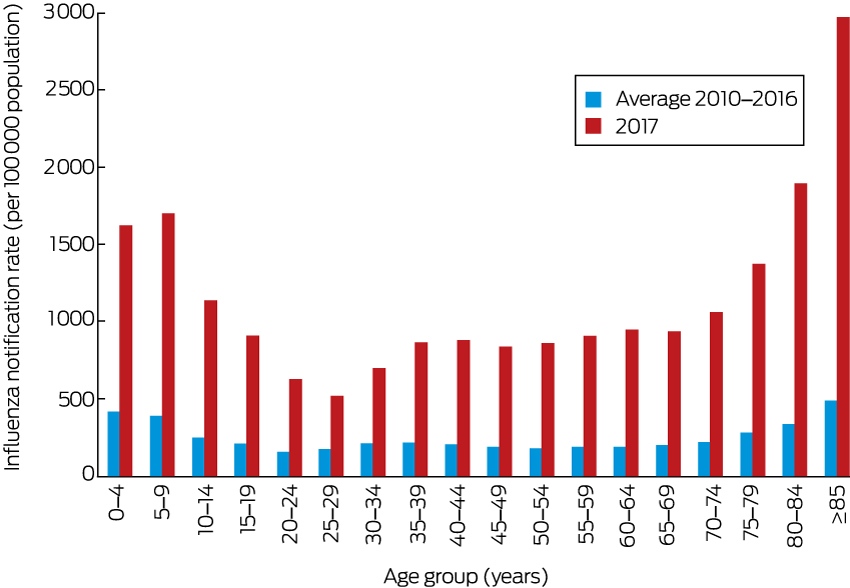
Source: National Notifiable Diseases Surveillance System influenza public dataset (www9.health.gov.au/cda/source/pub_influ.cfm).
Box 2 – Average proportion of influenza due to influenza type A versus type B and common subtypes of A, by age group, 2010–2016*
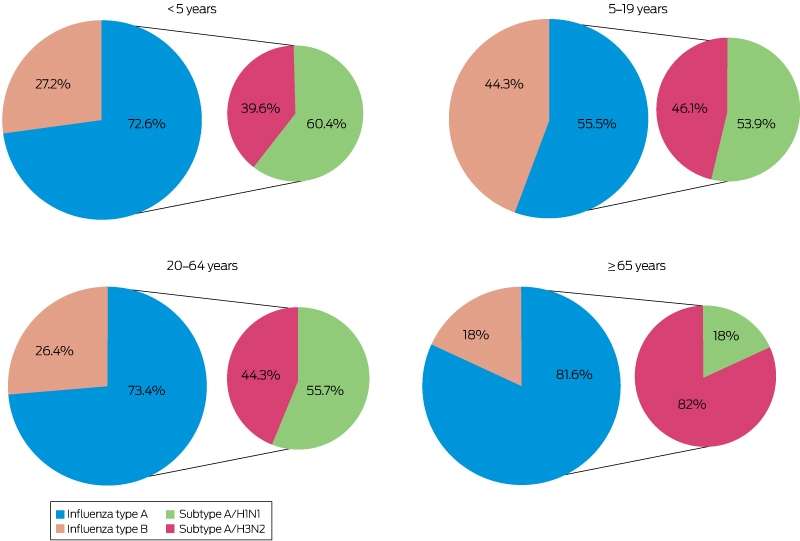
* The proportions of subtypes attributable to A/H1N1 and A/H3N2 have been derived based on samples that were subtyped only. A large proportion of type A influenza was not subtyped (∼ 75% of type A cases); however, it is generally accepted that the samples with subtyping data are representative of samples that are not subtyped. The figures do not include data on the proportion with both type A and type B, type C and untyped. These cases made up < 0.5% of the total influenza cases in each age group. Data sourced from: National Notifiable Diseases Surveillance System influenza public dataset (www9.health.gov.au/cda/source/pub_influ.cfm).
Box 3 – Influenza vaccines available and recommended for use in Australia in 2018
|
|
Standard influenza vaccines |
Enhanced influenza vaccines |
|||||||||||||
|
|
|||||||||||||||
|
Number and type of strains included in the vaccine |
4 (Quadrivalent) — A/H1, A/H3 and both B lineages |
3 (Trivalent) — A/H1, A/H3 and a single B lineage |
3 (Trivalent) — A/H1, A/H3 and a single B lineage |
||||||||||||
|
Vaccine brand |
Multiple brands* |
Fluzone High-Dose† |
Fluad‡ |
||||||||||||
|
How the vaccine is enhanced |
na — contains standard amount of antigen (15 μg per strain), no adjuvant |
Four times the amount of antigen (60 μg per strain) compared with standard dose vaccines |
Standard dose (15 μg per strain) adjuvanted with MF59§ |
||||||||||||
|
Recommended age group for use |
Children and adults aged from 6 months to < 65 years* |
People aged ≥ 65 years |
People aged ≥ 65 years |
||||||||||||
|
Manufacturing method |
Egg-based |
Egg-based |
Egg-based |
||||||||||||
|
|
|||||||||||||||
|
* Details on vaccine brands, registered age groups and recommended doses of quadrivalent influenza vaccines are given in the Australian Technical Advisory Group on Immunisation’s (ATAGI) Annual Influenza Statement (https://beta.health.gov.au/resources/publications/atagi-advice-on-seasonal-influenza-vaccines-in-2018). Providers should always check the age of the person to be vaccinated to ensure the recommended vaccine is provided. † Sanofi; France. ‡ Seqirus; Australia. § Novartis, USA. |
|||||||||||||||
Competing interests
Allen Cheng and Kristine Macartney are members of ATAGI. Sarah Sheridan and Cyra Patel are employed at the National Centre for Immunisation Research and Surveillance, which provides technical support to the ATAGI. No funding was specifically provided for the drafting of this manuscript.
Acknowledgements
The views expressed in this article are those of the individual authors, and are not necessarily the views of the Australian Technical Advisory Group on Immunisation (ATAGI) or the National Immunisation Program. For information from ATAGI, please see the ATAGI statement on the administration of seasonal influenza vaccines in 2018 (https://beta.health.gov.au/resources/publications/atagi-advice-onseasonal-influenza-vaccines-in-2018) and the Australian Immunisation Handbook Influenza chapter (http://immunise.health.gov.au/internet/immunise/publishing.nsf/Content/Handbook10-homewhandbook10part4whandbook10-4-7).
References
- Li-Kim-Moy J, Yin JK, Patel C, et al. Australian vaccine preventable disease epidemiological review series: influenza 2006 to 2015. Commun Dis Intell Q Rep 2016; 40: e482-e495.
- Metersky ML, Masterton RG, Lode H, et al. Epidemiology, microbiology, and treatment considerations for bacterial pneumonia complicating influenza. Int J Infect Dis 2012; 16: e321-e331.
- Kwong JC, Schwartz KL, Campitelli MA, et al. Acute myocardial infarction after laboratory-confirmed influenza infection. N Engl J Med 2018; 378: 345-353.
- Australian Government Department of Health. 2017 Influenza season in Australia: a summary from the National Influenza Surveillance Committee. http://www.health.gov.au/internet/main/publishing.nsf/Content/cda-ozflu-2017.htm (viewed June 2018).
- National Notifiable Diseases Surveillance System. Influenza (laboratory confirmed) public dataset. http://www9.health.gov.au/cda/source/pub_influ.cfm (viewed Mar 2018).
- Prime Minister, Minister for Health. Ground-breaking flu vaccines to protect millions of Aussies [media release]. 18 Feb 2018. https://www.pm.gov.au/media/ground-breaking-flu-vaccines-protect-millions-aussies (viewed Mar 2018).
- Sullivan SG, Chilver MB, Carville KS, et al. Low interim influenza vaccine effectiveness, Australia, 1 May to 24 September 2017. Eurosurveillance 2017; 22: 17-00707.
- Fielding JE, Levy A, Chilver MB, et al. Effectiveness of seasonal influenza vaccine in Australia, 2015: an epidemiological, antigenic and phylogenetic assessment. Vaccine 2016; 34: 4905-4912.
- Tsang P, Gorse GJ, Strout CB, et al. Immunogenicity and safety of Fluzone intradermal and high-dose influenza vaccines in older adults ≥ 65 years of age: a randomized, controlled, phase II trial. Vaccine 2014; 32: 2507-2517.
- Ansaldi F, Bacilieri S, Durando P, et al. Cross-protection by MF59-adjuvanted influenza vaccine: neutralizing and haemagglutination-inhibiting antibody activity against A(H3N2) drifted influenza viruses. Vaccine 2008; 26: 1525-1529.
- DiazGranados CA, Dunning AJ, Kimmel M, et al. Efficacy of high-dose versus standard-dose influenza vaccine in older adults. N Engl J Med 2014; 371: 635-645.
- DiazGranados CA, Robertson CA, Talbot HK, et al. Prevention of serious events in adults 65 years of age or older: a comparison between high-dose and standard-dose inactivated influenza vaccines. Vaccine 2015; 33: 4988-4993.
- Shay DK, Chillarige Y, Kelman J, et al. Comparative effectiveness of high-dose versus standard-dose influenza vaccines among US Medicare beneficiaries in preventing postinfluenza deaths during 2012–2013 and 2013–2014. J Infect Dis 2017; 215: 510-517.
- Izurieta HS, Thadani N, Shay DK, et al. Comparative effectiveness of high-dose versus standard-dose influenza vaccines in US residents aged 65 years and older from 2012 to 2013 using Medicare data: a retrospective cohort analysis. Lancet Infect Dis 2015; 15: 293-300.
- Mannino S, Villa M, Apolone G, et al. Effectiveness of adjuvanted influenza vaccination in elderly subjects in Northern Italy. Am J Epidemiol 2012; 176: 527-533.
- Australian Government Department of Health. Australian Technical Advisory Group on Immunisation (ATAGI). Clinical advice: statement on the administration of seasonal influenza vaccines in 2018. https://beta.health.gov.au/resources/publications/atagi-advice-on-seasonal-influenza-vaccines-in-2018 (viewed Mar 2018).
- National Centre for Immunisation Research and Surveillance. Influenza vaccines [fact sheet]. NCIRS, 2018. http://www.ncirs.edu.au/assets/provider_resources/fact-sheets/Influenza-fact-sheet.pdf (viewed June 2018).
- Falsey AR, Treanor JJ, Tornieporth N, et al. Randomized, double-blind controlled phase 3 trial comparing the immunogenicity of high-dose and standard-dose influenza vaccine in adults 65 years of age and older. J Infect Dis 2009; 200: 172-180.
- Frey SE, Reyes MR, Reynales H, et al. Comparison of the safety and immunogenicity of an MF59®-adjuvanted with a non-adjuvanted seasonal influenza vaccine in elderly subjects. Vaccine 2014; 32: 5027-5034.
- Tricco AC, Chit A, Soobiah C, et al. Comparing influenza vaccine efficacy against mismatched and matched strains: a systematic review and meta-analysis. BMC Medicine 2013; 11: 153.
- Centers for Disease Control and Prevention. Seasonal influenza vaccine effectiveness, 2005–2018 [website]. CDC, 2018. https://www.cdc.gov/flu/professionals/vaccination/effectiveness-studies.htm (viewed June 2018).
- Dey A, Wang H, Quinn H, et al. Surveillance of adverse events following immunisation in Australia annual report. Commun Dis Intell 2017; 41: e264-e278.
- National Centre for Immunisation Research and Surveillance. AusVaxSafety [website]. http://www.ncirs.edu.au/vaccine-safety/ausvaxsafety (viewed Mar 2018).
Linked content
-
MJA Podcast: Professor Kristine Macartney
-
MJA InSight: Under the microscope: enhanced flu vax for elders
Provenance: Not commissioned; externally peer reviewed.
Costs of Delivering the Hep B PAST Model of Care in Remote Australia: A Retrospective Pre–Post Study
Hoa Nguyen, Anh Le Tuan Nguyen, Paula Binks, Melita McKinnon, Emily Vintour-Cesar, Karen Wills, Nicola Stephens, Benjamin Cowie, Joshua S. Davis, Yuejen Zhao, Peter Nihill, Julie A. Campbell, Andrew J. Palmer, Jane Davies, Barbara de Graaff
Buruli Ulcer Acquired From Ringtail Possum Rescue
Daniel P. O'Brien, Naomi Clarke, Sara Bonnici, Mohammad A. Hussain
Q Fever Visceral Abscesses After Contact With Native Australian Marsupials
Samantha J. Laws, Enzo Binotto, James Stewart, Jennifer Ho, Trent Yarwood, Josh Hanson, Simon Smith
Hospital-Admitted Injection-Related Infections Among Incarcerated People Who Inject Drugs in Australia: A Retrospective Cohort Study
Andrew Palmer, Matthew Carter, Jeremy Yeo, Cecilia Shim, Jason Connor, Jeremy Hayllar, Gerald Holtmann, Naomi Moy, Elliott G. Playford, Naomi Runnegar, Paul J. Clark
The Live Attenuated Influenza Vaccine in Australia: An Additional Tool for Influenza Prevention
Cyra Patel, Alexis Pillsbury, Tran Nguyen, Xia Wang, Helen E. Quinn, Clayton K. Chiu, Allen C. Cheng, Katie L. Flanagan, Zhicheng Wang
Reflex Testing for Hepatitis D Infection: A Unique Opportunity to Reduce Hepatitis D-Related Chronic Liver Disease Deaths in Australia
Jessica Howell, Lauren Andersson, Miriam T. Levy, James O'Beirne, Leon Adams, Katharine Irvine, Avik Majumdar, Golo Ahlenstiel, Kathy Jackson, Krispin Hajkowicz, Joseph Doyle, Jane Davies, Sarah Cherian, Wayne Dimech, Alexander J. Thompson