




Reflection
Medical history
Volume 208 - Issue 9
James Parkinson’s Essay on the shaking palsy, 1817–2017
Author: Nadeem Toodayan
Med J Aust 2018; 208 (9): 384-386. || doi: 10.5694/mja17.01085
Published online: 21 May 2018
Published online: 21 May 2018
Commemorating the 200th anniversary of the first specific description of parkinsonism
Commemorating the 200th anniversary of the first specific description of parkinsonism
Except as a historical footnote in Talley and O’Connor’s time-honoured Clinical examination textbook,1 many younger generations of Australian medical practitioners may never have heard of James Parkinson’s (1755–1824) historic Essay on the shaking palsy.2 Certainly for medicos in their formative years, often already grappling with the ever expanding array of modern educational resources and facilities, this 200-year-old medical essay lurks low on the list of professional priorities. But this should not always be the case, and if William Osler’s (1849–1919) advice to doctors-in-training is anything to go by — “Let the old men read new books; you read the journals and the old books”3 — then there is reason enough to further our knowledge of the history of medicine during our training as medical practitioners. For those so persuaded, the bicentenary of Parkinson’s classic Essay provides ample impetus for historical reflection.
The Essay on the shaking palsy
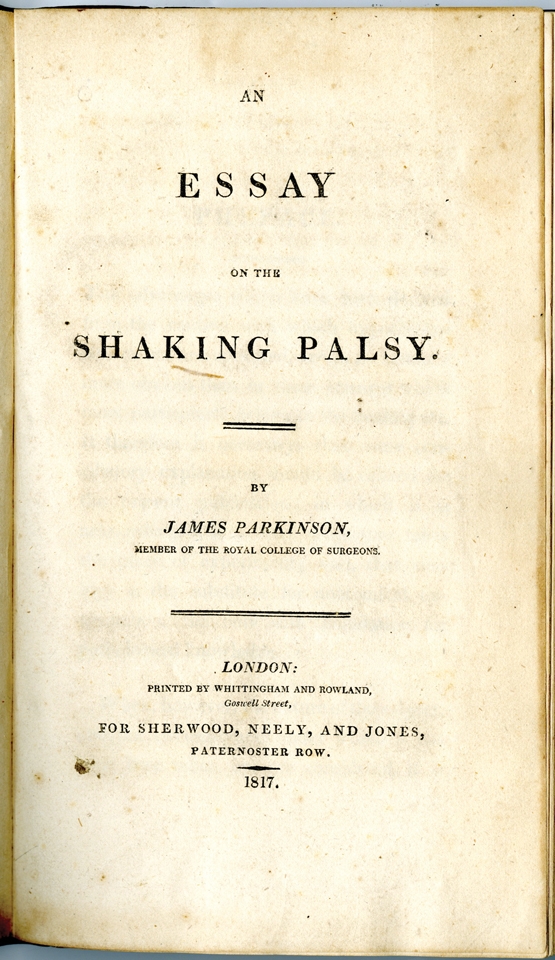
Originally sold as a 66-page medical pamphlet for 3 shillings4 (equivalent to about $20 in 2017), an authentic copy of James Parkinson’s 1817 Essay (Box 1) could fetch as much as $US90 000 at auction today.5 As a collector’s item it has always been exceedingly rare, and although usually out of reach in terms of private ownership, the monograph is much sought after by bibliophiles for its historical worth as a foundational text in English neurology. At the time it was printed in May 1817, the 62-year-old Parkinson was at the peak of his profession as a surgeon–apothecary. For years a political activist in a post-revolutionary era, his capacity for communal service was evident in the preface to his Essay as a desire to excite “the attention of those who may point out the most appropriate means of relieving a tedious and most distressing malady.”
As a medical treatise, Parkinson’s Essay is a masterful clinical exposition. Over five short chapters, the author elegantly elucidates both the history and defining features of the disease, distinguishes it from “other diseases with which it may be confounded”, and postulates both a proximate cause and a potential remedy. Except perhaps for its necessarily limited anatomical insights — a drawback that Parkinson acknowledges repeatedly throughout the work — the Essay provides a remarkably objective account of the disease.
The salient features of the disease are given in a most memorable inaugural description:
Involuntary tremulous motion, with lessened muscular power, in parts not in action and even when supported; with a propensity to bend the trunk forwards, and to pass from a walking to a running pace: the senses and intellects being uninjured.
The following passages of Chapter I provide a vivid and convincing clinical depiction of Parkinson disease, or “paralysis agitans” (shaking palsy) as Parkinson termed it. To the attentive reader, a number of now commonly known parkinsonian features are easily recognisable, and Parkinson clearly comments upon symptoms such as constipation, dysphagia, sialorrhoea, dysgraphia, dysarthria, frequent falls, and to some extent, sleep disturbance in the disease “history”. Parkinson then describes in detail six case histories exemplifying the disease. Two of these exemplars (cases II and III) he had “casually met with in the street”, and a third he had “only seen at a distance” (case V). In all instances, the author provides a notably acute account of the person’s condition, commenting not only on the characteristic features of the malady in appropriate detail, but also inquiring into lifestyle factors and the individual’s own perspectives of their symptoms whenever possible.
In Chapter II of his treatise, Parkinson more closely examines two of the most important symptoms of the shaking palsy. Demonstrating some scholarship, he adopts the classical terminologies of “tremor coactus” and “scelotyrbe festinans” to describe the compulsive resting tremor and hastening (or hurrying) gait that is characteristic of the disease. Freely quoting the original Latin nosologies of Franciscus Sylvius (1614–1672), Hieronymus David Gaubius (1705–1780), and François Boissier de Sauvages (1706–1767), he asserted that “the tremulous agitations, and the almost invincible propensity to run, when wishing only to walk … appear to be pathognomonic symptoms of this malady”. Further, he carefully distinguishes between voluntary and resting tremors with the following important observation:
… this affection [paralysis agitans] is distinguishable from tremor, by the agitation … occurring whilst the affected part is supported and unemployed, and being even checked by the adoption of voluntary motion.
In Chapter III, Parkinson further rationalises this important difference by pointing out that other “species of passive trembling”, namely essential tremor and “the trembling consequent to indulgence in the drinking of spirituous liquors”, are commonly improved by resting or supporting the affected limb. “In the real Shaking Palsy,” however, “the reverse of this takes place, the agitation continues in full force whilst the limb is at rest and unemployed; and even is sometimes diminished by calling the muscles into employment”.
The final two chapters of the Essay are concerned with providing a possible anatomic explanation for the disease and a potential remedy. Through “conjecture founded on analogy, and an attentive consideration of the peculiar symptoms of the disease”, a “diseased state of the medulla spinalis” or “the medulla oblongata” is hesitatingly proposed as a “supposed proximate cause” for the shaking palsy. Parkinson based this supposition primarily on a case of cervical trauma reported in 1769 in which certain characteristic features of the shaking palsy were exhibited and anatomic dissection had revealed swelling of the medulla. Carefully weighing up the limited anatomic evidence available, he concluded that the cause of the disease should be sought in “some slow morbid change in the structure of the medulla, or its investing membranes”. This is remarkably close to the primary seat of the disease in the pars compacta of the substantia nigra, located in the midbrain.
To relieve symptoms, Parkinson suggested typical remedies of the day, including cervical venesection, the application of vesicatories to the neck, and “making trial of the influence of mercury”. Whatever the merits of this advice, he remained reasonably optimistic about future advances in this regard: “there appears to be sufficient reason for hoping that some remedial process may ere long be discovered, by which, at least, the progress of the disease may be stopped.” Over the past two centuries, significant advances have indeed been achieved, but treatment that stops or even slows the disease has remained elusive.6
A devout disciple of the Scottish surgeon and anatomist John Hunter (1728–1793), whose evening anatomy lectures Parkinson had attended as a young apothecary in 1785, James Parkinson concludes his Essay by imploring “those who humanely employ anatomical examination in detecting the causes and nature of diseases” to apply “their benevolent labours” to discovering the ultimate cause and expediting the much needed relief of victims suffering from the shaking palsy. As evidenced in the opening lines of his masterwork, Parkinson regarded “anatomical examination” as “the only sure foundation for pathological knowledge”, and it is on this basis that he pays a closing tribute to those who had founded modern pathological anatomy in the preceding half century:
Every person of consideration and feeling, may judge of the advantages yielded by the philanthropic exertions of a Howard [the early English prison reformer John Howard (1726–1790)]; but how few can estimate the benefits bestowed on mankind, by the labours of a Morgagni, Hunter, or Baillie.
Parkinson the man
Because of growing interest in the history of Parkinson disease, the story of James Parkinson has enjoyed a progressive resurgence of attention over the past century. His for a time forgotten legacy has been studiously restored to full lustre in recent years, and his variously accomplished life has been the subject of numerous biographies.4,7-10 Considering these works, it is clear that in James Parkinson historians of medicine and science have found a diverse and disciplined genius: practitioner, palaeontologist, politician, and pamphleteer, he lived a life of remarkable industry and service to his community. Notwithstanding his varied and voluminous medical and scientific writings, it is clear that Parkinson’s historic Essay has now surpassed in fame his many other written works, and the term “Parkinson’s disease” — which was first formally introduced by Jean Martin Charcot (1825–1893) after reading Parkinson’s “remarkable article on paralysis agitans”11 — has since become one of the most widely recognisable disease names in all of medicine.
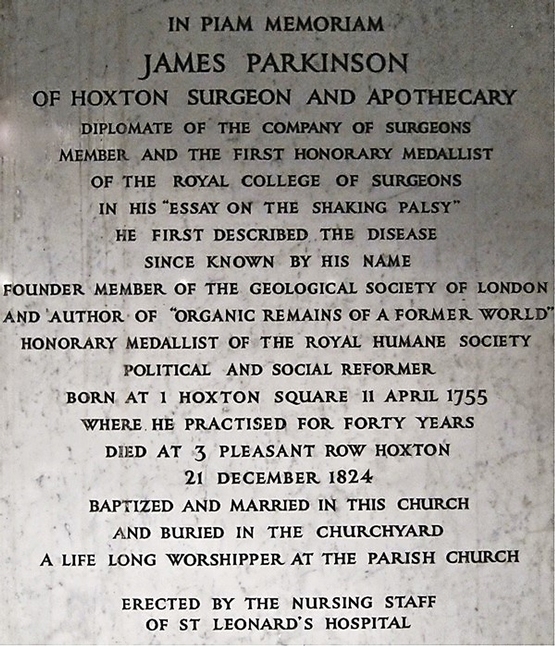
Porter memorably portrayed Parkinson as “a doctor with impeccably enlightened credentials”,12 credentials which are to this day engraved in a memorial tablet at St. Leonard’s Church in Shoreditch, London (Box 2), where Parkinson was baptised, married and buried. More than 60 years since this tablet was erected, worldwide interest in the old English doctor abounds. His beautifully written 200-year-old Essay on the shaking palsy is a fine example of early English neurology, and has captivated historically inclined neurologists for decades. Read and recollected with delight by many admirers this past year,13,14 the Essay will in all likelihood remain an erudite and enduring aspect of James Parkinson’s historical legacy to medicine.
Competing interests
No relevant disclosures.
References
- Talley NJ, O’Connor S. Clinical examination: a systematic guide to physical diagnosis. 3rd edition. Sydney: MacLennan & Petty. 1996.
- Parkinson J. An essay on the shaking palsy. London: Whittingham and Rowland for Sherwood, Neely, and Jones, 1817. https://archive.org/details/essayonshakingpa00parkuoft (viewed Dec 2017).
- Osler W. Internal medicine as a vocation. Medical News 1897; 71: 660-663. https://archive.org/download/cihm_52037/cihm_52037.pdf (viewed Dec 2017).
- Lewis C. The enlightened Mr. Parkinson: the pioneering life of a forgotten surgeon. London: Icon Books, 2017.
- Parkinson James. An essay on the shaking. Sale 8976: The Haskell F. Norman Library of Science and Medicine, 29 October 1998, New York [website]. http://www.christies.com/lotfinder/Lot/parkinson-james-1755-1824-an-essay-on-the-1339940-details.aspx (viewed Dec 2017).
- Przedborski S. The two-century journey of Parkinson disease research. Nat Rev Neurosci 2017; 18: 251-259.
- Rowntree LG. James Parkinson. Bull Johns Hopkins Hospital 1912; 33: 33-45.
- McMenemey WH. James Parkinson (1755–1824): a biographical essay. In Critchley M (editor) James Parkinson (1755–1824): a bicentenary volume of papers dealing with Parkinson's disease. London: Macmillan & Co., 1955; pp. 1-143.
- Morris AD. James Parkinson, his life and times. Basel: Birkhäuser, 1989.
- Roberts S. James Parkinson 1755–1824: from apothecary to general practitioner. London: Royal Society of Medicine Press, 1997.
- Goetz C, editor. Charcot the clinician: the Tuesday lessons. Excerpts from nine case presentations on general neurology delivered at the Salpêtrière Hospital in 1887–1888 by Jean-Martin Charcot. New York: Raven Press, 1987.
- Porter R. Enlightenment: Britain and the creation of the modern world. London: Penguin, 2001.
- Kempster PA, Hurwitz B, Lees AJ. James Parkinson’s chimera: syndrome or disease? J R Coll Physicians Edinb 2017; 47: 190-195.
- Lees A. An essay on the shaking palsy. Brain 2017; 140: 843-848.
Provenance: Not commissioned; externally peer reviewed.
Motor Neuron Disease Mortality Trends in Australia From 1986 to 2023: A Population-Based Study
Carol M. Y. Lee, Rupendra N. Shrestha, Julian Gold, Mark Stevenson, Kelly L. Williams, Lyndal Henden, Sandrine K. K. Chan Moi Fat, Zoe Zussa, Amanda Wright, Martin Jude, Mark A. S. Laidlaw, Willem J. R. Fokkink, Dominic B. Rowe
Mild traumatic brain injury and concussion and persisting post‐concussion symptoms: new guidelines to support evidence‐based assessment and management in Australia and Aotearoa New Zealand
Karen M Barlow, Jennie L Ponsford, Alice Theodom, Gill Cowen, Gavin A Davis, Vicki Anderson, Franz E Babl, David Cole, Jennifer Cullen, Stuart R Dalziel, Melinda Fitzgerald, Howard Flavell, Caroline Yates, Rebecca Kimble, John H Olver, Rhonda Orr, Mark Ralfe, Michael Rose, Nick Rushworth, Julia Treleaven, Gary Browne, Nathan Delang, Sarah Harris, Gary Mitchell, Sean Tweedy
The prevalence of and variation in indicators of the quality and safety of long term aged care in Australia, 2019: a cross‐sectional population‐based study
Tesfahun C Eshetie, Gillian E Caughey, Catherine Lang, Olivia Ryan, Renuka Visvanathan, Craig Whitehead, Keith Evans, Janet K Sluggett, Jyoti Khadka, Carolyn Dawkins, Helena Williams, Miranda Starke, Sara Blunt, Anne Liddell, Megan Corlis, Anna Sheppeard, Penelope Lello, Marilyn Thien, Steven L Wesselingh, Maria C Inacio
Health and economic benefits of improving pre‐hospital identification of stroke in Australian women: a modelling study
Thomas Gadsden, Lei Si, Emily R Atkins, Cheryl Carcel, Xia Wang, Stephen Jan, Mark Woodward, Laura E Downey
Symptom burden, quality of life, and diagnostic journey of people with postural orthostatic tachycardia syndrome, Australia, 2021–24: a descriptive patient registry data study
Marie‐Claire Seeley, Gemma Wilson, Eric Ong, Amy Langdon, Jonathan Chieng, Danielle Bailey, Kristina Comacchio, Amanda Page, Dennis H Lau, Celine Gallagher
The intersection of rurality and dementia prevalence in Australia for Aboriginal and Torres Strait Islander and non‐Indigenous peoples
Antonia J Clarke, Marwan Ahmed, Judith M Katzenellenbogen, John Towney (Wiradjuri), Anna H Balabanski, Adrienne Withall (Dharawal Yuin), Kylie Radford, Amy Brodtmann