




Volume 208 - Issue 8
Eye injury from toxic chemical mistaken for eye drops
Authors: Richard T Parker, Dominic P McCall and Chameen Samarawickrama
Med J Aust 2018; 208 (8): 369. || doi: 10.5694/mja17.00979
Published online: 7 May 2018
Published online: 7 May 2018
To the Editor:
A 49-year-old man, with a history of occasional red eye self-treated with over-the-counter naphazoline eye drops, accidentally self-administered a drop of “fibreglass resin catalyst”, containing concentrated (approximately 33%) methyl ethyl ketone peroxide (MEKP), to his left eye. The MEKP bottle was purchased at a local hardware store. The patient had previously placed the MEKP bottle on his bedside table and mistook it for his regular eye drops the following morning. Upon instillation, he felt immediate pain and irrigated his eye with water at home before presenting to the emergency department (ED). After appropriate ED irrigation and treatment, he was managed in the hospital’s ophthalmology department. After 13 days, his cornea had healed and his vision had returned to normal. However, there was residual evidence of limbal ischaemia — a poor prognostic sign in ocular chemical injuries.1,2
Ocular chemical injuries are a major source of preventable morbidity and blindness. Strongly oxidative compounds, such as MEKP, especially at high concentrations, cause rapid oxidative damage to corneal epithelium leading to cell death.3 MEKP in particular has been associated with long term symptoms and ocular surface dysfunction in patients who delay primary irrigation.4
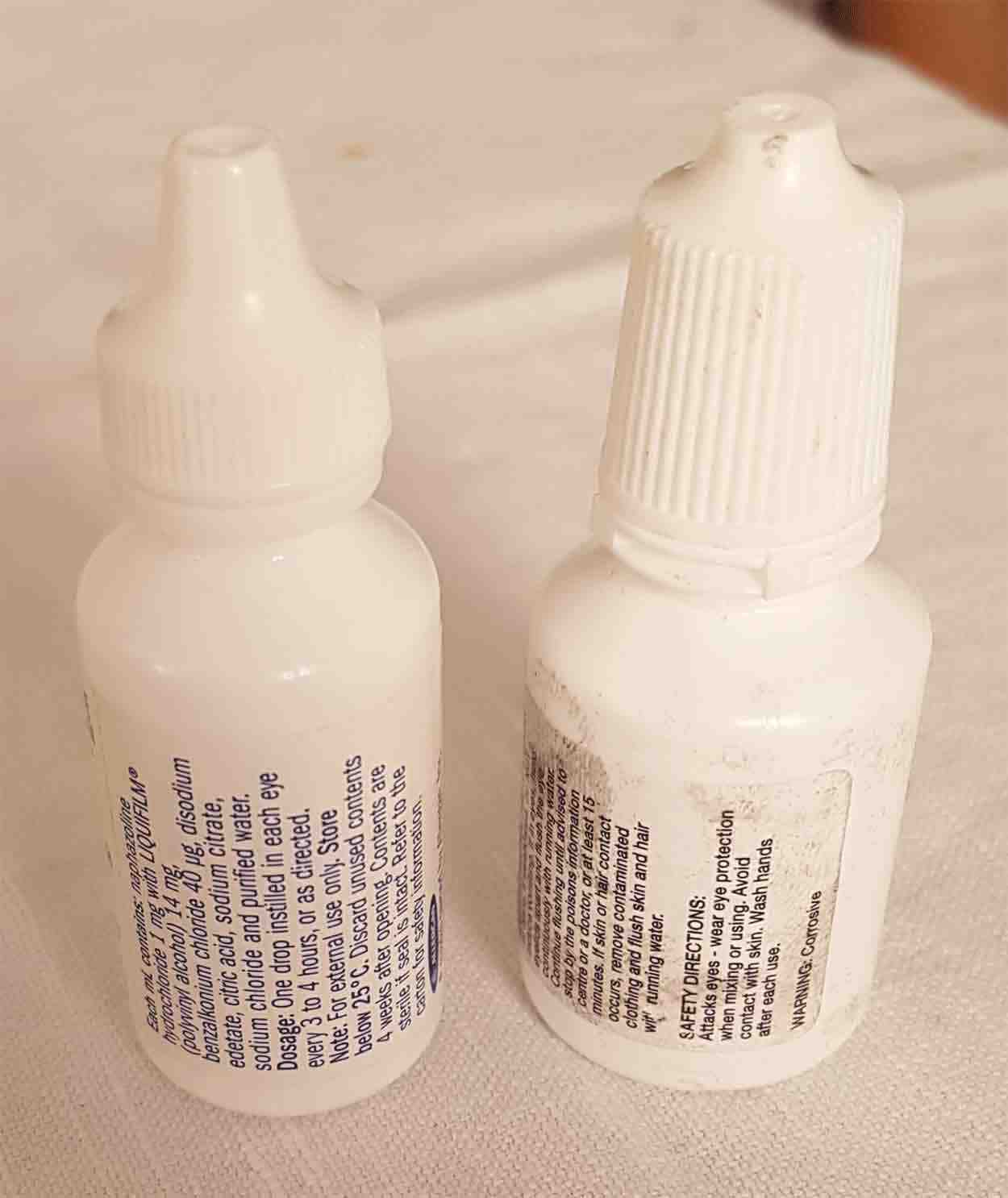
The injury reported herein was particularly deleterious as it involved the direct administration of MEKP to the eye, because the patient mistook it for his regular eye drops (Box). This confusion was due to the similar packaging of MEKP to many common eye drops used in ophthalmology. Similar injuries have been reported previously in the literature4 in patients who mistook MEKP for their regular eye drops. Often, patients’ underlying vision is poor, making it difficult for them to differentiate the products without careful inspection.4,5
Packaging MEKP in this medically familiar format poses a significant danger to the general public. We urge manufacturers to reconsider the presentation of this product by obvious colouring of the entire bottle (eg, bright orange with a black lid) so it is impossible to mistake MEKP for regular eye drops. Such a change could significantly reduce the number of preventable vision-threatening injuries sustained in this manner.
Competing interests
No relevant disclosures.
References
- Dua HS, King A, Joseph A. A new classification of ocular surface burns. Br J Ophthalmol 2001; 85: 1379-1383.
- Bunker DJ, George RJ, Kleinschmidt A, et al. Alkali-related ocular burns: a case series and review. J Burn Care Res 2014; 35: 261-268.
- Tripathi BJ, Tripathi RC, Millard CB, Borisuth NS. Cytotoxicity of hydrogen peroxide to human corneal epithelium in vitro and its clinical implications. Lens Eye Toxic Res 1990; 7: 385-401.
- Fraunfelder FT, Coster DJ, Drew R, Fraunfelder FW. Ocular injury induced by methyl ethyl ketone peroxide. Am J Ophthalmol 1990; 110: 635-640.
- Murphy C, Ho WO. Accidental self-induced chemical eye injury in patients with low vision. Eye (Lond) 2011; 25: 119.
A Diagnostic Headache
Thomas Glynn, Michelle T. Leech, Stacy K. Goergen, Emily Lin, Nadeem Toodayan, Ralph Junckerstorff
Neisseria meningitidis: an uncommon cause of conjunctivitis
Chloe Story, Tina Marinelli, Simeon Crawford, Amrita Ronnachit
Dismantling barriers to research and clinical care for individuals with a vision impairment
Eden G Robertson, Kate Hetherington, Meredith Prain, Julia Hall, Leighton Boyd AM, Rosemary Boyd OAM, Emily Shepard, Hollie Feller, Sally Karandrews, Fleur O'Hare, Kanae Yamamoto, Matthew P Simunovic, Robyn V Jamieson, Alan Ma, Lauren Ayton AM, Anai Gonzalez‐Cordero
The New South Wales Pharmacy Trial for herpes zoster: on the nose?
Christian P Pappas, Timothy R Holmes, Minas T Coroneo
Skin fragility disorder misdiagnosed as child abuse: a cautionary tale
Heather G Mack, Fred K Chen, John R Grigg
Health economic aspects of inherited retinal diseases: looking for cost‐effective treatments
Benjamin Kamien, Rachael Heath Jeffery, Fred K Chen