




Volume 207 - Issue 8
Cardiac Society of Australia and New Zealand position statement executive summary: coronary artery calcium scoring
Authors: Christian R Hamilton-Craig, Clara K Chow, John F Younger, V M Jelinek, Jonathan Chan and Gary YH Liew
Med J Aust 2017; 207 (8): 357-361. || doi: 10.5694/mja16.01134
Published online: 16 October 2017
Published online: 16 October 2017
CAC scoring is a robust and reproducible way of detecting coronary atherosclerosis and estimating future risk of cardiac events
Summary
Introduction
This article summarises the Cardiac Society of Australia and New Zealand position statement on coronary artery calcium (CAC) scoring. CAC scoring is a non-invasive method for quantifying coronary artery calcification using computed tomography. It is a marker of atherosclerotic plaque burden and the strongest independent predictor of future myocardial infarction and mortality. CAC scoring provides incremental risk information beyond traditional risk calculators such as the Framingham Risk Score. Its use for risk stratification is confined to primary prevention of cardiovascular events, and can be considered as individualised coronary risk scoring for intermediate risk patients, allowing reclassification to low or high risk based on the score. Medical practitioners should carefully counsel patients before CAC testing, which should only be undertaken if an alteration in therapy, including embarking on pharmacotherapy, is being considered based on the test result.
Main recommendations
- CAC scoring should primarily be performed on individuals without coronary disease aged 45–75 years (absolute 5-year cardiovascular risk of 10–15%) who are asymptomatic.
- CAC scoring is also reasonable in lower risk groups (absolute 5-year cardiovascular risk, < 10%) where risk scores traditionally underestimate risk (eg, family history of premature CVD) and in patients with diabetes aged 40–60 years.
- We recommend aspirin and a high efficacy statin in high risk patients, defined as those with a CAC score ≥ 400, or a CAC score of 100–399 and above the 75th percentile for age and sex.
- It is reasonable to treat patients with CAC scores ≥ 100 with aspirin and a statin.
- It is reasonable not to treat asymptomatic patients with a CAC score of zero.
Changes in management as a result of this statement
- Cardiovascular risk is reclassified according to CAC score.
- High risk patients are treated with a high efficacy statin and aspirin.
- Very low risk patients (ie, CAC score of zero) do not benefit from treatment.
Coronary artery calcium (CAC) scoring is a technique for measuring the amount of calcium in the coronary arteries using an electrocardiogram-gated non-contrast computed tomography (CT) scan of the heart. Its main clinical application is to predict the risk of a future cardiac event in asymptomatic individuals in the setting of primary prevention.
This article summarises the Cardiac Society of Australia and New Zealand (CSANZ) position statement on CAC scoring (http://www.heartlungcirc.org/article/S1443-9506(17)30501-2/fulltext). The position statement covers the available literature at this point in time, and provides expert consensus on clinical decision making based on CAC scores. It was developed by nominated working group members of the CSANZ, incorporating both imaging specialists and general cardiologists. The document was independently reviewed and approved by the CSANZ Imaging Council, the Quality and Standards Committee and the CSANZ Board.
Clinical risk prediction
The Heart Foundation, as part of the National Vascular Disease Prevention Alliance (NVDPA), has published guidelines on absolute cardiovascular disease (CVD) risk (https://www.heartfoundation.org.au/images/uploads/publications/Absolute-CVD-Risk-Full-Guidelines.pdf). The NVDPA recommends that all patients aged 45–75 years be actively assessed in general practice and provides an online calculator for absolute risk assessment (www.cvdcheck.org.au).
There are small differences between the NVDPA tool and Framingham Risk Score (FRS). The vast majority of research trials involving CAC scoring have used the FRS as the default risk prediction tool. Traditional FRS has cut-offs on 10-year risk at < 10%, 10–20% and > 20% in classifying low, intermediate and high risk groups (http://cvdrisk.nhlbi.nih.gov/calculator.asp). However, the NVDPA uses 5-year risk levels of < 10%, 10–15% and > 15% for the same groups; importantly, the FRS and NVPDA classifications of absolute cardiovascular risk are broadly similar, and are applicable in identifying intermediate risk patients prior to consideration of CAC scoring.
Certain populations are automatically deemed to be high risk: people with diabetes aged > 60 years or with albuminuria; chronic kidney disease (estimated glomerular filtration rate < 45 mL/min); blood pressure = 180/110 mmHg; familial hypercholesterolaemia; or total cholesterol levels > 7.5 mmol/L. Such patients should be treated with optimal medical management.1 It is important to note that most risk calculators, including the FRS and the NVDPA absolute CVD risk calculator (www.cvdcheck.org.au), do not account for family history, which can be a strong contributor to risk.
We acknowledge that certain subgroups of Aboriginal and Torres Straits Islander and Maori peoples who have poorer health outcomes are at increased risk and may warrant primary prevention regardless of risk score.2 CAC score data do not yet exist for Indigenous patients and neither prevalence nor severity has been established in this group.
Coronary artery calcification
A key concept is that coronary artery calcification provides direct visual evidence of coronary atherosclerosis present in an individual patient, whereas risk calculators are reliant on antecedent risk factors and epidemiologic calculations. The relationship between coronary artery calcification and major adverse cardiovascular events, including all-cause mortality, cardiovascular events and non-fatal myocardial infarction, has been established in a number of large-scale studies.1,3-5
Importantly, CAC scoring out-performs traditional risk scoring tools, such as the FRS and NVDPA calculators, for the assessment of an individual’s cardiovascular risk.6 CAC scoring is most useful in patients at intermediate risk, allowing reclassification into low or high risk categories based on the score.
Acquisition of CAC scans is relatively quick (less than 10 seconds, one breath-hold), has very low radiation exposure (about 0.5–1.0 mSv; similar to breast mammography) and does not require any intravenous contrast or special preparation. In Australia, Medicare does not currently regulate or reimburse for CAC testing, and the cost usually ranges from $100 to $200.
CAC scores are most commonly reported in Agatston units; the calculation is based on plaque density (> 130 Hounsfield units), the volume of the plaque and a weighting factor. The Agatston score is a highly reproducible, reliable metric that is the most direct in vivo measure of coronary atherosclerotic burden.1,3 A score of zero indicates no detectable coronary atherosclerosis, with a very low event rate (Box 1).
A positive score can be indexed to the patient’s age, sex and ethnicity to give a percentile, based on the Multi-Ethnic Study of Atherosclerosis7 (http://mesa-nhlbi.org/Calcium/input.aspx). This percentile tells us whether a patient has disproportionate atherosclerosis (above average) compared with age- and sex-matched cohorts.
The use of percentiles allows identification of individuals at high risk relative to age- and sex-matched cohorts (Box 2). Box 3 shows a table for easily identifying the patients above the 75th and 90th percentiles, based on age and sex.
Absence of coronary calcification: the power of zero
There have been multiple studies demonstrating the very low event rates in patients with a CAC score of zero.9-12 In a study of 44 052 patients, 45% had a zero score and cardiovascular mortality at 10 years was just under 1%.10 In another large study of 4864 patients with a follow-up of 15 years, a CAC score of zero conferred an annual mortality rate of less than 0.5%.13 Thus, pharmacotherapy is not warranted for asymptomatic patients in this group (Box 1) (note that patients with a CAC score of zero but with symptoms consistent with acute coronary syndrome should be investigated and managed according to CSANZ chest pain guidelines; https://www.heartfoundation.org.au/images/uploads/publications/ACS-guidelines-long-presentation_2016_v2_1.pdf).
Cost-effectiveness of CAC scoring-based primary prevention
There are currently no data in Australia and New Zealand to show that CAC is cost-effective in informing primary prevention decisions. Given the cost of testing is currently borne entirely by the patient, discussion regarding the implications of CAC results should occur before CAC scoring is recommended and undertaken.
Coronary artery stenosis
CAC scoring is a risk prediction tool and is not equivalent to a CT coronary angiogram. It is important to understand that a non-contrast CAC scan does not provide information on stenosis of the coronary arteries, and the presence of calcification on CAC scoring does not equate to stenosis at that site. It is therefore not appropriate to comment on the likelihood of stenosis based on a coronary calcium scan alone. Functional testing for ischaemia is not generally indicated in asymptomatic patients.
Recommendations
CAC scoring is recommended for patients who:
-
are at intermediate risk, aged 45–75 years (absolute 5-year cardiovascular risk, 10–15%) who are asymptomatic and do not have known coronary artery disease. CAC has the ability to reclassify patients into lower or higher risk groups; and
-
may also be considered for low and medium risk patients (absolute 5-year cardiovascular risk, < 10%) particularly in those where traditionally risk scores underestimate risk; eg, family history of premature CVD, and in patients with diabetes aged 40–60 years.
CAC scoring is not recommended for patients who:
-
are at very low risk (absolute cardiovascular 5-year risk, < 5%) or
-
are already at high risk (absolute cardiovascular 5-year risk, > 15%), as testing is unlikely to alter the recommended treatment. This includes some patients who are automatically considered to be high risk (eg, people with diabetes aged > 60 years, diabetes with albuminuria, chronic kidney disease [estimated glomerular filtration rate < 45 mL/min], blood pressure = 180/110 mmHg, familial hypercholesterolaemia, or cholesterol levels > 7.5 mmol/L) who should therefore be managed aggressively with optimal medical therapy; or
-
have symptomatic or previously documented coronary artery disease (prior myocardial infarction, stent or coronary artery bypass graft surgery).
Recommendations for management based on CAC results for asymptomatic patients are shown in Box 4. An algorithm for the clinical application of CAC scoring for asymptomatic risk assessment is shown in Box 5.
Very low risk: CAC score of zero
In asymptomatic patients with a CAC score of zero, the event rate is very low, and no pharmacotherapy is required7,12 (Box 1).
Low risk: CAC scores of 1–99
Patients with CAC scores of 1–99 have a relative risk about twice that of patients with a score of zero;8 however, the evidence for pharmacotherapy is weak, as no observational or prospective trial data are available to guide treatment decisions in this group. We recommend a healthy diet and lifestyle for maintaining a low 10-year risk, unless other clinical factors are present (eg, strong family history of premature infarction at < 50 years of age in a first degree relative; familial hypercholesterolaemia). Some clinicians may elect to offer statin therapy for patients with CAC score of 1–99, in conjunction with counselling patients on the risks and benefits of pharmacotherapy. However, at this point in time, based on the current available data, no strong recommendations can be made for or against treatment in this group.
Intermediate risk: CAC scores of 100–399
For patients classified as intermediate risk on the basis of CAC score, we recommend statin therapy to be reasonable (but not mandated) and therapy should be tailored to individual risk (Box 2). A CAC score of 100–399 equates to a 10-year risk of 10–20%, with an annual event rate of 1.3%.14 The current American College of Cardiology/American Heart Association blood cholesterol guidelines15 have expanded the indication for treatment with statins to include individuals aged 40–75 years with low-density lipoprotein cholesterol levels > 1.8 mmol/L and a calculated 10-year risk of > 7.5% for primary prevention (Class I indication, Level A evidence), such as patients with CAC scores of 100–399.
Patients with CAC scores of 100–399 but above the 75th percentile are reclassified as high risk (see below).
High risk: CAC score = 400 or > 75th percentile
For patients reclassified as high risk on the basis of CAC score (> 15% absolute 10-year risk), we recommend aspirin and high efficacy statin therapy.
The St Francis Heart Study16 showed that for patients with CAC score > 400, there was a significant reduction in CVD events (8.7% v 15%; P = 0.046) with statin therapy versus placebo. Aspirin and a high efficacy statin (eg, 20–40 mg rosuvastatin or 20–80 mg atorvastatin) to achieve low-density lipoprotein cholesterol levels < 2.0 mmol/L are recommended in this group. Functional testing may be considered on an individual basis, as there are no data to support revascularisation in asymptomatic patients.
Patients with CAC scores of 100–399 but above the 75th percentile are reclassified as high risk. Because age is a main driver of vascular risk, a younger person with a CAC score above the 75th percentile is likely to have an increased lifetime risk of a cardiovascular event, and early therapy is warranted to reduce the risk of future major adverse cardiac events17 (Box 6).
Aspirin
We recommend that patients with CAC scores = 100 will derive net benefit from aspirin.
Routine use of aspirin in the general population for primary prevention is not recommended due to an increased rate of bleeding.18-20 A recent analysis of the Multi-Ethnic Study of Atherosclerosis estimated benefit against risk for aspirin according to CAC scoring results and found that patients with CAC scores = 100 derived net benefit from aspirin, regardless of their traditional risk factors.21
Repeat scanning
Among patients with a zero CAC score, 25% developed CAC over a period of 5 years.22 Therefore, it is reasonable to repeat the scan for such patients to detect coronary calcium conversion and reclassify risk; this is recommended after 5 years.
For a positive CAC score, routine rescanning is not currently recommended. However, an increase in CAC scores of > 15% or scores = 100 are predictive of increased future myocardial infarction and mortality.23 Calcification progression predicts cardiac events even after adjusting for risk factors and baseline score, thus repeat scanning in low risk patients (CAC scores of 1–99) may be reasonable in circumstances where reassessment of risk is indicated,24 or after 5 years.
Conclusion
CAC scoring is a robust and reproducible way of detecting coronary atherosclerosis and to estimate future risk of cardiac events. It has incremental benefit beyond traditional risk prediction tools. It can be easily performed using current multidetector CT with very low radiation and low cost. It is of greatest benefit when applied to asymptomatic individuals aged 45–75 years who are at intermediate risk as determined by risk calculators (Box 3 and Box 5). CAC scoring helps reclassify patients into either lower risk, with potential cost savings in minimising therapy (CAC score of zero), or higher risk groups (CAC scores = 400, or 100–399 and above the 75th percentile) where early and more aggressive therapies may lead to improved outcomes.
Box 1 – Example: coronary artery calcium (CAC) scoring for risk reclassification
A 58-year-old woman with systolic hypertension (150 mmHg) who recently quit smoking presents for coronary risk assessment. Her cholesterol levels are: total, 6.5 mmol/L; high-density lipoprotein, 1.05 mmol/L; low-density lipoprotein; 4.4 mmol/L; and triglycerides, 1.3 mmol/L. Her 5-year NVPDA absolute risk is calculated as high (> 16%) but she is very reluctant to start a statin. Her CAC score is zero, equating to very low risk (true event rate, 1.7% on calculator [https://www.mesa-nhlbi.org/MESACHDRisk/MesaRiskScore/RiskScore.aspx]). It is reasonable to reassure her, not prescribe a statin, and perform 24-hour ambulatory blood pressure monitoring to further assess her hypertension and guide antihypertensive therapy. Repeat CAC scoring may be considered after 5 years to reassess coronary risk.Box 2 – Example: use of percentiles to interpret coronary artery calcium scoring
A 48-year-old woman has a strong family history of premature coronary artery disease. Her coronary artery calcium score is 110 (in the intermediate range). However, when indexed to age and sex, her score is at the 99th percentile (http://mesa-nhlbi.org/Calcium/input.aspx). This means she has disproportionate atherosclerosis for her age and sex, reclassifying her as high risk and warranting primary prevention treatment.Box 3 – Indicative coronary artery calcium (CAC) percentiles by score, sex and age*
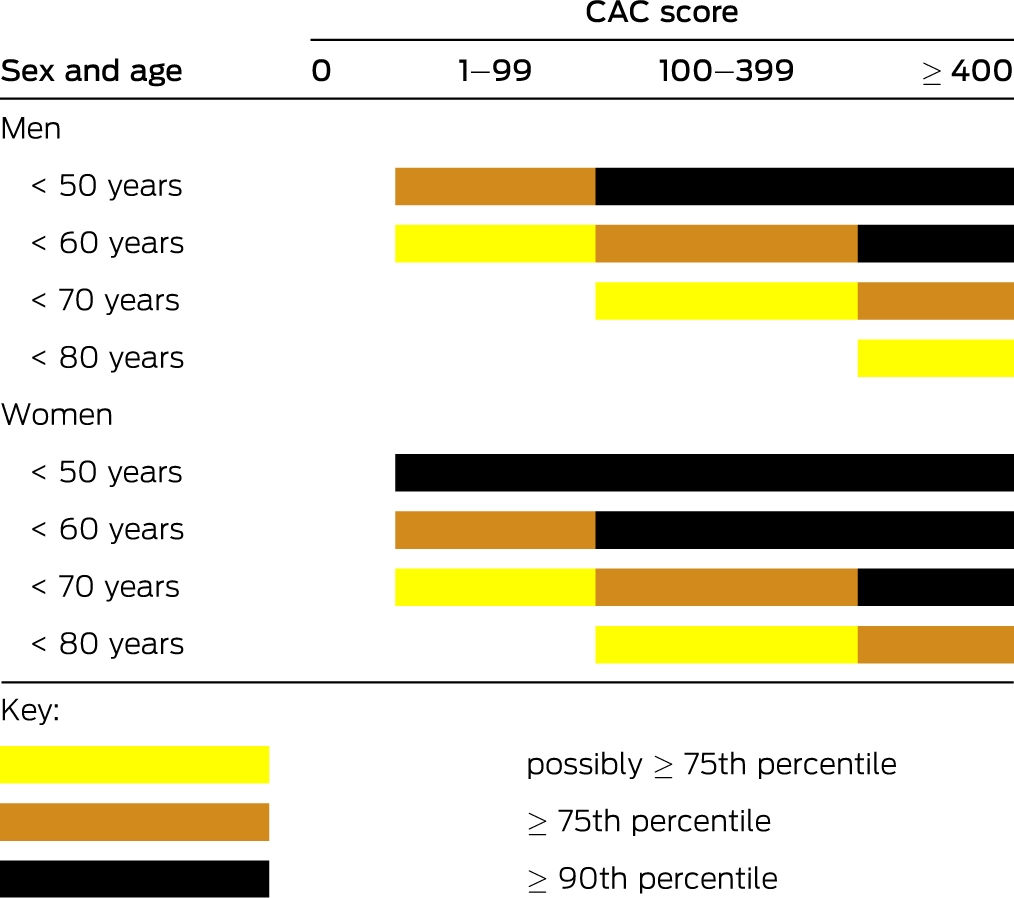
* Adapted from Hecht et al.8 Percentiles determined using the Multi-Ethnic Study of Atherosclerosis calculator (http://mesa-nhlbi.org/Calcium/input.aspx).
Box 4 – Recommendations for management based on coronary artery calcium (CAC) scores for asymptomatic patients
|
CAC score |
5-year risk |
Guidance |
|||||||||||||
|
|
|||||||||||||||
|
0 |
Very low |
Reassure; maintain healthy diet and lifestyle |
|||||||||||||
|
1–99 |
Low |
Maintain healthy diet and lifestyle |
|||||||||||||
|
100–399 |
Moderate |
Aspirin recommended |
|||||||||||||
|
100–399 and > 75th percentile* |
Moderately high |
Reclassify as high risk |
|||||||||||||
|
= 400 or > 75th percentile* |
High |
Aspirin recommended |
|||||||||||||
|
|
|||||||||||||||
|
* Percentile based on patient’s age, sex and ethnicity using the Multi-Ethnic Study of Atherosclerosis calculator (http://mesa-nhlbi.org/Calcium/input.aspx). |
|||||||||||||||
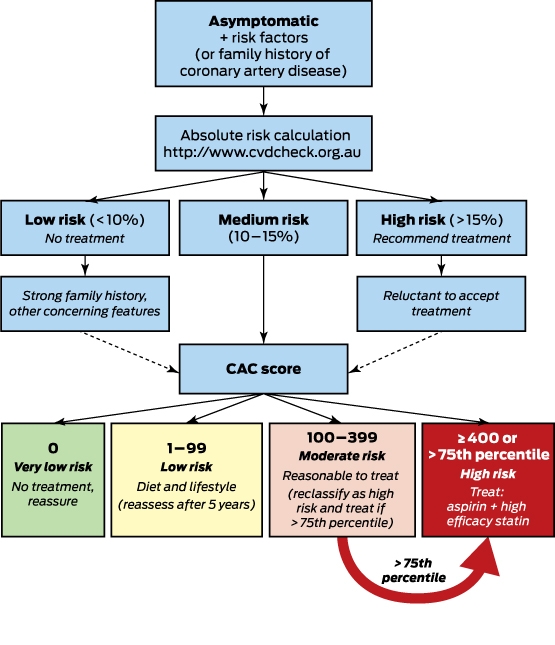
Box 6 – Example: early therapy to reduce the risk of future major adverse cardiac events
A 52-year-old man presents for a check-up, as his brother recently received a coronary artery stent. He is not hypertensive, and quit smoking 4 years ago with your help. His lipid profile shows cholesterol levels of: total, 5.1 mmol/L; high-density lipoprotein, 1.0 mmol/L; low-density lipoprotein, 3.5 mmol/L; and triglycerides, 1.2 mmol/L. Absolute risk is calculated as low (www.cvdcheck.org.au), with no therapy recommended. Because of his family history, however, you order a coronary artery calcium (CAC) score. This is calculated at 369 Agatston units, which is 96th percentile for an age- and sex-matched patient, reclassifying him as high risk. His Framingham 10-year risk of coronary heart disease inclusive of the coronary calcium score data is 14.4% (high risk), compared with only 6.4% risk without using the CAC score (https://mesa-nhlbi.org/CAC-Tools.aspx), demonstrating how much his risk was underestimated without the CAC score. You prescribe 100 mg aspirin and 20 mg of a high efficacy statin (eg, atorvastatin or rosuvastatin) for primary prevention.Competing interests
No relevant disclosures.
References
- Detrano R, Guerci AD, Carr JJ, et al. Coronary calcium as a predictor of coronary events in four racial or ethnic groups. N Engl J Med 2008; 358: 1336-1345.
- Wang Z, Hoy WE. Is the Framingham coronary heart disease absolute risk function applicable to Aboriginal people? Med J Aust 2005; 182: 66-69.
- Greenland P, LaBree L, Azen SP, et al. Coronary artery calcium score combined with Framingham score for risk prediction in asymptomatic individuals. JAMA 2004; 291: 210-215.
- Budoff MJ, Shaw LJ, Liu ST, et al. Long-term prognosis associated with coronary calcification: observations from a registry of 25,253 patients. J Am Coll Cardiol 2007; 49: 1860-1870.
- LaMonte MJ, FitzGerald SJ, Church TS, et al. Coronary artery calcium score and coronary heart disease events in a large cohort of asymptomatic men and women. Am J Epidemiol 2005; 162: 421-429.
- Yeboah J, Young R, McClelland RL, et al. Utility of nontraditional risk markers in atherosclerotic cardiovascular disease risk assessment. J Am Coll Cardiol 2016; 67: 139-147.
- McClelland RL, Jorgensen NW, Budoff M, et al. 10-year coronary heart disease risk prediction using coronary artery calcium and traditional risk factors: derivation in the MESA (Multi-Ethnic Study of Atherosclerosis) with validation in the HNR (Heinz Nixdorf Recall) study and the DHS (Dallas Heart Study). J Am Coll Cardiol 2015; 66: 1643-1653.
- Hecht H, Blaha MJ, Berman DS, et al. Clinical indications for coronary artery calcium scoring in asymptomatic patients: expert consensus statement from the SCCT. J Cardiovasc Comput Tomogr 2017; 11: 157-168.
- Sarwar A, Shaw LJ, Shapiro MD, et al. Diagnostic and prognostic value of absence of coronary artery calcification. JACC Cardiovasc Imaging 2009; 2: 675-688.
- Blaha M, Budoff MJ, Shaw LJ, et al. Absence of coronary artery calcification and all-cause mortality. JACC Cardiovasc Imaging 2009; 2: 692-700.
- Shareghi S, Ahmadi N, Young E, et al. Prognostic significance of zero coronary calcium scores on cardiac computed tomography. J Cardiovasc Comput Tomogr 2007; 1: 155-159.
- Blaha MJ, Cainzos-Achirica M, Greenland P, et al. Role of coronary artery calcium score of zero and other negative risk markers for cardiovascular disease: the Multi-Ethnic Study of Atherosclerosis (MESA). Circulation 2016; 133: 849-858.
- Valenti V, Ó Hartaigh B, Heo R, et al. A 15-year warranty period for asymptomatic individuals without coronary artery calcium: a prospective follow-up of 9,715 individuals. JACC Cardiovasc Imaging 2015; 8: 900-909.
- Greenland P, Bonow RO, Brundage BH, et al. ACCF/AHA 2007 clinical expert consensus document on coronary artery calcium scoring by computed tomography in global cardiovascular risk assessment and in evaluation of patients with chest pain. J Am Coll Cardiol 2007; 49: 378-402.
- Stone NJ, Robinson JG, Lichtenstein AH, et al. 2013 ACC/AHA guideline on the treatment of blood cholesterol to reduce atherosclerotic cardiovascular risk in adults: a report of the American College of Cardiology/American Heart Association Task Force on Practice Guidelines. J Am Coll Cardiol 2014; 63(25 Pt B): 2889-2934.
- Arad Y, Spadaro LA, Roth M, et al. Treatment of asymptomatic adults with elevated coronary calcium scores with atorvastatin, vitamin C, and vitamin E: the St. Francis Heart Study Randomized Clinical Trial. J Am Coll Cardiol 2005; 46: 166-172.
- Blaha MJ, Silverman MG, Budoff MJ. Is there a role for coronary artery calcium scoring for management of asymptomatic patients at risk for coronary artery disease? Clinical risk scores are not sufficient to define primary prevention treatment strategies among asymptomatic patients. Circ Cardiovasc Imaging 2014; 7: 398-408; discussion.
- Antithrombotic Trialists’ Collaboration; Baigent C, Blackwell L, et al. Aspirin in the primary and secondary prevention of vascular disease: collaborative meta-analysis of individual participant data from randomised trials. Lancet 2009; 373: 1849-1860.
- Berger JS, Roncaglioni MC, Avanzini F, et al. Aspirin for the primary prevention of cardiovascular events in women and men: a sex-specific meta-analysis of randomized controlled trials. JAMA 2006; 295: 306-313.
- Seshasai SR, Wijesuriya S, Sivakumaran R, et al. Effect of aspirin on vascular and nonvascular outcomes: meta-analysis of randomized controlled trials. Arch Intern Med 2012; 172: 209-216.
- Miedema MD, Duprez DA, Misialek JR, et al. Use of coronary artery calcium testing to guide aspirin utilization for primary prevention: estimates from the multi-ethnic study of atherosclerosis. Circ Cardiovasc Qual Outcomes 2014; 7: 453-460.
- Min JK, Lin FY, Gidseg DS, et al. Determinants of coronary calcium conversion among patients with a normal coronary calcium scan: what is the “warranty period” for remaining normal? J Am Coll Cardiol 2010; 55: 1110-1117.
- Raggi P, Callister TQ, Shaw LJ. Progression of coronary artery calcium and risk of first myocardial infarction in patients receiving cholesterol-lowering therapy. Arterioscler Thromb Vasc Biol 2004; 24: 1272-1277.
- Budoff MJ, Hokanson JE, Nasir K, et al. Progression of coronary artery calcium predicts all-cause mortality. JACC Cardiovasc Imaging 2010; 3: 1229-1236.
Provenance: Not commissioned; externally peer reviewed.
Fatty Liver Disease in Australia: A Narrative Review on the Epidemiology, Natural History, Prognostication and Management in People With Metabolic Dysfunction
Karl Vaz, Daniel Clayton-Chubb, William W. Kemp, Stuart K. Roberts, Ammar Majeed
Sex Differences in Management and Outcomes of People With ST-Elevation Myocardial Infarction, New South Wales, 2011–2020: A Retrospective Cohort Study
Adam C. Livori, Jedidiah I. Morton, Dianna J. Magliano, Jonathan E. Shaw
Rethinking Rheumatic Fever Diagnosis: Progress, Pitfalls and the Path Towards a Definitive Test
Anna P. Ralph, Rachel Webb, Tom Parks, Nicole J. Moreland, Asha C. Bowen, Benjamin Jones, Emma Ndagire, Andrea Z. Beaton
Sex Differences in Management and Outcomes of People With ST-Elevation Myocardial Infarction, New South Wales, 2011–2020: A Retrospective Cohort Study
Samia Kazi, Simone Marschner, Clara K. Chow
Distribution of Cardiovascular Disease Risk Based on the Updated 2023 Guideline-Recommended Australian Cardiovascular Disease Risk Algorithm and Comparison With the 2012 Algorithm: An Observational Study
Nina Lazarevic, Meghana Bhat, Grace Joshy, Danielle C. Butler, Mark Woodward, Anushka Patel, Rod T. Jackson, Garry Jennings, Rosemary Wyber, Ellie Paige, Emily Banks
They Brought the Hospital to Me
Hugh N. Burrill