




Volume 207 - Issue 7
Improving organ donation rates and transplantation in Australia
Authors: Richard DM Allen and Henry CC Pleass
Med J Aust 2017; 207 (7): 287-288. || doi: 10.5694/mja17.00590
Published online: 2 October 2017
Published online: 2 October 2017
Broader acceptance of organs from circulatory death donors would increase donor rates significantly
Broader acceptance of organs from circulatory death donors would increase donor rates significantly
The initiative funded by the Federal Government in 2009 to improve both the identification of potential deceased organ donors and family consent rates has dramatically changed the prospects for Australians with end-stage organ failure. The subsequent establishment of a coordinated DonateLife network, with more than 150 medical and nursing staff charged with identifying potential organ donors, has led to the donation rate increasing over the past 5 years from 11.4 to 20.9 donors per million population (pmp) in 2016. Record numbers of organ transplants and reduced waiting times for transplantation have resulted.1,2
The increase in donation rates can be largely attributed to greater appreciation of the value of organs donated after a determination of circulatory death. Donation after circulatory death (DCD) is feasible after planned withdrawal of ventilation from patients with severe irreversible brain pathology or other non-survivable illness. In 2016, 128 of 503 deceased donors in Australia (25.4%) were DCD donors.2
In this issue of the Journal, Rakhra and his colleagues report evidence that the organ donation rate in Australia could increase still further were the true potential of DCD donation realised.3 The authors reviewed data on 8870 deaths of ventilated patients in the 75 Australian hospitals in the DonateLife network over a 30-month period (to the end of 2014), and compared their suitability as DCD donors with 202 actual DCD donors. If the authors’ proposed uniform DCD criteria were applied nationally, with a family consent rate of 60% overall donor numbers could be increased to 21.3 pmp. Data from 2016 suggest that this may already be happening in Victoria; 56% of all DCD procedures in Australia were performed there, and the state donor rate was 32.3 pmp.2
Not all deceased organ donors are equal. The DCD organ retrieval procedure usually involves withdrawing ventilation outside the operating room, and cessation of circulation is determined in the presence of the family. After moving the donor to the operating room, experienced donor surgeons expeditiously commence aortic perfusion with cooled organ preservation solutions. If the time between withdrawal of life support and cool perfusion is less than 30 minutes, liver and heart procurement is considered appropriate; the limit for kidney retrieval is 60 minutes, for lungs 90 minutes. These perhaps arbitrary restrictions derive from concerns about the detrimental effect of prolonged warm ischaemia and consequential organ reperfusion injury to the recipient. This is particularly problematic for DCD liver transplantation; ischaemic cholangiopathy affects as many as 25% of DCD liver recipients, often necessitating re-transplantation.4 Caution therefore prevails in Australia, and only 15 of 283 liver transplants in 2016 (5.3%) were from DCD donors.2
Accordingly, liver transplant clinicians continue to prefer livers from brain-dead, heart-beating donors (DBD). DBD organ retrieval is more challenging, requiring as long as 3–4 hours, particularly if an appropriate donor liver can be split in situ to facilitate transplantation into both adult and child recipients.
The key performance indicators for the organ donation sector in Australia are absolute organ donor numbers and numbers of organs transplanted. This does not place them at odds with the transplantation sector, which must also balance numbers against the need for life-saving transplantation and complication-free, long term graft function. Having shown that survival rates for DCD and DBD lung transplants are similar, lung transplant units in Australia are quite willing to accept DCD donor lungs.5 Similarly, unpublished data from the Australia and New Zealand Dialysis and Transplant Registry (ANZDATA) indicate equivalence of results at 5 years for non-death censored graft survival after DCD kidney transplantation using current DCD donor criteria (Box). Nevertheless, many nephrologists remain reluctant to accept DCD donor kidneys for young dialysis-dependent patients.
The transplantation community should rise to the challenge posed by the donation sector and broaden their criteria for accepting DCD organs. As Australian heart transplant programs already do, liver transplant programs may soon have access to the transformative technology of normothermic machine perfusion of marginal donor livers for pre-conditioning and assessing organ function before possible transplantation.6 For kidney transplantation, focusing on reduced cold ischaemia times, organ perfusion technology, and calcineurin inhibitor-sparing maintenance immunosuppression protocols may lead to wider acceptance of DCD donor kidneys.
The article by Rakhra and colleagues also highlights the importance of a whole-of-hospital approach for identifying potential donors and improving the suboptimal family consent rate for organ donation in Australia. Employing designated organ donor requesters is already helping. If all goes to plan, the remaining problem will be the ability of transplanting hospitals, already faced with substantially increased activity, to cope with further increases in organ donor numbers. There will be no shortage of candidate recipients, provided there is adequate resourcing of transplanting hospitals by state governments. This includes providing skilled staff and appropriate clinical environments, not only for the initial transplantation procedure, but also for managing the ever increasing number of transplant recipients surviving long term.
Box – Uncensored survival of donor kidney grafts for donation after circulatory death (DCD) or donation after brain death (DBD), transplanted in Australia, 2001–2015*
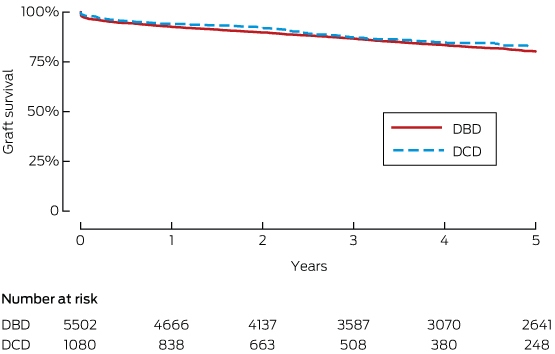
* The data, which exclude multiple organ recipients, were provided by Phil Clayton, Australia and New Zealand Dialysis and Transplant (ANZDATA) Registry, South Australian Health and Medical Research Institute, Adelaide.
Competing interests
No relevant disclosures.
References
- Australia and New Zealand Organ Donation Registry. Summary of organ donation: organs retrieved and actually transplanted. Dec 2016. http://www.anzdata.org.au/anzod/updates/20170208_ANZOD_DonorSummaryReport_2016December.pdf (accessed Aug 2017).
- Australia and New Zealand Organ Donation Registry. Monthly report on deceased organ donation in Australia. Dec 2016. http://www.anzdata.org.au/anzod/updates/ANZOD2016summary.pdf (accessed Aug 2017).
- Rakhra SS, Opdam HI, Gladkis L, et al. Untapped potential in Australian hospitals for organ donation after circulatory death. Med J Aust 2017; 207: 294-301.
- Cao Y, Shahrestani S, Chew HC, et al. Donation after circulatory death for liver transplantation: a meta-analysis on the location of life support withdrawal affecting outcomes. Transplantation 2016; 100: 1513-1524.
- Levvey BJ, Harkess M, Hopkins P, et al. Excellent clinical outcomes from a national donation after cardiac death lung transplant collaborative. Am J Transplant 2012; 12: 2406-2413.
- Dhittal KK, Iyer A, Connellan M, et al. Adult heart transplantation with distant procurement and ex-vivo preservation of donor hearts after circulatory death: a case series. Lancet 2015; 385: 2585-2591.
Provenance: : Commissioned; externally peer reviewed.
Medical Colleges Have an Obligation to Ensure Full Participation in Clinical Quality Registries
Thomas J. Hugh
Getting on the Same Page: Why Australia Needs a National Maternity Early Warning System (MEWS) Chart
Briony A. Cutts, Lucy Bowyer, Nisha Khot, Sandra Lowe, Stefan C. Kane
Data for Equity: Can Linked Administrative Data Inform Pathways to More Equitable Child Health?
Sarah Gray, Shuaijun Guo, Meredith O'Connor, Elodie O'Connor, Katrina Williams, Hannah Badland, Susan Woolfenden, Josie Dickerson, Gerry Redmond, Marnie Downes, Sharon R. Goldfeld
Specialty College Selection: Why Change is Critical to Support a Future Rural Workforce
Matthew R. McGrail, Jenny May AM, Katherine Logan
Differentiated and simplified oral HIV pre‐exposure prophylaxis (PrEP) models hold the key to virtually eliminating HIV transmission in Australia by 2030
Tyson Arapali, Sarah Warzywoda, Anthony K J Smith, Curtis Chan, Timothy R Broady, Erin Sullivan, Catherine MacPhail, Mohamed A Hammoud, Alexander Dowell‐Day, Benjamin R Bavinton
The number of cancer‐related deaths that could be attributable to spatial disparities in survival in Australia, 2010–2019: a retrospective population‐based cohort study
Charlotte K Bainomugisa, Jessica Cameron, Paramita Dasgupta, Peter Baade